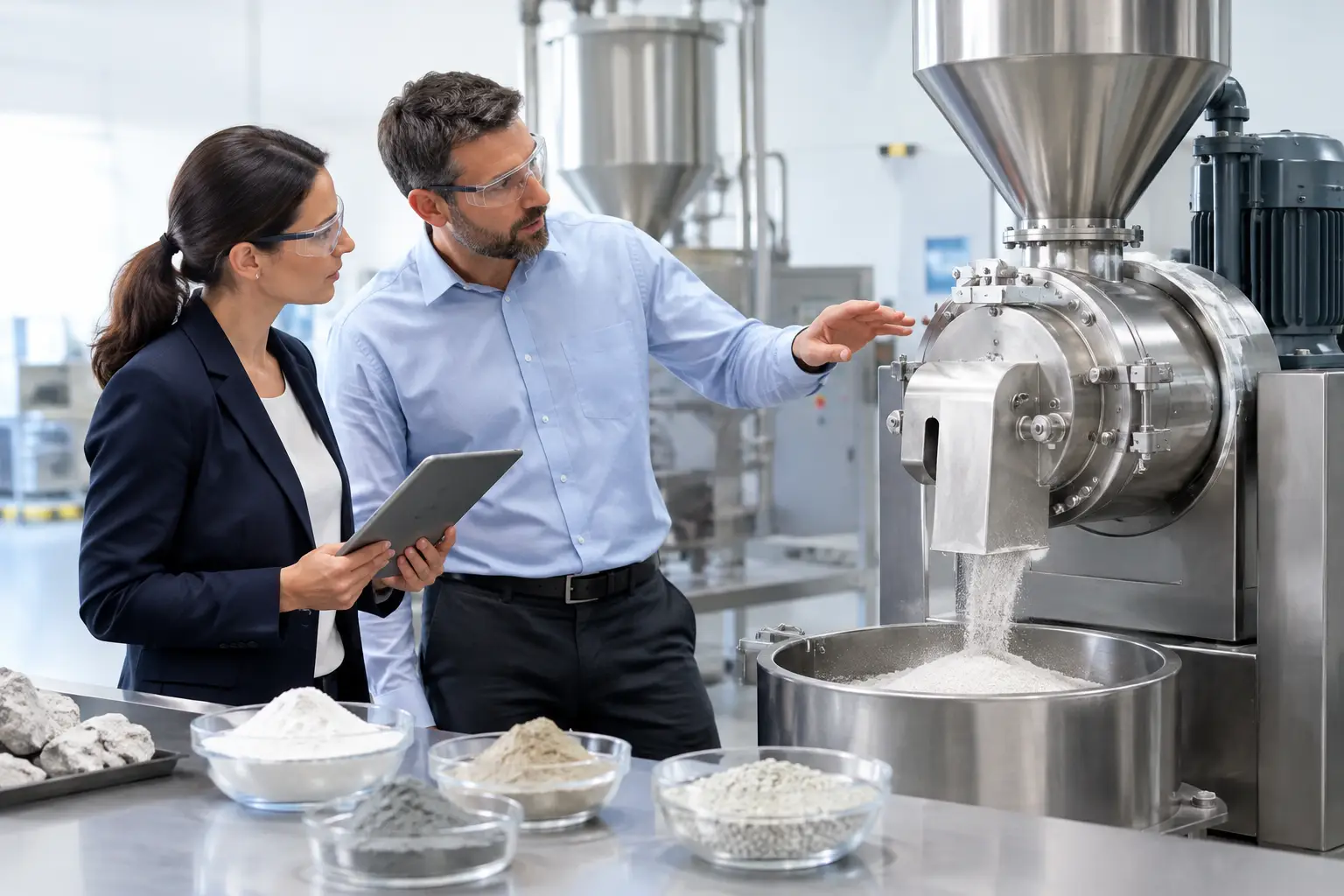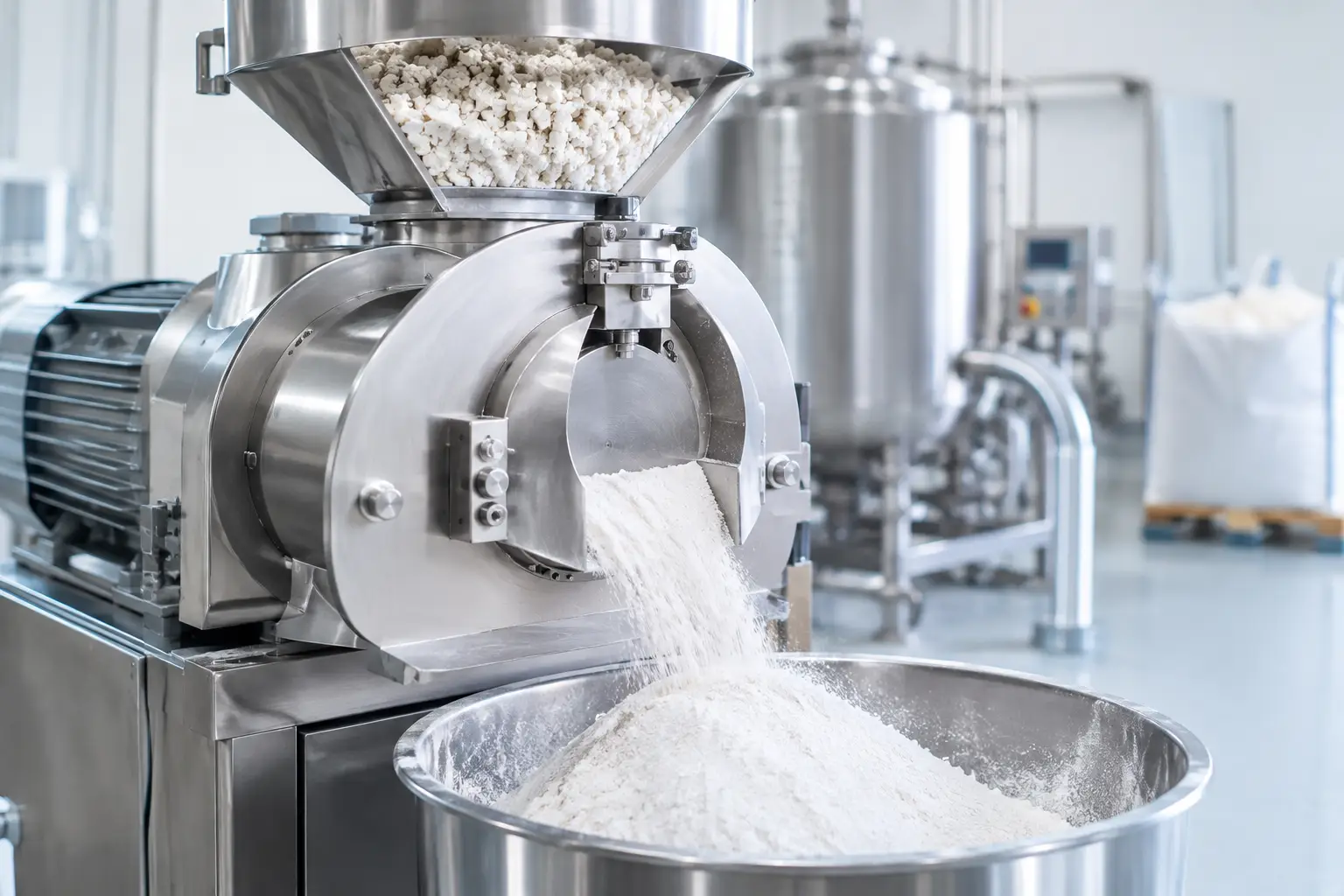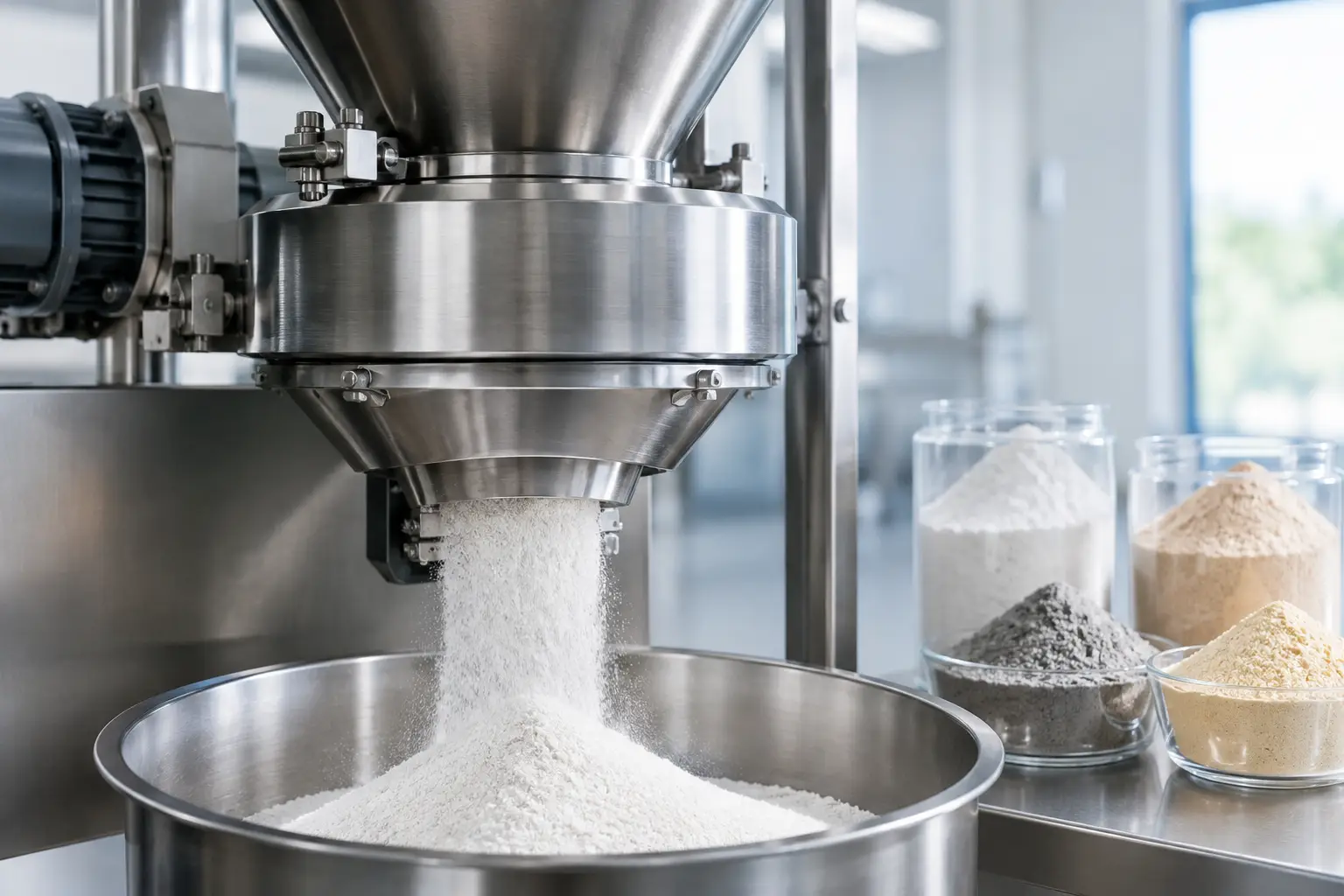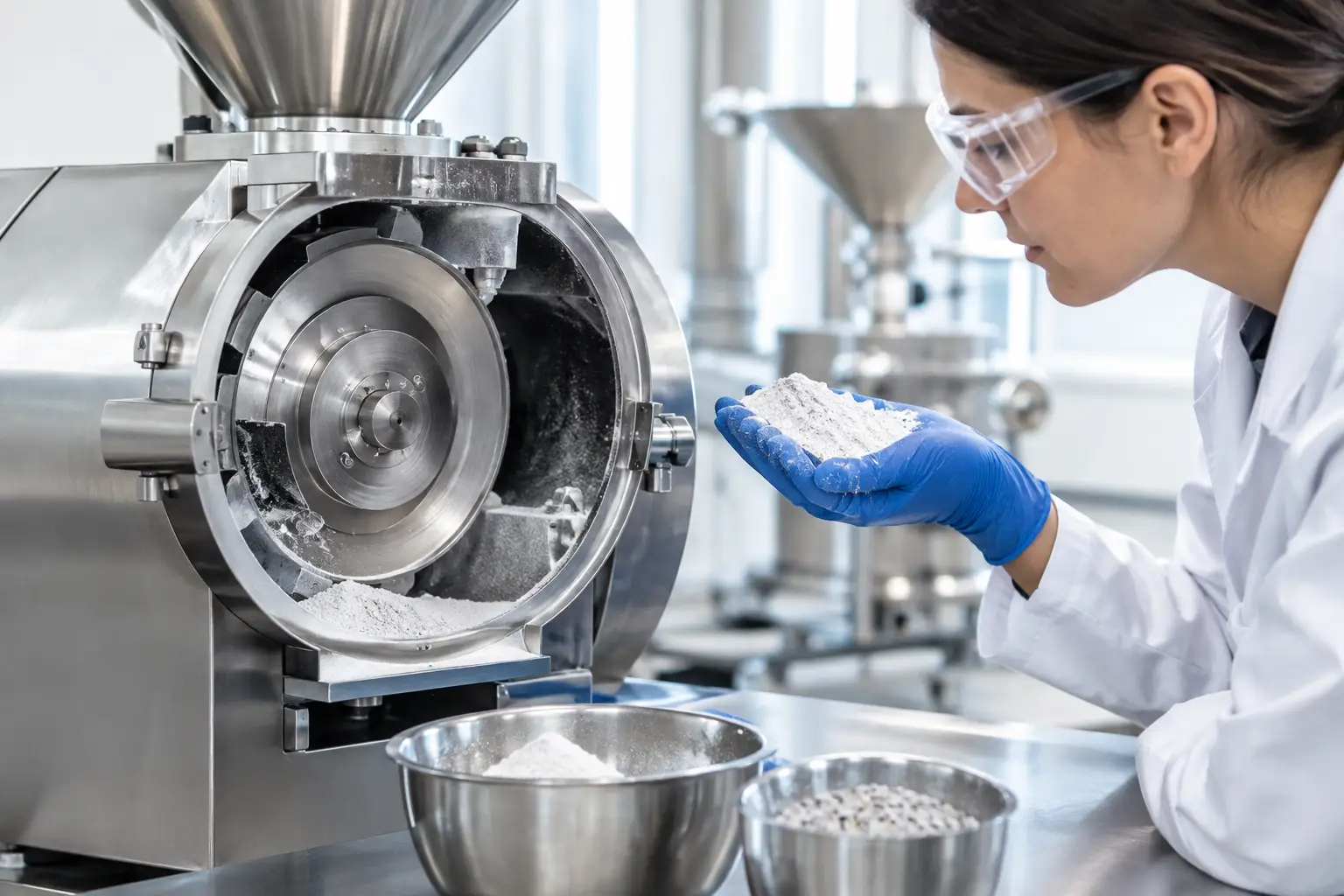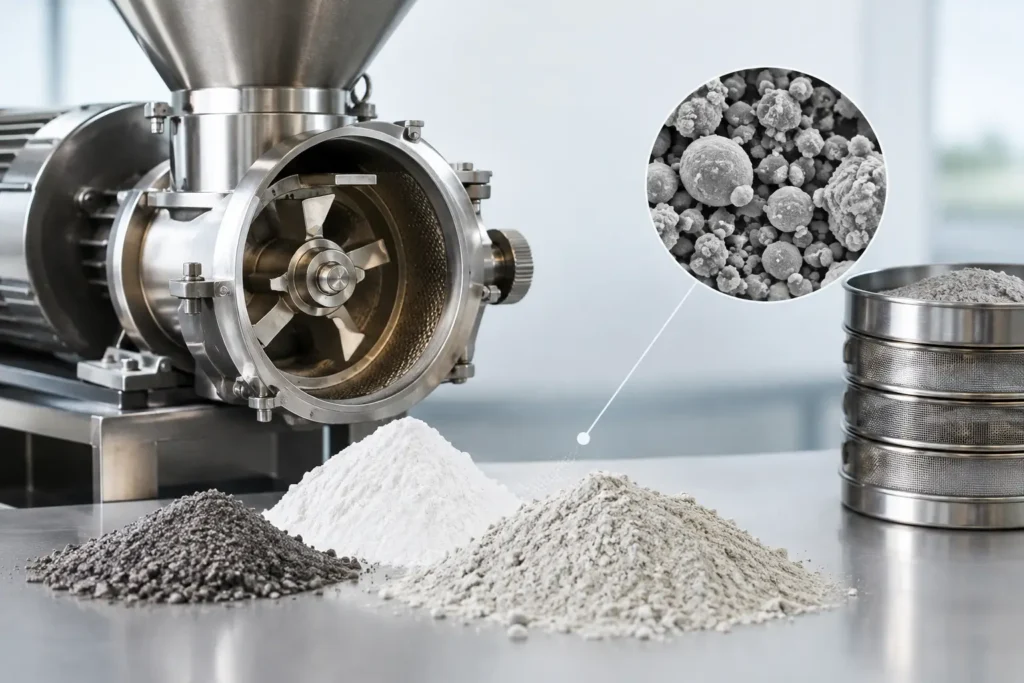
A powder can meet its average size target and still create a production problem. It may bridge in a hopper, segregate after blending, generate excessive dust, dissolve too slowly, or deliver inconsistent downstream performance. Effective particle sizing is not simply a laboratory measurement. It is a process-control discipline that connects raw material behavior, milling performance, product quality, and plant economics.
Particle Sizing Is More Than an Average
Most powder specifications begin with a single number, often a median particle diameter such as D50. That number is useful, but it does not tell the full operating story. Two materials can have the same D50 while behaving very differently if one has an excessive coarse fraction, a high level of fines, or a broad distribution.
Particle size distribution, commonly called PSD, describes how particle sizes are spread across a sample. Percentile values provide a practical way to define it. D10 is the size below which 10% of the particles fall. D50 is the median size, and D90 is the size below which 90% of the particles fall. Together, these values indicate whether the product is tightly controlled or broadly distributed.
That distinction affects manufacturing results. Coarse particles can create grit, reduce dissolution rate, limit reaction surface area, or interfere with coating and compaction. Excessive fines can increase dust loading, reduce flowability, create handling losses, and raise the risk of agglomeration. In applications such as battery materials, pharmaceuticals, specialty chemicals, and mineral processing, the tails of the distribution can matter as much as the median.
A usable specification therefore begins with product function, not a generic micron target. The right question is not only, “What D50 do we need?” It is also, “What level of oversize is acceptable, how much fine material can the process tolerate, and how repeatable must the distribution be from batch to batch?”
Why Particle Size Changes Process Behavior
Particle size influences surface area, and surface area changes how materials interact with their environment. As particles become finer, they generally dissolve faster, react more readily, disperse more easily, and provide greater contact area. Those benefits often come with trade-offs: finer powders may have lower bulk density, more electrostatic behavior, greater moisture sensitivity, and more difficult flow characteristics.
Flow behavior illustrates why size cannot be considered in isolation. A coarse, angular powder may flow poorly because particles interlock. A very fine powder may also flow poorly because cohesive forces become dominant. Particle shape, surface texture, moisture content, and bulk density all influence the outcome. Milling equipment can alter some of these attributes along with size, which is why mill selection must account for the complete material profile.
Particle size also affects downstream equipment. A narrow distribution can improve feeding consistency and support more predictable blending or tableting. In pneumatic conveying, an increase in fines may change pickup velocity requirements, filter loading, and dust-collection performance. In a liquid dispersion, inadequate reduction can leave agglomerates or slow wetting, while excessive energy can damage heat-sensitive or fragile materials.
Measuring Particle Size the Right Way
No measurement method is universally correct. The method must match the material, the target range, and the property being controlled. Sieve analysis remains practical for relatively coarse, free-flowing products. Laser diffraction is widely used for dry powders and dispersions across a broad size range. Dynamic image analysis can provide useful information on shape and oversized particles, while microscopy may be necessary when particle morphology or agglomeration must be examined directly.
Each method measures particles differently. Laser diffraction reports an equivalent spherical diameter based on light scattering, while sieves sort particles by their ability to pass through apertures. Those results may not match exactly, particularly for elongated, flaky, or irregular materials. A specification developed with one method should not be transferred to another without correlation work.
Sample preparation is equally important. If a cohesive powder is not adequately dispersed before testing, the reported PSD may represent agglomerates rather than primary particles. Too much dispersion energy, however, can fracture fragile particles and produce an artificially fine result. The operating procedure should define sample mass, dispersion medium or air pressure, feed rate, measurement duration, and cleaning practices. Without this discipline, apparent shifts in PSD may be measurement variation rather than a true change in the process.
Representative Sampling Protects the Data
A precise instrument cannot correct a nonrepresentative sample. Powders frequently segregate by size during conveying, discharge, storage, and transport. Fine particles may concentrate in one area, while larger particles migrate elsewhere. Taking a grab sample from a drum or tote can produce misleading results, especially when the distribution is broad.
Sampling should reflect the actual decision being made. For batch release, that may mean collecting increments across the full batch and combining them according to a defined plan. For continuous processing, samples should be collected at planned intervals after the process has stabilized. Sample splitting must also preserve the distribution. Methods that allow fines to escape or coarse particles to settle will compromise the result before analysis begins.
Matching Milling Technology to the Target PSD
Particle sizing begins upstream of the analyzer. The mill, classifier, feed system, and process conditions determine whether a target distribution can be achieved consistently at the required throughput.
Hammer mills and universal mills are often effective for general size reduction where moderate fineness, practical throughput, and straightforward operation are priorities. Screen selection, rotor speed, feed rate, and material properties determine the finished distribution. They may be a strong fit for materials that break readily and do not require a very tight top-size limit.
Pin mills and turbo mills can provide finer reduction and are well suited to many food, chemical, and nutraceutical applications. Their performance depends on impact energy, internal airflow, residence time, and the material’s tendency to soften, melt, or coat internal surfaces. For heat-sensitive materials, temperature control is not optional. It is part of maintaining both product integrity and repeatable sizing.
Jet mills are commonly considered when ultrafine particle sizing, low contamination, and tight control are required. Because size reduction occurs through particle-to-particle impact in a high-velocity gas stream, jet milling can limit mechanical contact with grinding media. Integrated classification helps control the upper end of the distribution, but compressed gas demand, feed conditioning, and material response must be evaluated against the required production rate.
Air classifier mills combine impact grinding with internal classification, allowing fine particles to exit while oversized particles remain in the grinding zone. This can be valuable when a narrow PSD is needed without relying solely on screens. Cryogenic grinding may be appropriate for elastic, waxy, fatty, or temperature-sensitive materials that resist conventional milling. Lowering the material temperature can make it more brittle, reduce smearing, and preserve volatile components, though it adds utility, handling, and safety considerations.
The best technology depends on more than target microns. Engineers should assess hardness, abrasiveness, moisture, melting point, initial feed size, desired throughput, contamination limits, explosion risk, and cleaning requirements. A pilot trial with representative material is often the most reliable path to defining the achievable PSD and operating window.
Controlling the Variables That Cause PSD Drift
Once a process is established, particle size control depends on managing the variables that change during production. Feed rate is a common source of variation. Overfeeding a mill can reduce impact intensity, increase internal residence time in unpredictable ways, and shift the distribution toward coarser material or broader tails. Underfeeding can increase energy input per particle and generate unnecessary fines.
Rotor speed, classifier speed, airflow, grinding pressure, screen condition, and product temperature also influence results. Worn components may gradually introduce a wider distribution before the issue becomes obvious in production data. For abrasive materials, wear-resistant construction and planned inspection intervals can protect both particle-size consistency and contamination control.
Environmental conditions deserve attention as well. Changes in humidity can alter powder cohesion and feeding behavior. Variability in incoming raw material moisture, density, or starting PSD may require adjustment to maintain the finished specification. Closed-loop process controls, trend monitoring, and defined response limits help operators identify drift before it becomes a rejected batch or a downstream disruption.
Designing a Specification That Production Can Hold
An overly narrow PSD specification can increase cost, reduce throughput, and create unnecessary rework without improving product performance. An overly broad specification can transfer variability to blending, filling, dissolution, reaction, or final-product quality. The practical target is a distribution that supports the intended function with a stable, economically achievable process window.
Development work should establish the relationship between PSD and critical performance outcomes. If D90 drives nozzle wear, tablet texture, dispersion quality, or customer acceptance, that parameter belongs in the specification. If a small shift in D50 has no measurable effect, forcing a tight limit may not add value. Capability studies should demonstrate that the selected milling system can repeatedly meet the requirement under normal operating variation, not only under ideal trial conditions.
Scale-Up Requires More Than Matching a Lab Result
A laboratory result proves potential, not production capability. Scale-up changes feed dynamics, heat generation, airflow, residence-time distribution, and material handling behavior. A larger system may require different feeder design, dust collection capacity, conveying velocities, or classifier settings to reproduce the desired PSD.
The most effective scale-up programs define critical process parameters during trials, then verify them at pilot and production scale. They also account for startup, shutdown, cleaning, and routine maintenance. DP Mills approaches this work as a process-engineering exercise, aligning milling technology and supporting equipment with the performance required at full production.
The value of particle sizing is realized when the data leads to a controllable process. A meaningful PSD target, representative sampling, suitable measurement method, and properly engineered milling system give manufacturers a stronger basis for consistent output, efficient operation, and confident scale-up.