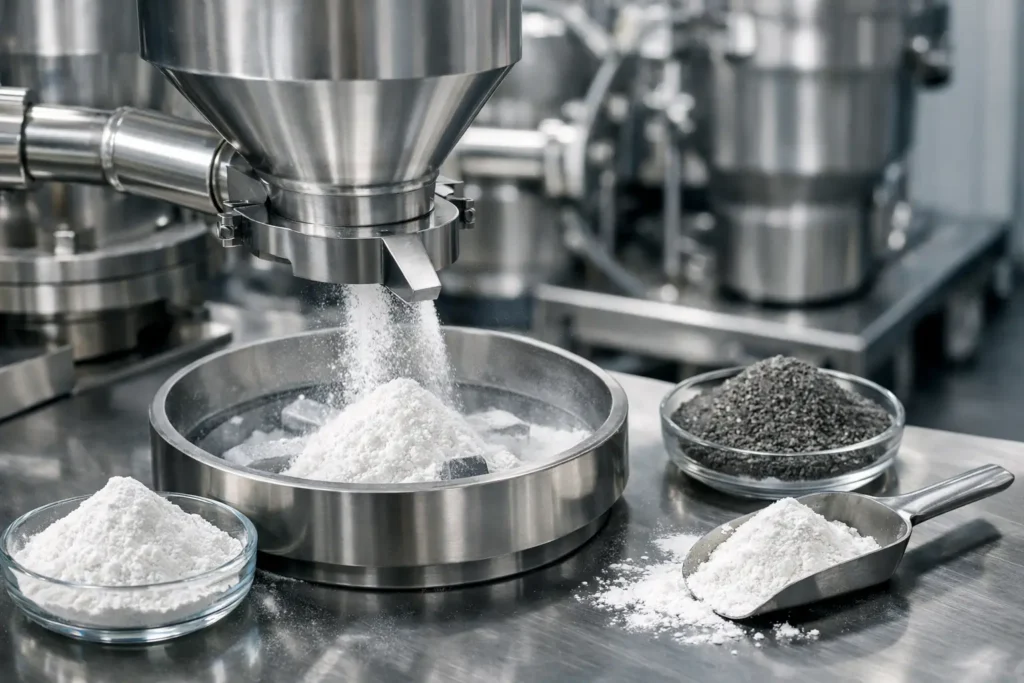
Abrasive powder milling is rarely limited by whether a machine can break a hard material. The real challenge is producing the required particle size distribution at a commercially useful rate while controlling wear, heat, contamination, dust, and unplanned downtime. For manufacturers processing silica, alumina, ceramics, minerals, battery materials, abrasive media, or specialty chemical powders, those factors determine whether a milling line remains stable over months of production.
A mill that performs well on a short trial can still become an expensive production problem if its wear surfaces erode quickly, its product becomes contaminated by metallic fines, or its classification system cannot hold the required top-size limit. Effective abrasive powder processing starts with the material and the process target, then matches the milling technology and system design to both.
Why Abrasive Powders Require a Different Milling Approach
Abrasiveness is not simply a measure of material hardness. Particle shape, feed size, moisture, bulk density, friability, and mineral composition all affect how aggressively a powder wears internal surfaces. Angular particles such as crushed silica can cut and scour components. Dense ceramic materials can create high-impact wear. Fine particles may also migrate into seals, bearings, filters, and conveying equipment, extending the wear challenge beyond the mill itself.
The required finished specification adds another layer of complexity. A coarse mineral product may tolerate a broad distribution and conventional impact milling. A precision abrasive, battery precursor, or engineered ceramic powder may require a narrow particle size distribution, limited oversize, and strict contamination limits. In these applications, the grinding mechanism, classifier configuration, air handling system, and construction materials must work as one process.
Production teams should also distinguish between reducing particle size and controlling particle size. Size reduction alone can create excessive fines, wide distribution, or recirculating oversize. Particle control requires an engineered balance between milling energy, residence time, air flow, and classification cut point.
Selecting Equipment for Abrasive Powder Milling
There is no universal mill for abrasive materials. The most suitable technology depends on feed size, target fineness, capacity, sensitivity to contamination, and the material’s response to impact, attrition, or particle-to-particle collision.
Impact Mills for Coarse to Intermediate Reduction
Hammer mills, universal mills, and certain turbo mills can be effective when the process requires robust reduction from larger feed sizes to an intermediate powder. Their advantages include straightforward operation, high throughput potential, and flexibility across many mineral and industrial materials.
For highly abrasive products, however, rotor tips, hammers, liners, screens, and discharge components require careful material selection. Hardened steels may be appropriate for some duties, while ceramic, carbide, or wear-resistant alloy components may provide better service life in more severe applications. The correct choice depends on the product specification as well as wear rate. A highly wear-resistant component is not automatically the right solution if it introduces unacceptable contamination or complicates maintenance.
Air Classifier Mills for Controlled Fine Grinding
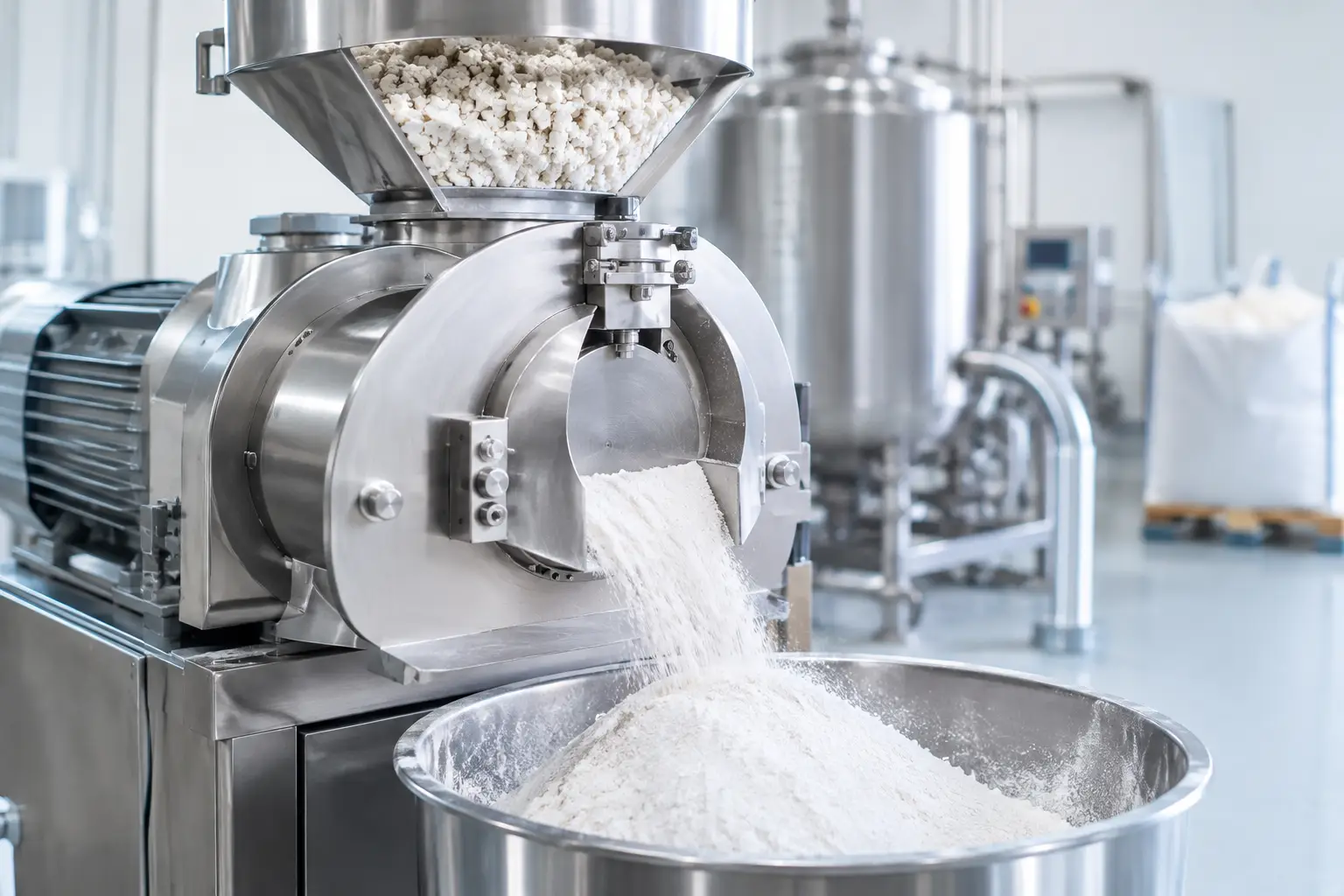
An air classifier mill combines mechanical size reduction with internal air classification. Particles that meet the target size leave with the air stream, while oversized particles return to the grinding zone. This arrangement can improve control of the final top size and reduce unnecessary overgrinding compared with a mill operating without effective classification.
For abrasive powders, the classifier is a critical wear point. The classifier wheel, housing, inlet zone, and product discharge path should be evaluated for wear protection and cleanability. Stable air flow is equally important. Changes in fan performance, filter loading, or conveying pressure can shift the effective cut point and create product variation even when mill speed remains unchanged.
Jet Mills for Fine, High-Purity Products
Jet milling uses compressed gas to accelerate particles into high-velocity collisions. Because particle-to-particle impact performs much of the size reduction, jet mills can minimize direct mechanical contact in the grinding zone. This makes them a strong option for fine abrasive powders where low metallic contamination and tight particle control are priorities.
Jet milling is not automatically the lowest-cost route. Compressed gas demand, feed conditioning, and system scale must be considered. The process is most compelling when product value, fine-size requirements, purity needs, or downstream performance justify the operating cost. For some materials, a staged process using mechanical pre-grinding followed by jet milling provides a more economical path to the final specification.
Cryogenic Grinding for Heat-Sensitive or Difficult Materials
Some abrasive-containing formulations include binders, polymers, waxes, resins, or materials that soften during milling. Cryogenic grinding can reduce product temperature and improve fracture behavior by using low-temperature process conditions. It is particularly useful when heat causes smearing, agglomeration, loss of flowability, or changes in product properties.
The added complexity of cryogenic media handling and insulation must be justified by the material behavior. If conventional air cooling and controlled feed rates can maintain acceptable temperatures, a cryogenic system may not be necessary. Testing should establish the actual thermal limit rather than assuming the hardest material requires the coldest process.
Wear Control Is a Process Design Issue
Wear protection is often treated as a component-selection decision made after equipment is chosen. In abrasive powder milling, it should be addressed during process design. Wear occurs at the feed inlet, grinding chamber, rotor or nozzle zone, classifier, discharge, valves, bends, conveying lines, cyclones, and filters. A durable mill connected to poorly designed transfer piping can still experience frequent outages.
Liner material and geometry matter. Replaceable wear liners can reduce maintenance cost and protect the main mill body, but access must be practical for plant maintenance teams. Dead zones should be minimized because they can collect product, increase cross-contamination risk, and create uneven internal wear. In pneumatic systems, long-radius bends, proper velocity control, and abrasion-resistant piping can substantially improve service life.
Wear monitoring should be planned rather than reactive. Establish baseline inspection intervals after commissioning, measure critical components, and track changes in product particle size, mill power, differential pressure, and throughput. A gradual decline in performance may indicate liner wear or classifier erosion before a visible failure occurs.
Contamination Control Must Match the Product Risk
Every grinding system introduces some possibility of contamination. The question is whether the contamination level and type are acceptable for the application. In a construction mineral product, trace metallic wear may have little effect. In electronic ceramics, specialty coatings, pharmaceuticals, food ingredients, or battery materials, the same contamination can create a quality failure.
Construction materials should be selected with the finished product in mind. Options may include stainless steel, hardened alloys, ceramic-lined contact surfaces, tungsten carbide, or specialized coatings. Each has trade-offs involving wear life, cleanability, cost, impact resistance, and potential product interaction.
Dust collection also affects contamination control. A properly designed filter system maintains pressure balance, captures fine powder, and prevents uncontrolled fugitive dust. For products requiring closed handling, the milling system should integrate contained feeding, transfer, collection, and discharge rather than treating containment as an add-on after the mill is installed.
Process Variables That Determine Product Consistency
Once the equipment platform is selected, repeatable abrasive powder milling depends on disciplined control of operating variables. Feed rate influences residence time and grinding load. Rotor speed or jet pressure changes the available milling energy. Classifier speed and air flow influence the final cut point. A small change in one variable can affect throughput, distribution width, temperature, and circulating load.
Feed preparation deserves equal attention. Consistent feed size, controlled moisture, and reliable metering improve milling stability. Oversized feed can overload the mill or accelerate wear. Moisture can promote buildup, reduce classifier efficiency, and cause powder to bridge in hoppers. When material arrives with variable moisture or bulk density, upstream conditioning may be more valuable than forcing the mill to compensate.
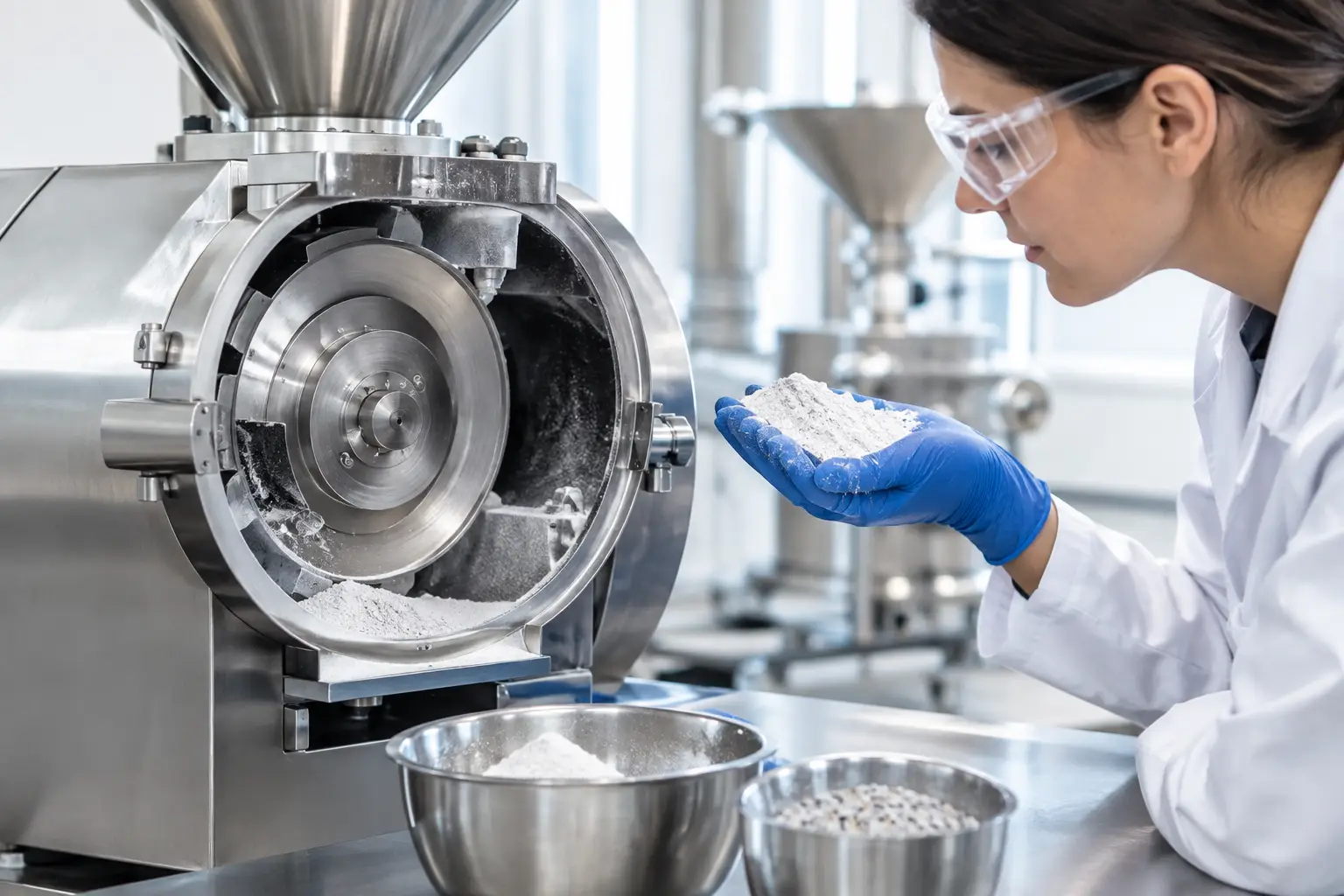
Pilot trials are the most reliable way to identify the operating window. A useful trial evaluates more than a single particle size result. It should document throughput, energy consumption, product temperature, particle size distribution, contamination, yield, dust collection behavior, and wear observations. The best solution is often the process that holds specification with the fewest sensitive adjustments, not the one that produces the finest result in a brief test.
Designing for Scale and Long-Term Operation
Scaling abrasive milling from pilot work to production requires more than increasing motor horsepower. Air volume, classifier geometry, feed delivery, product collection, and material residence time all change with system size. A line that produces a narrow distribution at pilot scale may need a different classifier arrangement or multiple parallel mills to preserve performance at higher capacity.
An engineered system should also account for maintenance access, spare wear components, controls, and future capacity needs. If production growth is expected, provisions for modular expansion, additional classification capacity, or upgraded collection equipment can prevent an otherwise avoidable system replacement.
For abrasive applications, the right milling solution is the one that treats product quality, wear life, containment, and throughput as connected requirements. DP Mills evaluates those requirements as a complete process, helping manufacturers move from trial results to dependable production performance.