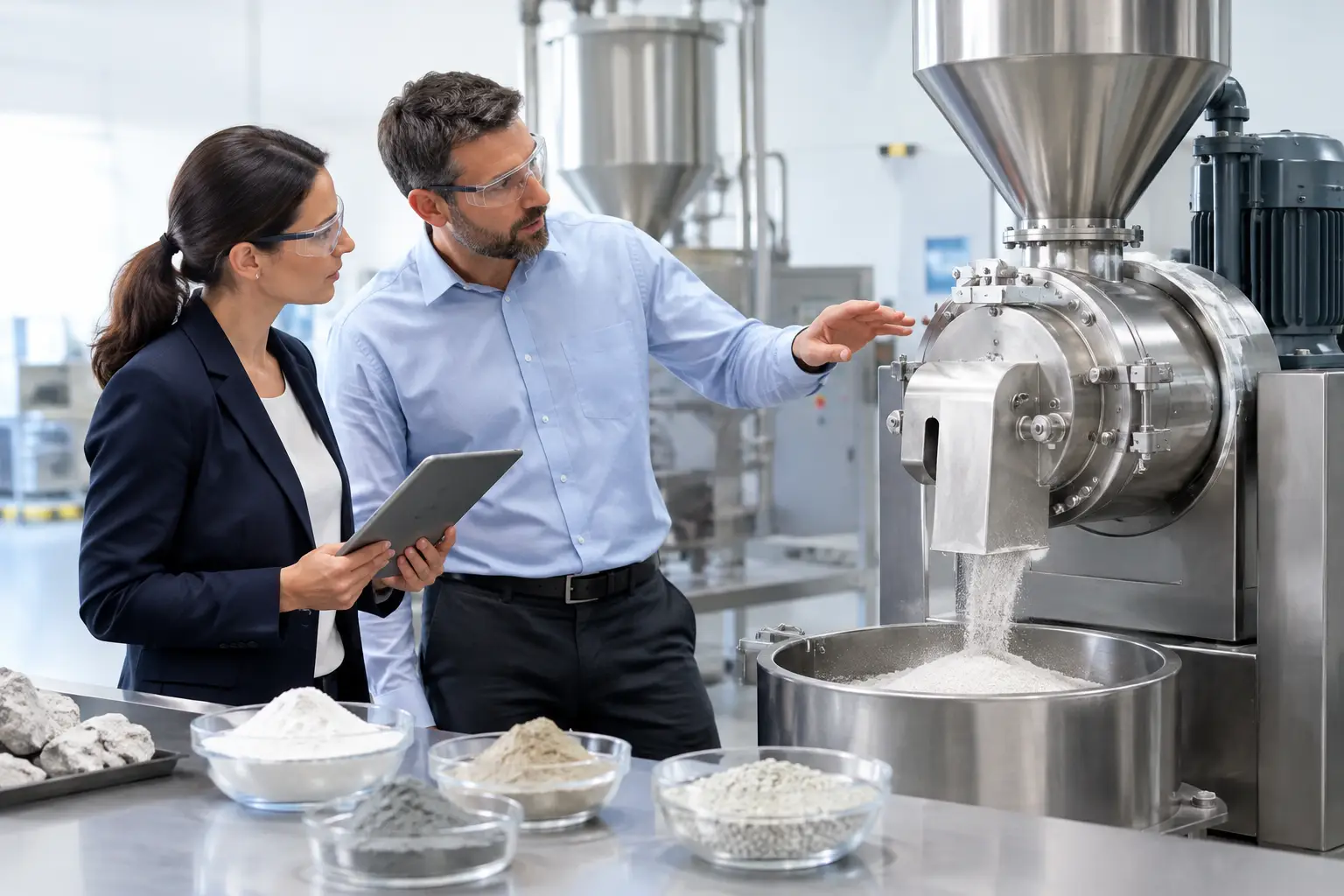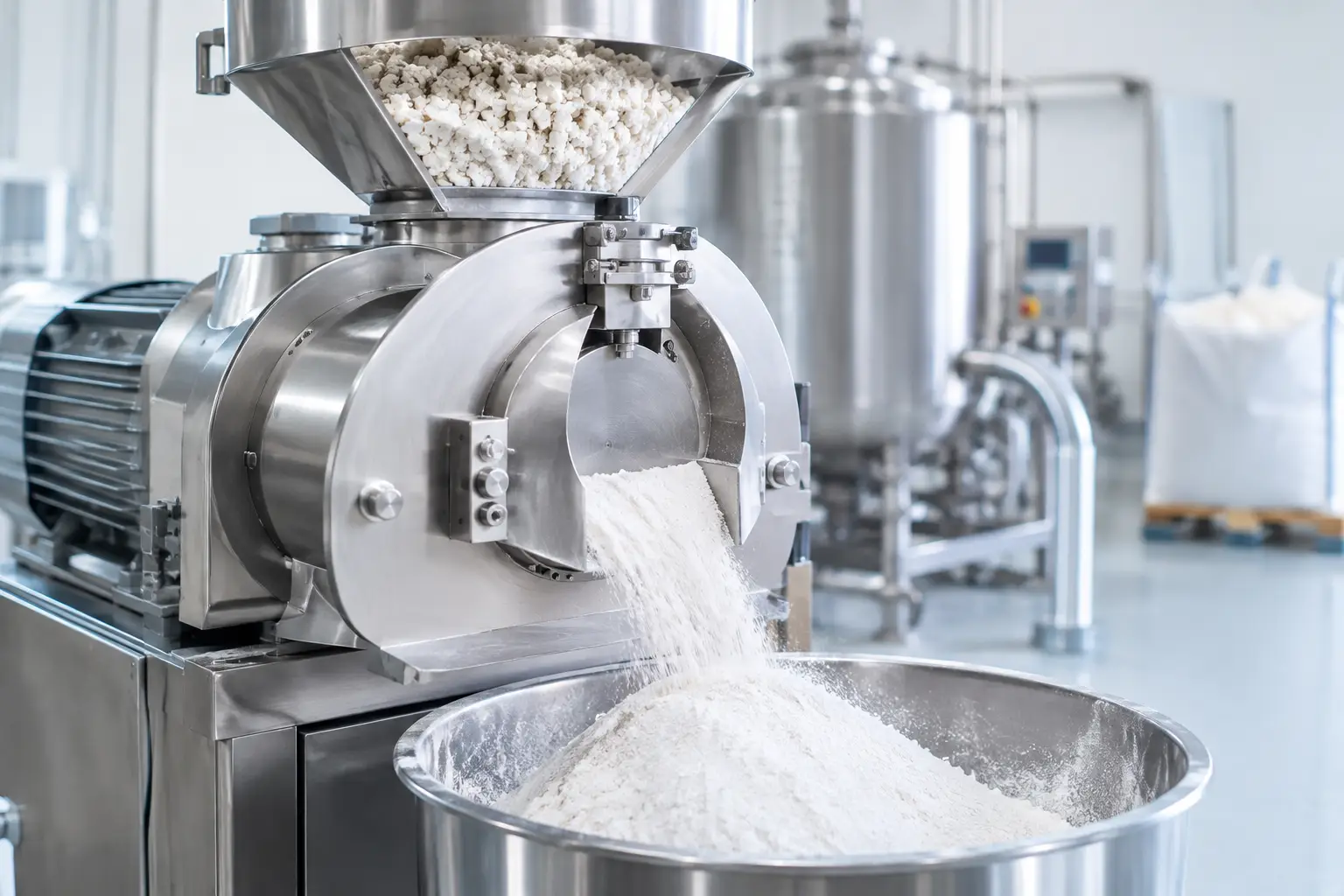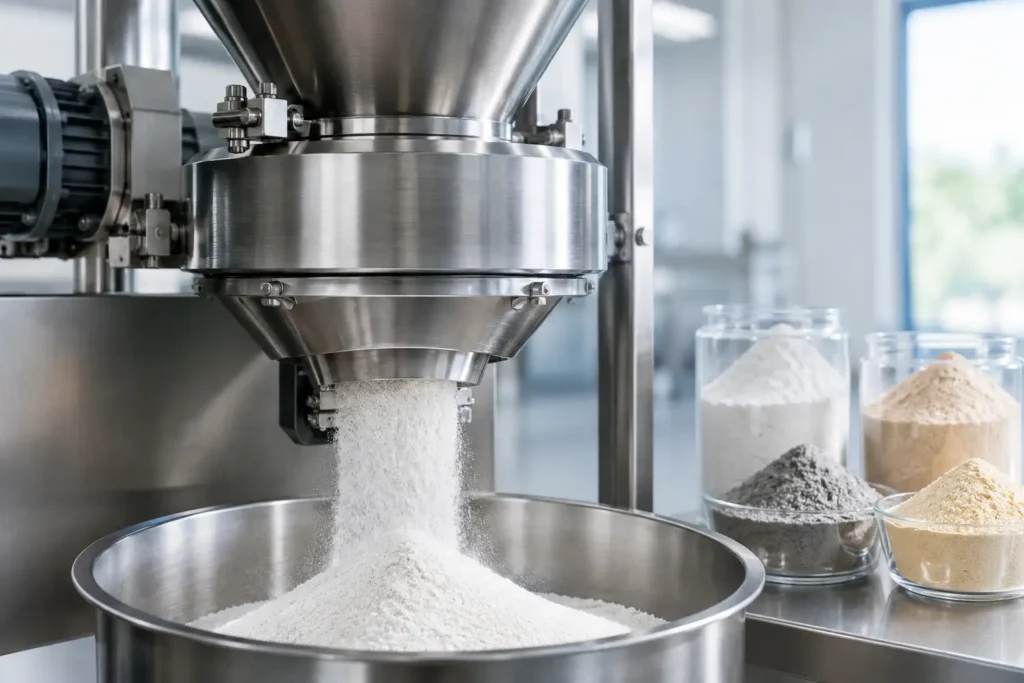
A blend can pass initial testing and still fail at the packaging line. The cause is often not the formulation or the blender. It is what happens after blending: a long drop into a hopper, vibration during conveyance, a poorly designed refill cycle, or a wide particle-size distribution that allows larger particles to separate from fines. To reduce powder segregation, manufacturers must treat the entire process path as part of blend control.
Segregation is especially costly in pharmaceutical, nutraceutical, food, chemical, battery, and advanced-material production. It can create assay variation, inconsistent functional performance, dusting, rejects, rework, and difficult investigations. The most effective solutions begin with material characterization, then connect milling, classification, conveying, storage, and discharge into one engineered system.
Why powder segregation occurs
Powders do not behave as a uniform mass. Individual particles differ in size, shape, density, surface texture, moisture content, and electrostatic charge. When those differences are large enough, handling energy can cause components to separate.
The most familiar mechanism is sifting or percolation. Fine particles move downward through voids between larger particles during vibration, free fall, or repeated movement. Coarser particles remain closer to the top or migrate toward vessel walls. A blend may look uniform in a tote, yet discharge with a changing composition from the first container to the last.
Fluidization is another common mechanism. Air introduced during pneumatic transfer, hopper filling, or high-velocity product drops can suspend fine, low-density particles while heavier or larger particles settle. In some materials, dust and fines are carried to filters or collection points, changing the composition of the remaining bulk powder.
Trajectory segregation occurs when particles travel differently as they leave a conveyor, chute, or mill discharge. Coarse particles typically carry farther than fines. If product enters a bin from one side or falls over a significant distance, localized segregation can develop before the bin is even full.
No single mechanism explains every problem. Many operations face a combination of percolation, air entrainment, and poor flow patterns. That is why a corrective action aimed only at the blender often produces limited results.
Reduce powder segregation by controlling particle properties
Particle-size distribution is one of the strongest predictors of segregation risk. Broad distributions create a greater opportunity for fines to move through coarse-particle voids. Large differences in density or morphology can amplify the effect, particularly for blends containing a low-dose active ingredient, coating additive, flavor, pigment, or conductive material.
Milling and air classification can narrow the distribution before blending or downstream processing. The objective is not simply to make every material finer. Excessive size reduction can raise surface area, worsen cohesion, increase dust, alter dissolution or reactivity, and add unnecessary energy demand. The practical target is a controlled distribution that supports the product’s functional requirement while reducing the size gap between blend components.
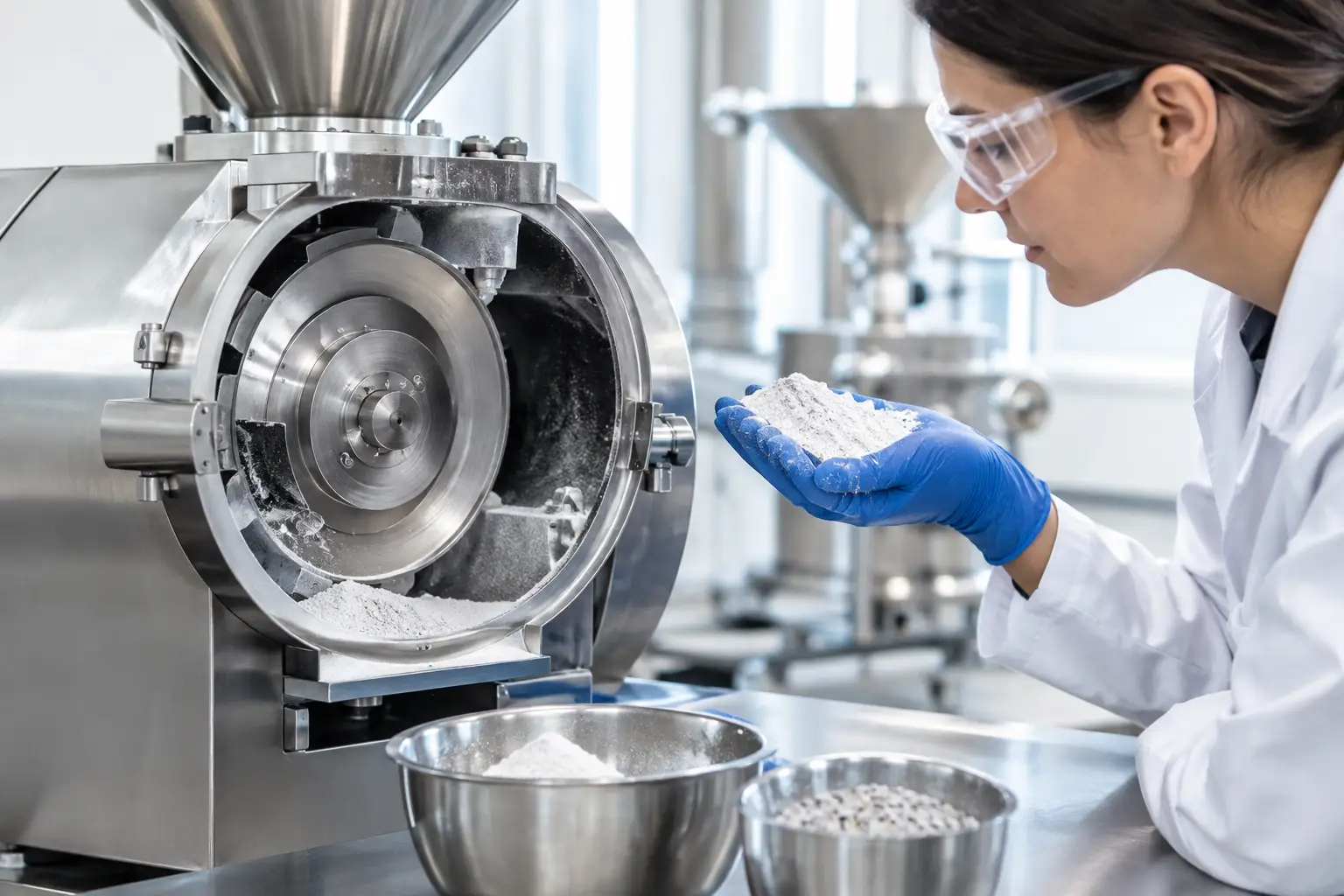
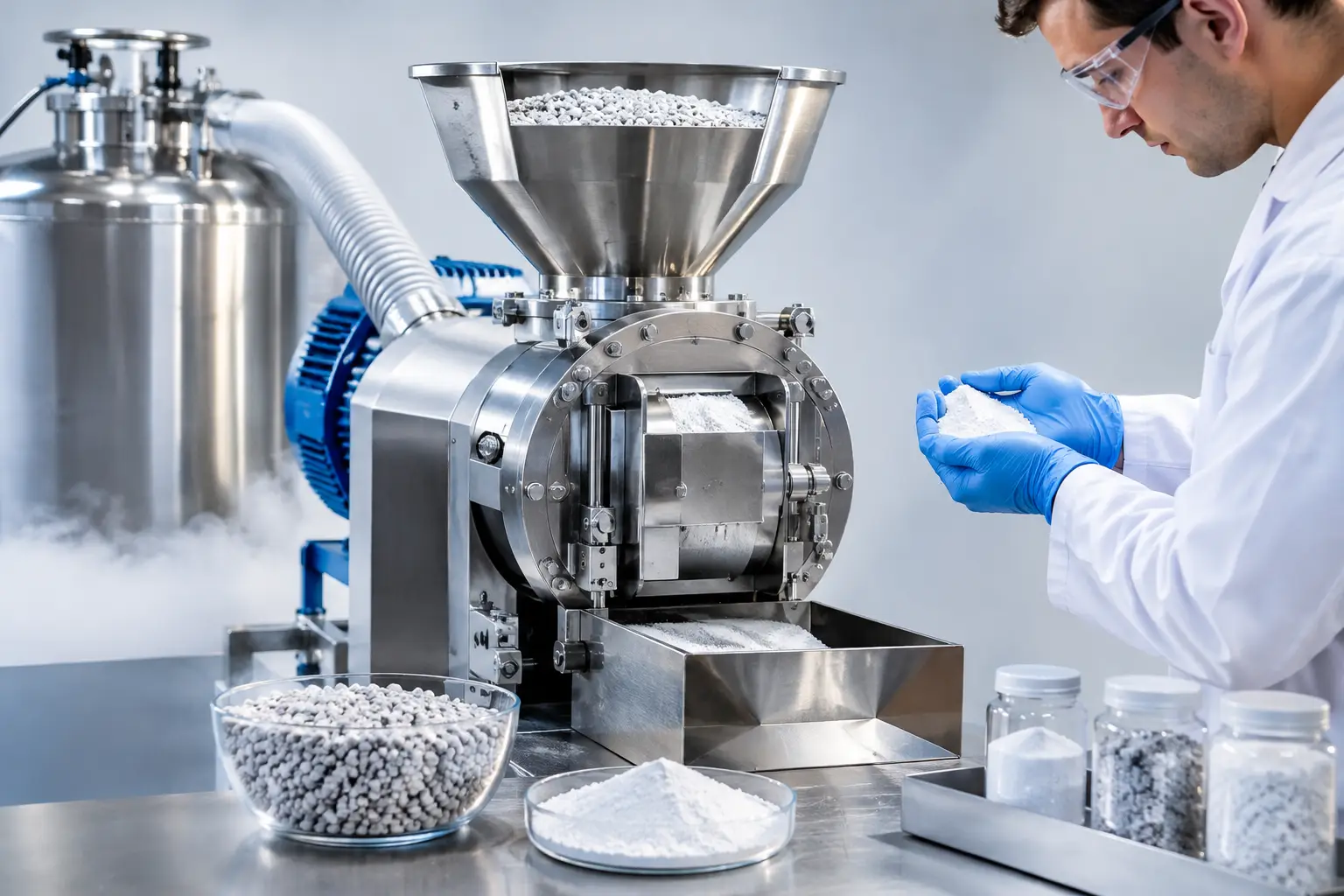
A jet mill can be effective when contamination control, tight particle-size control, or low-temperature processing is required. Air classifier mills provide an integrated approach to impact milling and classification, helping remove oversized particles and control the upper end of the distribution. Pin, hammer, turbo, universal, and cone mills each have appropriate operating ranges depending on material hardness, heat sensitivity, feed condition, and required throughput.
The milling system must also avoid creating a high fraction of uncontrolled fines. A process that achieves the target D50 but generates excessive sub-micron or dust-like material may increase fluidization and make the product more difficult to convey. Evaluate the complete distribution, not just one specification point.
Particle shape matters as well. Rounded, free-flowing particles may segregate more readily by percolation than irregular particles that interlock. Conversely, highly irregular or cohesive particles can bridge in hoppers and discharge unpredictably. The right particle engineering strategy depends on the material and the next processing step.
Match component distributions before blending
When multiple materials are blended, compare their full particle-size distributions and bulk densities rather than reviewing supplier specifications in isolation. Two ingredients can both meet their individual specifications and still have enough variation between them to segregate in production.
This is particularly relevant when raw material sources change, recycled material is introduced, or a milling screen and rotor configuration is modified. Establishing acceptable component-to-component ranges can prevent blend uniformity issues before they reach the line.
Design transfers to minimize separation energy
Every transfer point deserves attention. The risk rises when powders experience a high free-fall distance, repeated impacts, abrupt changes in direction, or excessive air velocity. These conditions provide the energy that allows particles to separate.
Keep drop heights as short as practical and use properly designed chutes, telescoping fill tubes, or mass-flow feed arrangements where appropriate. Product should enter storage vessels in a controlled stream rather than striking one side of the bin. For fine powders, a dust-tight filling arrangement with managed venting can prevent air displacement from carrying fines out of the incoming material stream.
Pneumatic conveying requires a careful balance. High air velocity may protect against line plugging, but it can also increase attrition, generate fines, and encourage fluidization at the receiver. Dense-phase conveying may reduce velocity and particle damage for suitable materials, though it is not universally applicable. Cohesive powders, fragile agglomerates, long conveying distances, and variable feed rates all affect the choice.
Mechanical conveying can reduce air-related segregation in some applications, but poorly selected equipment may introduce vibration, shear, or residence-time variation. Screw conveyors, for example, can be useful for controlled short transfers, yet they may alter fragile products or create uneven discharge if operated inconsistently. The equipment decision should follow material testing, not a general preference for one transfer method.
Use hopper geometry that supports mass flow
A hopper can either preserve uniformity or undo the work completed upstream. In funnel-flow hoppers, product moves through a central channel while material near the walls remains stagnant. Segregated zones can form and persist. Coarse material may flow first, while fines or cohesive fractions remain behind until a later refill or upset condition.
Mass-flow hopper design promotes first-in, first-out discharge across the full cross section of the vessel. It is often the preferred approach for segregation-sensitive powders because it reduces stagnant regions and limits the opportunity for material to separate during storage. Achieving true mass flow requires the correct wall angle, wall surface, outlet size, and feeder interface for the powder’s measured flow properties.
Do not assume a steep cone alone will solve the problem. Flow behavior changes with humidity, temperature, particle size, moisture pickup, consolidation pressure, and batch variation. A hopper that works with a dry pilot lot may perform differently with production material stored for several hours. Representative testing is essential.
Agitation devices, vibrators, and air pads can restore flow, but they should be used with caution. They may resolve bridging or ratholing while increasing segregation, compaction, or particle damage. Their role should be confirmed through sampling, not judged only by whether the hopper empties.
Validate the process with meaningful sampling
Blend uniformity samples taken directly from a blender do not prove that finished product remains uniform. A useful validation plan follows the powder through the points where segregation is most likely: mill discharge, blend discharge, intermediate tote, hopper outlet, and final package or dose location.
Sampling must be designed to avoid creating misleading results. Thief samples can disturb the powder bed and may not represent the material discharged under normal conditions. Time-based samples from the actual discharge stream are often more informative. Compare early, middle, and late discharge fractions, then assess the relevant quality attribute such as assay, particle size, density, moisture, color, conductivity, or active concentration.
Trend process conditions alongside quality data. Changes in milling speed, classifier setting, air flow, conveying pressure, hopper level, refill frequency, or material lot can reveal the real source of variation. This data-driven approach prevents teams from making expensive modifications based on a single failed batch.
Build segregation control into system design
The most durable answer is usually not an add-on device. It is an integrated design that begins with the desired particle distribution and follows the material through each transfer, storage, and feeding step. Milling technology, air classification, dust collection, conveying method, hopper geometry, and controls should be selected as a system.
For new lines, pilot trials can establish how a material responds to size reduction, classification, and handling before full-scale equipment is specified. For existing lines, a structured process review can identify whether the highest-value improvement is a tighter milling cut, a revised transfer, a hopper retrofit, or a change in operating sequence. DP Mills applies this application-first approach to help manufacturers connect particle processing decisions to reliable downstream performance.
The practical goal is not to eliminate every particle difference. It is to make the process tolerant of normal variation and prevent handling steps from magnifying it. When particle engineering and material handling are designed together, blend uniformity becomes far easier to maintain at production scale.