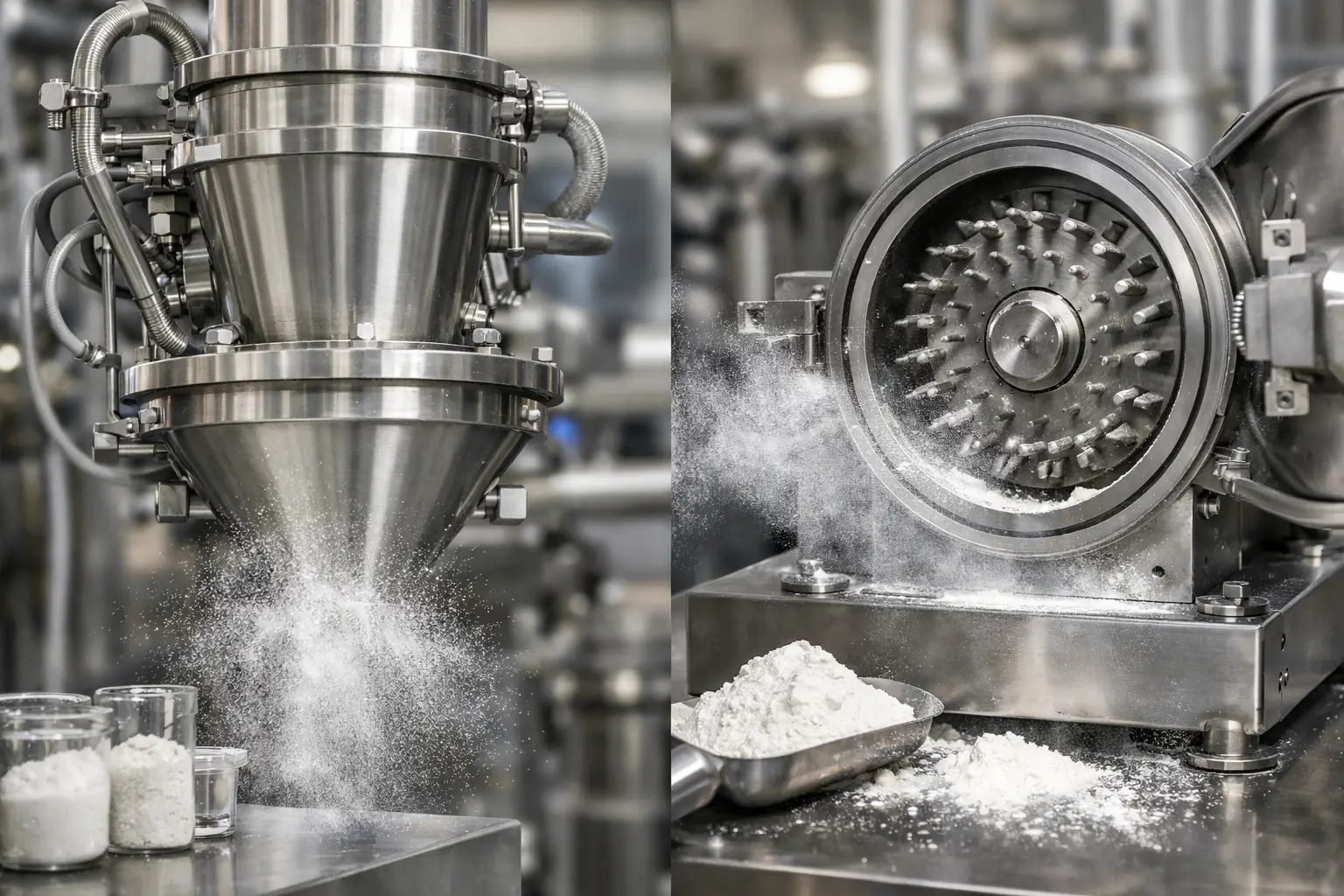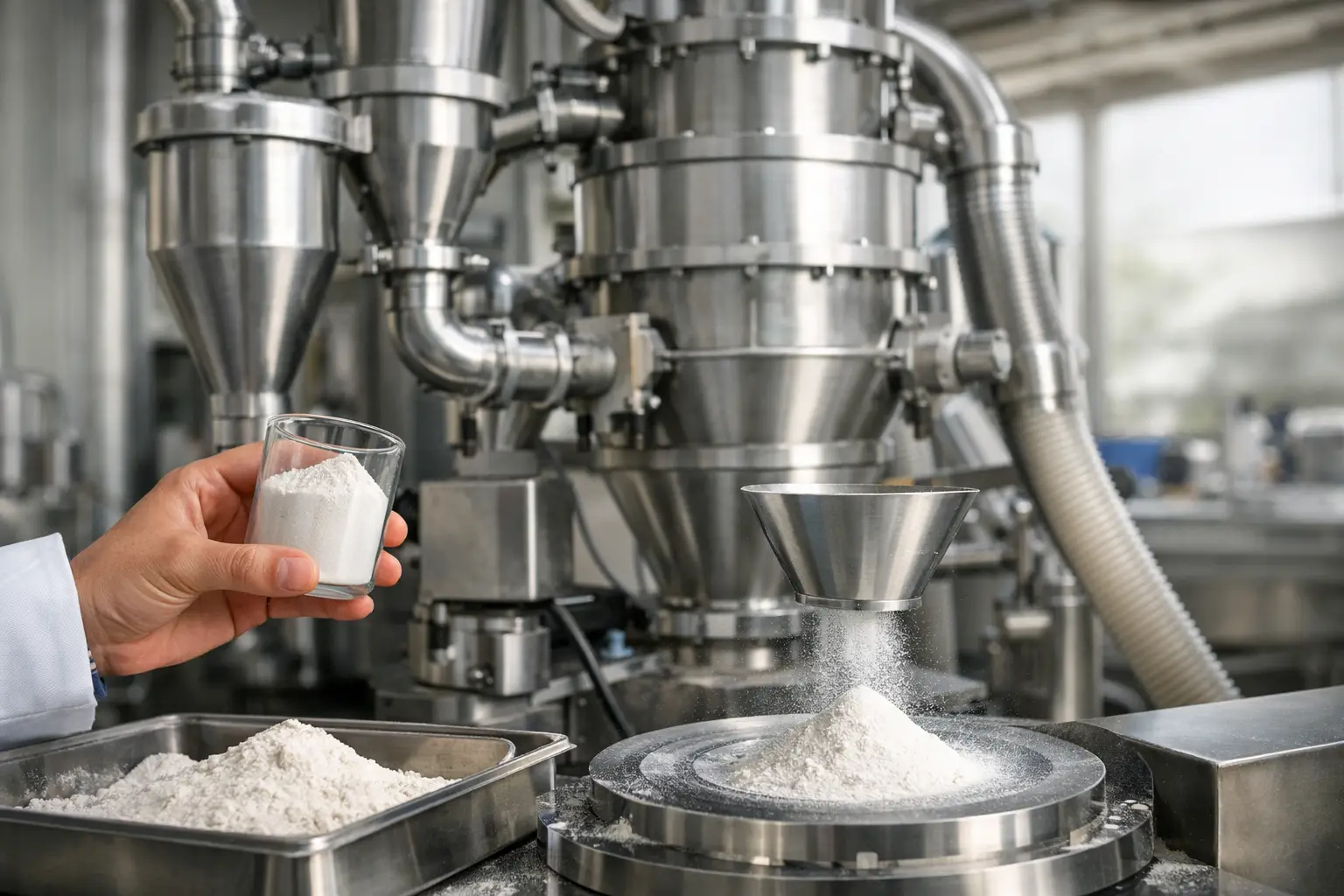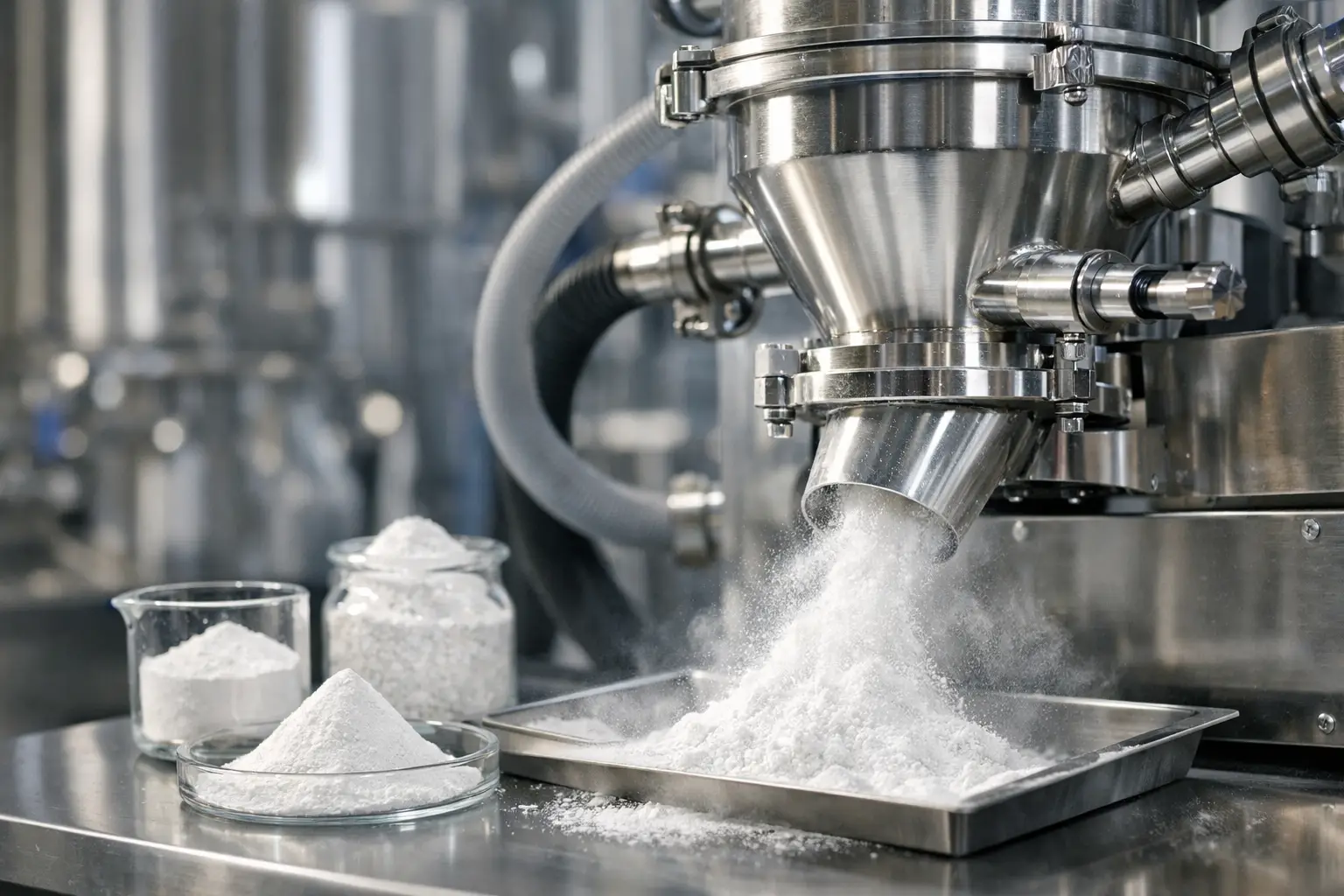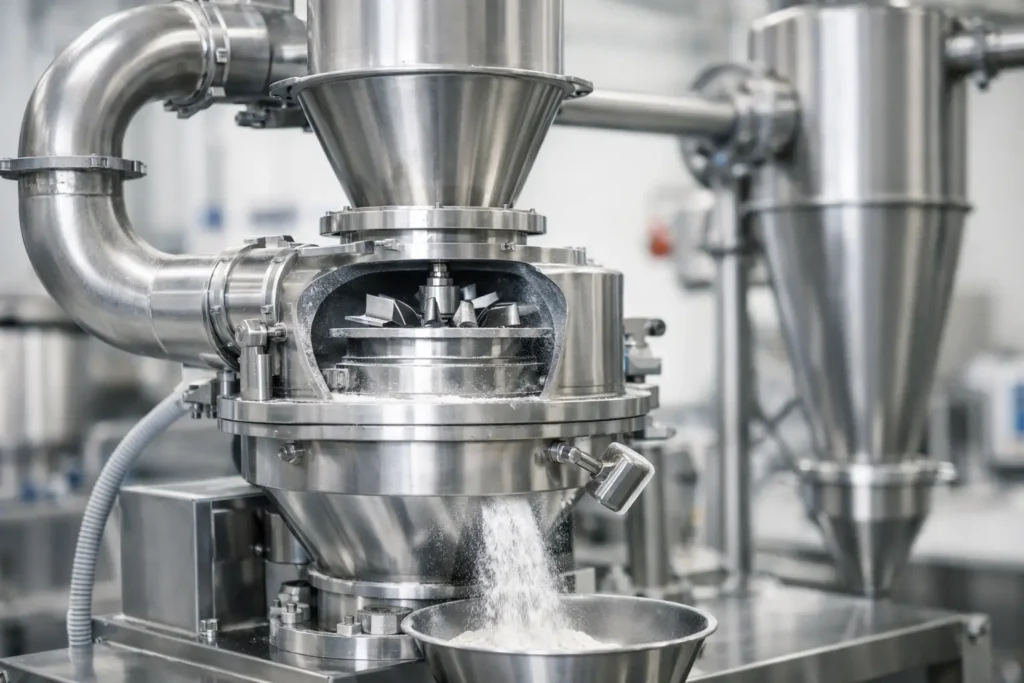
When a production line struggles with oversized particles, excess fines, or inconsistent flow properties, the problem is often not just grinding capacity. It is control. That is where understanding the air classifier mill working principle becomes valuable, because this machine does more than reduce size. It combines impact milling and dynamic classification in a single system to produce a tighter particle size distribution with better process efficiency.
For manufacturers handling pharmaceuticals, food ingredients, chemicals, minerals, battery materials, or nutraceutical powders, that difference matters. Product performance, downstream blending, dust behavior, and yield can all change when size reduction and particle separation are managed together instead of treated as separate steps.
What is the air classifier mill working principle?
At its core, the air classifier mill working principle is based on two actions occurring at the same time inside one housing. The mill uses a high-speed rotor with grinding elements to reduce particle size through impact and shear. At the same time, an integrated classifier wheel uses controlled airflow and centrifugal force to separate fine particles from coarse ones.
Material enters the grinding zone and is struck repeatedly by rotating hammers, pins, or beaters, depending on the mill design. As particles become smaller, the process air carries them toward the classifier. Fine particles that meet the target cut point pass through the classifier and exit the mill. Coarser particles are rejected by the classifier and returned to the grinding zone for further reduction.
This internal recirculation is what makes the technology different from simpler impact mills. Instead of allowing all material to pass once it is fractured, the air classifier mill keeps oversized particles in the system until they are small enough to meet the process requirement.
How the process works inside the mill
Although specific configurations vary by application, the sequence is generally straightforward. Feed material enters the mill through an inlet, often assisted by metering equipment that helps maintain a stable loading rate. Once inside, the rotating grinding assembly accelerates the particles and subjects them to repeated impact against the mill components and against other particles.
A controlled air stream moves through the mill at the same time. This airflow serves several functions. It helps transport material, influences residence time, supports internal classification, and can assist with temperature management for heat-sensitive products.
As particles migrate upward or outward toward the classifier zone, the classifier wheel creates a selective barrier. Finer particles, which are lighter and more easily carried by the air stream, pass through the wheel and move to product collection. Larger or heavier particles experience greater centrifugal resistance and are forced away from the classifier, falling back into the grinding chamber.
That loop continues until the particle is fine enough to escape. In practical terms, the machine is continuously grinding and continuously sorting.
Why classification matters as much as grinding
In many industrial processes, achieving the target particle size is only part of the requirement. Controlling the top size and limiting excess fines are often just as important. A material that is nominally fine but contains too many coarse particles can affect dissolution, reactivity, coating performance, or blend uniformity. Too many fines can create dust, handling problems, poor bulk density, or filtration issues.
The integrated classifier is what gives the mill much of its value. Instead of relying on a fixed screen alone, the classifier allows the cut point to be adjusted by changing operating parameters such as classifier speed and airflow. That makes the system more flexible when production targets shift or when raw material behavior changes.
This also explains why air classifier mills are often selected for applications where tighter control is needed than a conventional hammer mill or pin mill can provide on its own.
Key operating variables that affect performance
Classifier speed
Classifier speed is one of the most important settings in the system. Increasing classifier speed generally produces a finer product because the classifier applies a stronger centrifugal field, making it harder for larger particles to pass. Reducing classifier speed allows coarser particles to exit more easily.
There is a trade-off. Finer settings can reduce throughput because more material is rejected back into the grinding zone. That increases residence time and internal load. In production environments where capacity is critical, the finest achievable result may not be the most efficient operating point.
Rotor speed
The grinding rotor speed affects impact energy. Higher rotor speeds typically increase size reduction intensity and can improve the breakage of tougher materials. But more speed can also increase heat generation, wear, and fines production, depending on the material.
For friable products, excessive rotor speed may create more fines than needed. For harder materials, too little speed may limit reduction and force the classifier to reject too much coarse material back into the chamber.
Airflow volume
Airflow influences particle transport, cooling, and the effectiveness of classification. If airflow is too low, material movement may become unstable and fine particles may not be carried efficiently to the classifier. If airflow is too high, the mill may discharge particles too quickly or alter the cut point in ways that reduce product consistency.
Balancing airflow with feed rate and rotor speed is essential. This is one reason process development matters. The best settings are rarely determined by a single variable in isolation.
Feed rate and material characteristics
Feed rate affects loading inside the mill, which in turn affects grinding efficiency and classification stability. Overfeeding can increase residence time, overload the classifier, and broaden the particle size distribution. Underfeeding can reduce mill efficiency and waste installed capacity.
Material properties also have a major impact. Hardness, friability, moisture content, fat content, bulk density, and thermal sensitivity all influence how the product behaves in the grinding chamber. A material that performs well in one air classifier mill setup may behave very differently with a change in upstream conditioning or raw material source.
Where air classifier mills fit best
Air classifier mills are particularly useful when a process needs fine to medium-fine particle size reduction with tighter top-size control than a basic impact mill can typically deliver. They are often well suited for powders that must meet a defined distribution while maintaining efficient continuous production.
In food and nutraceutical processing, they can support applications where consistency, cleanliness, and controlled fineness are essential. In chemicals and minerals, they are often used where particle size affects dispersion, reactivity, or end-product performance. In advanced materials, the appeal is often precision and repeatability rather than simple throughput.
That said, no milling technology is universal. If the target size moves into the very fine micron range, a jet mill may be more appropriate. If the material is extremely heat sensitive or prone to smearing, cryogenic grinding or another specialized approach may be the better fit. The right choice depends on the target specification, material behavior, and operating economics.
Practical advantages of the design
The biggest operational advantage of this technology is that size reduction and classification happen in one machine. That can reduce equipment footprint, simplify system layout, and eliminate the need for separate downstream classification in some applications.
It also gives operators more control over product quality. Instead of being limited to a fixed mechanical screen, they can fine-tune performance using process variables. For plants that run multiple products or need to adapt to changing specifications, that flexibility can be valuable.
From a maintenance and reliability standpoint, proper machine design matters. Wear protection, sanitary construction where required, access for cleaning, rotor and classifier design, and integration with dust collection all affect long-term performance. An air classifier mill is not just a grinding chamber. It is part of a broader process system.
Common limitations and trade-offs
Air classifier mills offer strong process control, but they are not without constraints. Very abrasive materials can accelerate wear if the system is not engineered with the right materials of construction. Sticky or high-moisture products may foul internal components and reduce classification efficiency. Heat-sensitive products may require additional attention to airflow, inlet temperature, or alternative milling methods.
There is also a balance between fineness and throughput. Tighter particle targets usually require more internal recirculation, which can lower output. In some cases, manufacturers initially focus on the smallest possible size, only to find that overall line efficiency or yield suffers. The better question is often not How fine can the mill go, but What particle distribution delivers the best total process result?
Why engineering and testing matter
Because the air classifier mill working principle depends on the interaction of mechanical force and air-based separation, real-world results are highly application specific. Lab data, pilot trials, and process evaluation are often necessary to define the right machine size and operating window.
This is where an engineering-driven approach makes a practical difference. A well-matched system considers not only target particle size, but also feed behavior, contamination risk, temperature rise, required throughput, cleanability, explosion protection, and downstream integration. For demanding applications, the mill should be selected as part of the process, not as a standalone piece of equipment.
For manufacturers evaluating new milling capacity or upgrading an existing line, understanding the internal mechanism is more than a technical exercise. It helps explain why some systems produce a stable, repeatable powder and others create variability that shows up everywhere else in the plant. When grinding and classification are aligned with the material and the production objective, an air classifier mill can become a highly efficient tool for achieving both particle control and dependable throughput.
The most useful place to start is with the product requirement itself, because the right milling solution is rarely the one with the most speed or the smallest advertised size range. It is the one that performs consistently under real operating conditions.