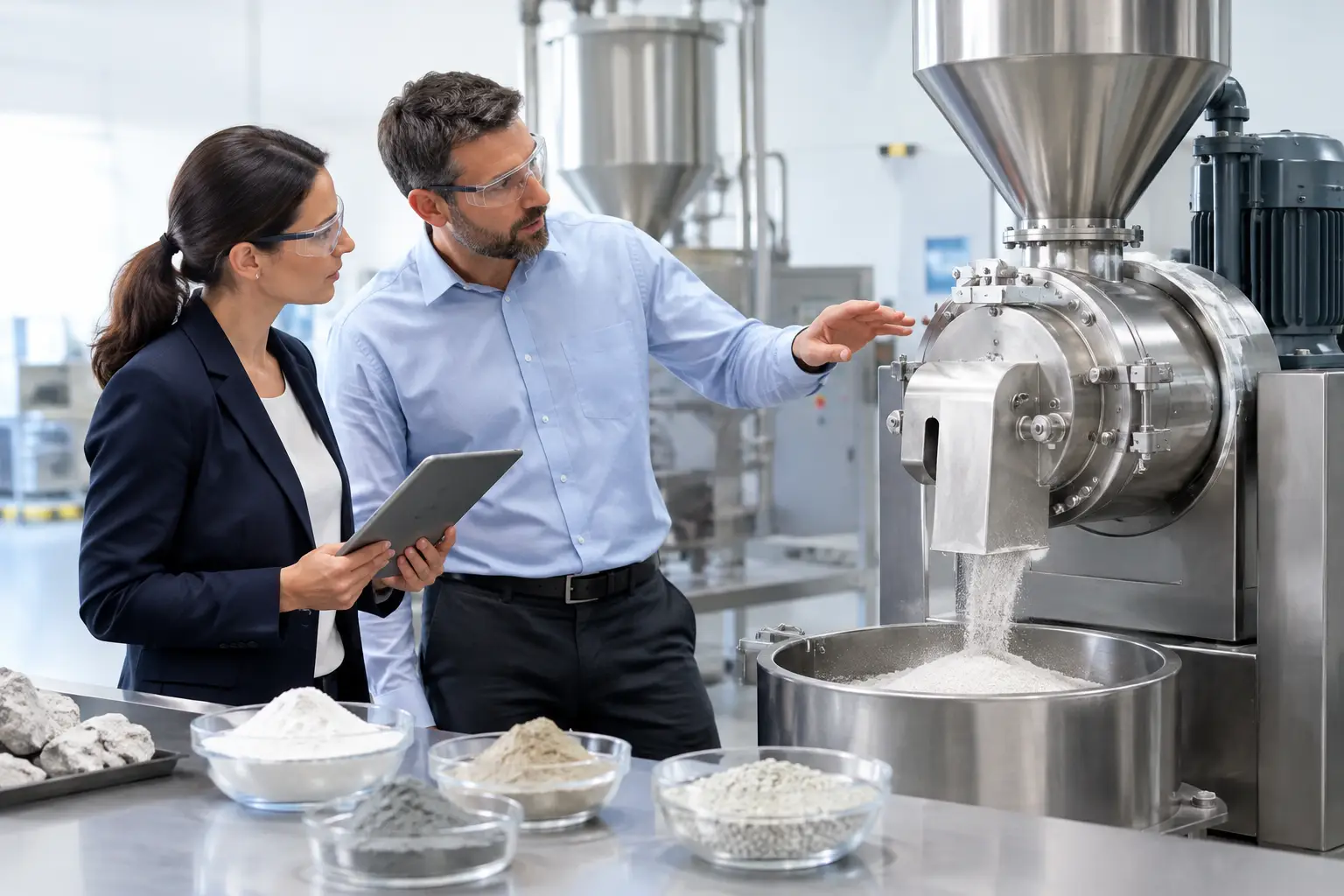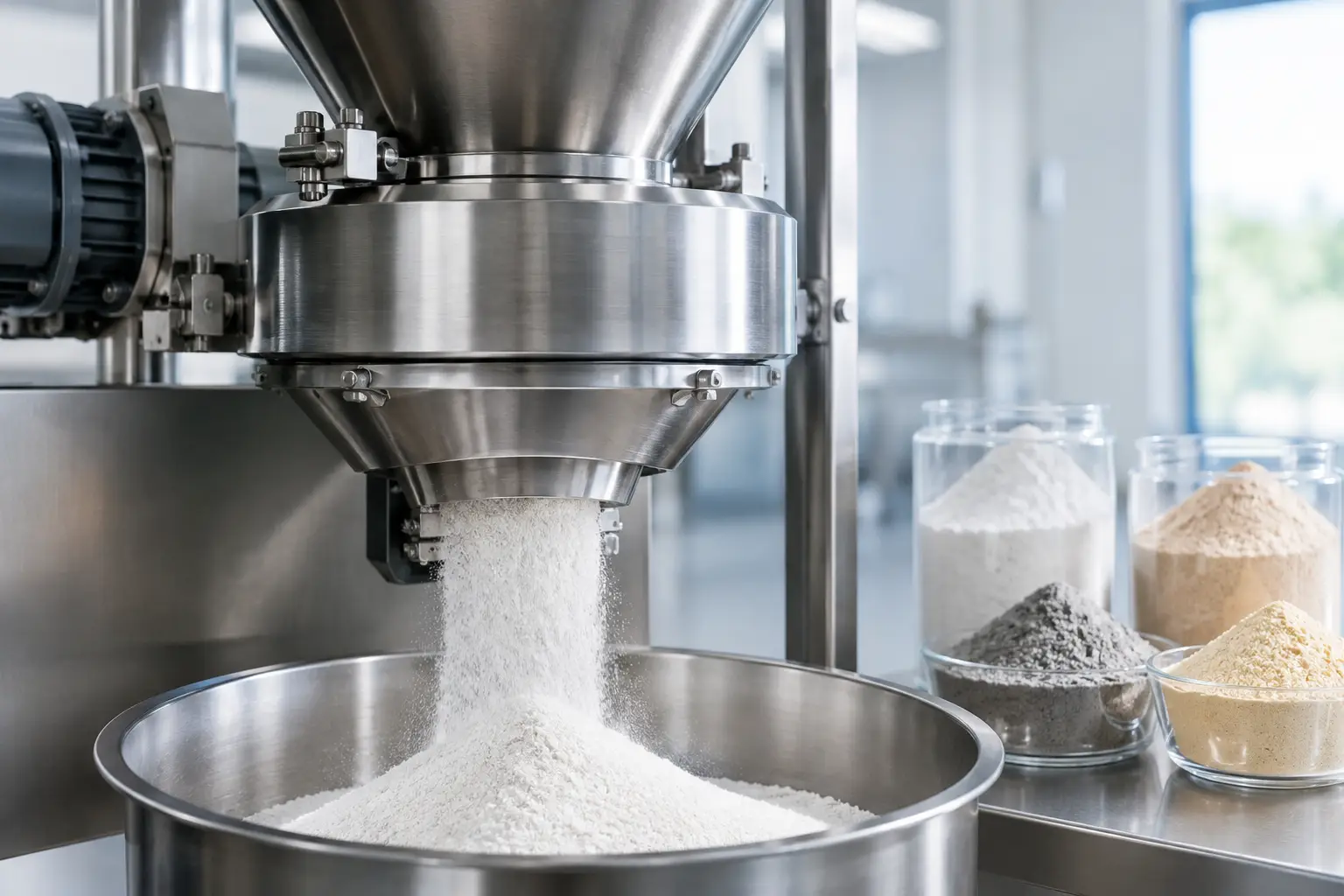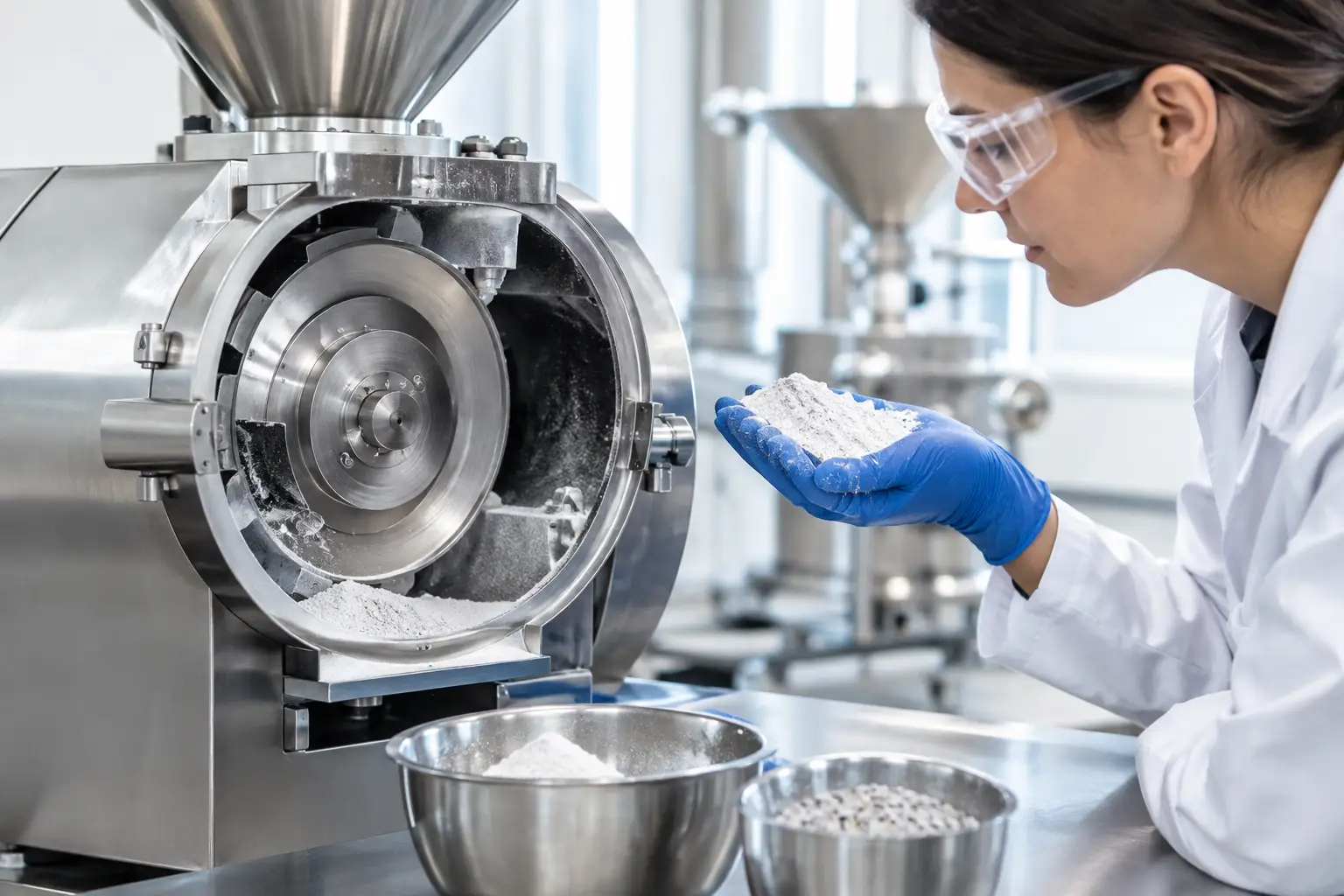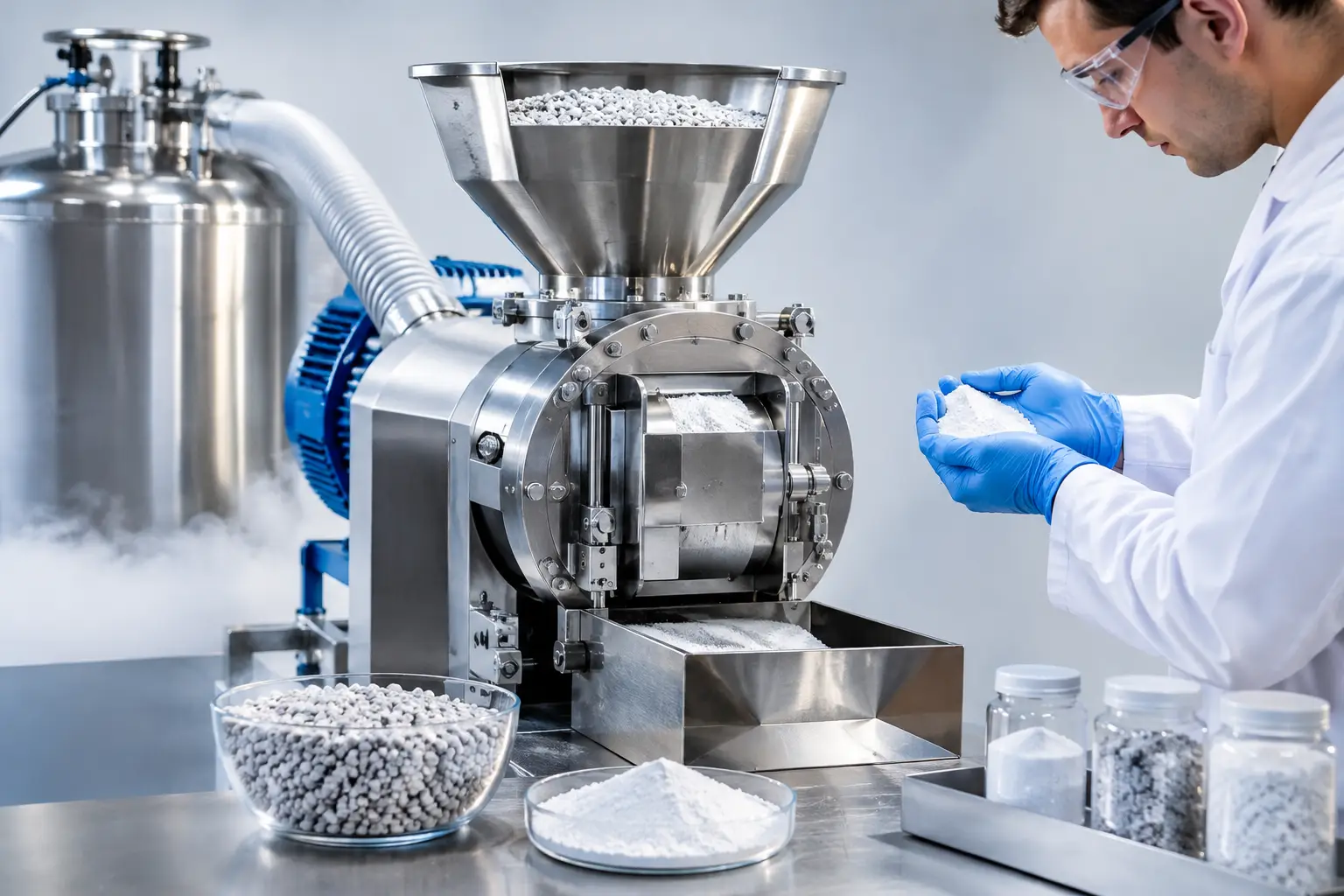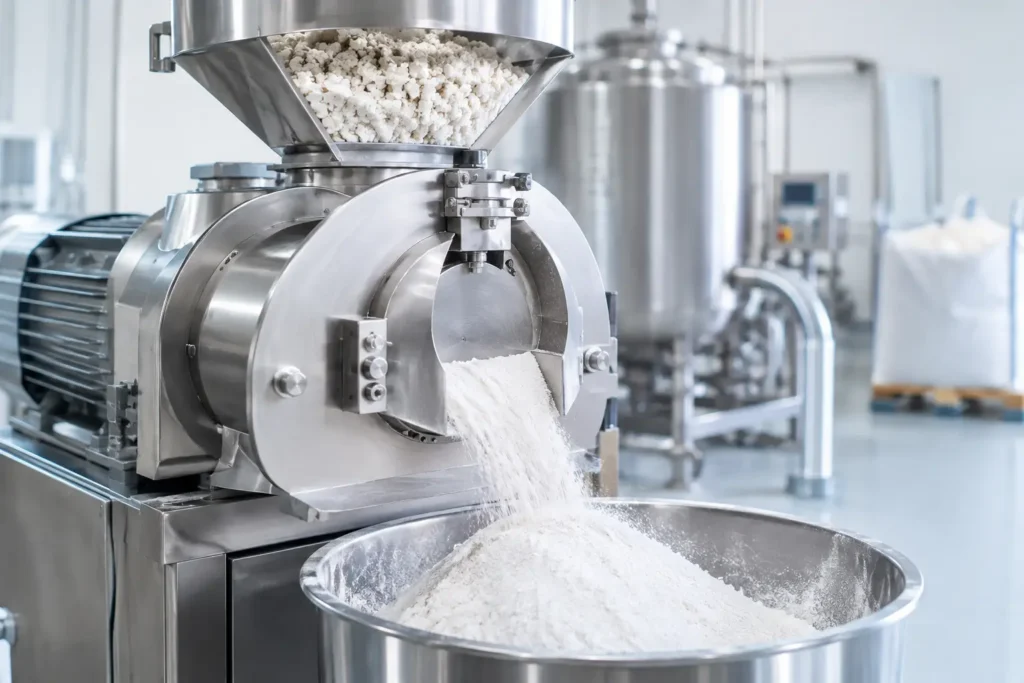
A pilot run can produce an excellent powder and still fail to predict production performance. Process scale up changes more than batch size: it changes material feed behavior, residence time, heat load, airflow, conveying demands, cleaning requirements, and the consequences of small process variations. For manufacturers working with tightly controlled powders, the goal is not simply to make more material. It is to reproduce the required particle size distribution, product integrity, yield, and operating stability at a commercially useful rate.
That distinction matters in pharmaceutical, food, chemical, battery, mineral, and advanced material applications. A milling system that produces a narrow distribution at development scale may produce excess fines, broad particle size variation, or temperature-related degradation when throughput rises. Successful scale-up begins by treating the process as an integrated system rather than selecting a larger version of the original mill.
Why Process Scale Up Is Not Linear
Capacity is often described in pounds per hour or kilograms per hour, but throughput alone is a poor scale-up metric. As equipment dimensions increase, the relationships among grinding energy, air volume, classifier performance, material velocity, and dwell time do not increase at the same rate. A change in one variable can shift the entire operating window.
For example, increasing feed rate without sufficient airflow can raise the internal material load in an air classifier mill or jet mill. The result may be a coarser product, a wider distribution, or unstable classification. Increasing rotor speed may recover fineness, but it can also add heat, increase wear, and generate more fines. These are not equipment failures. They are process interactions that must be understood before production equipment is specified.
Material behavior also becomes more visible at scale. A free-flowing powder in a small hopper may bridge in a larger vessel. A mildly cohesive material may compact under longer storage or transfer conditions. Products with low bulk density can challenge feeder accuracy and dust collection capacity, while abrasive materials can change mill performance as wear surfaces age. The scale-up plan must account for these behaviors under realistic production conditions.
Start With Material and Product Requirements
A reliable process starts with a clear definition of what the finished powder must achieve. Average particle size is rarely enough. Engineers should establish the complete particle size distribution, including the acceptable coarse fraction and fines level, as well as bulk density, flowability, moisture range, temperature sensitivity, and any limits on contamination.
The material itself should be evaluated for hardness, friability, elasticity, abrasiveness, fat or oil content, hygroscopicity, electrostatic behavior, and potential for agglomeration. These properties influence the milling mechanism that will be effective. Brittle crystalline products may respond well to impact or jet milling, while fibrous, fatty, heat-sensitive, or highly elastic materials may require different equipment configurations or preconditioning.
Feedstock variation deserves equal attention. Production plants do not always receive the same material characteristics used in early trials. Lot-to-lot differences in moisture, particle shape, initial size, or density can move a process outside its preferred operating range. A scale-up study should test representative material variation, not only an ideal sample. This provides a more realistic view of process capability and helps establish acceptable feed specifications.
Build Process Scale Up Around the Full System
The mill is central to size reduction, but it is only one part of the process. Feed preparation, metering, air handling, classification, collection, discharge, conveying, and controls all influence final product quality. Scaling a mill while leaving upstream and downstream equipment undersized often creates a bottleneck that appears to be a milling problem.
Feed Control Determines Milling Stability
A consistent feed rate is essential because most mills operate within a defined loading range. Underfeeding can reduce throughput and alter particle-on-particle interactions. Overfeeding can increase residence time, raise temperature, reduce classification efficiency, and create surging. Loss-in-weight feeders, screw feeders, vibratory feeders, and rotary valves must be selected around the material’s flow characteristics rather than nominal capacity alone.
Hopper geometry, agitation, bin activators, and refill procedures also matter. If the feeder sees fluctuating bulk density or intermittent bridging, the mill will receive an inconsistent load. This creates particle size variation even when rotor speed, air settings, and other mill parameters remain unchanged.
Airflow and Collection Are Production Variables
In pneumatic milling systems, airflow affects transport, cooling, separation, and collection. The required air volume and pressure depend on material density, target fineness, system resistance, and the selected process technology. Filter area, media selection, cleaning method, and pressure drop must be sized for the actual dust load at production throughput.
An undersized dust collector can restrict airflow as differential pressure rises. That may reduce classification performance, increase product retention in the system, and make cleaning more difficult. Conversely, excessive air velocity can increase wear, affect product recovery, or carry oversized particles farther than intended. The air system should be validated as part of the milling process, not treated as a utility afterthought.
Residence Time and Heat Must Be Managed Together
Finer particle targets generally require more energy, whether that energy comes from impact, attrition, compressed gas, or a combination of mechanisms. At higher production rates, accumulated heat can affect softening, melting, oxidation, moisture loss, flavor, potency, or chemical stability. The risk is especially relevant for polymers, food ingredients, nutraceuticals, active pharmaceutical ingredients, and battery materials.
There are several ways to control thermal exposure, including optimized feed rates, cooling air, staged milling, shorter residence time, and cryogenic grinding. The right approach depends on the material and product requirement. Cryogenic processing can improve brittleness and reduce thermal damage for certain materials, but it adds complexity and operating cost. It should be selected when its process advantages justify those requirements.
Use Pilot Trials to Establish an Operating Window
Pilot testing is most valuable when it is structured to answer scale-up questions, not simply demonstrate that a material can be milled. Trials should map the relationship between feed rate, rotor or classifier speed, airflow, pressure, temperature, and particle size distribution. Product samples should be collected across the expected operating range rather than at one favorable setpoint.
The outcome should be an operating window: a defined range of conditions that consistently meets product specifications. This is more useful than a single target setting because it gives operations teams room to manage normal production variation. It also helps engineering teams identify where controls, alarms, or interlocks may be needed.
For demanding applications, evaluate more than particle size. Measure yield, bulk density, moisture, surface characteristics, flow behavior, color where relevant, and contamination levels. Examine equipment retention and recovery during startup, shutdown, and product changeover. A process with strong steady-state performance may still be inefficient if it leaves excessive material in the mill, filter, or conveying line.
Select Equipment by Mechanism, Not Nameplate Capacity
Different milling technologies produce different stress conditions in the material. Hammer mills and pin mills can provide efficient impact size reduction for many products. Universal and turbo mills offer flexibility across a broad range of applications. Air classifier mills combine grinding and classification where tighter control of top size is required. Jet mills are often selected for ultrafine powders, heat-sensitive materials, or applications that require reduced mechanical contact. Cone mills can be effective for delumping and controlled deagglomeration, while cryogenic systems address materials that become difficult to mill at ambient temperature.
The best choice depends on the desired particle size, feed size, material properties, required throughput, cleanability, containment, and acceptable operating cost. A higher-capacity machine is not automatically the more economical solution if it creates excess fines, requires frequent cleaning, or operates inefficiently at the intended production rate.
Construction materials and internal geometry also deserve careful review. Stainless steel may be appropriate for many sanitary and corrosion-sensitive applications, while wear-resistant linings, ceramics, or specialized alloys may be necessary for abrasive minerals and advanced materials. Where metal contamination is a concern, the complete product-contact path must be considered, including feeders, valves, classifiers, conveying lines, and collection equipment.
Design for Cleaning, Maintenance, and Changeover
A production-scale system must perform reliably after the first campaign. Accessibility for inspection, cleaning, and wear-part replacement affects uptime just as directly as milling capacity. Internal ledges, long transfer lines, difficult filter access, and poorly designed discharge points can increase retained product and extend changeovers.
For multiproduct facilities, the cleaning strategy should be defined during system design. Some applications require washdown capability, while others require dry cleaning and controlled disassembly. Containment requirements may call for enclosed transfers, sealed connections, glovebox interfaces, or specialized dust collection. These choices influence layout, controls, operator procedures, and total project cost.
Maintenance planning should include expected wear rates, spare-parts strategy, and access to critical components. Abrasive materials can change rotor balance, screen condition, classifier geometry, and product quality over time. Monitoring differential pressure, motor load, temperature, vibration, and feed rate can help identify drift before it becomes a production interruption.
Scale With Data, Not Assumptions
The most dependable scale-up projects combine material characterization, controlled pilot trials, process modeling, and practical production experience. They also recognize where direct equivalence is not possible. A production system may need a different mill configuration, feeder arrangement, or air-handling design to achieve the same product result achieved in development.
DP Mills approaches these projects as process engineering work, matching milling technology and integrated system design to the realities of the material, product specification, and plant operation. Early attention to the full process reduces the risk of costly redesigns after installation.
The strongest scale-up decision is one that gives the operations team a stable, measurable operating window – not just a larger machine capable of reaching a headline throughput number.