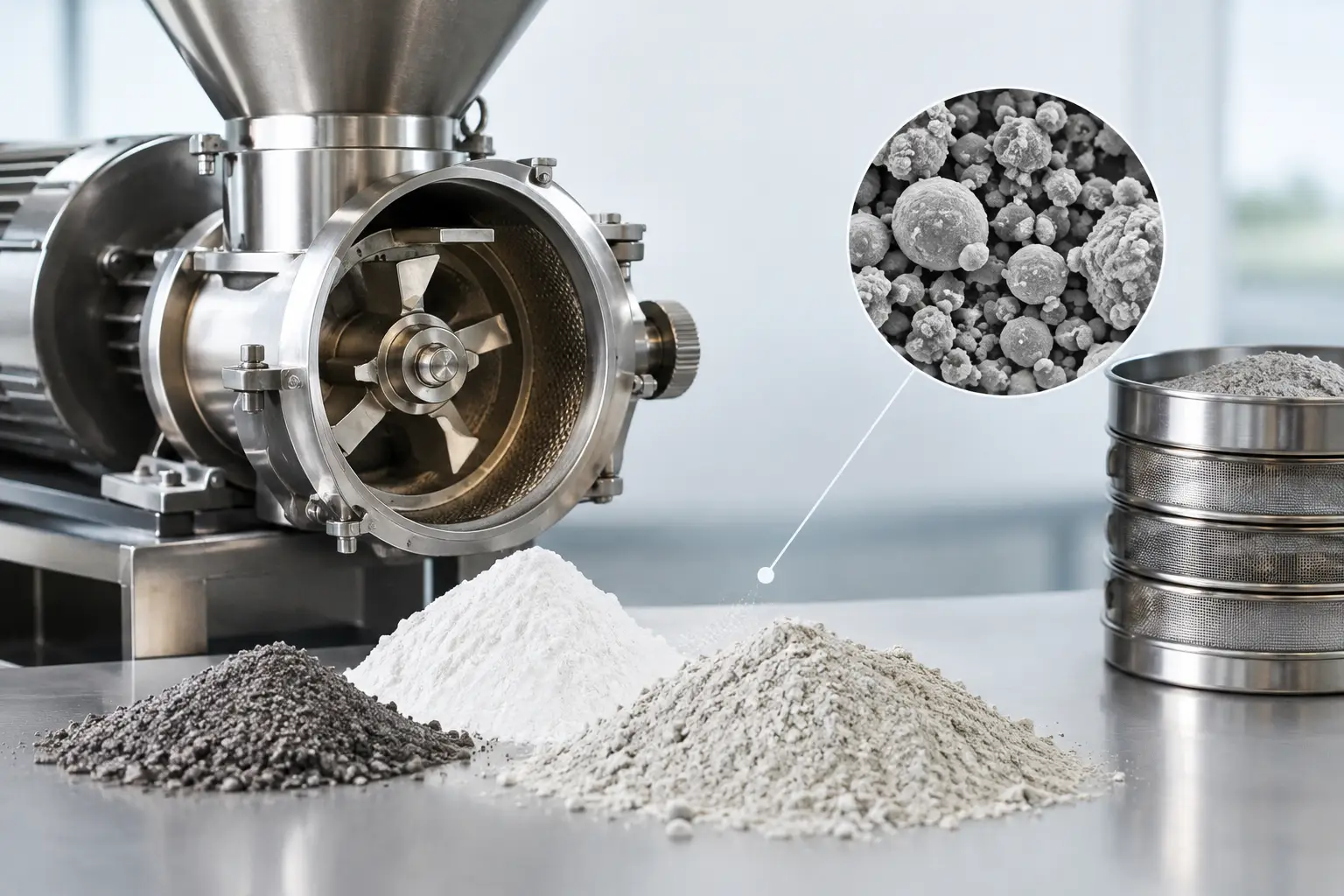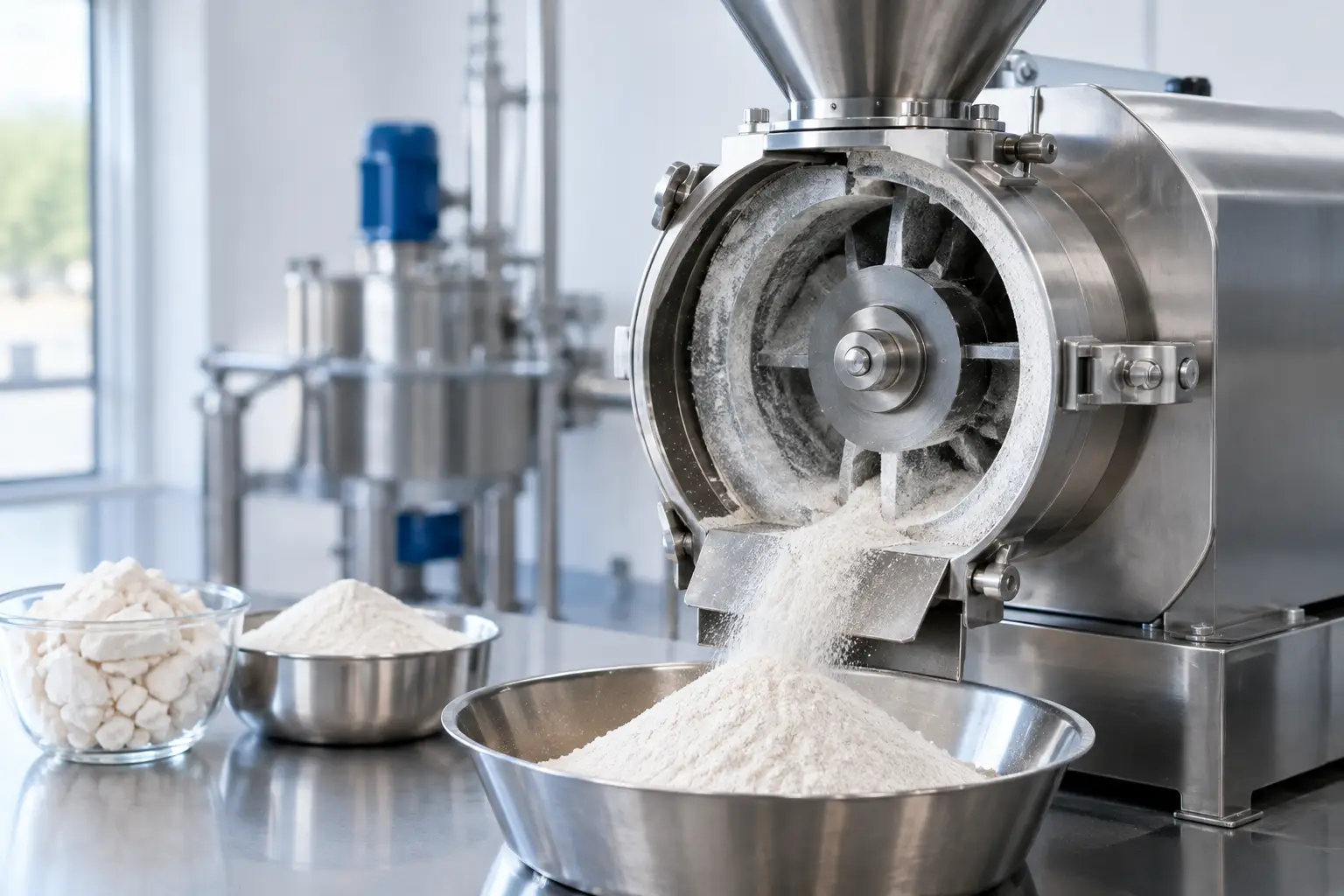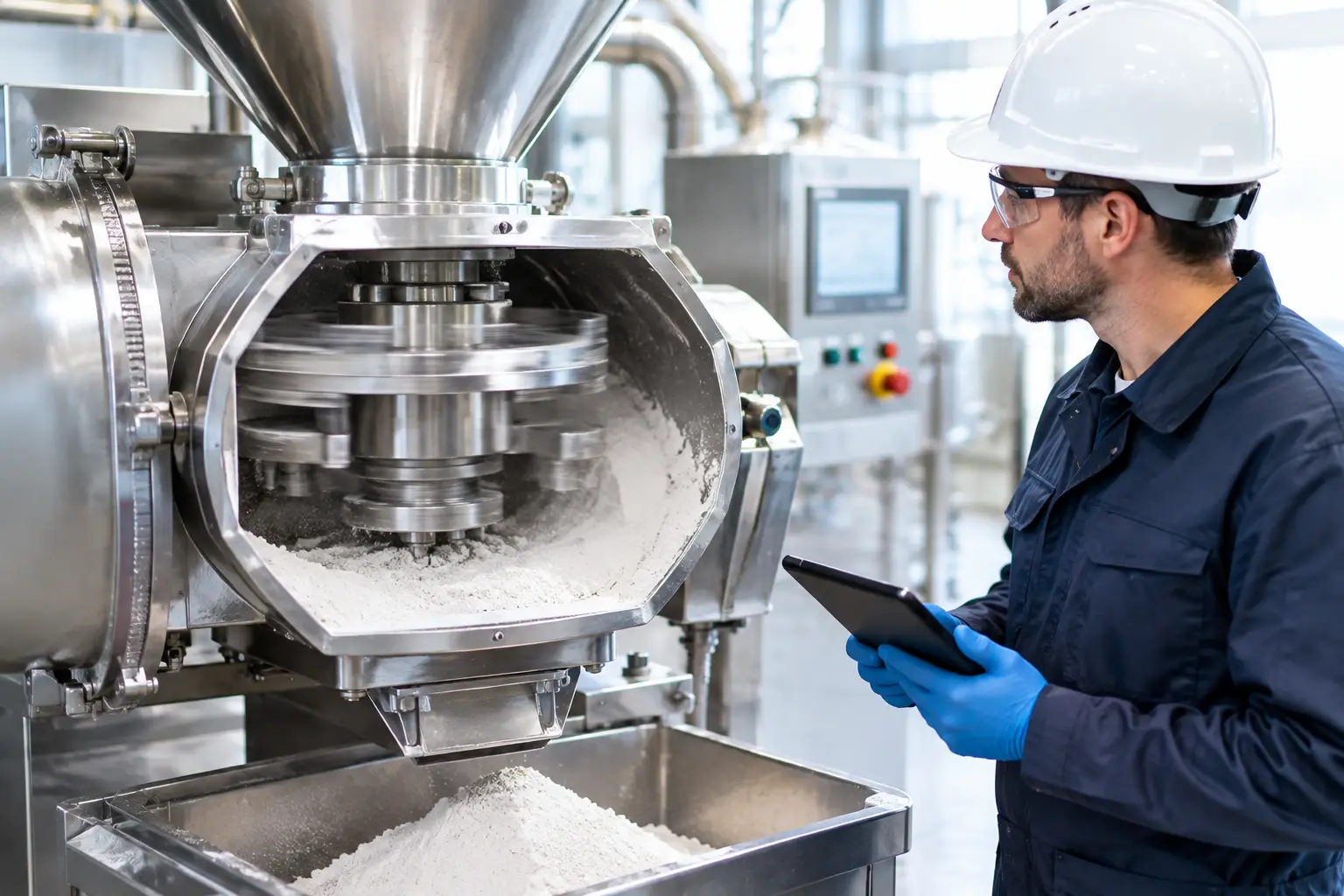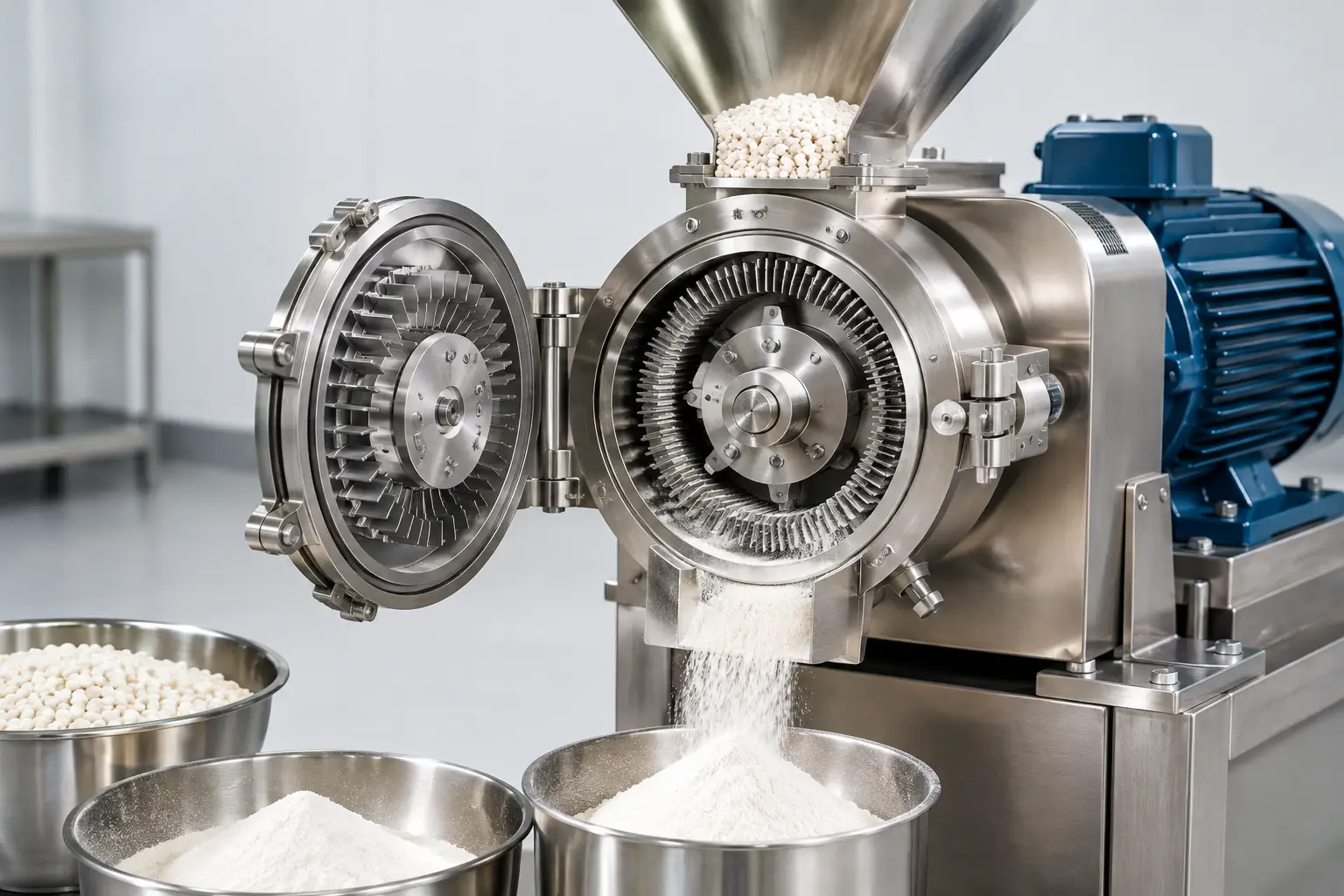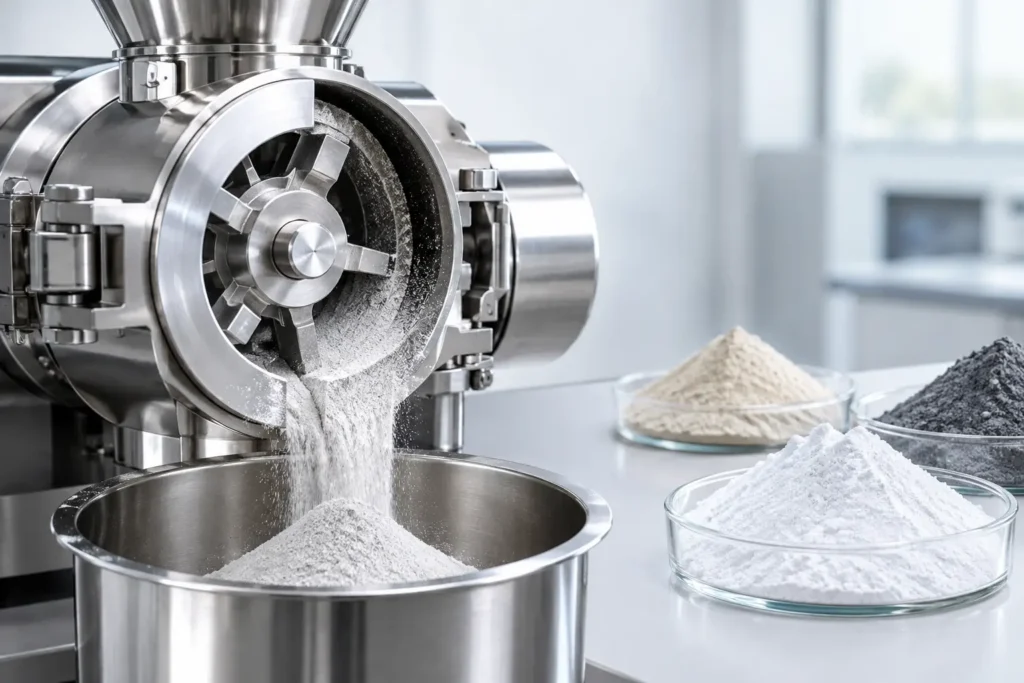
A single black speck in a white pharmaceutical excipient, a trace metal result in battery powder, or allergen carryover in a food ingredient can stop production long after the mill has been shut down. Contamination free milling is therefore not simply a matter of selecting polished equipment. It is a process design objective that depends on material flow, mill geometry, construction materials, cleaning access, wear management, containment, and operating discipline.
For manufacturers processing high-value or regulated powders, contamination risk has direct consequences: rejected batches, costly investigations, lost throughput, customer complaints, and exposure to compliance issues. The right milling system reduces those risks without sacrificing the particle size control, capacity, and repeatability the application requires.
What contamination free milling means in practice
No industrial process is entirely free of risk. In practice, contamination free milling means engineering the system to prevent, control, and verify potential contamination sources at a level appropriate for the product and industry. The acceptable standard differs substantially between a mineral filler operation, a nutraceutical line, a pharmaceutical suite, and a battery-material process.
The first step is defining what contamination means for the specific material. It may mean metallic wear particles, polymer fragments, lubricant migration, fibers from gaskets, residual product from a previous campaign, ambient dust, moisture, or foreign material introduced during charging and discharge. For reactive, high-purity, or tightly specified products, even trace contamination can alter performance.
This definition should include measurable acceptance criteria. A target such as “clean milling” is too broad to guide equipment selection. Engineers need to establish the allowable foreign-material level, particle size distribution, moisture range, temperature limit, trace-metal limit, and cleaning validation requirements before specifying a mill.
The contamination sources that matter most
Contamination usually enters through a limited number of predictable paths. The mill itself is one path, but it is rarely the only one. A system can have a high-quality milling chamber and still create unacceptable risk through poor conveying design, difficult-to-clean connections, or uncontrolled ambient exposure.
Wear from the grinding zone
Any size-reduction method involving mechanical contact creates some level of wear. In hammer mills, pin mills, universal mills, turbo mills, and cone mills, the product interacts with rotating components, screens, liners, and the housing. Abrasive materials can accelerate wear and introduce particles from contact surfaces.
The practical answer is not always to avoid mechanical mills. They can provide excellent throughput, reliable control, and cost-effective operation for many products. Instead, the mill must be matched to material abrasiveness, required fineness, and purity limits. Hardened alloys, stainless steel, ceramic liners, and engineered coatings each offer benefits, but their suitability depends on the product chemistry and the contaminant profile that must be avoided.
Jet milling can reduce concerns associated with mechanical grinding media because particle size reduction occurs through high-velocity particle-to-particle impact. However, jet mills still require careful consideration of nozzle material, classifier components, process gas quality, and wear surfaces, particularly with abrasive minerals and advanced materials.
Cross-contact between products
Campaign processing is a common source of contamination. Residual powder can remain in dead zones, transfer lines, filters, rotary valves, screen frames, and discharge components long after a chamber appears clean. Fine powders are particularly difficult because they migrate into joints, collect on ledges, and adhere through static charge or moisture.
A cleanable system begins with geometry. Product-contact surfaces should be accessible, smooth, and designed to minimize traps. Toolless or quick-release access can reduce cleaning time, but the greater value is consistent inspection and verification. If operators cannot readily see, reach, and clean a component, that component can become the limiting factor in a validated changeover process.
Heat, moisture, and material degradation
Not every contamination event involves a foreign particle. Heat generated during milling can degrade a heat-sensitive material, alter flavor or color, initiate oxidation, or change a powder’s flow and dissolution behavior. Moisture pickup can create agglomerates, affect chemical stability, and compromise downstream processing.
For temperature-sensitive products, cryogenic grinding may be appropriate. Lowering material temperature can make elastic or waxy feedstocks more brittle while reducing thermal exposure. This approach requires sound control of the cooling medium, moisture management, insulation, and safe handling procedures. It is effective when the product behavior justifies its additional operating complexity.
The surrounding process environment
Open charging, leaking connections, unsealed collection points, and poorly controlled air handling can introduce dust and foreign matter before or after milling. In addition, a powder escaping from one process area can become contamination in another.
Contained system design addresses both product protection and worker exposure. Properly engineered feed interfaces, sealed transfer equipment, dust collection, pressure balance, and enclosed discharge arrangements help keep the process isolated from its environment. For combustible dusts, containment must be considered alongside explosion protection and system grounding rather than treated as a separate design exercise.
Choosing the milling technology around the risk
There is no universal contamination-free mill. The right technology depends on target particle size, feed properties, throughput, thermal sensitivity, abrasiveness, cleanability, and the level of purity required.
An air classifier mill can combine impact grinding with internal classification, allowing control of top particle size while reducing the need for external screening. It can be a strong choice when a narrow distribution and efficient operation are priorities. The internal classifier, however, must be evaluated for wear, access, and cleaning based on the material.
A cone mill is often selected for deagglomeration, sizing, and controlled milling of materials that require gentle handling. Its relatively straightforward design can support cleanability, particularly in batch operations. It may not be the best fit when very fine particle sizes or high-energy reduction are required.
Hammer, pin, and turbo mills provide versatile mechanical size reduction across a wide range of materials. Their effectiveness depends heavily on rotor speed, screen selection, feed consistency, and component metallurgy. When contamination limits are tight, a detailed review of wear parts and cleaning procedures is essential.
Jet mills are often considered for high-purity, fine-particle applications because they eliminate conventional grinding media and can achieve very fine sizes. Yet they are not automatically the correct answer. They require compressed gas or process gas of suitable quality, may have higher energy demand, and must be configured to manage wear for abrasive products.
The best selection process starts with material testing. Representative trials reveal how the powder responds to impact, attrition, airflow, temperature, and classification. They also identify practical concerns that data sheets cannot predict, including buildup, static behavior, screen blinding, wear rate, and achievable yield.
Engineering controls that protect product integrity
A contamination-control strategy is strongest when it includes the complete processing line, not just the mill. The most effective systems typically address several controls at once:
- Product-contact materials selected for chemical compatibility, wear resistance, and the allowable trace-element profile.
- Hygienic, crevice-minimizing geometry with access points that support inspection and repeatable cleaning.
- Controlled feeding and discharge to prevent unfiltered ambient exposure and reduce product hold-up.
- Magnetic separation, screening, and upstream inspection where those controls are appropriate for the risk.
- Validated cleaning procedures, documented changeover steps, and preventive maintenance based on actual wear conditions.
These measures involve trade-offs. A highly polished, fully accessible system may increase capital cost. Ceramic-lined components may protect against metal contamination but require evaluation for brittleness and application-specific wear. A dedicated line may offer the lowest cross-contact risk, while a multi-product line can provide better asset utilization when cleaning validation is feasible.
Verification is part of the process, not a final check
Visual inspection alone is not a contamination-control program. Manufacturers need a verification plan that reflects the risk profile of the powder and the consequences of failure. This may include swab testing, rinse sampling, trace-metal analysis, retained samples, particle inspection, filter checks, and documented pre-startup inspections.
Wear monitoring deserves particular attention. A mill can perform within particle-size specifications while wear components gradually create an unacceptable contamination pathway. Establishing inspection intervals based on material abrasiveness, operating hours, and production data is more reliable than replacing components only after a failure.
Process data also helps distinguish a contamination issue from a material-change issue. Shifts in mill amperage, differential pressure, air flow, temperature, or classifier speed may signal buildup, component wear, or feed variability before product quality is affected. Integrating these operating signals into routine review supports earlier intervention and more consistent production.
Build contamination control into scale-up
A process that performs cleanly at pilot scale does not automatically remain clean at production scale. Larger systems introduce longer transfer paths, more valves, higher feed rates, larger filters, and different residence times. Each addition creates another surface, seal, or operating condition that must be evaluated.
DP Mills approaches scale-up as an engineering exercise rather than a simple capacity increase. The goal is to preserve material integrity while meeting production requirements for throughput, particle size, containment, and cleanability. That often means reviewing the entire material path, from receiving and feeding through milling, classification, collection, and packaging.
The most useful question is not whether a mill can produce a target size. It is whether the complete system can repeatedly produce that size at the required purity, yield, and operating rate. Define the contamination risks early, test the actual material, and make cleaning and maintenance part of the equipment specification. That discipline gives production teams a process they can trust long after commissioning.