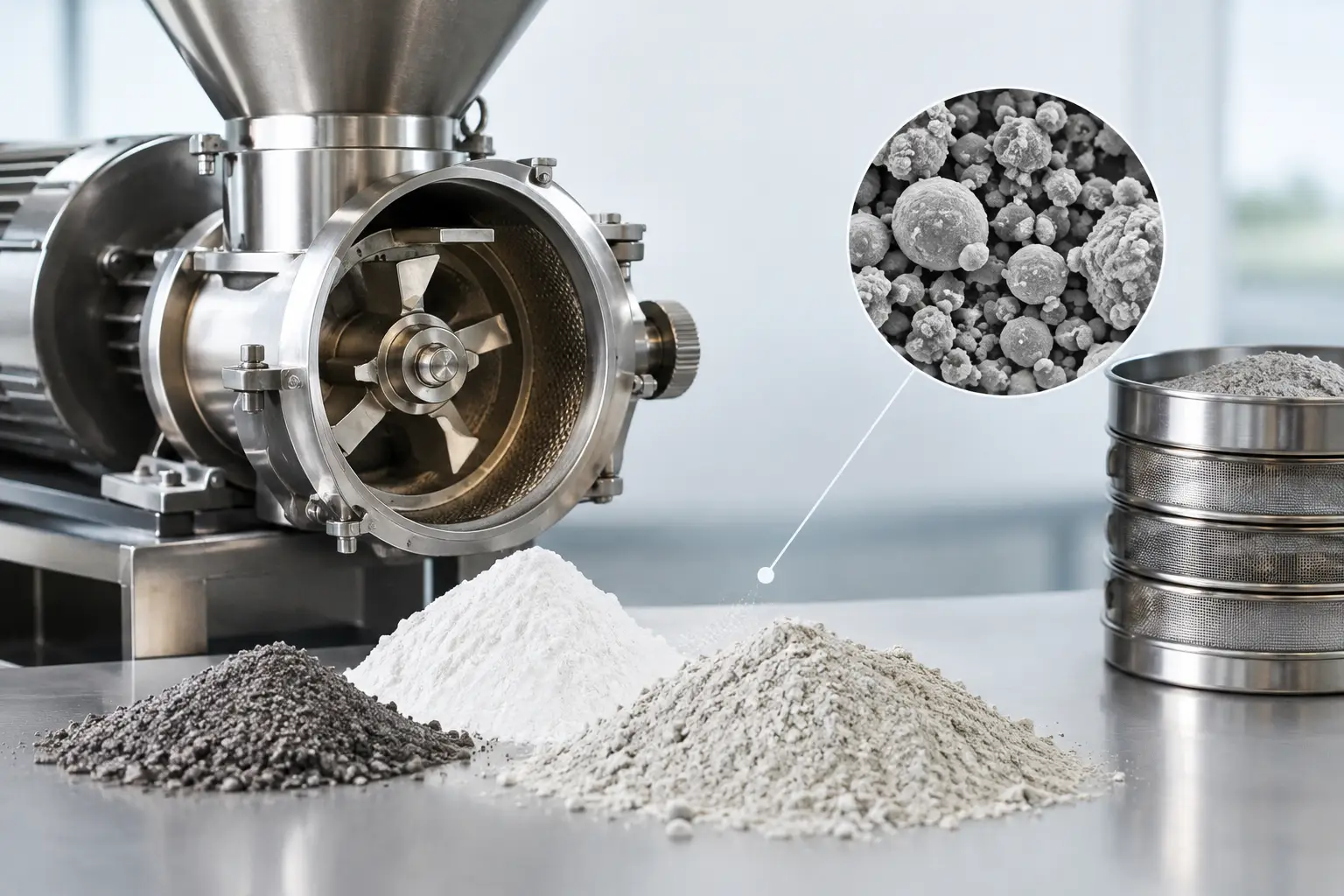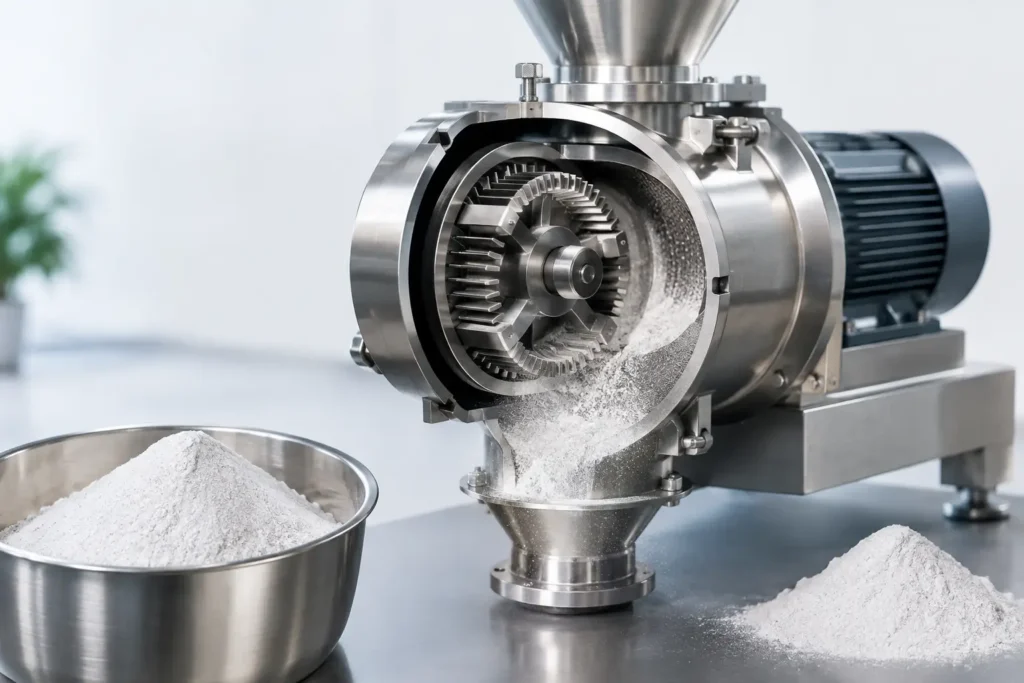
A powder that arrives as soft, moisture-driven lumps does not necessarily need to be ground. It may only need controlled deagglomeration to restore free flow, expose the intended primary particles, and feed downstream equipment consistently. Selecting the best equipment for powder deagglomeration begins with that distinction. Applying more energy than the material requires can create excess fines, heat, yield loss, dust, and an unnecessarily difficult process.
For process engineers and plant teams, the objective is usually straightforward: break weak agglomerates without materially changing the particle size distribution that defines product performance. The equipment decision becomes more complex when throughput, hygienic design, containment, abrasive wear, temperature sensitivity, and cleanability are also on the line.
Start With the Cause of Agglomeration
Agglomerates form for different reasons, and the mechanism matters more than the visible lump size. Hygroscopic food powders may cake after exposure to humidity. Nutraceutical blends can bridge or compact during storage and transport. Fine chemical powders may agglomerate through electrostatic attraction, residual solvent, or particle-to-particle adhesion. Battery and advanced-material powders can require controlled dispersion while avoiding contamination from contact components.
First determine whether the material contains weak, friable agglomerates or hard compacted lumps. Weak agglomerates often separate with low-shear mechanical action. Hard agglomerates may need impact, compression, or a combination of size reduction and classification. If the material is sticky, partially melted, or high in moisture, changing the upstream storage, drying, conveying, or environmental controls may be as important as selecting a mill.
A useful process evaluation also measures the incoming and required particle size distribution, bulk density, flow behavior, moisture, temperature sensitivity, and allowable level of fines. Without this information, an equipment selection can look correct on a datasheet while producing an unacceptable product on the plant floor.
Best Equipment for Powder Deagglomeration by Material Behavior
There is no universal machine for deagglomeration. The right solution depends on the energy required to separate agglomerates, the allowable change to primary particle size, and the operating conditions around the equipment.
Cone Mills for Controlled, Low-Energy Conditioning
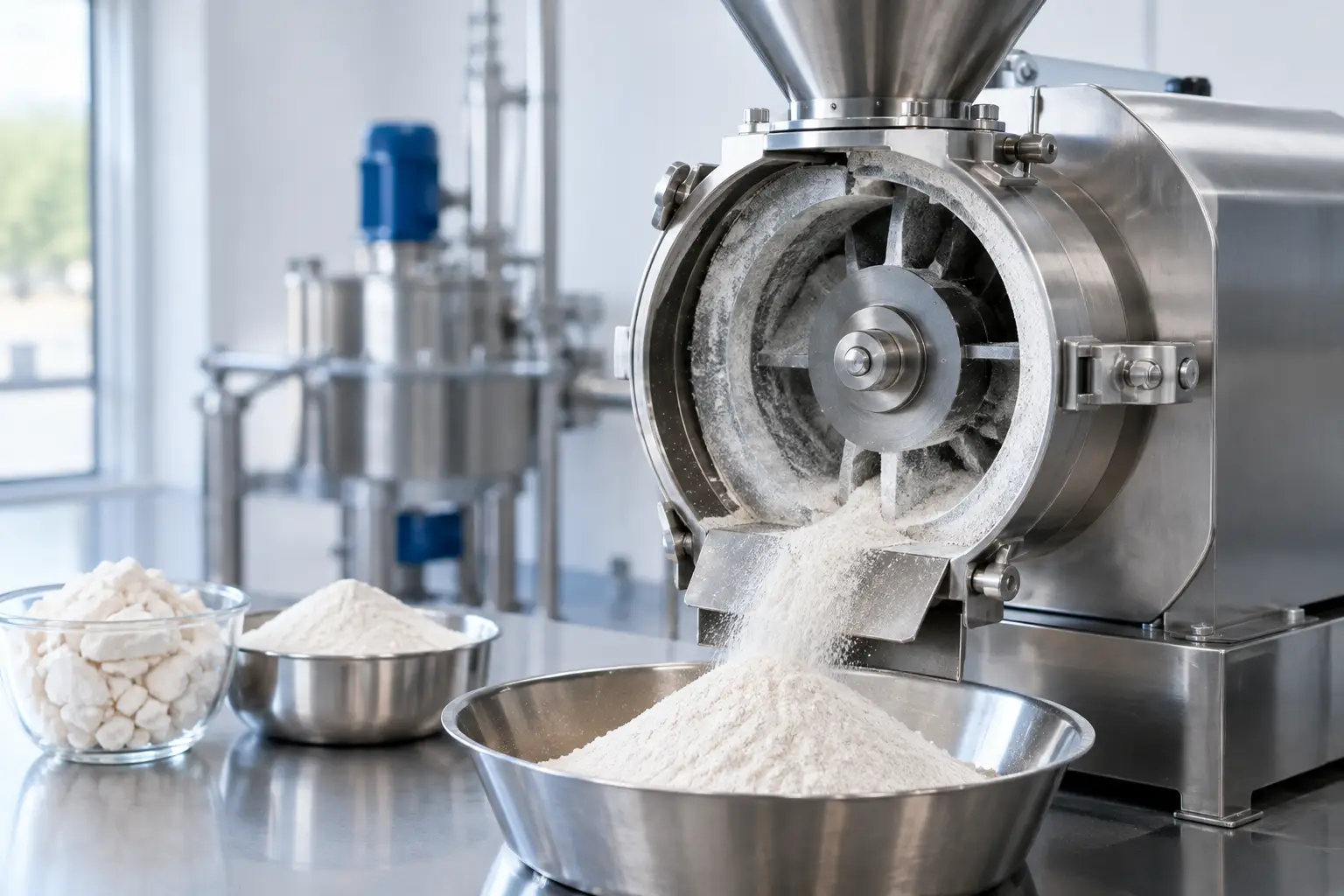
Cone mills are often the first option when a process needs gentle delumping, product conditioning, or consistent feed preparation. Material passes through an impeller and screen arrangement that applies controlled mechanical action. The result is typically a more uniform feed with limited particle breakage when the screen, impeller profile, and rotational speed are selected correctly.
This makes cone mills well suited to pharmaceutical powders, nutraceutical ingredients, food materials, and other products where preserving the original particle structure matters. They can also be useful before blending, tableting, encapsulation, packaging, or pneumatic conveying.
The trade-off is capacity and lump strength. A cone mill is not the right answer for large, dense, or highly compacted agglomerates that require substantial impact energy. Screen blinding can also become a concern with sticky or moisture-sensitive materials, so pilot testing should reflect real humidity and feed conditions.
Hammer Mills for Higher Throughput and Tougher Lumps
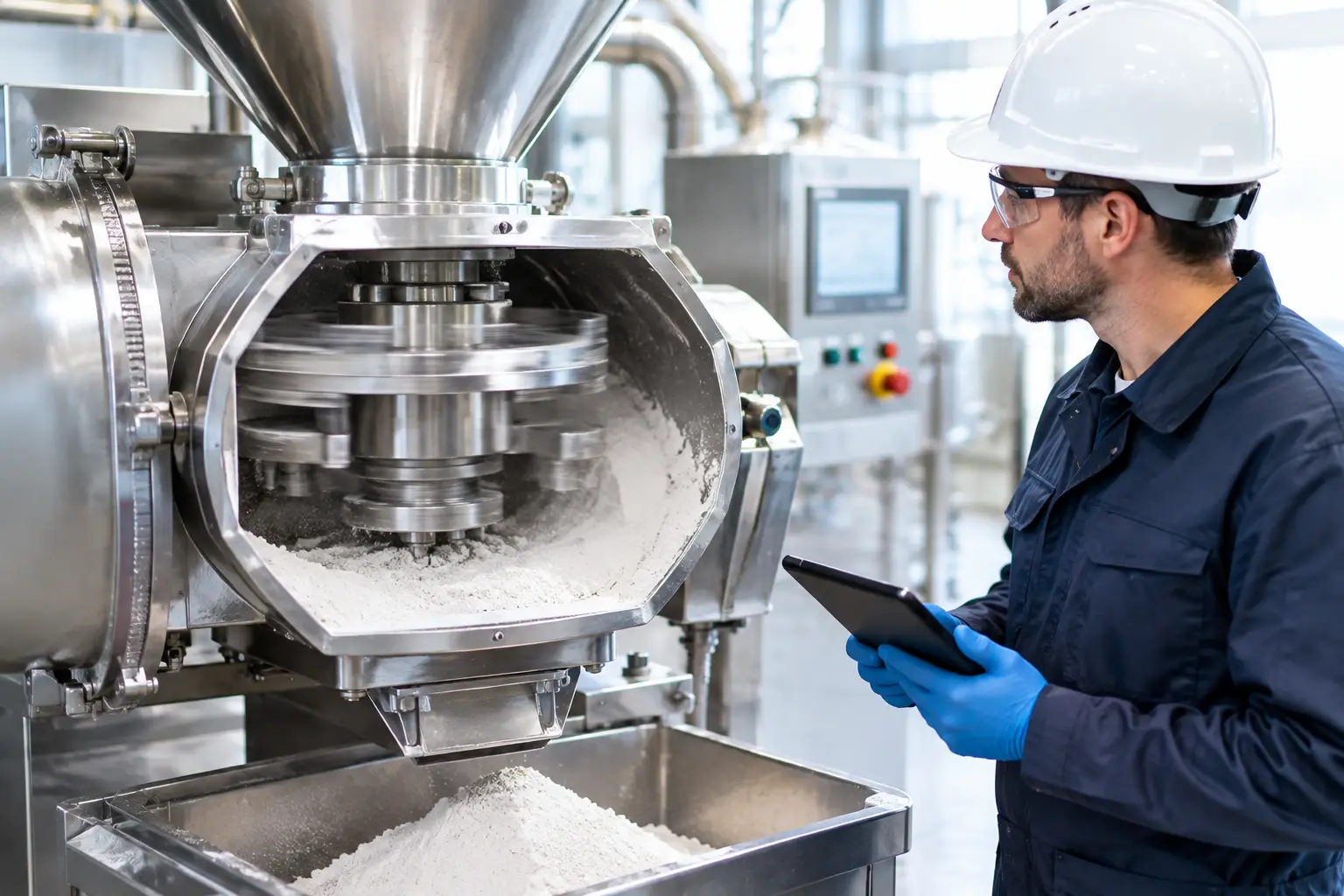
Hammer mills use high-speed impact to break agglomerates against a screen or grinding chamber. They are effective for bulk powders with stronger lumps, variable feed conditions, and higher throughput requirements. In many chemical, mineral, food, and industrial-material applications, they provide a practical balance of capacity, simplicity, and size control.
The same impact that makes a hammer mill effective can also generate fines. For a product with a narrow particle size specification, screen selection, rotor speed, feed rate, and air handling must be evaluated as a system. Heat generation should also be considered for low-melting, heat-sensitive, or fat-containing ingredients.
Hammer mills are a strong choice when the process can tolerate some secondary particle reduction and needs dependable reduction of hard agglomerates. They are less suitable when preserving fragile particle morphology is the primary requirement.
Pin Mills for Fine Deagglomeration and Dispersion
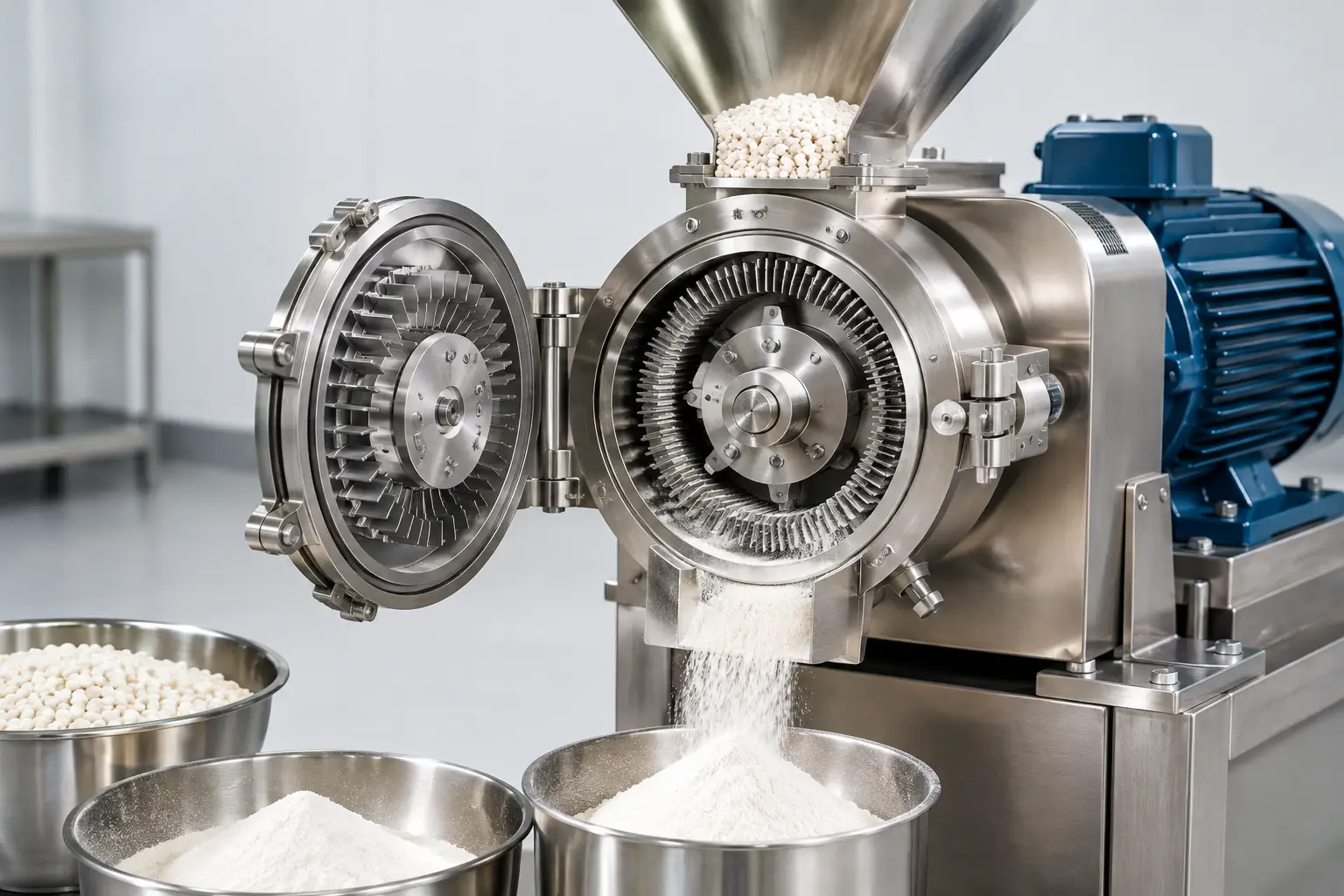
Pin mills create particle reduction through impact between rotating and stationary, or counter-rotating, pins. They can be effective for fine, brittle agglomerates and applications needing a tighter, more consistent output than a coarse delumper or low-energy conditioning mill can provide.
For powders that have formed compacted fine clusters, pin milling can improve dispersion and reduce oversize material efficiently. It is frequently considered for chemicals, food ingredients, specialty minerals, and advanced materials where the feed is already relatively fine but does not flow or disperse as intended.
The operating window matters. Higher tip speeds improve breakage but can raise product temperature, increase fines, and accelerate wear with abrasive materials. When contamination control is critical, the mill’s material of construction, liner selection, and wear-part management deserve the same attention as the nominal capacity.
Air Classifier Mills When Fines Must Be Controlled
An air classifier mill combines impact milling with internal air classification. This configuration is useful when deagglomeration must be paired with active control of the top particle size. Oversized material remains in the grinding zone until it is sufficiently reduced, while material meeting the classifier cut point exits with the process air.
This approach can be valuable for fine chemicals, pigments, mineral powders, and engineered materials where oversized agglomerates cause downstream quality problems. It offers more control than a conventional screen mill, particularly when a tight maximum particle size is required.
However, an air classifier mill is not automatically the best answer for a powder that only needs gentle separation. It introduces more process complexity, including airflow management, dust collection, and classifier settings. If low-energy deagglomeration meets the product specification, a simpler machine may offer lower operating cost and easier cleaning.
Jet Mills for Ultra-Fine, High-Purity Applications
Jet mills use high-velocity gas streams to create particle-to-particle collisions. With no conventional mechanical grinding media in the milling zone, they can be advantageous for very fine products, heat-sensitive materials, and applications where metal contamination must be minimized.
For agglomerated powders requiring submicron or micron-scale dispersion, jet milling can deliver results that mechanical mills may not achieve. Pharmaceutical active ingredients, specialty chemicals, and advanced battery materials are examples where its capabilities may justify the higher utility demand and system complexity.
Jet milling should be selected for a clear technical reason, not simply because it is a high-performance technology. Compressed gas consumption, feed consistency, and required classification performance all affect the total operating value. For coarse or weak agglomerates, it can be more equipment than the process needs.
Process Details That Decide Performance
Deagglomeration performance is not set by the mill alone. Feed presentation often determines whether a system runs steadily or cycles between starvation and overload. A properly designed hopper, agitator, screw feeder, rotary valve, or loss-in-weight feeder can prevent bridging and meter material into the mill at a stable rate.
Dust collection and containment are equally important. Fine powders can create housekeeping, cross-contamination, worker-exposure, and combustible-dust concerns. The deagglomeration system should be designed with appropriate seals, pressure balance, collection equipment, and access points for cleaning and maintenance. In regulated production, the cleanability of contact surfaces and validation approach may narrow the equipment options early in the project.
For abrasive materials, wear is a production variable rather than a maintenance footnote. Changes in screens, pins, hammers, liners, or classifiers can alter product quality over time. Wear-resistant materials and planned inspection intervals help maintain a consistent particle profile while avoiding unplanned downtime.
Validate the Equipment With Representative Trials
The most reliable selection method is a trial using representative feedstock and realistic operating conditions. Test material should reflect expected moisture, storage time, incoming agglomerate strength, and particle size variation. A small laboratory sample that has been freshly prepared may not reveal the behavior of bulk material received after transportation or stored in a warehouse.
During trials, evaluate more than the final sieve result. Measure throughput, yield, temperature rise, bulk density, fines generation, cleaning time, energy use, and the stability of the process over an extended run. If the powder feeds a blender, press, classifier, coating system, or packaging line, assess the downstream improvement as well. The best result is not always the finest output. It is the output that makes the next production step more predictable.
DP Mills approaches deagglomeration as a process-design question rather than a catalog selection exercise. Matching the milling technology, feeder, air handling, containment strategy, and controls to the material creates a system that can hold product quality as production demands increase.
The right deagglomeration equipment should make the powder easier to process without creating a new particle-size problem to solve. Start with the actual agglomerate mechanism, define what must remain unchanged in the product, and use representative trials to establish the operating window before committing to full-scale production.