Sugar Milling: Why Particle Size Rules Food & Beverage Production
(And How DP Pulverizers Pin Mills Deliver the Sweet Spot)
Sugar seems simple. White. Sweet. Granular. And it seems sugar milling would be simple, but it is not. But beneath those tidy crystals is a world of physics, solubility curves, hygroscopic behavior, thermal sensitivity, and some downright fussy behavior when you try to mill it. In food and beverage manufacturing, sugar is less an ingredient and more a functional tool—one that behaves very differently depending on the particle size you give it.
Understanding this is the difference between a perfect glaze and a gritty one, a stable powdered drink mix and one that sinks like a rock, a high-speed packaging line that flows beautifully and one that clogs like an old sink. Sugar particle size determines solubility rate, mouthfeel, flowability, compaction, and even hygroscopic stability. That’s why manufacturers who can mill their own sugar gain a massive advantage: total control of functionality.
Let’s wander through the science.
The Science of Sugar Solubility: Why Particle Size Matters
Sugar dissolves faster when the particle size is small—basic surface area logic. But the degree of smallness dramatically changes behavior:
• Coarse sugar dissolves slowly, ideal for controlled sweetness release and minimal dust.
• Standard granulated sugar is the all-purpose workhorse.
• Caster/superfine sugar boosts solubility in drinks, frostings, and instant mixes.
• Powdered sugar (confectioner’s sugar) gives you that silky texture and instant solubility that cookies and icing depend on.
• Ultra-fine milled sugar enables instant beverages, high-speed industrial mixing, aeration in pastries, and consistent flavor distribution in nutraceuticals.
Solubility is fundamentally tied to how much real estate (surface area) each crystal exposes to water. Reduce the crystal size, increase the real estate, enhance the dissolution rate—that’s the whole dance.
But there’s another twist: heat degradation and caramelization. Sugar loves to melt under friction, and the moment it does, the entire process gums up. That means the mill you choose absolutely must keep temperatures in check.
Sugar Behavior in Food Processing: The Hidden Engineering Challenges
Sugar is a diva. Truly.
It is hygroscopic (loves to grab moisture), melts under friction, and loves to recrystallize into clumps if humidity or temperature wanders.
When milling sugar, manufacturers must contend with:
• Friction-induced heat → melting → caking → mill blockages
• Dust generation → explosion hazard → ATEX/Ex-Proof considerations
• Variability in solubility rates → inconsistent product performance
• Moisture uptake → sticky flow and packaging issues
• High throughput demands → without introducing thermal damage
This is why not all mills can handle sugar, and why so many food facilities fight with everything from clumping to dusting to brown streaks (heat burn) in their final product.
This is where the right technology matters. Specifically: the Pin Mill.
How DP Pulverizers Pin Mills Transform Sugar Milling
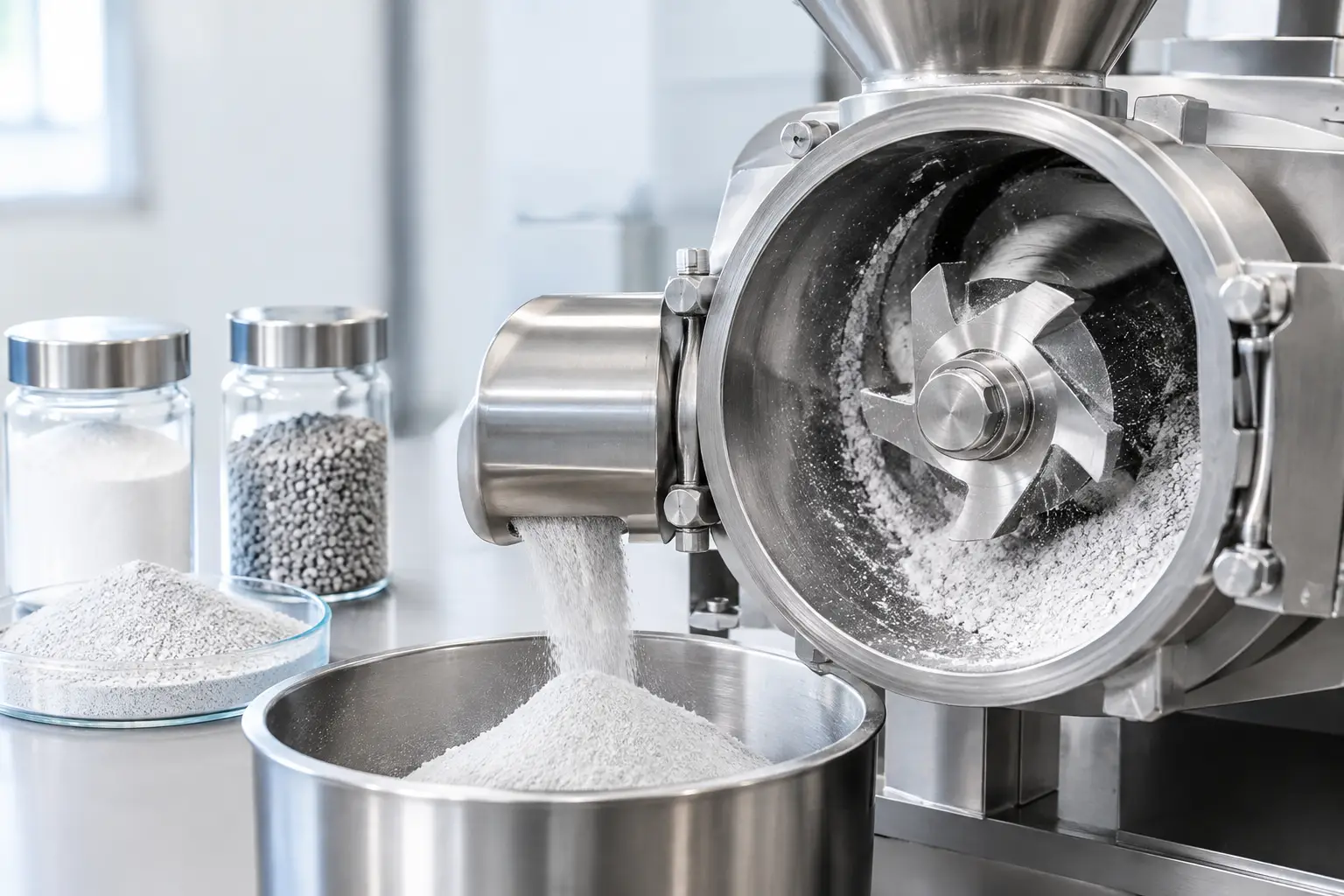
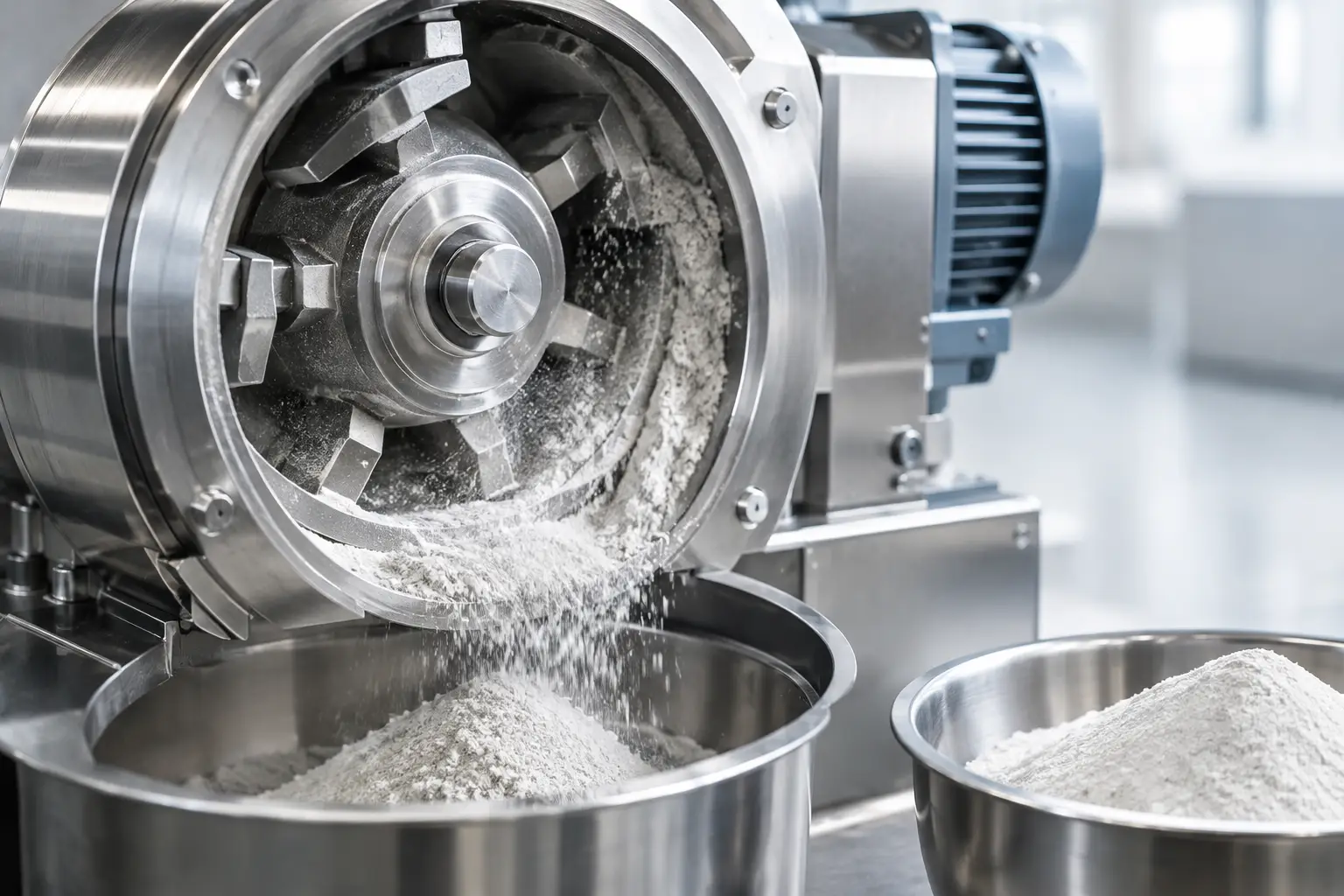
The DP Pulverizers Pin Mill isn’t just a grinder—it’s a precision engineering tool for sugar functionality. Its design directly solves every one of sugar’s fussy behaviors.
1. Ultra-Fine, Controlled Particle Size Distribution
The intermeshing pins break sugar crystals through impact—not shear—giving you:
• tight PSD (particle size distribution)
• customizable fineness (from caster sugar to icing sugar to ultra-fine)
• instant solubility grades for beverages and syrups
The result is a product that dissolves evenly every time.
2. Minimal Heat Generation → No Caramelization
The pin mill’s airflow and chamber design minimize frictional heat. Sugar crystals stay cool, dry, and intact, meaning you avoid:
• melting
• caking
• caramel streaking
• buildup on the rotor
Consistency stays high. Cleaning stays easy.
3. Food-Grade Stainless Construction (304/316L)
DP designs the mill with hygienic, sanitary finishes suitable for:
• beverages
• confectionery
• bakery
• nutraceuticals
• powdered drink mixes
• flavor houses
No contamination. No corrosion. Fully washdown-capable depending on the spec.
4. Explosion-Safety for Dusty Applications
Sugar dust is a notorious explosion risk. DP addresses this with:
• ATEX/Ex-Proof optionality
• engineered grounding
• designed airflow control
• dust-tight construction
• ability to integrate into nitrogen-inert systems if required
It’s engineering built for real-world plant realities.
5. Scalability From Lab to High-volume Production
DP Pulverizers offers pin mills in sizes appropriate for:
• R&D development
• pilot batches
• high-throughput beverage lines
• industrial confectionery plants
Same feel, same behavior, same PSD—just scaled.
Why Milling Your Own Sugar Changes Everything
When you control your sugar particle size, you control your product quality.
Instant beverages dissolve faster.
Glazes shine smoother.
Syrups homogenize easier.
Dry mixes disperse more evenly.
Packaging speeds up.
Costs drop.
And product consistency skyrockets.
This is why more manufacturers are investing in in-house milling—and why DP Pulverizers Pin Mill has become the go-to solution.
Bringing It All Together: The DP Pulverizers Advantage
DP doesn’t just sell a mill. They engineer a solution that aligns with:
• food safety
• explosion safety
• thermal behavior
• particle science
• sanitation requirements
• application-specific solubility targets
From 75 microns to 400 microns, from fine powder to ultra-fine instantization grades, DP Pulverizers gives food and beverage manufacturers the power to dictate exactly how their sugar behaves—not hope it behaves.
It’s not just milling sugar. It’s shaping performance.