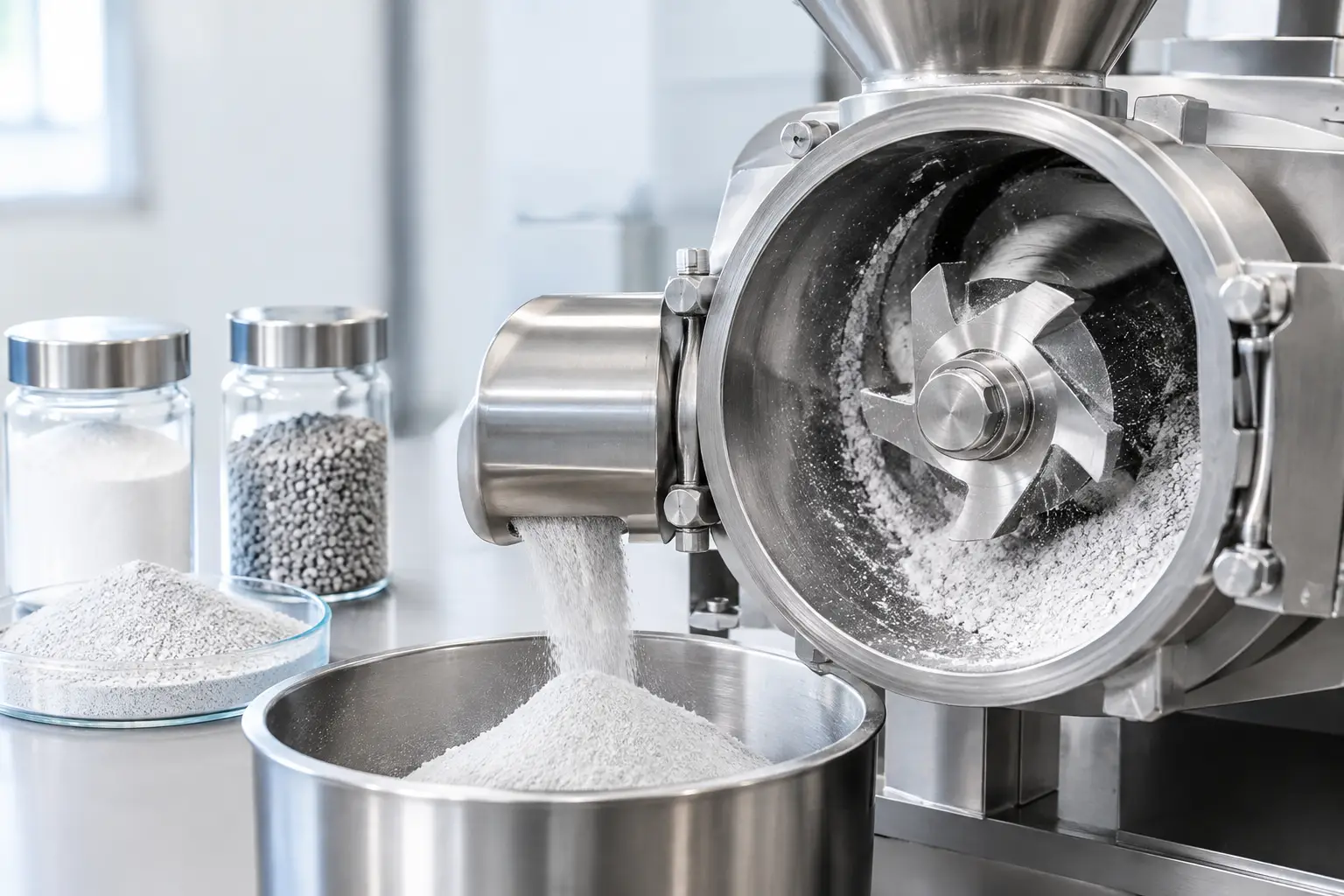
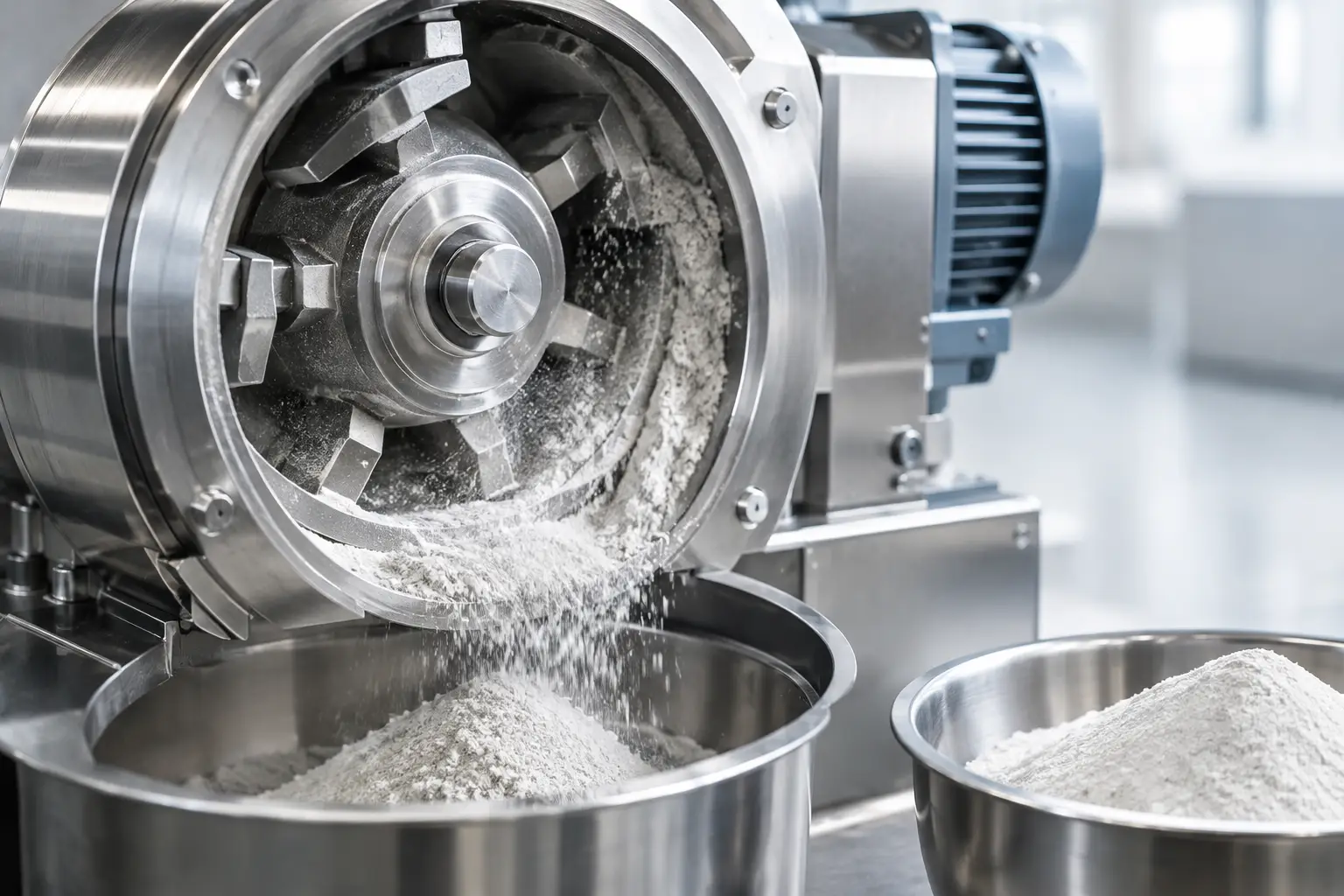
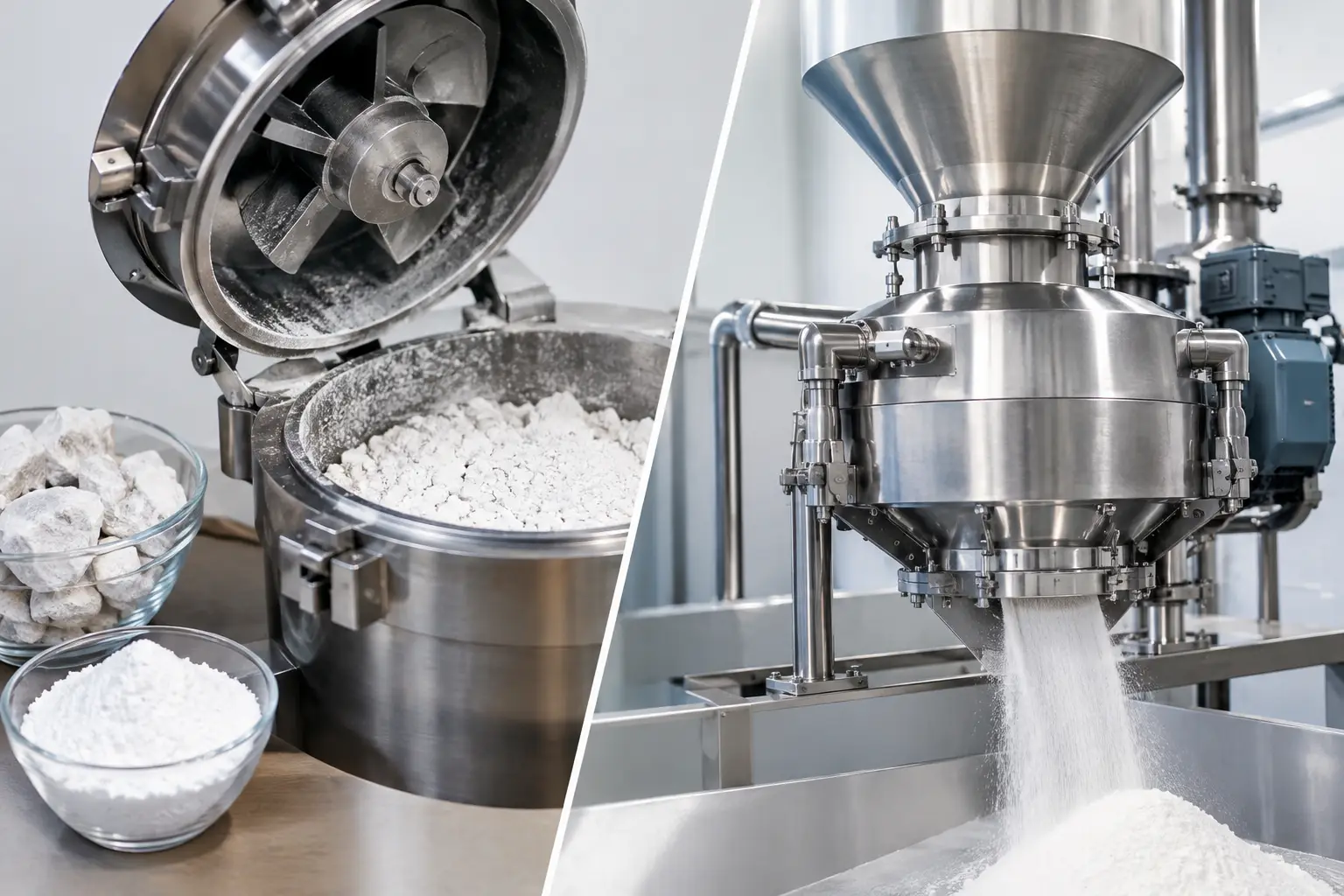
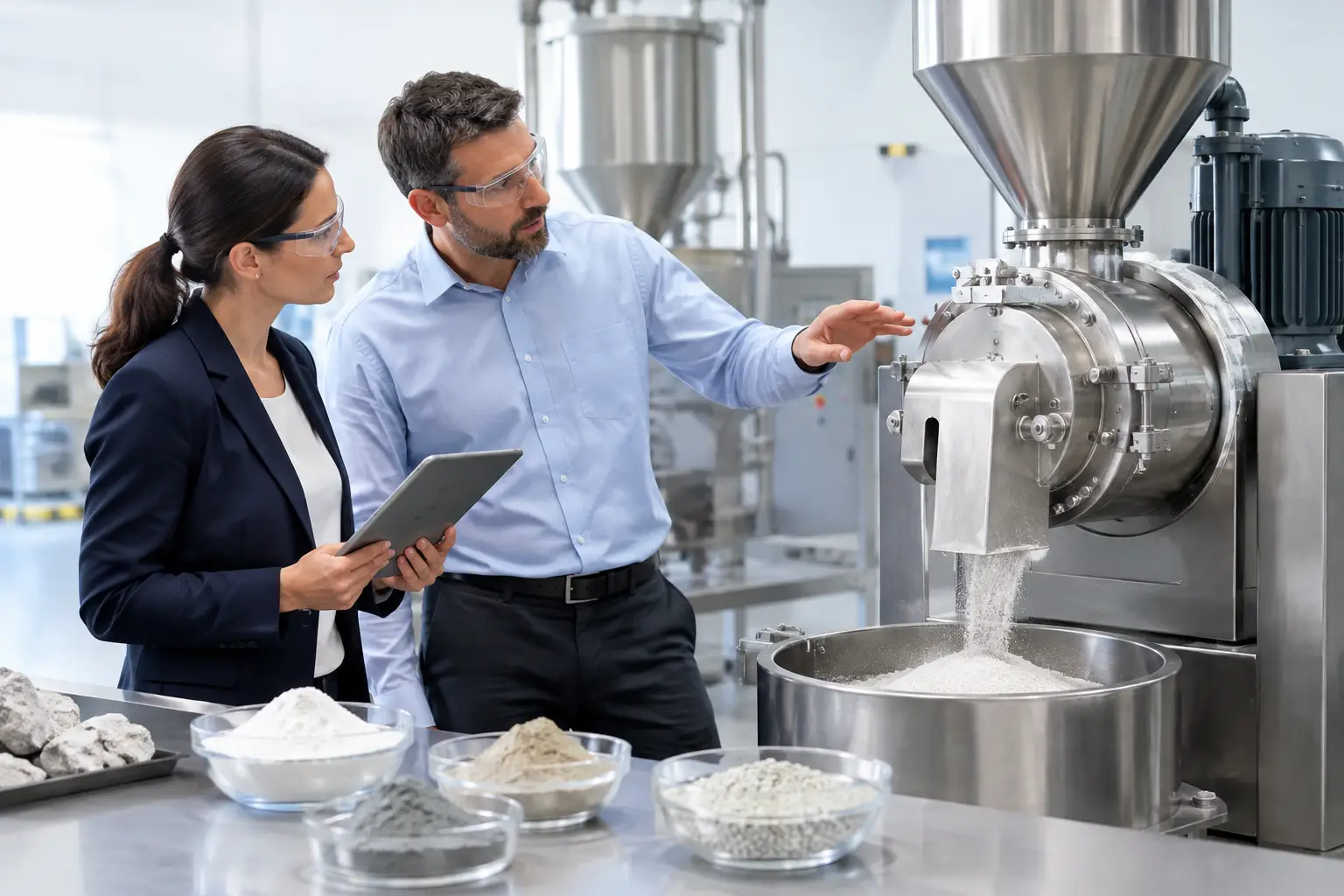
A pilot mill that produces an acceptable powder at 50 pounds per hour can reveal very little about what happens at 2,000 pounds per hour. When manufacturers scale up powder processing production, the central challenge is not simply selecting a larger machine. It is preserving the particle size distribution, material properties, containment performance, and operating stability that made the pilot process successful.
The transition from development to full production changes the mechanics of the process. Feed behavior shifts, residence time changes, heat accumulates differently, and downstream equipment begins to influence mill performance. A successful scale-up plan treats milling as part of an integrated process, with defined quality targets and enough operating flexibility to manage real production variation.
Start With the Product, Not the Mill
Scale-up decisions should begin with the characteristics the finished powder must retain. A target median particle size alone is rarely sufficient. Engineers should define the acceptable particle size distribution, maximum coarse fraction, bulk density range, moisture limit, flow characteristics, temperature exposure, and any requirements for particle shape or surface condition.
Those specifications determine whether a process needs impact milling, controlled attrition, fluid-energy milling, air classification, or cryogenic grinding. They also define how much process latitude is available. A food ingredient may tolerate a broader distribution than a pharmaceutical intermediate. A battery material may require exceptionally tight control of oversize particles and trace contamination. In both cases, a mill that reaches the target average size but creates unacceptable fines, heat damage, or metal wear is not a production solution.
Material behavior must be characterized under realistic conditions. Friability, hardness, elasticity, abrasiveness, fat content, hygroscopicity, melting point, and electrostatic tendency can all affect the preferred technology. A material that feeds consistently in a small batch may bridge in a larger hopper. A powder that remains free-flowing during a short test may agglomerate after longer residence in production equipment.
Scale Up Powder Processing Production as a System
Throughput is the visible scale-up objective, but it is the outcome of several interconnected variables. Feed rate, mill speed or grinding energy, airflow, classifier settings, screen selection, inlet temperature, and material loading must work together. Increasing only the feed rate often produces a wider distribution, more recirculating load, unstable amperage, or excess heat.
A production-scale system should be evaluated from raw material delivery through final collection and packaging. This includes feeder accuracy, hopper geometry, conveying method, dust collection capacity, air handling, classification, product discharge, and controls. Each component can become the limiting factor even when the mill itself has available capacity.
For example, an air classifier mill may have adequate grinding capability, but insufficient process air can reduce classification efficiency and increase the coarse fraction. A hammer mill may achieve the needed throughput, while a poorly designed feed system causes surging that creates inconsistent product. A jet mill may deliver the required fine particle size, but compressed air demand and collection efficiency must be engineered for continuous operation rather than occasional pilot runs.
The goal is to establish a stable operating window, not a single favorable test point. That window should show how product quality responds when feed rate, moisture, temperature, and incoming particle size vary within expected production limits.
Build a Representative Scale-Up Data Set
Pilot trials are most useful when they produce data that can guide equipment sizing and process control. Record feed particle size, moisture, bulk density, flow behavior, feed rate, milling parameters, air volume, pressure, motor load, product temperature, yield, and particle size distribution. Capture both steady-state results and startup, shutdown, and changeover behavior.
Testing should also use representative raw material. Substituting a cleaner, drier, or more uniform development lot can create an overly optimistic process design. Where incoming material varies by supplier, season, or upstream process, the scale-up program should include those realistic boundaries.
This information supports more than mill selection. It helps determine the required feeder type, whether agitation or conditioning is needed in the hopper, the appropriate dust collector design, and whether a classifier or secondary screening step is necessary. It also identifies which parameters deserve automated control and which should be monitored as quality indicators.
Select Milling Technology Around the Failure Modes
Every milling technology has strengths and operating limits. The correct choice depends on how the material fails during size reduction and which risks matter most to the application.
Impact-based equipment such as hammer mills, pin mills, turbo mills, and universal mills can provide efficient size reduction for many dry, friable materials. Their capacity and practical maintenance profile make them strong options when moderate-to-fine particle sizes are required. Screen selection, tip speed, and feed control become especially important as production rate increases.
Air classifier mills combine milling and dynamic classification, making them well suited to applications requiring tighter control over top size and a more defined particle size distribution. They can reduce the need for downstream separation, but performance depends on balanced airflow, classifier speed, and consistent feed conditions.
Jet mills are often selected for micronization, hard materials, or heat-sensitive applications where mechanical grinding media is undesirable. They can achieve very fine particle sizes with low contamination potential, although energy use, compressed gas availability, and collection design must be considered early in the project.
Cryogenic grinding may be appropriate for elastic, heat-sensitive, oily, or low-melting materials that smear or soften under conventional milling. The added complexity of cryogenic handling can be justified when it improves yield, preserves volatile components, or prevents screen blinding and buildup.
The practical question is not which mill has the highest nominal capacity. It is which process can consistently produce compliant material at the required rate, with acceptable operating cost and maintenance exposure.
Control Heat, Contamination, and Dust Before They Become Production Problems
At higher production rates, heat generation can become a product-quality issue rather than a minor operating detail. Friction, compressed air expansion, high rotor speeds, and recirculating material can all influence final product temperature. Thermal exposure may affect flavor, active ingredient stability, moisture, flowability, or downstream compaction behavior.
Temperature control can involve chilled process air, insulated or jacketed equipment, lower-energy milling stages, increased airflow, or cryogenic conditioning. The right approach depends on the material and the degree of size reduction required. Lowering temperature without addressing excessive residence time or poor classifier performance may not solve the root cause.
Contamination control also becomes more demanding at production scale. Material contact surfaces, wear components, seals, gaskets, and cleaning access should align with the product specification and the plant’s quality requirements. Abrasive minerals and advanced materials may require hardened, ceramic, or specialized liners. Food, nutraceutical, and pharmaceutical applications may prioritize sanitary construction, cleanability, and validated changeover procedures.
Dust containment deserves the same engineering attention. Fine powders can create housekeeping burdens, worker exposure concerns, cross-contamination risk, product loss, and, for combustible materials, a process safety hazard. Enclosed transfer, correctly sized dust collection, pressure relief strategy, grounding, and effective sealing must be evaluated as part of the complete system. These requirements vary by material and facility, so they should be assessed during design rather than added after commissioning.
Design for Uptime and Controlled Expansion
A scale-up project can meet its throughput target on paper and still underperform if operators cannot maintain it efficiently. Access to screens, rotors, classifier components, filters, and wear parts affects planned downtime. So do cleanout time, changeover requirements, and the ability to inspect critical components without extensive disassembly.
Production controls should support repeatability without making the system difficult to operate. Variable-frequency drives, loss-in-weight feeding, differential pressure monitoring, temperature measurement, airflow monitoring, and motor load trends can provide early warning of process drift. A well-designed control strategy allows operators to identify a developing issue before it becomes an off-spec batch or unplanned shutdown.
Capacity planning should also account for growth, but oversized equipment is not automatically the answer. A system operating far below its effective range may have poor control, excessive energy use, or inadequate particle size performance. In some applications, a modular arrangement, parallel processing line, or provision for future classifier and collection upgrades offers a better path than selecting one oversized mill.
DP Mills approaches these decisions as an application and system-engineering problem. The most effective solution is built around the material, quality requirements, operating environment, and production objectives, then verified through practical process development.
Commission Against Measurable Production Criteria
Commissioning should confirm more than mechanical operation. Before routine production begins, establish acceptance criteria for throughput, particle size distribution, yield, product temperature, energy consumption, containment, cleaning performance, and operating stability. Run enough material to assess steady-state performance and normal transitions, not just a short successful demonstration.
Document the initial operating window and the response of the system to controlled adjustments. This creates a useful baseline for training, preventive maintenance, troubleshooting, and future capacity planning. It also prevents process knowledge from residing only with one operator or one commissioning team.
The best scale-up projects do not chase the largest possible hourly rate on the first day. They create a controlled, maintainable process that keeps producing within specification as raw materials, schedules, and customer demand change.