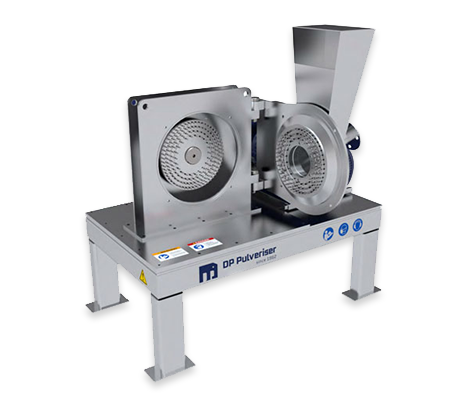
DP Pulverizer Americas Inc
One Mill, Infinite Possibilities
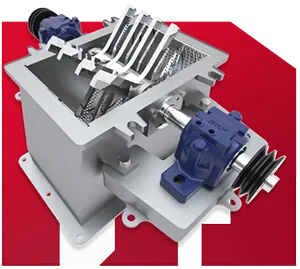
DP Pulverizer Pin Mills offer high-speed, impact-based grinding for fine to medium powders—ideal for efficient, consistent processing across food, pharmaceutical, chemical, and battery industries. Our Pin Mills lead the industry in engineering, innovation, performance, & quality, all while keeping a realistic price that everyone can afford.
DP Pulverizer Pin Mills are used across a wide variety of industries:
Need help selecting the right solution? Contact us now
Discuss your application, material, and production goals with our experts. We'll help identify the most suitable milling solution for your requirements.
A pin mill is a type of high-speed impact mill used for fine grinding and size reduction of dry, free-flowing materials. It uses one or two rotating discs fitted with rows of hardened pins to repeatedly impact particles, breaking them down into smaller, uniform sizes.
Unlike jet mills, pin mills rely on mechanical impact energy, not compressed gas, making them a highly efficient and economical solution for many fine grinding applications where ultra-fine micronization is not required.
Pin mills are widely used across industries such as food processing, chemicals, pharmaceuticals, nutraceuticals, minerals, pigments, and agricultural products.
In a pin mill, material enters the grinding chamber and is accelerated outward by centrifugal force. As the product moves through the rotating pin field, it is subjected to multiple high-speed impacts between:
Rotating pins
Stationary pins (in counter-rotating designs)
Particle-to-particle collisions
Each impact fractures the material until it reaches the desired size, after which it exits the mill through the discharge zone.
Particle size is controlled by:
Rotor speed
Pin configuration
Feed rate
Internal airflow
Pin mills are commonly selected for particle size ranges between:
~50 microns to 500 microns, depending on material and configuration
They excel at producing uniform fine powders without excessive fines when properly configured.
Pin mills are available in multiple configurations, the most common being:
Single-Rotor Pin Mills
One rotating pin disc and one stationary disc
Simpler design and lower power consumption
Ideal for many food and chemical applications
Counter-Rotating Pin Mills
Two pin discs rotating in opposite directions
Higher relative impact velocity
Finer particle sizes and increased throughput
DP Pulverizer offers both configurations, selected based on application requirements.
Pin mills are particularly effective for brittle or semi-brittle materials, including:
Sugar and sweeteners
Spices and seasonings
Starches and flours
Food additives
Chemicals and salts
Pigments and dyes
Minerals and soft crystalline materials
They are especially popular where consistent granulation and tight PSD control are required without the complexity of jet milling.
Pin mills are often selected because they offer:
High grinding efficiency
Compact footprint
Lower operating cost than jet mills
Excellent repeatability
Straightforward operation and maintenance
For many fine grinding applications, pin mills provide the best balance of performance, simplicity, and cost.
In industrial applications, pin mills are frequently integrated into complete processing systems, including:
Feeding and dosing equipment
Pre-breaking or conditioning stages
Air classification (optional)
Dust collection and containment
PLC-based controls
When engineered as part of a system, pin mills deliver reliable and scalable performance.
A pin mill reduces particle size through high-speed mechanical impact. Material is accelerated into a rotating field of hardened pins, where it experiences repeated impacts that fracture the particles into smaller, uniform sizes.
Unlike jet mills, which rely on compressed gas, pin mills use rotational kinetic energy generated by one or two high-speed rotors. This makes pin milling efficient, compact, and well suited for many fine grinding applications.
Material enters the pin mill through a controlled feed system, ensuring a steady and consistent flow into the grinding zone.
Common feeding methods include:
Screw feeders
Rotary valves
Gravity feeding
Loss-in-weight feeders
Consistent feed rate is essential for stable operation and uniform particle size distribution.
Once inside the milling chamber, material is accelerated outward by centrifugal force created by the high-speed rotating disc(s).
As particles move radially through the pin field:
Velocity increases rapidly
Particle momentum builds
Impact energy rises
This acceleration prepares particles for effective size reduction.
The core size-reduction mechanism in a pin mill is impact.
Particles collide with:
Rotating pins
Stationary pins (in single-rotor designs)
Opposing rotating pins (in counter-rotating designs)
Other particles in the milling zone
Each impact fractures the particle, and repeated impacts continue reducing size as the material progresses through the pin field.
Counter-rotating pin mills increase relative impact velocity, enabling finer grinding and higher throughput.
Particle size is influenced by how long material remains in the milling chamber, known as residence time.
Residence time is controlled by:
Rotor speed
Feed rate
Internal airflow
Pin configuration
Higher rotor speeds and longer residence time produce finer particles, while lower speeds favor coarser output.
Once particles reach the desired size, they are carried out of the milling chamber by internal airflow and discharged through the outlet.
In some systems:
Induced airflow assists product transport
Optional classifiers help refine particle size
Dust collection systems capture fine powders
This ensures clean discharge and consistent product recovery.
For applications requiring tighter particle size control, pin mills can be paired with:
Internal or external air classifiers
Cyclones and filters
Closed-loop or recirculating systems
This allows oversized particles to be returned for further grinding while fines exit the system.
Pin mills generate more heat than jet mills due to mechanical impact and friction. However, temperature rise is managed through:
Short residence time
Internal airflow
Optional cooling or cryogenic operation
For heat-sensitive materials, pin mills can be operated under cryogenic conditions, combining mechanical impact with low temperatures for improved performance.
Pin mills are well suited for continuous operation, offering consistent throughput and predictable performance when properly configured.
This makes them ideal for:
Production environments
High-throughput applications
Scalable processing systems
A pin mill is a high-speed impact grinding system made up of several critical components that work together to control particle size, throughput, and product consistency. While designs vary by application and capacity, all industrial pin mills share the same fundamental elements.
Understanding these components helps manufacturers evaluate performance, maintenance requirements, and suitability for specific materials.
The rotor assembly is the core of the pin mill. It consists of one or two discs fitted with rows of hardened pins that rotate at high speed.
Depending on configuration:
Single-rotor pin mills use one rotating disc and one stationary disc
Counter-rotating pin mills use two discs rotating in opposite directions
The relative speed between pins determines impact energy and directly influences particle size reduction efficiency.
The pins are the primary impact elements responsible for particle fracture.
Key characteristics include:
Precisely spaced rows for uniform impact
Hardened or wear-resistant materials
Replaceable designs for maintenance and longevity
Pin geometry, spacing, and material selection are tailored to the application to balance grinding intensity, wear resistance, and product quality.
In single-rotor pin mills, the stationary disc provides a fixed pin field that interacts with the rotating pins.
This configuration:
Creates repeated impact zones
Improves size reduction efficiency
Simplifies mechanical design
In counter-rotating designs, both discs rotate, increasing relative velocity and grinding intensity.
The milling chamber encloses the rotor and pin assemblies, containing the grinding process and directing material flow.
The chamber is engineered to:
Promote smooth radial material movement
Minimize dead zones and buildup
Withstand mechanical stress and vibration
Materials of construction are selected based on wear resistance, cleanliness, and regulatory requirements.
The feed inlet introduces material into the milling chamber in a controlled manner.
Feed systems may include:
Gravity-fed inlets
Screw feeders
Rotary airlocks
Loss-in-weight feeding systems
Consistent feed rate is critical for maintaining stable milling conditions and uniform particle size distribution.
The drive system provides the rotational energy required for grinding.
This typically includes:
High-speed electric motor
Direct drive or belt-driven transmission
Variable frequency drive (VFD) for speed control
Adjustable rotor speed allows operators to fine-tune grinding intensity and final particle size.
Pin mills rely on controlled airflow to transport material through the grinding zone and assist with product discharge.
Airflow:
Removes heat generated during milling
Helps carry fine particles out of the mill
Improves process stability
In some systems, airflow is induced externally to improve efficiency and dust control.
Once particles reach the desired size, they exit the milling chamber through the discharge outlet.
The discharge system may be connected to:
Cyclones
Bag filters or cartridge filters
Pneumatic conveying systems
Efficient discharge ensures high yield and clean product recovery.
Modern pin mills are often equipped with instrumentation and controls to monitor operating parameters such as:
Rotor speed
Feed rate
Motor load
Temperature
These controls improve repeatability, protect equipment, and support integration into automated production lines.
Depending on the application, pin mills may include optional features such as:
Air classifiers for tighter particle size control
Cooling jackets or airflow cooling
Cryogenic operation for heat-sensitive materials
These options expand the operating range of pin mills and improve product quality in demanding applications.
While each component has a specific function, pin mill performance depends on how well the system is engineered as a whole. Proper alignment of rotor design, pin configuration, airflow, and controls ensures consistent results and reliable operation.
This is where system-level engineering—rather than component selection alone—makes the difference.
DP Pulverizer pin mills are engineered to deliver efficient, repeatable fine grinding across a wide range of dry, free-flowing materials. Designed as industrial systems rather than off-the-shelf machines, they offer measurable advantages in performance, reliability, and long-term value.
DP Pulverizer pin mills are designed to maximize impact efficiency while maintaining precise control over particle size.
Key benefits include:
Optimized pin geometry and spacing
High-speed rotor design for consistent impact energy
Adjustable operating parameters for fine tuning
This results in uniform size reduction without excessive fines or over-grinding.
Consistent product quality depends on repeatable milling performance. DP pin mills deliver:
Stable particle size distribution
Predictable batch-to-batch results
Reliable performance in continuous operation
This makes them ideal for applications where particle size affects flowability, blending behavior, solubility, or downstream processing.
DP Pulverizer pin mills offer high performance in a compact footprint, making them easy to integrate into existing production lines or space-constrained facilities.
This is especially valuable in:
Food and nutraceutical plants
Chemical processing facilities
Pilot and production environments
For many fine grinding applications, pin mills provide an excellent alternative to jet mills at a lower operating cost.
Advantages include:
No compressed gas requirements
Lower energy consumption for target particle sizes
Simpler system infrastructure
This makes DP pin mills a cost-effective solution when ultra-fine micronization is not required.
DP Pulverizer pin mills are available in multiple configurations to match application needs, including:
Single-rotor designs for efficient standard grinding
Counter-rotating designs for finer particle sizes and higher throughput
Cryogenic configurations for heat-sensitive or elastic materials
This flexibility ensures the mill is tailored to the process rather than forcing process changes to fit the equipment.
DP pin mills are built for industrial duty using high-quality materials and precision manufacturing.
Design priorities include:
Wear-resistant pins and rotors
Rigid housing to minimize vibration
Accessible layouts for maintenance
These features contribute to long equipment life and reduced downtime.
DP Pulverizer pin mills are designed for ease of use, with straightforward operation and minimal maintenance requirements.
Benefits include:
Easy access to wear parts
Replaceable pins and components
Clear control interfaces
This simplifies training and day-to-day operation.
DP pin mills are engineered to integrate seamlessly into complete milling and material handling systems, including:
Feeding and dosing equipment
Air classification
Dust collection and containment
PLC-based automation
This system-level approach improves overall process stability and efficiency.
DP Pulverizer pin mills are used successfully across industries such as:
Food and sugar processing
Nutraceuticals and supplements
Chemicals and specialty materials
Pigments and dyes
Minerals and industrial powders
This breadth of application reflects their versatility and reliability.
DP pin mills are an excellent choice when:
Fine, uniform particle size is required
Operating simplicity and efficiency matter
Energy and operating costs must be controlled
Mechanical impact milling is suitable for the material
In these applications, DP Pulverizer pin mills deliver consistent results with a strong return on investment.
Pin mills are highly effective for many fine grinding applications, but they are not universally suitable for all materials or processing requirements. Understanding their limitations helps ensure the correct milling technology is selected for each application.
Pin mills are designed for fine grinding, but they are not intended for ultra-fine micronization.
Limitations include:
Difficulty achieving particle sizes below ~20–30 microns
Wider particle size distribution compared to jet mills at very fine ranges
For applications requiring sub-10 micron or ultra-narrow particle size distribution, jet milling is typically more appropriate.
Because pin mills rely on mechanical impact and friction, they generate more heat than non-mechanical technologies.
This can lead to:
Softening or melting of heat-sensitive materials
Product degradation or discoloration
Agglomeration and buildup in the milling chamber
While airflow, cooling, or cryogenic operation can mitigate heat, temperature-sensitive materials may still require alternative technologies.
Pin mills are most effective on brittle or semi-brittle materials.
They may struggle with:
Fibrous plant materials
Rubber-like or elastic substances
Materials that deform rather than fracture
In such cases, cryogenic milling or cutting technologies may be more effective.
Pin mills involve direct mechanical contact between pins and particles, which leads to wear over time—especially when processing abrasive materials.
Considerations include:
Periodic pin replacement
Maintenance downtime
Wear-related changes in grinding performance
Material selection and proper configuration help manage wear, but it remains a factor in operating cost.
Pin mills perform best with dry, free-flowing feed material.
Challenges arise when:
Feed contains excessive moisture
Material is sticky or prone to clumping
Feed size or flow is inconsistent
Upstream conditioning or pre-processing may be required to achieve stable operation.
While pin mills offer good control over particle size, they generally provide less precise top-cut control than jet mills with internal classification.
For applications where extremely tight particle size distribution is critical, additional classification equipment may be required.
Because pin mills involve mechanical wear components, there is a greater risk of trace contamination compared to non-contact technologies such as jet mills.
For ultra-high-purity or pharmaceutical-grade applications, additional material selection or alternative milling methods may be preferred.
Pin mills may not be the ideal choice when:
Ultra-fine micronization is required
Materials are highly heat-sensitive, elastic, or fibrous
Maximum purity is critical
Extremely tight particle size control is needed
In these scenarios, jet milling or cryogenic milling often delivers better results.
Pin mills are a powerful and efficient solution when applied to the right materials and particle size ranges. However, the best processing outcomes are achieved by matching the milling technology to the material behavior, not forcing a single solution across all applications.
At DP Mills, milling is just one chapter of the story.
Real manufacturing challenges don’t begin or end at particle size. They live in how materials are fed, mixed, conditioned, and moved—reliably, repeatedly, and without contamination or waste.
That’s why DP Mills delivers integrated powder processing solutions, combining:
Precision milling
Engineered mixing
Intelligent bulk material handling
All designed to work as one coherent system, not a collection of disconnected machines.
Our mills are engineered to perform within a larger production ecosystem. Whether you’re reducing size, controlling top cut, or preserving heat-sensitive materials, DP Mills systems are designed with upstream and downstream integration in mind.
This means:
Consistent feed rates into the mill
Controlled discharge into mixers or classifiers
Reduced rework, fines, and yield loss
Scalable performance from R&D to full production
Milling becomes predictable. Operations become calmer. Engineers sleep better.
Particle size alone doesn’t make a product sellable. Homogeneity does.
That’s why DP Mills systems are frequently paired with PerMix industrial mixers, engineered for powders, pastes, and hybrid formulations across food, pharmaceutical, chemical, battery, and advanced material applications.
Integrated milling and mixing allows manufacturers to:
Mill and blend in a continuous or batch-controlled workflow
Achieve tighter formulation tolerances
Reduce material transfers and exposure to air or moisture
Design cleaner, safer, more automated plants
When milling and mixing are designed together, performance compounds.
Milling systems are only as good as the material feeding them.
DP Mills works alongside A.I.S. (Automated Ingredient Systems) to deliver fully automated bulk material handling—because manual feeding and inconsistent dosing have no place in modern production.
These systems include:
Loss-in-weight and gain-in-weight feeding
Automated batching and recipe control
Pneumatic and mechanical conveying
Dust containment and sanitary transfer
The result is a controlled, repeatable process from raw material intake to finished blend—without bottlenecks or operator guesswork.
Instead of coordinating multiple vendors, timelines, and control philosophies, DP Mills provides a single, unified solution for:
Milling + Mixing + Bulk Material Handling
This approach reduces:
Commissioning time
Integration risk
Control system conflicts
Long-term maintenance headaches
And it increases:
Process reliability
Product consistency
Line efficiency
ROI on capital equipment
From initial material testing to full turnkey systems, DP Mills doesn’t just ask “What micron size do you need?”
We ask “What does your process need to succeed?”
Because the future of manufacturing isn’t standalone machines.
It’s intelligent systems that work together—quietly, efficiently, and relentlessly.
That’s Milling, Mixing, & Bulk Material Handling—done right.
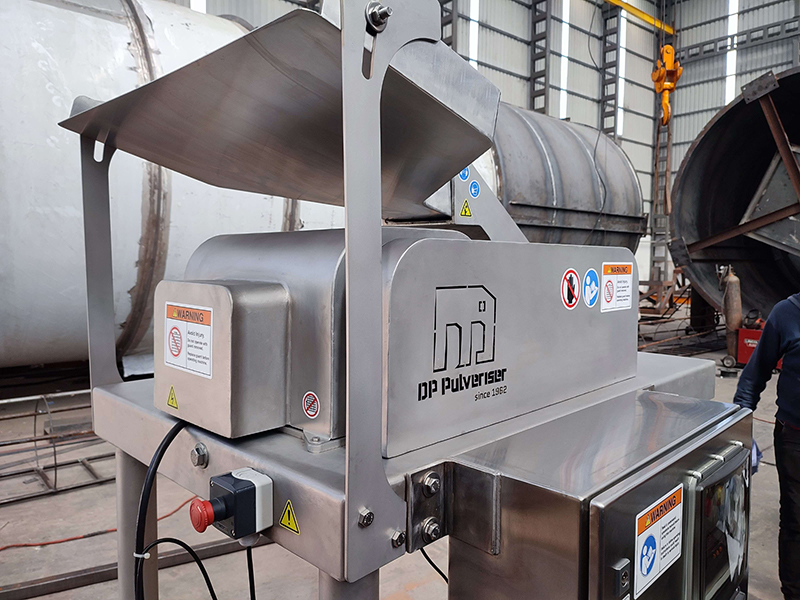
Engineering solutions that fuel client success.
Choosing a pin mill is about more than selecting a machine—it’s about selecting a partner who understands material behavior, impact mechanics, and real-world production demands. DP Pulverizer pin mills are engineered for manufacturers who need reliable, repeatable fine grinding without unnecessary complexity.
DP Pulverizer does not treat pin mills as one-size-fits-all equipment. Each system is engineered based on:
Material hardness and brittleness
Desired particle size range
Throughput requirements
Heat sensitivity and wear considerations
Downstream process needs
This ensures the mill performs as intended from day one, rather than requiring costly trial-and-error adjustments.
DP pin mills are built on proven impact milling principles, refined through real industrial applications. Whether the process calls for a single-rotor or counter-rotating configuration, DP selects and configures the design that best balances:
Grinding efficiency
Particle size uniformity
Energy consumption
Equipment longevity
The result is a pin mill that works with the process, not against it.
For many fine grinding applications, pin mills offer the ideal balance between performance and simplicity. DP Pulverizer pin mills deliver:
Consistent, controllable particle size
High throughput in a compact footprint
Lower operating cost than jet milling
Straightforward operation and maintenance
This makes them an excellent solution when ultra-fine micronization is not required, but quality and consistency still matter.
DP Pulverizer pin mills are designed for continuous industrial operation, with a focus on durability and serviceability.
Design priorities include:
Wear-resistant pins and rotors
Rigid housings to minimize vibration
Accessible layouts for inspection and maintenance
Long service life under demanding conditions
This reliability translates into reduced downtime and predictable operating costs.
DP pin mills are engineered to integrate cleanly into complete milling and material handling systems, including:
Feeding and dosing equipment
Airflow management and dust collection
Optional classification
PLC-based automation
This system-level approach ensures stable operation and simplifies scale-up or future expansion.
Perhaps most importantly, DP Pulverizer provides practical, transparent guidance. If a pin mill is not the best solution for the application, DP will recommend an alternative—whether that’s jet milling, cryogenic milling, or a multi-stage process.
That honesty saves time, money, and frustration.
DP Pulverizer pin mills are the right solution when:
Fine, uniform grinding is required
Mechanical impact milling suits the material
Operating efficiency and simplicity matter
Long-term reliability is critical
In these cases, DP Pulverizer pin mills deliver dependable performance backed by real engineering expertise.
From initial discussions through commissioning and long-term operation, DP Pulverizer works as a process partner, not just an equipment supplier. The goal is not simply to sell a pin mill, but to deliver a system that performs consistently in real production environments.
Graphene offers major potential in batteries, coatings, and composites, but particle control, con...
Find the best mills for pharmaceuticals by comparing jet, pin, hammer, cone, and classifier mills...
Learn how the air classification process controls particle size, improves yield, and supports cle...