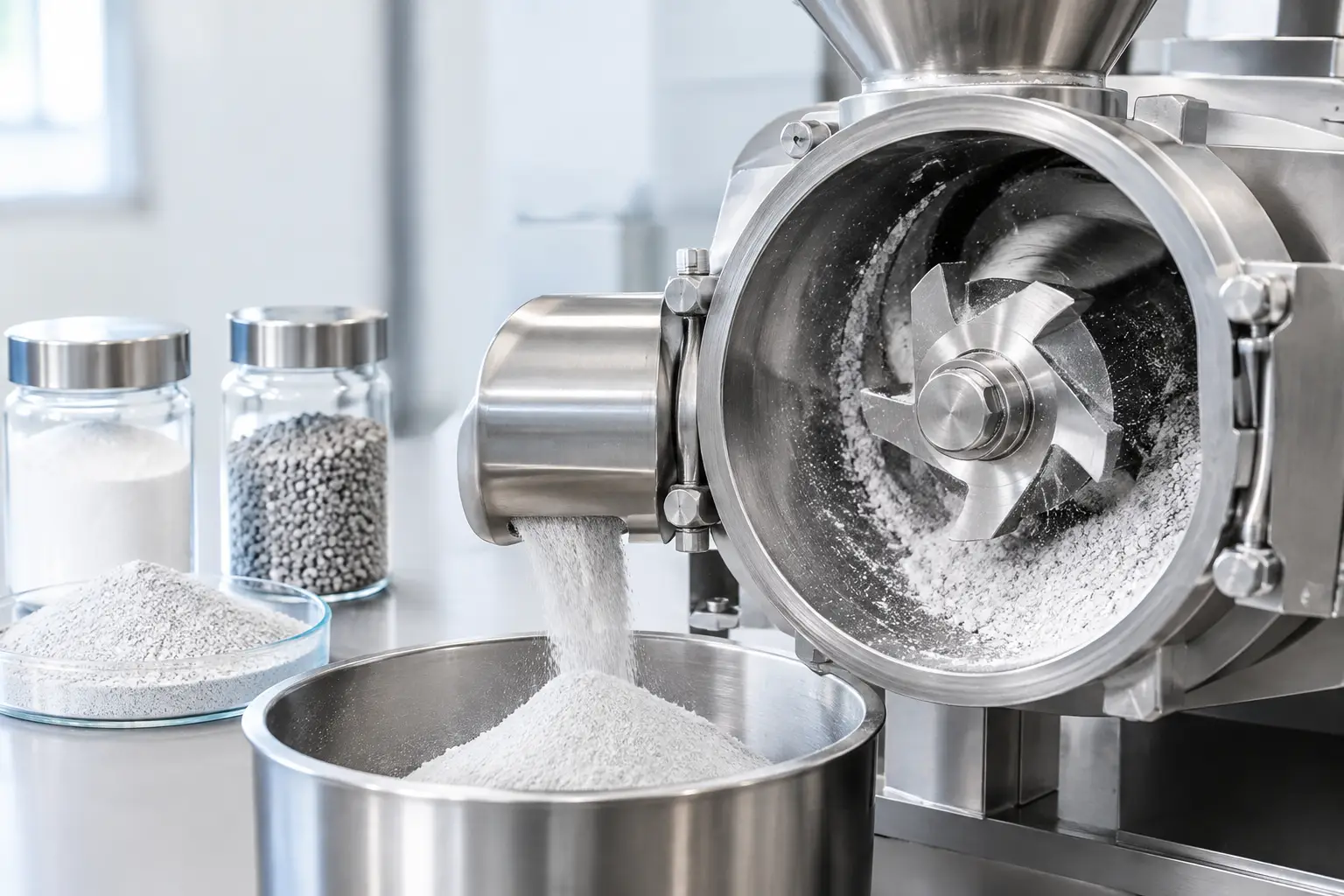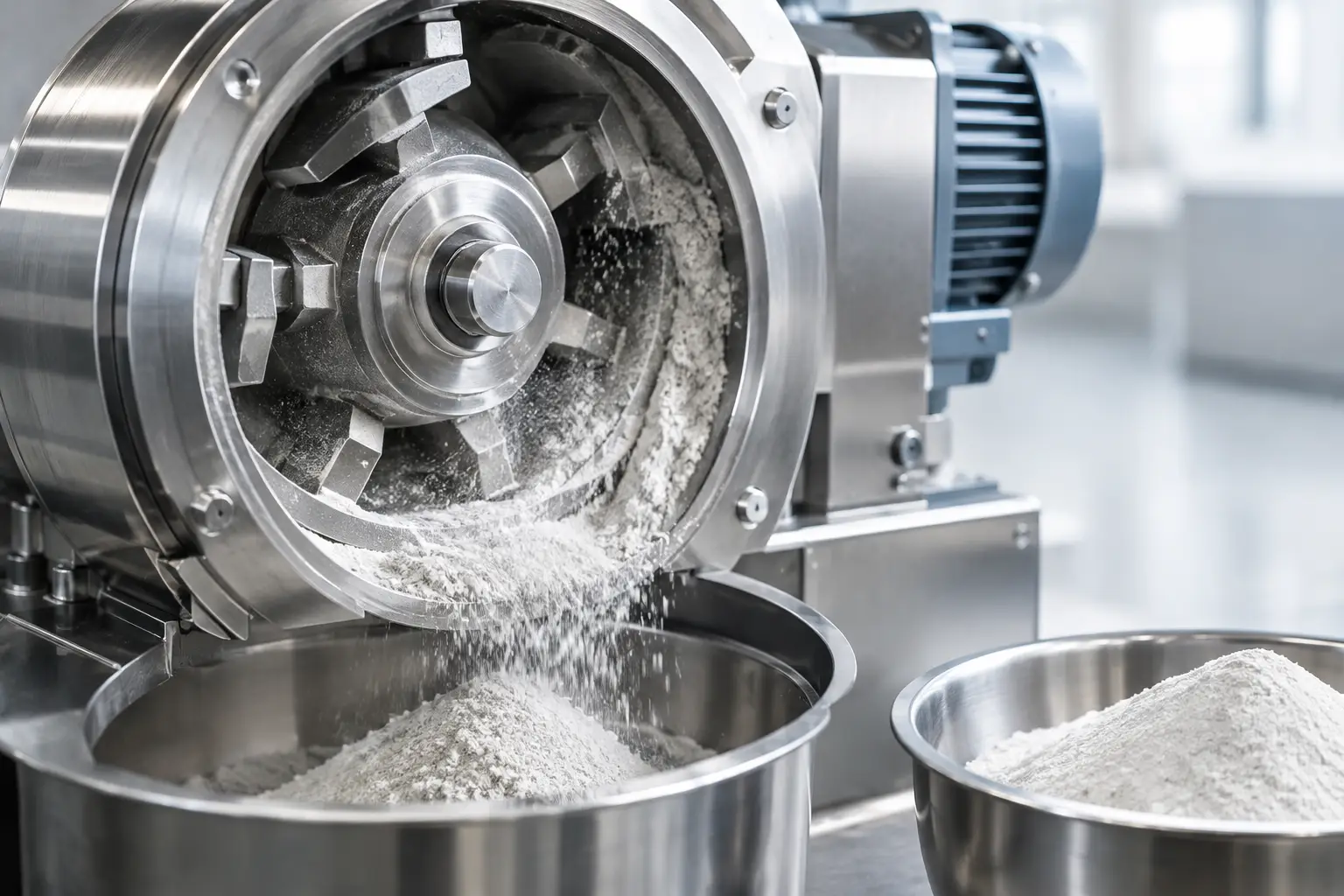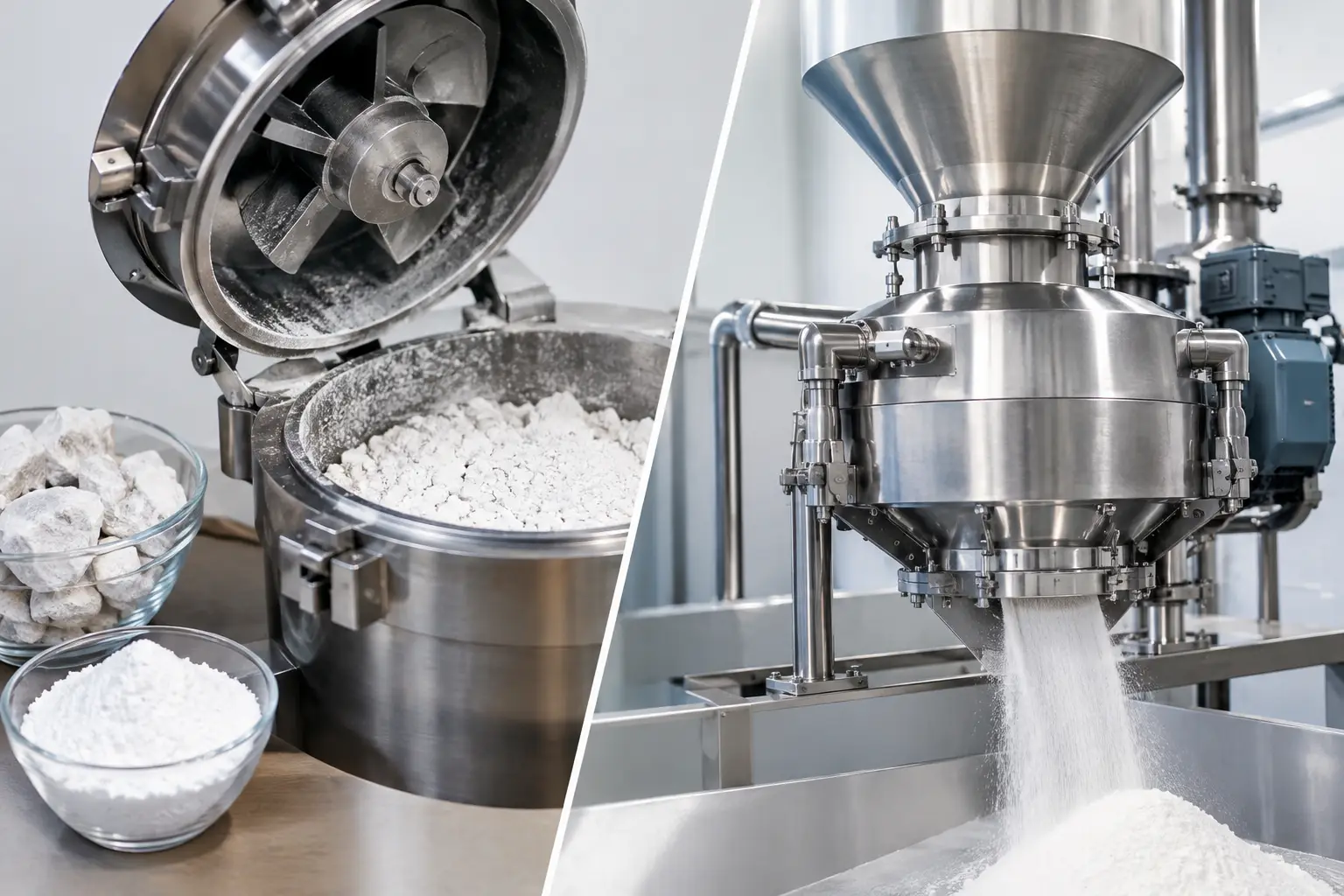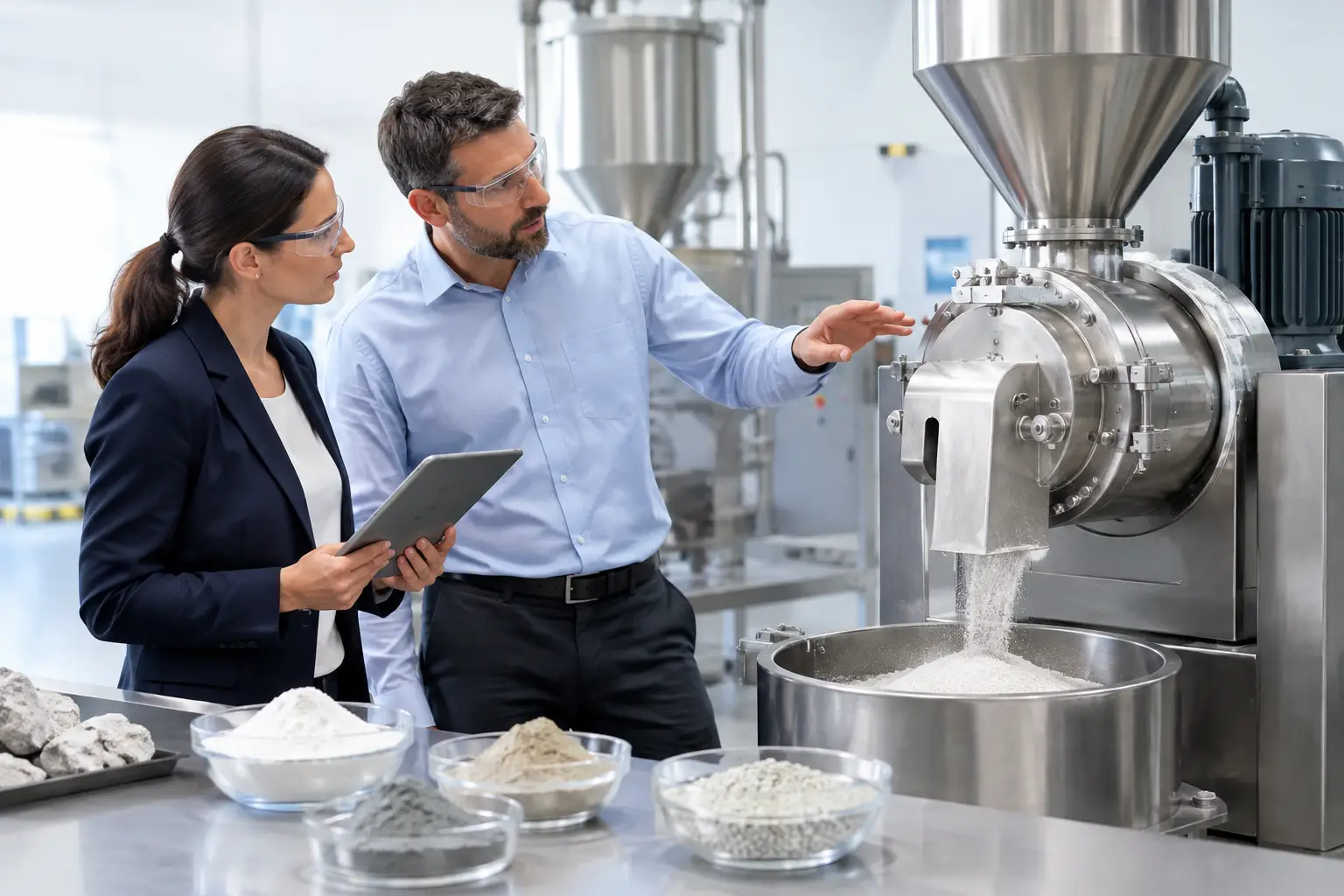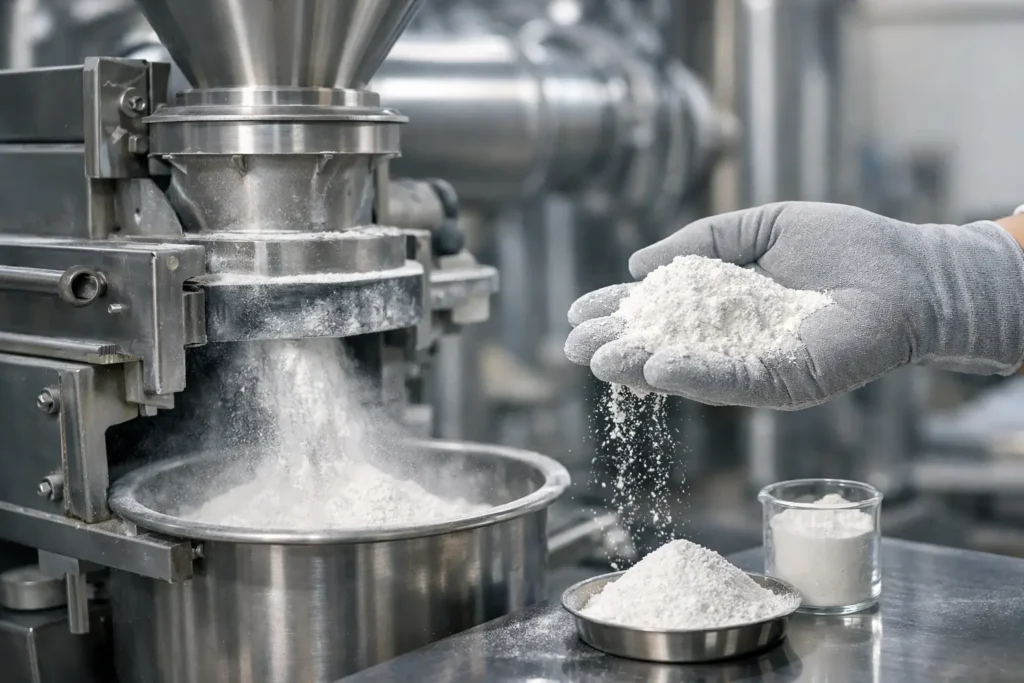
A hammer mill may look like a straightforward size-reduction machine, but the question, “can hammer mills make fine powder,” has no universal yes or no answer. In many industrial applications, a properly configured hammer mill can produce a fine powder efficiently. In others, it will create excessive heat, a broad particle size distribution, or low yield at the required top size. The result depends on the material, target specification, and the complete milling system around the mill.
For manufacturers, the relevant question is not whether a hammer mill can reduce material to a small particle size. It can. The practical question is whether it can consistently produce the required powder at the necessary throughput, with acceptable temperature control, contamination risk, energy use, and maintenance demand.
Can Hammer Mills Make Fine Powder?
Hammer mills reduce material primarily through high-speed impact. A rotating shaft carries swinging or fixed hammers that strike feed material inside a grinding chamber. Particles continue to be impacted and accelerated against liners, screens, or other particles until they are small enough to pass through the discharge opening.
This mechanism is highly effective for coarse-to-medium grinding and can extend into fine powder production when the material is friable and the mill is configured correctly. Many hammer mill applications can achieve powder in the approximate 50 to 500 micron range, although actual performance varies widely. Some materials can be processed finer under favorable conditions, while others become difficult to mill well below a few hundred microns.
A screen is often the principal control point. Smaller screen openings retain particles longer in the chamber, increasing the opportunity for additional impacts. But reducing screen size does not automatically produce a better fine powder. It also raises airflow resistance, dwell time, heat generation, and the chance of screen blinding or throughput loss.
For a material that fractures cleanly, a hammer mill can be a productive and economical route to fine powder. For a heat-sensitive, elastic, waxy, sticky, or extremely hard material, impact milling may reach a practical limit before the desired particle size is achieved.
What Determines the Finest Achievable Size?
Particle size is the outcome of material behavior and machine design working together. A mill cannot overcome unfavorable material characteristics simply by running faster or installing a finer screen.
Material properties set the starting point
Brittle, dry materials generally respond well to hammer milling because they crack and fracture under impact. Minerals, dried food ingredients, many chemicals, and certain agricultural materials often fall into this category. Their particles break repeatedly without substantial deformation or adhesion.
Ductile, fibrous, fatty, hygroscopic, and thermoplastic materials behave differently. Instead of fracturing, they may bend, smear, soften, or collect on internal surfaces. A polymer may become tacky as temperature rises. A botanical powder may retain fibers that resist passage through a fine screen. A high-fat food ingredient can coat the screen and reduce capacity quickly.
Moisture is equally influential. A modest increase in moisture content can change a free-flowing material into one that compacts or blinds the screen. Conversely, excessive drying can create dust-control challenges, increased fines losses, or material degradation. Feed conditioning should be considered part of the milling process, not an upstream detail.
Mill configuration controls the impact environment
Tip speed influences impact energy. Higher tip speed can improve breakage on suitable materials, but it also increases heat, wear, noise, and the risk of over-processing fines. Hammer profile, number of hammers, chamber geometry, liner design, and rotor balance all affect how particles move through the grinding zone.
Screen selection is important, but screen design matters as much as nominal opening size. Open area, hole shape, thickness, and the relationship between screen and hammer tip can change both capacity and particle size distribution. A fine screen with inadequate open area may force long residence times, turning a capacity problem into a heat and quality problem.
Feed rate must remain stable. An underfed hammer mill can generate unnecessary fines and consume energy inefficiently. An overloaded mill may produce a wider distribution, raise motor load, and discharge material before it has received sufficient impact. Metered feeding and properly designed material handling are often required for repeatable results.
Airflow can improve or limit fine grinding
Air assists particle transport through many hammer mill systems. It removes finished particles from the grinding chamber, carries heat away, and supports dust collection. When airflow is too low, fines can remain in the chamber too long and generate excess heat. When airflow is too high, material may leave prematurely, leading to a coarser product or unstable separation performance.
A well-designed pneumatic conveying and collection system should be matched to the mill, feed characteristics, and product density. Fan selection, duct velocity, cyclone or filter performance, and pressure balance all influence final product recovery. For fine powders, the collection system is not an accessory. It is part of the particle-size-control strategy.
The Trade-Off Between Fineness and Production Rate
The smallest possible particle size is rarely the best process target. As a hammer mill is pushed toward finer powder, throughput generally declines. More energy is required per pound of product, wear increases, and the risk of heat buildup rises. The fraction of ultrafine particles may also increase, creating downstream issues with flowability, dusting, blending, filtration, or product appearance.
A process specification should define more than an average particle size. Engineers should establish the desired distribution, including the acceptable coarse fraction and fines fraction. A product with a median size of 100 microns may still fail if too many particles exceed the top-size limit or if too much material falls below a dust-sensitive lower range.
This distinction is especially relevant in pharmaceutical, nutraceutical, battery, chemical, and advanced material applications. The requirement may be a narrow distribution, not simply a smaller number on a particle-size report. Hammer mills can be effective where a broader distribution is acceptable or where a downstream classification step can remove oversize material.
When a Hammer Mill Is the Right Choice
A hammer mill is often a strong choice when the feed is dry, brittle, and reasonably free-flowing; the target is in the fine rather than ultrafine range; and production requires dependable, high-throughput operation. It can also be well suited to applications where a simple mechanical design, accessible wear components, and practical operating costs are priorities.
For example, a manufacturer processing dried mineral powders may find that an appropriately sized hammer mill and screen produce the required specification efficiently. A food processor reducing dry spices or dehydrated ingredients may achieve the desired powder while maintaining a practical production rate, provided temperature, sanitation, and dust containment are addressed.
Hammer mills also work well as a first reduction stage ahead of more specialized equipment. Pre-milling can lower the load on a downstream classifier mill, pin mill, or jet mill, improving total system capacity and reducing the cost of producing finer fractions.
When Another Milling Technology May Perform Better
If the product requires a consistently narrow distribution below the practical range of a screen mill, an air classifier mill may be a better fit. Internal classification returns oversize particles to the grinding zone while allowing in-spec fines to exit, providing tighter control than a conventional screen-based process.
Jet mills are often selected for very fine or ultrafine powders, particularly when contamination control and low product temperature are critical. Their energy demand and compressed-air requirements must be evaluated against the quality benefit. Pin mills can be effective for friable materials requiring finer grinding than a conventional hammer mill can provide, while cone mills may be preferable when gentle deagglomeration and controlled sizing are more important than high-impact fracture.
Cryogenic grinding can change the economics for materials that soften or smear at ambient temperatures. Cooling can make elastomers, waxes, spices, polymers, and other heat-sensitive materials more brittle, allowing more efficient fracture and better powder flow. It adds system complexity, but it can be the difference between an unstable process and a viable one.
Validate Performance With Representative Material
Equipment selection should be based on trials using representative feedstock, moisture levels, and production targets. Bench-scale results are useful, but scale-up must account for feed uniformity, air handling, heat removal, conveying distance, collection efficiency, and continuous operating duration.
The most useful trial measures more than particle size. It should document throughput, energy use, product temperature, yield, wear, dust behavior, screen condition, and cleaning requirements. If the material has regulated or high-purity requirements, the trial should also evaluate contact materials, containment, cleanability, and potential cross-contamination pathways.
DP Pulverizer Americas approaches this work as a process-design question rather than a catalog selection exercise. The right answer may be a hammer mill, but it may also be a staged system with classification, cooling, or alternate grinding technology.
A hammer mill can make fine powder when the material and process conditions support impact grinding. The best operating result comes from defining the complete powder specification first, then engineering the milling system around the actual behavior of the material.