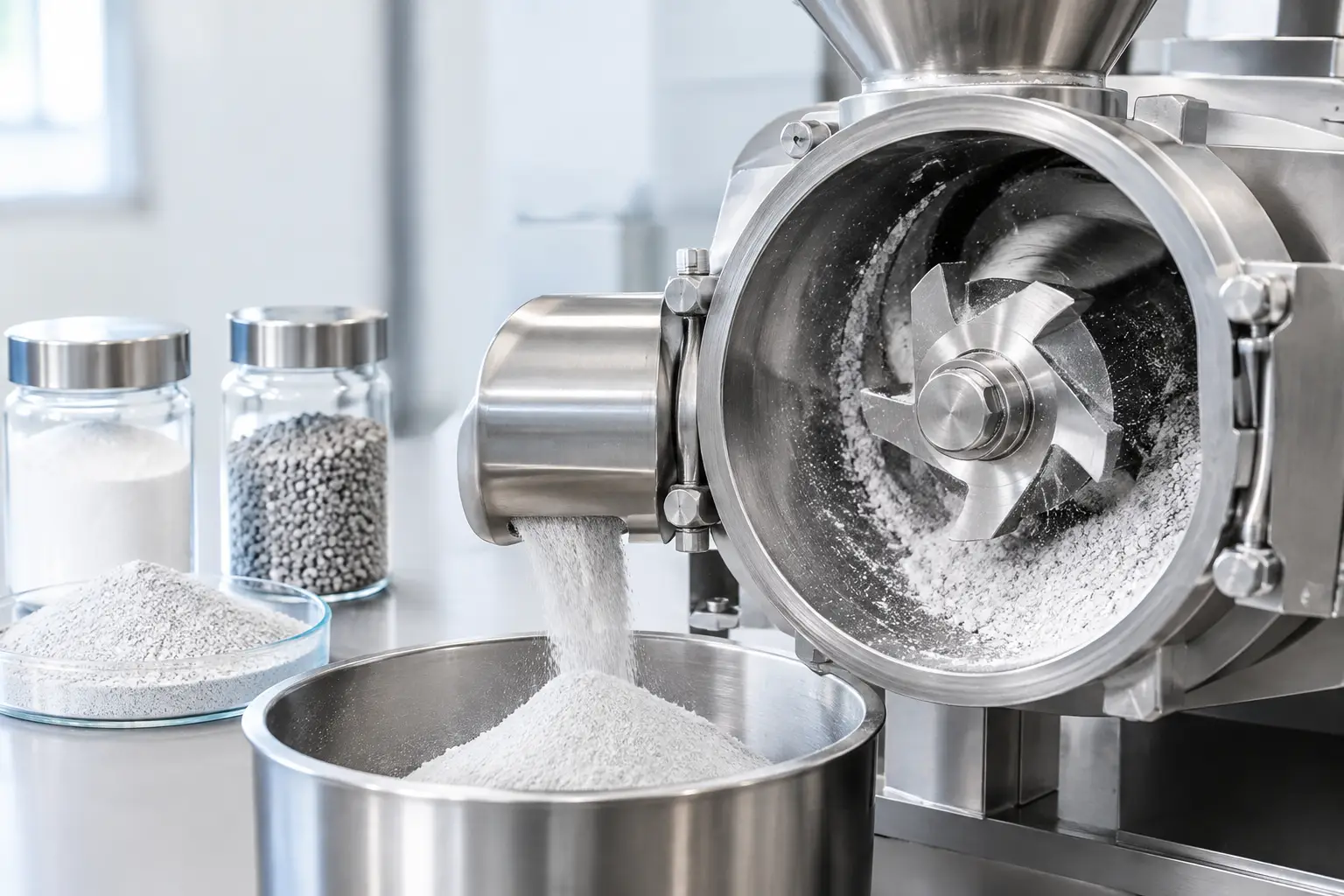
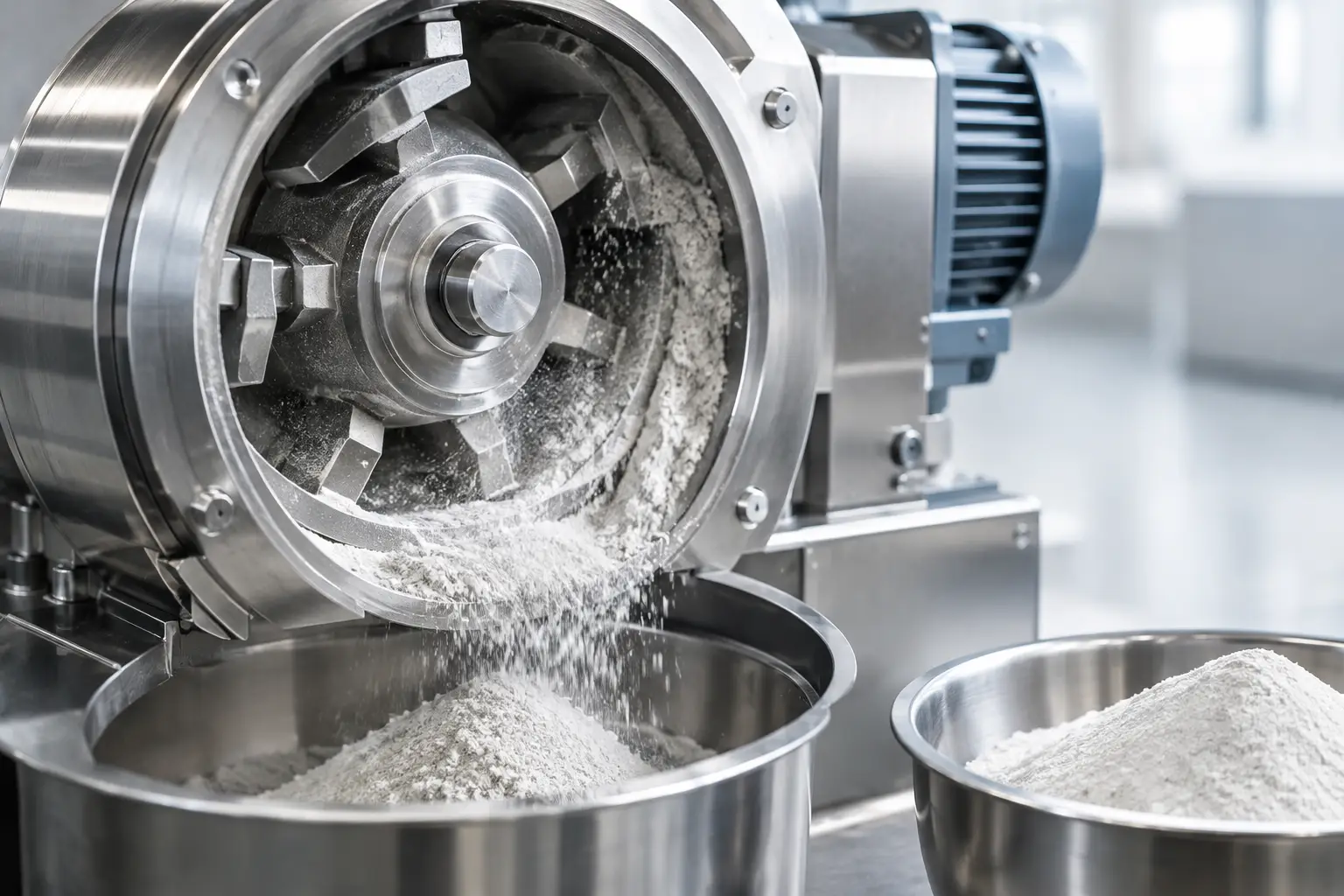
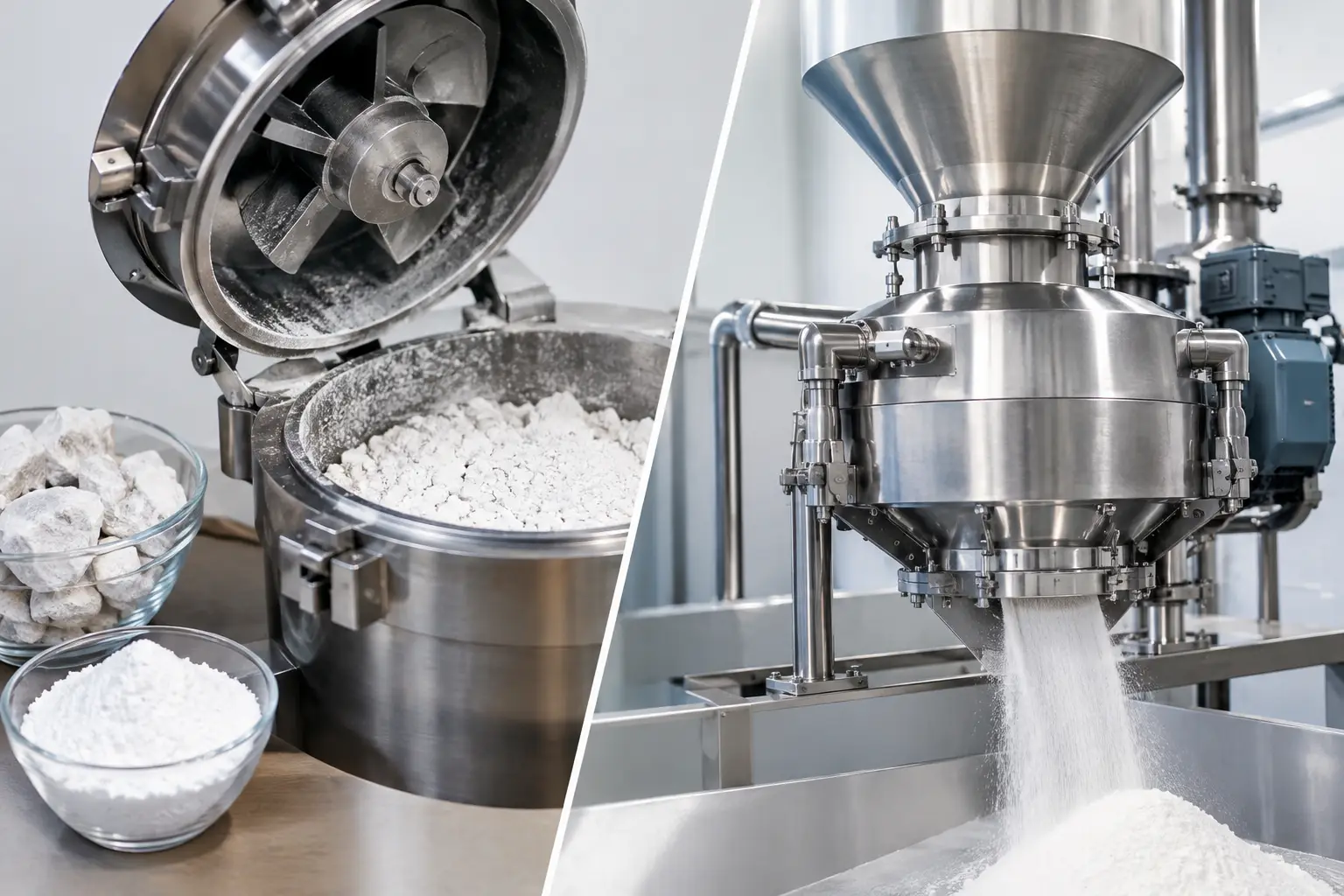
A cone mill application review should begin with the material, not the machine. A conical mill can be highly effective for deagglomeration, delumping, controlled sizing, and reclaim processing, but its performance depends on powder behavior, feed condition, screen selection, rotor design, and the demands of the surrounding process. For manufacturers working under strict quality, containment, or throughput requirements, choosing a cone mill solely by capacity rating can create avoidable production limits.
Cone mills are commonly selected when the objective is a controlled, relatively gentle reduction of oversized particles or agglomerates. They are not designed to replace high-energy mills where significant micronization is required. Understanding that distinction early helps process teams specify equipment that supports product quality, operator safety, cleaning requirements, and scalable production.
Where Cone Mills Fit in a Processing Line
A cone mill uses a rotating impeller or rotor to guide material through a screen. Size reduction occurs through a combination of impact, shearing, and attrition as particles pass between the rotor and screen. Compared with more aggressive milling technologies, the process typically produces less heat and fewer fines, making it well suited to materials that need conditioning rather than intensive grinding.
In pharmaceutical and nutraceutical operations, cone mills are frequently used to break granules after drying, condition material before tablet compression or encapsulation, and reclaim oversized product. Food processors may use them to eliminate lumps in powders, sugars, spices, protein blends, and functional ingredients. Chemical, battery, and advanced-material manufacturers may apply conical milling to improve feed consistency before blending, packaging, downstream classification, or other controlled unit operations.
The application is often straightforward on paper: reduce a coarse fraction to a target size. In production, however, the real requirement may be to improve blend uniformity, prevent screen blinding, stabilize feeder performance, reduce dust generation, or keep a downstream press from receiving variable material. Those process objectives should guide the equipment review.
Cone Mill Application Review: Start With Material Behavior
The first question is not, “What screen size is needed?” It is, “How does this material behave before, during, and after milling?” A dry, free-flowing agglomerate behaves very differently from a hygroscopic powder, a waxy granule, a fibrous ingredient, or an electrostatically charged active material.
Particle size distribution matters, but it is only one part of the evaluation. Process teams should also examine bulk density, moisture content, hardness, friability, fat or oil content, melting tendency, compressibility, and flowability. A material that mills cleanly at room temperature in a development batch may smear, compact, or blind the screen during a long production run because of heat buildup, environmental humidity, or inconsistent incoming feed.
Feed form is equally important. Cone mills can process material delivered by gravity, vacuum transfer, manual charging, or integrated upstream equipment, but each arrangement affects consistency. Large, dense agglomerates may require a different inlet configuration or rotor style than a light powder with intermittent lumps. If the feed is starved, the mill may operate inefficiently. If it is flooded, material residence time can rise and the final distribution may become broader than expected.
A useful trial should represent the full material range, not only an ideal sample. Include normal variation in moisture, particle size, density, and temperature. This provides a more realistic view of throughput stability, screen condition, dust behavior, and product yield.
Screen, Rotor, and Speed Set the Result
A conical mill does not produce one fixed particle size simply because a specific screen is installed. Screen aperture, open area, thickness, and hole profile all influence the result. Round holes, grated screens, and other screen geometries can change the balance between throughput, particle shape, and fines generation.
Rotor or impeller selection determines how force is applied to the material. A more aggressive configuration may improve reduction of hard agglomerates and increase throughput, but it can also create additional fines, increase temperature, or damage fragile granules. A gentler configuration may preserve product structure and reduce attrition, though capacity can be lower for difficult materials.
Speed is another variable with a practical trade-off. Higher tip speed can help process tougher or larger agglomerates, but it is not automatically better. Excessive speed may increase heat, noise, wear, and fine generation. Lower speed may support a narrower, more controlled result for friable material, provided the required capacity is maintained.
The right operating window is established through testing. Rather than targeting a single screen size, evaluate combinations of screen type, rotor design, and speed against measurable acceptance criteria: particle size distribution, retained oversize, fines percentage, bulk density, temperature rise, throughput, and yield. For regulated applications, the evaluation should also account for cleanability, traceability, and repeatability from batch to batch.
Throughput Is More Than Pounds Per Hour
Nameplate capacity is a starting point, not a process guarantee. Actual throughput depends on the material, desired reduction ratio, feed method, screen open area, and downstream restrictions. A mill that processes a free-flowing placebo at a high rate may deliver a fraction of that output with a cohesive product that requires more residence time.
Plant teams should define both average and peak throughput requirements. Average rate supports production planning, while peak capacity accounts for surges from upstream dryers, blenders, or transfer systems. If the cone mill becomes a bottleneck, operators may compensate by increasing rotor speed or forcing feed, which can shift the particle distribution and create inconsistent downstream performance.
Consider how the mill fits with the rest of the line. The discharge must move product away at a rate that prevents backup. If the material is vacuum conveyed after milling, conveying air velocity and receiver design can affect fines segregation. If the mill feeds a tablet press, capsule filler, blender, or packaging system, the downstream equipment may have tighter flowability requirements than the mill alone suggests.
For scale-up, preserve the process intent rather than assuming that a larger machine will reproduce pilot results at the same settings. Rotor tip speed, feed rate per available screen area, residence time, and material temperature should be reviewed as production scale changes. A well-designed scale-up program avoids the common problem of achieving an acceptable particle size distribution in the pilot suite but a different result on the production floor.
Cleaning, Containment, and Material Integrity
For many applications, the mill’s reduction performance is only one part of the specification. Cleaning access, changeover time, containment, and product-contact materials can determine whether equipment is practical for routine use.
Pharmaceutical, nutraceutical, and specialty chemical manufacturers may need designs that support rapid disassembly, defined cleaning procedures, and inspection of product-contact surfaces. Poor access around screens, gaskets, and discharge areas can extend changeovers and increase cross-contamination risk. The best configuration depends on the cleaning standard, product potency, and frequency of campaign changes.
Containment requirements should be addressed at the system level. A cone mill may need enclosed charging, dust-tight connections, vacuum transfer interfaces, local extraction, or integrated containment solutions. Open charging can be adequate for certain low-risk materials, but it may be unsuitable when dust exposure, housekeeping, or product loss is a concern.
Material construction also deserves review. Stainless steel grades, surface finish, gasket compatibility, wear components, and seal design should match the chemistry and cleaning method. Abrasive mineral or advanced-material applications may prioritize wear resistance and service access. Food and pharmaceutical applications may place greater emphasis on sanitary geometry and validation support. There is no universal configuration because the risk profile changes with the product.
When a Cone Mill Is Not the Best Choice
A cone mill is a strong option for controlled conditioning, but it has limits. If the process requires a very fine powder, tight micron-scale control, or substantial reduction of hard crystalline materials, a jet mill, air classifier mill, pin mill, hammer mill, or another technology may be more appropriate. Attempting to force a cone mill into a high-energy grinding application often leads to low capacity, frequent screen wear, excess heat, and an unsatisfactory distribution.
Likewise, materials that are extremely sticky, heat-sensitive, fibrous, or prone to melting may need a specialized approach. Cooling, modified feed design, a different milling principle, or cryogenic processing may be necessary. The correct answer depends on the product’s physical behavior and the finished specification, not on the familiarity of a particular machine type.
Build the Review Around Production Evidence
The most reliable equipment decisions come from application testing that mirrors real operating conditions. Record feed properties, mill settings, product temperature, particle size distribution, throughput, yield, and observations such as screen blinding or static buildup. Then repeat the conditions that appear promising to confirm consistency.
DP Mills approaches cone mill selection as a process question: what must the material do before and after milling, and what production constraints must the system meet? That perspective helps teams evaluate not only reduction performance, but also integration, cleaning, containment, maintainability, and future capacity needs.
A cone mill should make the next process step more predictable. When testing is built around that outcome, the selected system becomes a dependable part of production rather than a source of variation that operators must manage around.