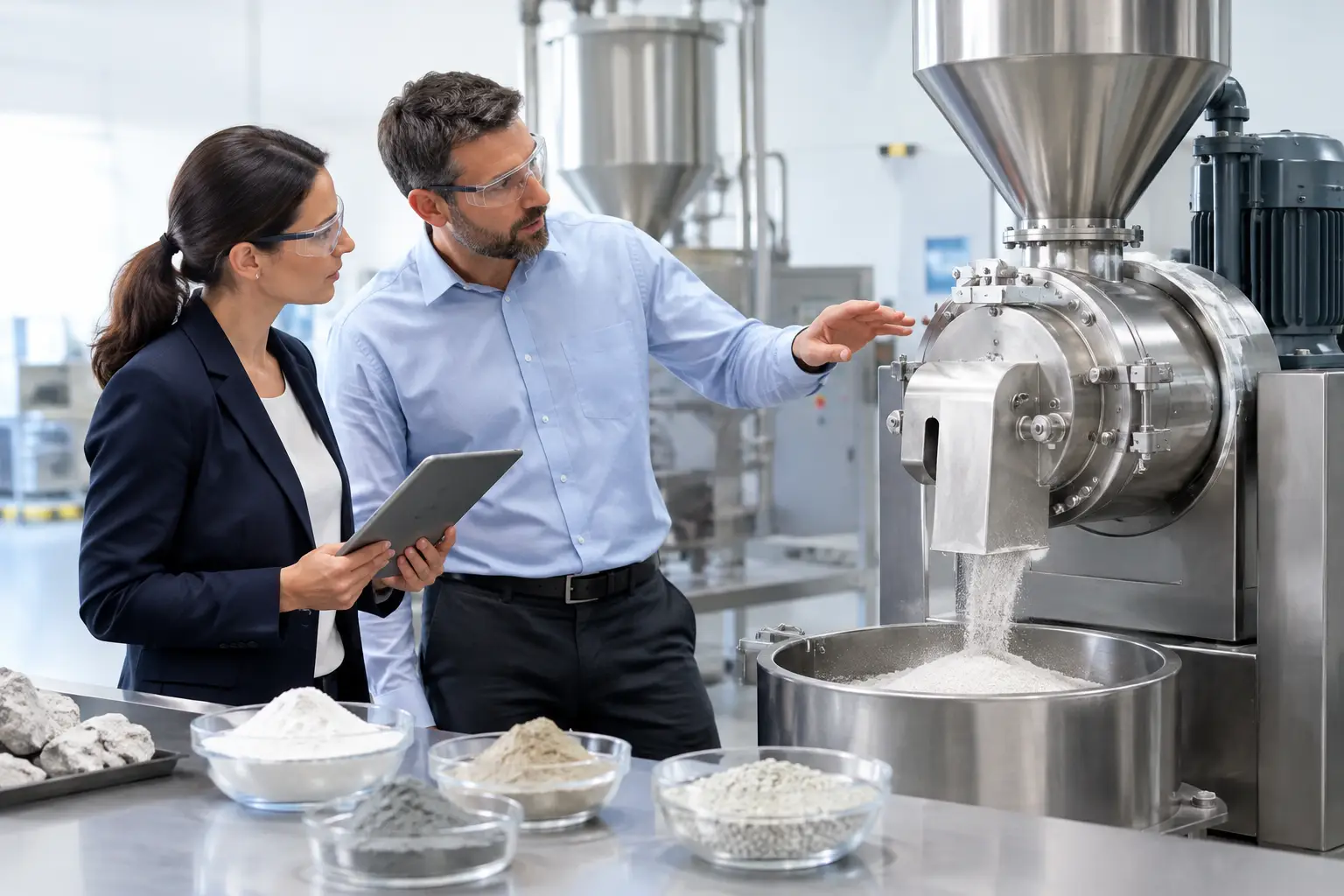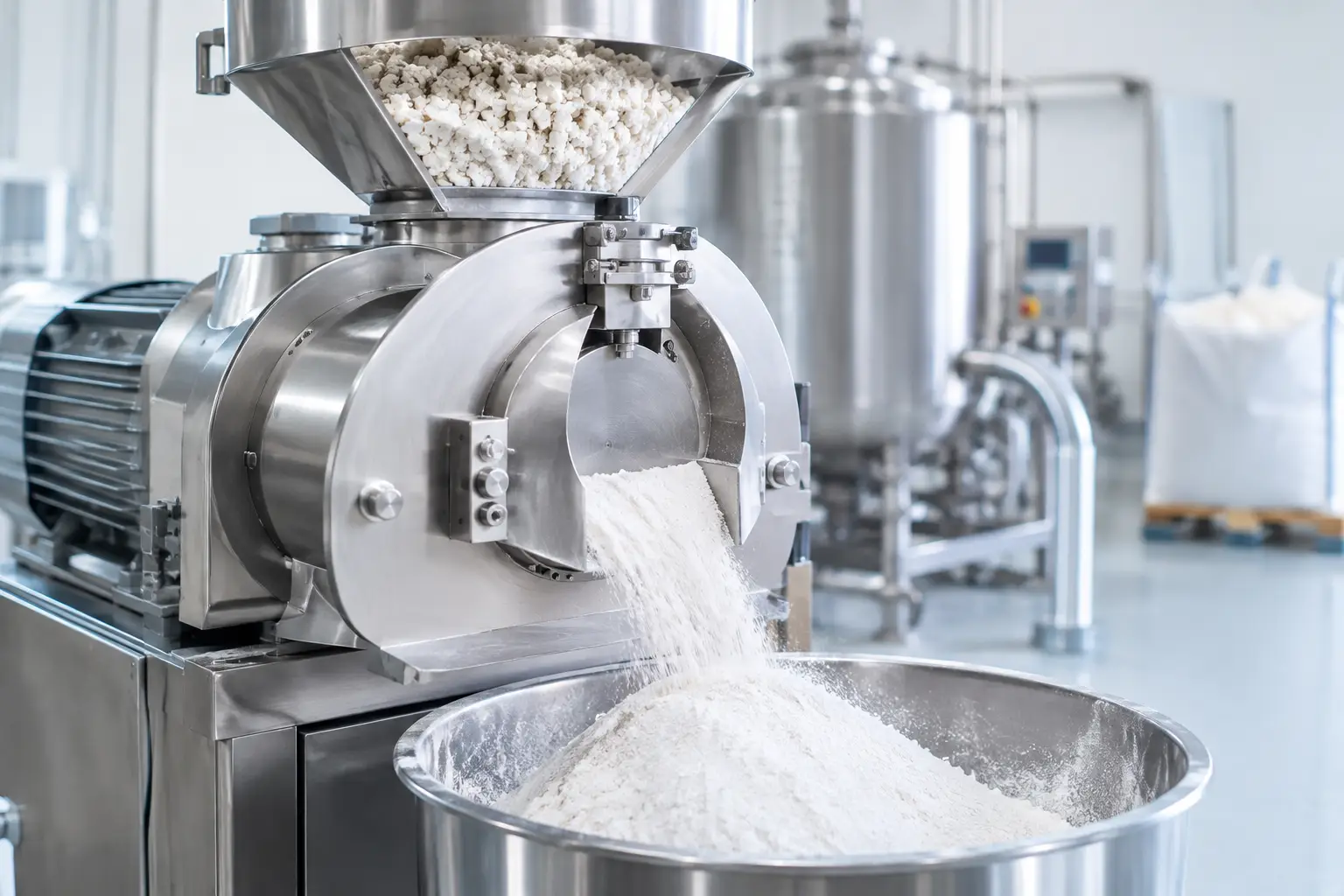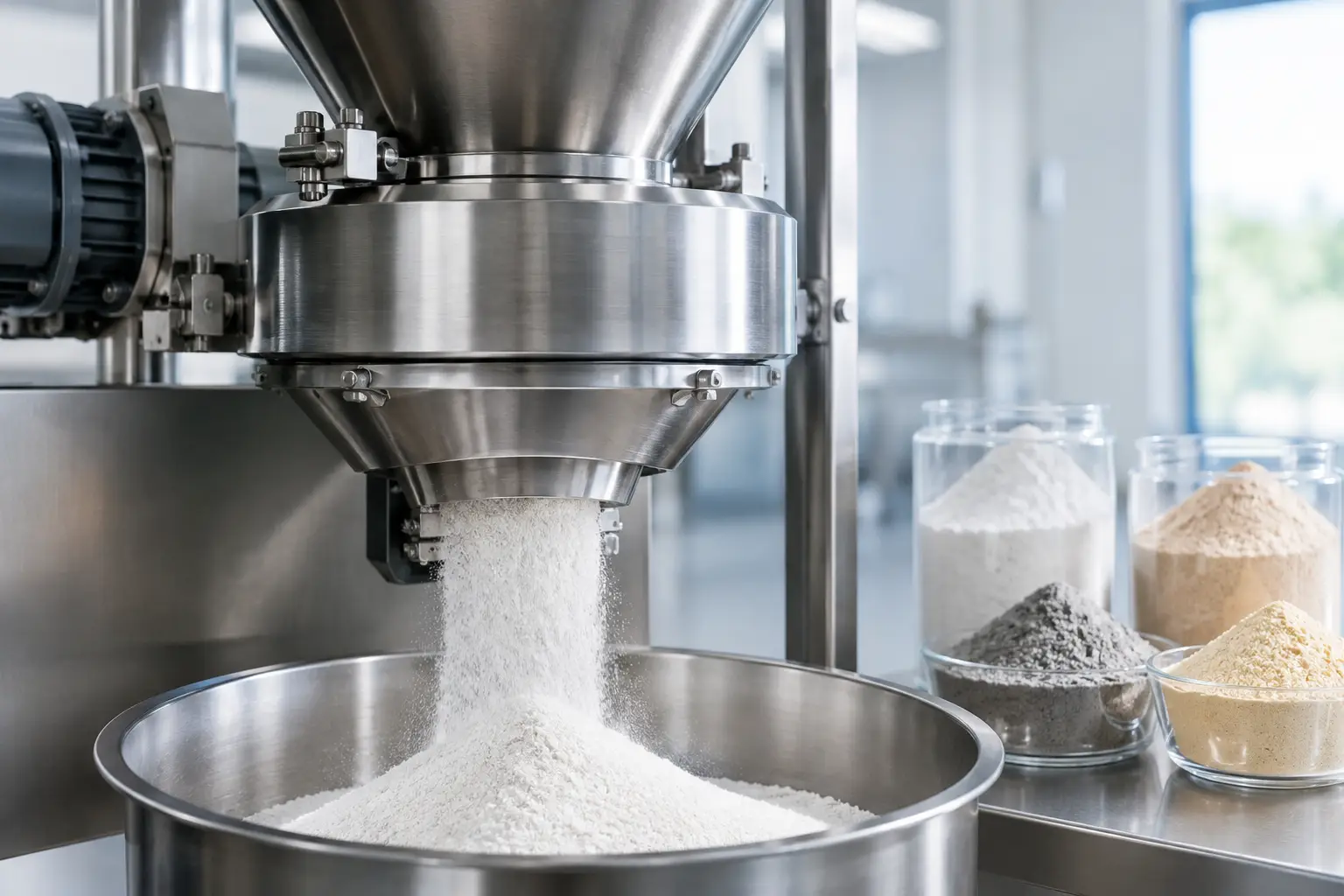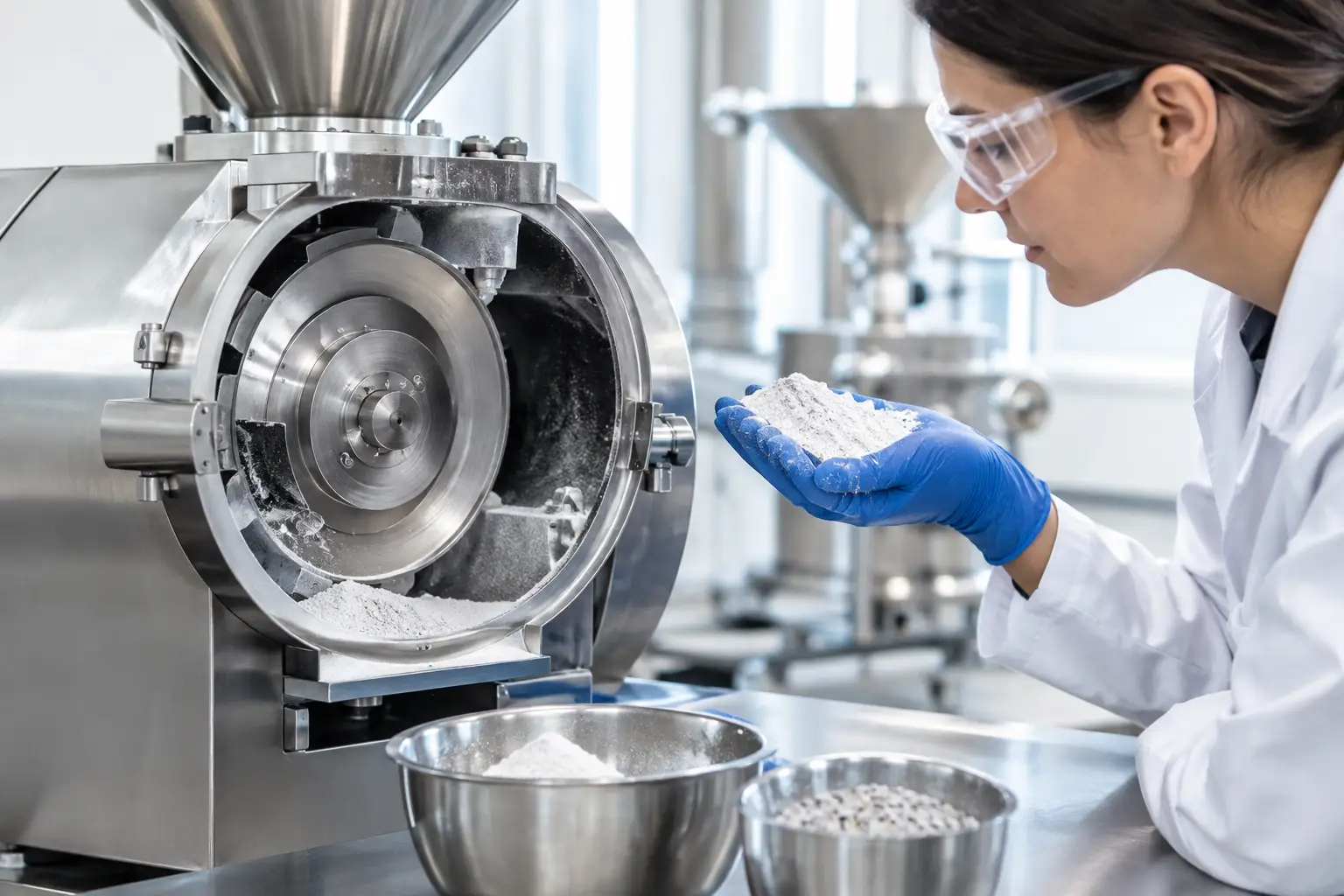
A micronization process that produces an acceptable D50 in a pilot trial can still fail at production scale. The common failure is treating scale-up as a matter of installing a larger mill. Knowing how to scale a micronization process requires controlling the complete process window: feed behavior, energy input, classification, air handling, material temperature, containment, and downstream powder handling.
For pharmaceutical, food, chemical, battery, and advanced material manufacturers, the real objective is not simply more pounds per hour. It is reproducible particle size distribution at the required capacity, with predictable yield, manageable operating cost, and no compromise to material integrity.
Start With the Product Specification, Not the Mill Size
Micronization specifications are often stated as a single target, such as a D50 or a maximum particle size. That is necessary, but it is rarely sufficient for scale-up. Two lots can have the same D50 while behaving very differently in blending, dissolution, compaction, coating, dispersion, or final product performance.
Define the particle-size requirements as a distribution, including D10, D50, D90, oversize limits, and allowable fines where relevant. Then establish the additional product attributes that must remain unchanged as capacity increases. These may include moisture content, bulk density, flowability, specific surface area, crystallinity, potency, color, flavor, or electrochemical performance.
Material condition matters just as much as the final specification. A feed with variable moisture, agglomeration, particle morphology, or bulk density will not respond consistently to identical milling settings. Before increasing throughput, characterize the incoming material and determine the acceptable feed range. This creates a practical operating envelope rather than a target based on one successful test lot.
How to Scale a Micronization Process From Pilot to Production
The best scale-up path uses pilot results to identify the governing process relationships, then confirms them on production-representative equipment. It does not assume that a larger chamber, more horsepower, or higher air volume will duplicate pilot performance.
In jet milling, for example, particle reduction depends on collision energy, particle concentration, grinding gas pressure, classifier performance, and residence time. Increasing feed rate without maintaining the right balance can broaden the distribution, increase coarse material, or raise the recycle burden. In an air classifier mill, rotor tip speed, airflow, feed rate, and classifier settings work together. Changing one variable to recover throughput can alter cut point and generate excess fines.
A disciplined scale-up study should establish the relationship between capacity and the following operating variables:
- Feed rate and feeder accuracy
- Mill energy input, such as gas pressure, rotor speed, or tip speed
- Process airflow, air-to-product ratio, and system pressure balance
- Classifier speed or cut-point setting
- Product temperature, moisture exposure, and residence time
These variables should be evaluated as a system. A higher feed rate may require changes to both classifier conditions and conveying air. If the material is heat-sensitive, the available process window may narrow further, making cryogenic grinding or an alternative milling method more appropriate than simply adding cooling downstream.
Choose Equipment Based on Material Behavior
There is no universal micronization technology. The right approach depends on hardness, brittleness, elasticity, thermal sensitivity, abrasiveness, explosibility, required particle size, and contamination tolerance.
Jet mills are often selected for very fine particle sizes, tight distributions, and applications where media contamination must be avoided. Their scale-up depends heavily on compressed gas availability, classifier control, feed consistency, and collection efficiency. Production capacity may be limited by the economics of gas consumption as much as by the mill itself.
Air classifier mills combine impact milling and integrated classification, making them well suited for many fine-grinding applications where controlled top size and continuous operation are required. Hammer mills, pin mills, turbo mills, and universal mills may provide a more efficient path when the target size is less extreme or when material characteristics favor impact rather than fluid-energy milling.
For fatty, waxy, elastic, or heat-sensitive products, cryogenic milling can preserve friability and prevent softening, smearing, or loss of volatile components. The trade-off is added complexity around refrigerant use, insulation, safety, and controls. For abrasive minerals, ceramics, or battery materials, wear-resistant construction and contamination control may become the primary design drivers.
The scale-up decision should be based on test data from representative material, not a nominal equipment capacity chart. Capacity ratings are useful starting points, but they cannot account for the behavior of a specific formulation or feedstock.
Protect Particle Size by Managing Feed and Classification
Feed control is frequently the difference between a stable process and an inconsistent one. At pilot scale, manual feeding or short test runs can hide flow problems that become persistent at production rates. Bridging, rat-holing, segregation, pulsation, and inconsistent bulk density can create rapid swings in mill load and product size.
A production system may need loss-in-weight feeding, agitation, hopper geometry designed for the material, conditioning equipment, or a controlled pre-break stage. For cohesive powders, a feeder that delivers a stable mass flow is more valuable than a feeder with a high maximum rate.
Classification must also scale with the grinding zone. If the classifier cannot reject coarse particles efficiently at higher loading, oversized material exits with the product. If it becomes too aggressive, throughput falls and excessive fines may be produced. Confirm performance through full particle-size distribution testing, not only through a single sieve result or median value.
Design the Entire System, Not Just the Micronizer
A production micronization line includes more than the mill. The feeder, air source, filters, cyclone or product collector, conveyors, valves, controls, and packaging interface all affect process stability. A mill may have sufficient capacity while the collection system creates backpressure, product hold-up, or unacceptable yield loss.
Airflow design deserves particular attention. Duct diameter, run length, bends, filter loading, and fan selection influence pressure balance and transport velocity. Improperly designed conveying can lead to buildup, attrition after milling, segregation, or plugs that force unplanned shutdowns.
For applications with strict quality requirements, design must also address cleanability and cross-contamination. Material-contact finishes, sanitary construction, access points, clean-in-place or wash-in-place requirements, gasket selection, and filter change procedures should be considered before finalizing the layout. In battery, pharmaceutical, and high-purity chemical applications, a small contamination source can outweigh the benefits of higher throughput.
Account for Heat, Moisture, and Powder Handling
Micronization increases surface area, which can make powders more reactive to heat and humidity. A product that appears stable immediately after milling may absorb moisture during collection or packaging, changing flowability, agglomeration tendency, or performance downstream.
Monitor product temperature at the mill discharge and after collection, especially when scaling impact-based systems. If temperature rises with throughput, investigate whether the cause is higher residence time, insufficient airflow, increased recirculation, or feed conditions. Cooling the product after it has degraded is not an effective correction.
Fine powders also demand deliberate dust management. Evaluate dust collection efficiency, grounding and bonding, explosion protection requirements, operator exposure limits, and containment performance. These factors are part of production capacity because a line that must be frequently cleaned, stopped for filter issues, or operated below its design rate will not deliver its expected output.
Validate With Extended Runs and Meaningful Data
Short trials prove feasibility. Extended runs reveal whether the process is commercially viable. Conduct scale-up trials long enough to capture filter loading, feeder behavior, heat buildup, wear, product accumulation, and shifts in particle size over time.
Track throughput, yield, energy use, pressure drop, product temperature, particle-size distribution, and downtime causes. Where applicable, include moisture, bulk density, assay, and contamination testing. Compare results across multiple incoming material lots, because a process that only works with ideal feedstock is not ready for routine manufacturing.
Set acceptable control limits before production startup. Operators need a clear response when feed rate drifts, classifier current changes, pressure drop rises, or product size approaches specification limits. This turns process knowledge into repeatable operating practice rather than relying on individual operator judgment.
Build Scale-Up Around Long-Term Operating Value
The lowest initial equipment cost is not always the lowest-cost micronization solution. Energy consumption, compressed air demand, wear parts, cleaning time, filter replacement, labor, product yield, and uptime can have a larger effect on total cost over the life of the system.
Engineered customization is often justified when it removes a persistent production constraint. That may mean a classifier configuration tailored to a narrow top-size limit, a cryogenic feed system for a difficult material, upgraded wear protection, or integrated containment designed around the plant’s exposure requirements. DP Mills approaches these decisions as process design questions, with the goal of matching the equipment and supporting system to actual production conditions.
A reliable scale-up is built on representative testing, defined control limits, and an integrated system designed for the material. When those elements are addressed before installation, production teams can increase capacity without turning particle-size consistency into the next bottleneck.