A jet mill is often considered when a conventional mechanical mill can no longer meet the specification without creating a new problem: excess heat, unacceptable wear, broad particle size distribution, or product contamination. This guide to jet mill applications explains where fluid-energy milling delivers measurable value, where it may not be the best fit, and which process variables determine production performance.
How Jet Milling Produces Fine, Clean Powders
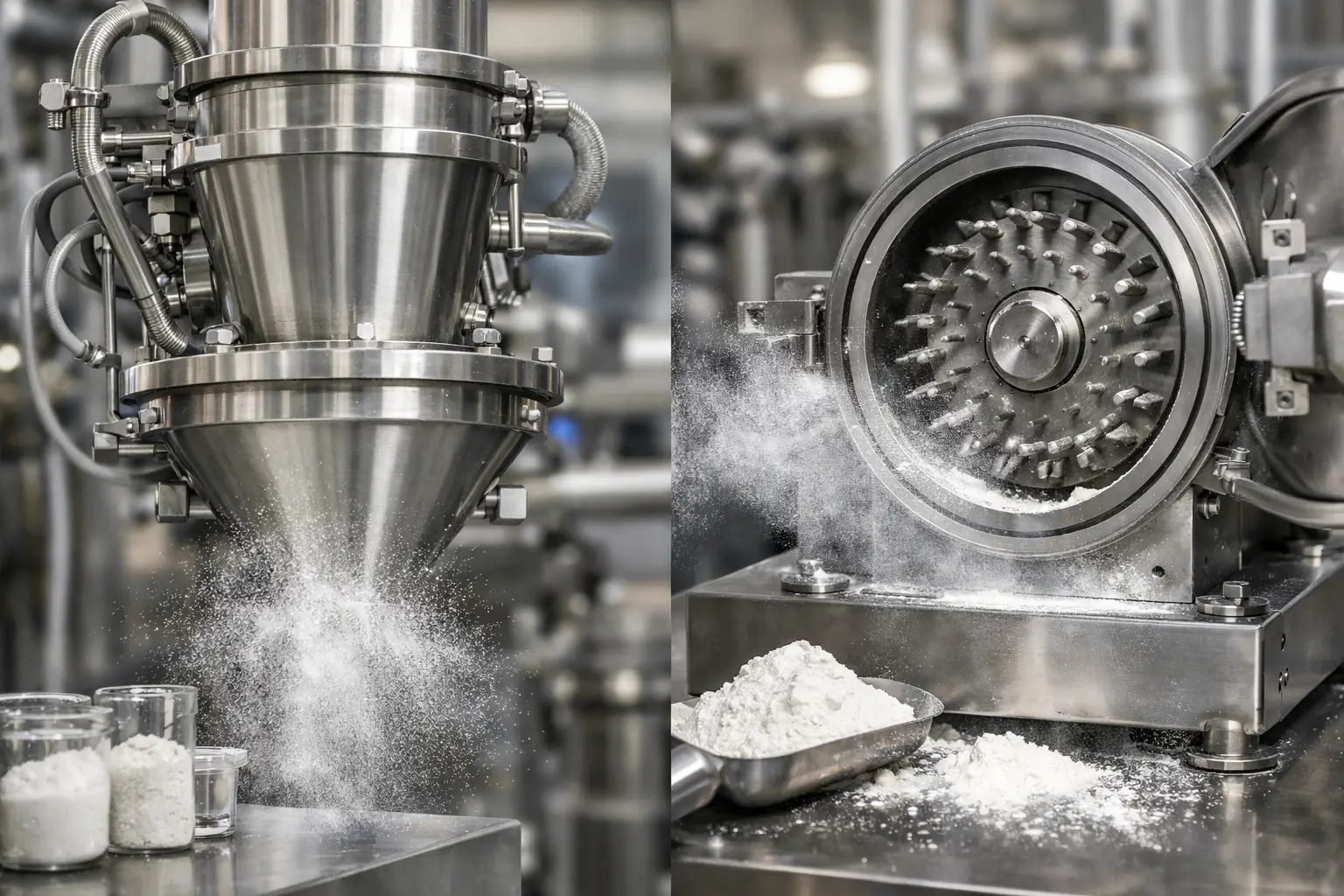
Jet mills use high-velocity compressed gas, typically air, nitrogen, or steam, to accelerate particles inside a grinding chamber. Size reduction occurs primarily through particle-to-particle collision rather than contact with grinding media, hammers, or pins. An integrated classifier separates particles that have reached the target size from oversize material that remains in the milling zone.
This operating principle makes jet milling particularly effective for fine and ultrafine powders, commonly in the low-micron range. Exact capability depends on material hardness, density, feed size, moisture, desired distribution, classifier design, and gas conditions. A laboratory result should therefore be treated as a starting point, not a guarantee of full-scale output.
The limited internal contact surfaces can reduce metal contamination and abrasive wear compared with mechanical impact mills. That matters for high-purity products, difficult abrasive materials, and formulations in which trace contamination can affect quality, downstream performance, or regulatory acceptance. Because the grinding mechanism is gas-driven, jet mills also avoid much of the heat generated by high-speed mechanical components. The process is not automatically cold, however. Compressed gas temperature, pressure reduction, feed rate, and residence time still require engineering attention for heat-sensitive products.
Guide to Jet Mill Applications by Industry
Jet mills are selected for an outcome, not simply for a target micron size. In many applications, that outcome is a narrower distribution, improved dispersion, higher surface area, better dissolution, or controlled material behavior in a downstream process.
Pharmaceutical and nutraceutical powders
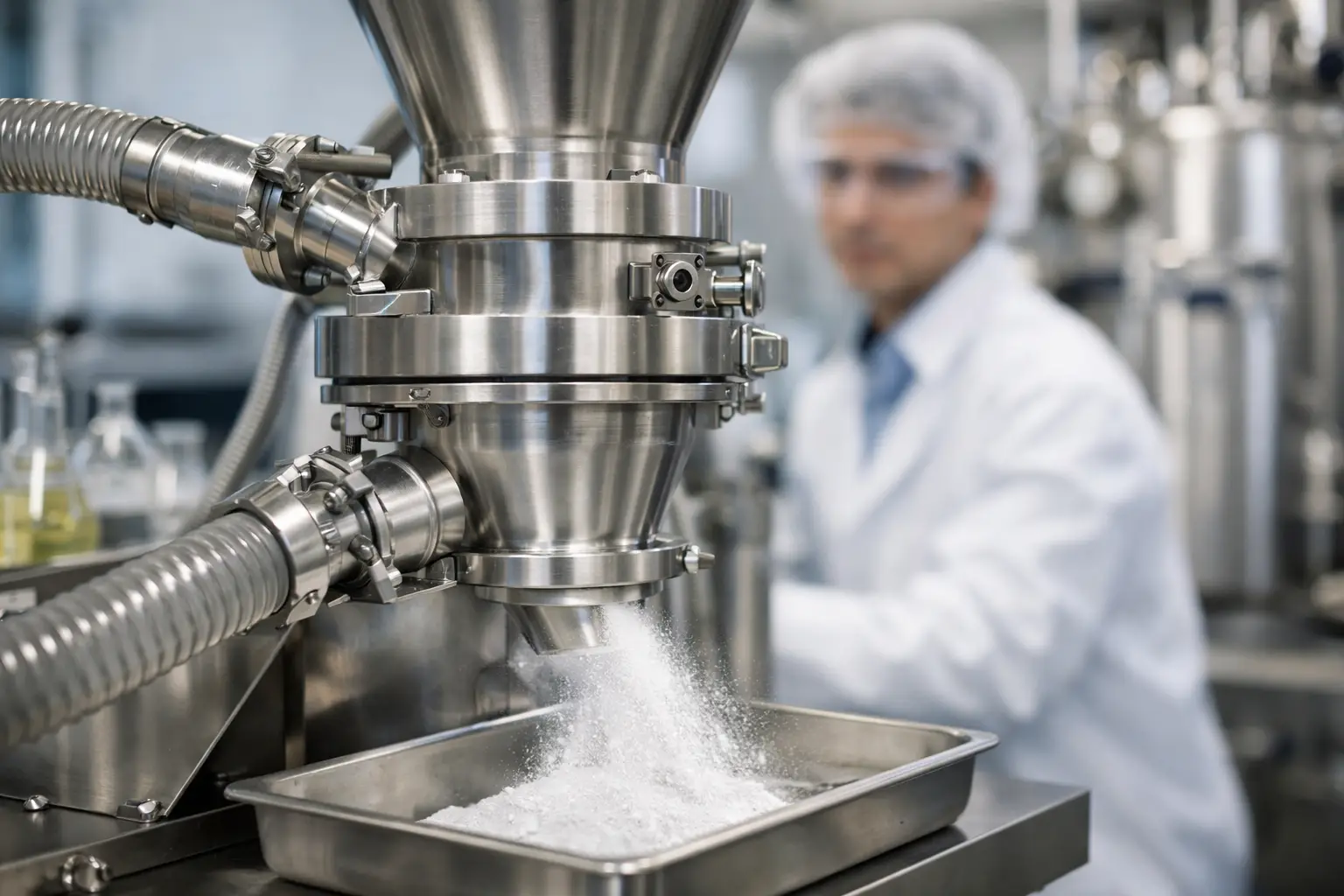
In pharmaceutical processing, particle size can influence dissolution rate, bioavailability, blend uniformity, inhalation performance, and tablet or capsule consistency. Jet mills are widely used to micronize active pharmaceutical ingredients and selected excipients when a tightly controlled fine fraction is required. Closed systems, appropriate construction materials, contained transfer, cleanability, and validated operating controls are often as important as the mill itself.
For potent compounds, the system design must address containment from feeding through collection and discharge. Nitrogen operation may also be appropriate when oxidation or flammability is a concern. The right solution may include isolators, contained charging, pressure controls, high-efficiency filtration, and a discharge arrangement that protects both product and operator.
Nutraceutical applications present a different mix of challenges. Botanical extracts, fermentation products, vitamins, amino acids, and mineral ingredients can be hygroscopic, sticky, low-density, or sensitive to temperature. A jet mill can produce fine powder where it remains free-flowing enough to feed consistently. When a material softens, agglomerates, or retains too much moisture, preconditioning, drying, cryogenic processing, or a different mill type may provide a more stable process.
Food ingredients and specialty powders
Food processors may use jet milling for spices, flavors, functional ingredients, proteins, starch derivatives, sweeteners, and mineral fortification ingredients. Fine particle size can improve dispersibility, mouthfeel, color development, extraction behavior, and mix uniformity. In flavor applications, lower thermal exposure can help preserve volatile characteristics that may be lost during aggressive mechanical grinding.
Food-grade applications require practical attention to sanitary design, product changeover, allergen management, dust control, and cleaning access. A mill that achieves the target size but takes too long to clean between products can reduce available production time and increase cross-contact risk. Material trials should evaluate not only particle size but also cleaning behavior, yield, and retention in the complete system.
Chemicals, pigments, and performance additives
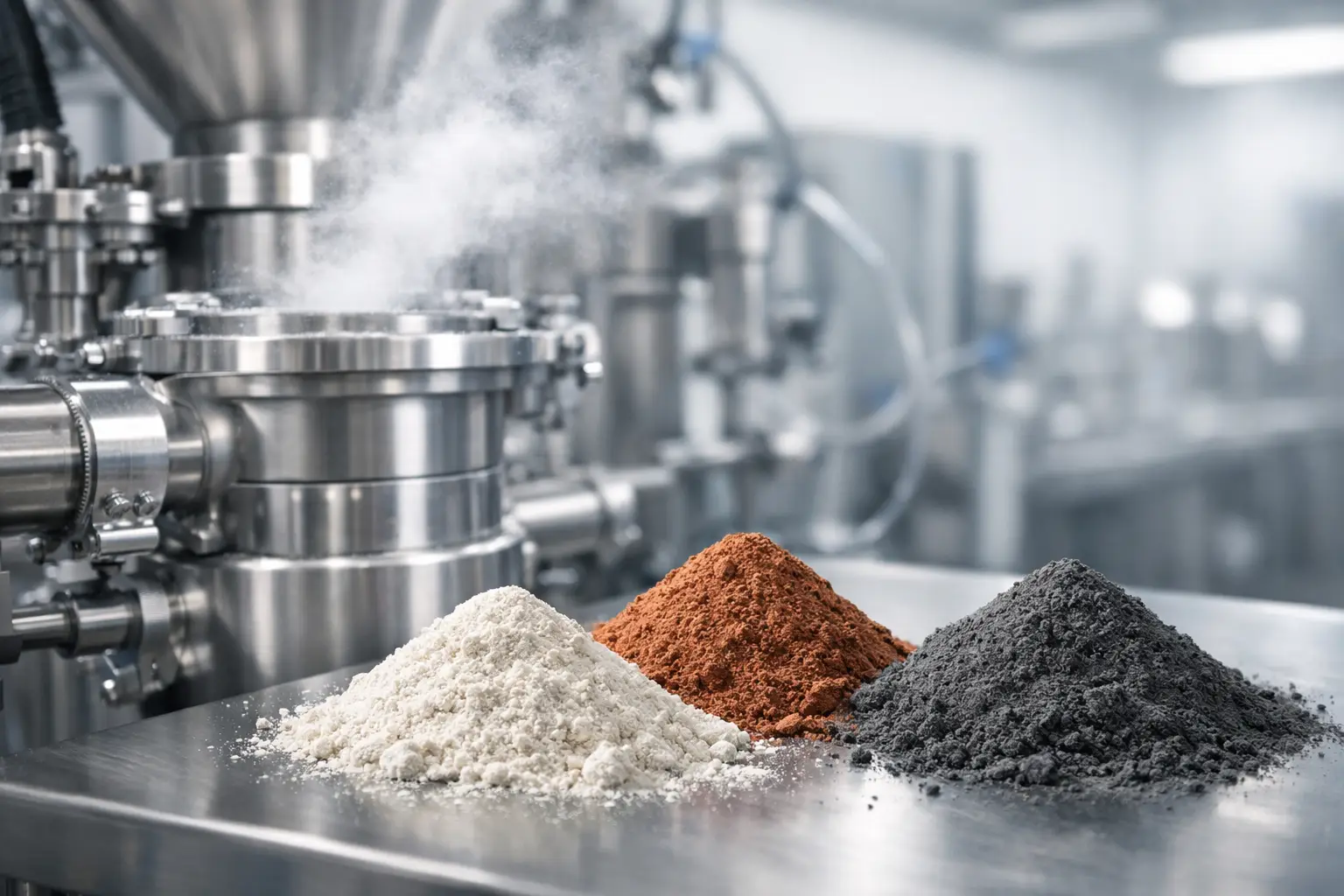
Specialty chemical manufacturers use jet milling for pigments, resins, catalysts, polymers, agrochemical ingredients, ceramic materials, and functional additives. Here, a controlled fine distribution may improve pigment strength, surface coating performance, chemical reactivity, suspension stability, or dispersion in a final formulation.
Abrasive mineral fillers and ceramic powders demonstrate one of jet milling’s practical advantages. Mechanical mills may experience substantial wear when processing hard materials, adding maintenance cost and potentially introducing unwanted metallic particles. Properly selected jet mill construction materials can reduce this exposure. Still, wear does not disappear. Nozzles, classifiers, liners, and collection components must be evaluated against the material’s hardness, throughput requirement, and purity specification.
For reactive or combustible powders, the mill should be designed as part of a complete hazard-managed process. Inert gas circulation, oxygen monitoring, pressure relief strategy, grounded equipment, dust collection, and safe material handling must be considered at the system level. Milling equipment alone does not make a process safe.
Battery and advanced materials
Battery materials, electronic ceramics, engineered minerals, and other advanced materials frequently demand narrow particle size distributions and low contamination. Small changes in particle morphology or particle size can affect packing density, coating quality, conductivity, reaction kinetics, and final component performance.
Jet milling can be well suited to refining precursor materials, ceramic powders, conductive additives, and other high-value powders where precision outweighs the cost of compressed gas. Nitrogen processing is often considered when materials are moisture-sensitive or oxidation-sensitive. For these applications, material handling before and after the mill deserves equal focus. Exposure during feeding, collection, storage, or transfer can undo the benefit of a carefully controlled milling step.
Process Variables That Control Results
Particle size in a jet mill is not set with a single adjustment. Grinding gas pressure affects particle acceleration and collision energy. Classifier speed or geometry influences the cut point. Feed rate changes the solids loading in the chamber, while feed particle size and consistency affect how efficiently material circulates and breaks down.
Higher gas pressure may support a finer grind, but it also increases utility demand and may not improve results once the process reaches a practical limit. Similarly, reducing feed rate can produce a finer product, yet throughput may fall below the economics required for production. The target is not the finest powder possible. It is the specified particle size distribution at an acceptable yield, energy use, and operating cost.
Moisture is another frequent constraint. Even modest moisture can cause fine particles to agglomerate, coat internal surfaces, or bridge in feeders. Particle shape and bulk density also influence feed stability. A consistent gravimetric feeding system, properly conditioned feed material, and appropriate pneumatic conveying design are often necessary to maintain steady product quality.
When a Jet Mill Is Not the Best Choice
Jet milling is a high-performance option, but it is not a universal replacement for hammer, pin, turbo, or air classifier mills. If the required product is relatively coarse, a mechanical mill may provide substantially higher throughput at lower energy cost. If the feed is wet, fibrous, highly elastic, or prone to melting, a jet mill may struggle without upstream conditioning or temperature control.
Very high production rates can also change the economics. Compressed gas is a meaningful operating cost, especially when inert gas is required. Gas recovery and recirculation systems may improve economics for certain applications, but they add capital cost and process complexity. The decision should be based on total operating value, including yield, quality, maintenance, utilities, labor, downtime, and the cost of off-spec material.
Evaluating a Jet Mill System Before Purchase
A productive evaluation begins with a clear material and product specification. Define the incoming particle size, bulk density, moisture, flow behavior, hardness, thermal sensitivity, and any hazards. Then define the required particle size distribution, allowable oversize fraction, throughput range, contamination limits, and downstream handling requirements.
Representative process trials are essential. Test the actual production material whenever possible, including expected lot-to-lot variation. Evaluate particle size distribution, not only a single average measurement. Also measure yield, residual material in the system, gas consumption, temperature, classifier stability, and the powder’s downstream behavior in blending, compaction, dispersion, or packaging.
System integration should be part of the discussion from the start. Feeders, air or gas supply, classifiers, cyclones, filters, collection vessels, controls, containment equipment, and conveying components determine whether the mill performs consistently on the plant floor. DP Pulverizer Americas approaches jet milling as an engineered process system, matching equipment configuration to the material, production objective, and operating constraints.
The most useful next step is to translate the product specification into a trial plan with measurable acceptance criteria. A well-designed test does more than confirm that a powder can be milled finely. It shows whether the complete process can deliver that powder reliably, safely, and economically at production scale.