Choosing the Right Mill: A Guide to Hammer Mills, Pin Mills, Jet Mills, Cone Mills, & Turbo Mills
By DP Pulverizer | Precision Milling Experts
In today’s rapidly evolving manufacturing landscape, particle size matters more than ever. Whether you’re producing pharmaceuticals, fine chemicals, nutraceuticals, or functional foods, the milling technology you choose directly affects your product quality, consistency, throughput, and ultimately your bottom line.
At DP Pulverizer, we understand that no single mill fits every application. That’s why we offer a full spectrum of industrial milling equipment engineered to meet specific material characteristics and process requirements.
Here’s a detailed guide to help you understand which type of mill is best suited for your production goals.
🔨 Hammer Mills
When toughness meets throughput.
Ideal for: Coarse to mid-range grinding
Industries: Agriculture, biomass, minerals, recycling, food waste
Material types: Fibrous, dry, tough, and brittle materials
Key Features:
- Rotor-based impact with swinging hammers
- Replaceable screen for particle size control
- Robust design with high-capacity output
Benefits:
- Excellent for pre-grinding or primary reduction
- Low maintenance and high uptime
- Adaptable to batch or continuous processes
Use Case: Breaking down dried herbs before fine milling or reducing slag and minerals in cement manufacturing.
📌 Pin Mills
For controlled fine grinding with minimal heat.
Ideal for: Fine, low-fat content powders
Industries: Food, spice, chemicals, nutraceuticals
Material types: Brittle or crystalline materials
Key Features:
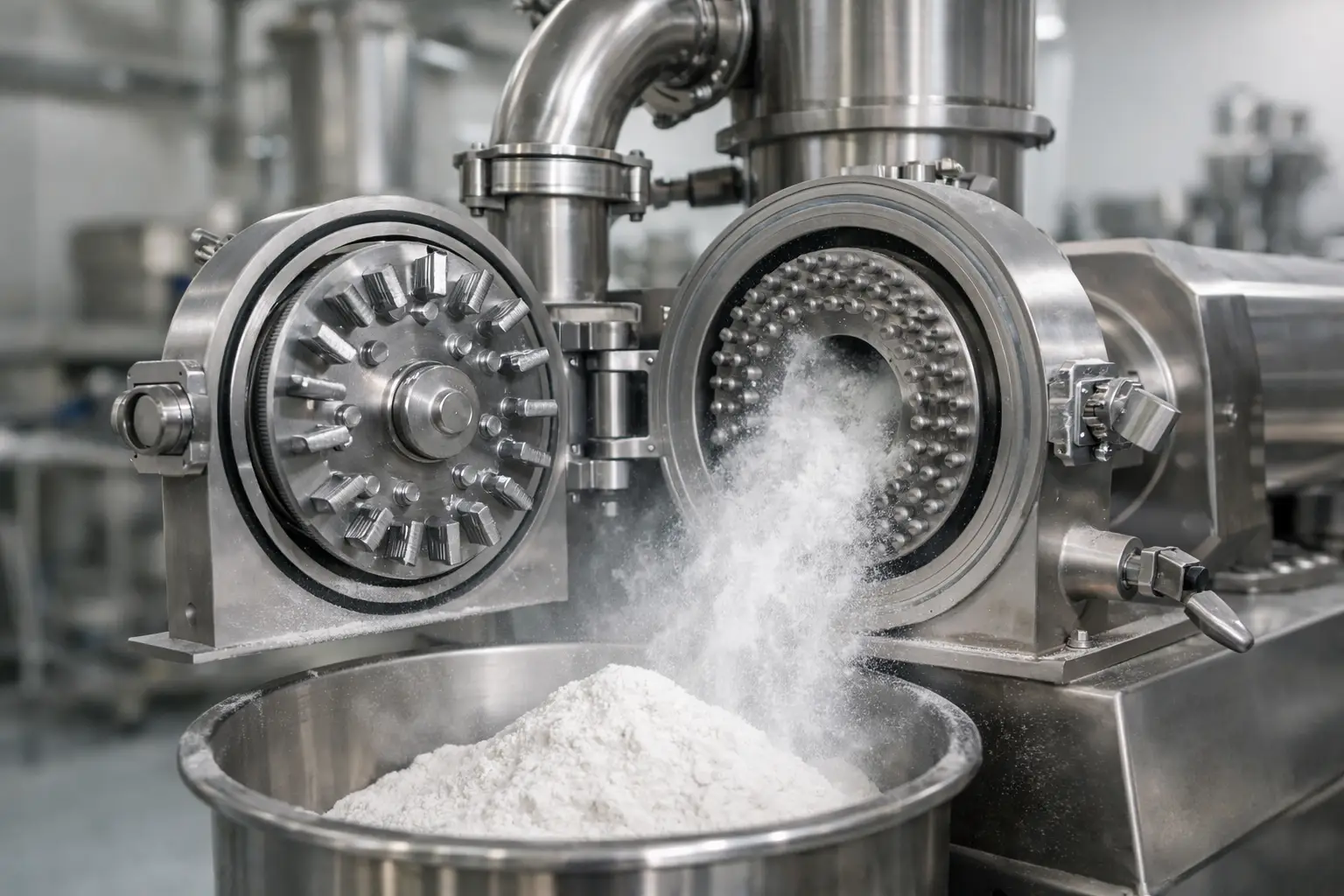
- Two discs with precision pins rotate against each other
- Shearing forces generate particle reduction
- Heat buildup is minimized
Benefits:
- Highly adjustable final particle size
- Preserves sensitive flavors and volatile oils
- Easily integrates into hygienic production environments
Use Case: Achieving a consistent grind on black pepper or crystalline sugars for confectionery production.
💨 Jet Mills
Micronization redefined.
Ideal for: Ultra-fine powders down to sub-micron levels
Industries: Pharmaceuticals, specialty chemicals, pigments
Material types: Heat-sensitive, high-value, fine-particle applications
Key Features:
- Utilizes compressed air or inert gas for particle-on-particle collision
- No moving parts in the grinding zone
- Ultra-narrow particle size distribution (D50 often < 10 µm)
Benefits:
- Clean, contamination-free grinding
- Ideal for sterile or cleanroom environments
- Minimal energy waste due to optimized nozzle design
Use Case: Micronizing APIs (active pharmaceutical ingredients) to enhance bioavailability in tablet and capsule formulations.
🔻 Cone Mills (Conical Mills)
Gentle precision for critical downstream processes.
Ideal for: Deagglomeration, sieving, and granulation
Industries: Pharma, nutraceuticals, chemical processing
Material types: Moist granules, agglomerated particles, dry powders
Key Features:
- Conical screen with rotating impeller
- Low-shear, low-heat process
- Easily scalable for R&D to production
Benefits:
- Improves flowability of bulk powders
- Consistent and repeatable particle sizes
- Often used post-fluid bed dryer or blender
Use Case: Sizing dried granules before compression in tablet manufacturing or polishing blends before packaging.
🌪 Turbo Mills (Bar Turbo Mills)
High-speed powerhouses for thermal sensitivity.
Ideal for: Lightweight, fatty, sticky, or low-melting materials
Industries: Plastics, waxes, food processing, pigments
Material types: Soft resins, heat-sensitive compounds, starches
Key Features:
- Rotor-stator design creates a vortex of kinetic energy
- Internal airflow prevents overheating
- Integrated classification system (optional)
Benefits:
- Handles materials that would melt or smear in other mills
- High throughput with fine particle size
- Compact design and low energy consumption
Use Case: Milling waxes, thermoplastics, or functional starches without melting or degradation.
✅ How to Choose the Right Mill?
Selecting the correct milling system depends on several key criteria:
- Material hardness and moisture content
- Required particle size distribution
- Thermal sensitivity of the product
- Batch vs continuous operation
- Sanitation or ATEX compliance needs
At DP Pulverizer, our engineers don’t just sell machines — they solve problems. Whether you need a standalone unit or a fully integrated system with feeders, classifiers, and dust collection, we offer customized, scalable, and compliant solutions to support your process from R&D to production.
💡 Why Partner with DP Pulverizer?
- 🌍 Global footprint with local support
- ⚙️ In-house engineering and process design
- 🛠 Full range of spare parts and service
- 📈 Turnkey systems available
- 🔬 Lab & pilot testing for validation
- 💡 ATEX & GMP-ready solutions
📞 Let’s Find the Right Milling System for You
Our process specialists are ready to help you navigate your milling options and improve your production line.
🔗 Request a Consultation Now
📩 sales@dpmills.com