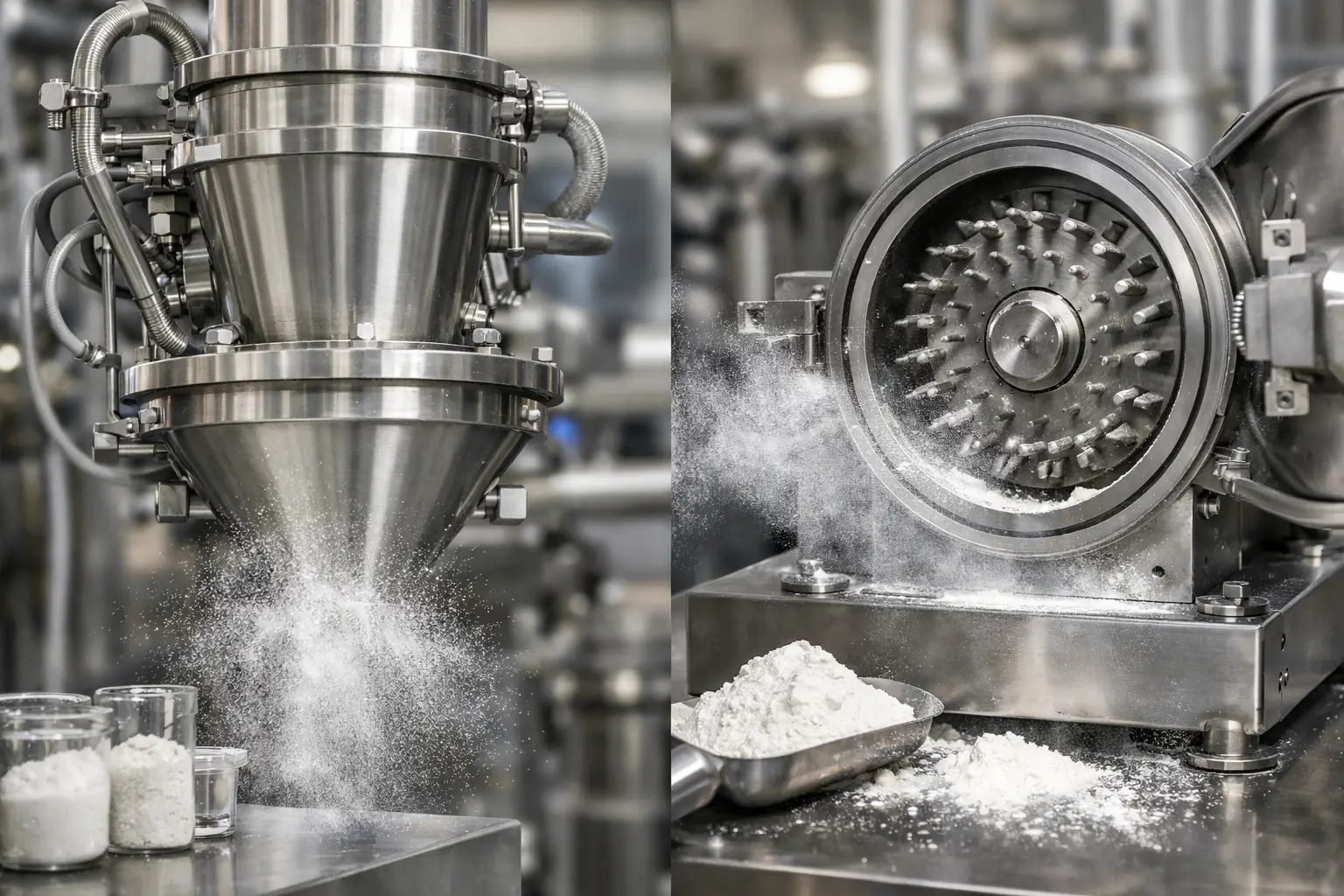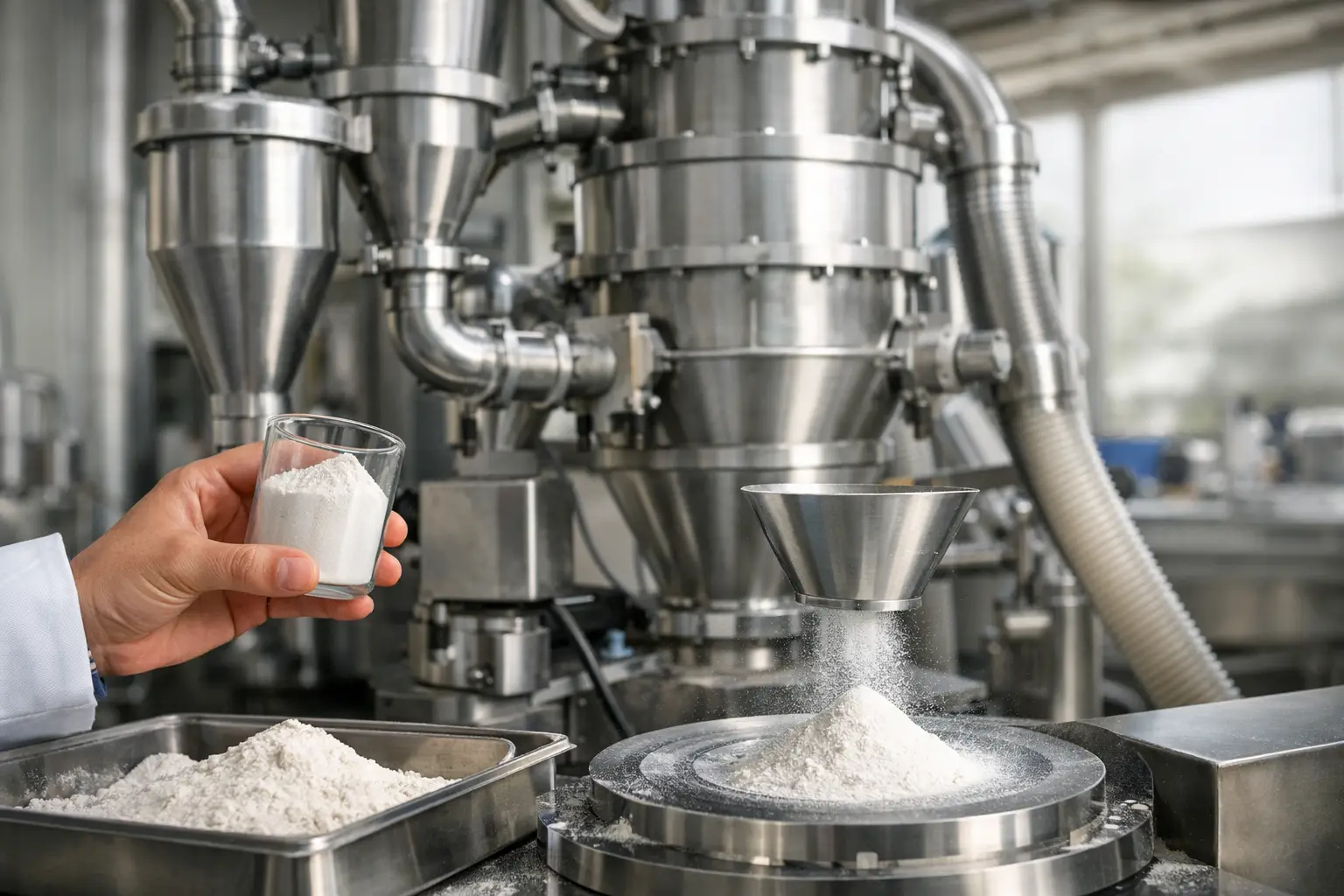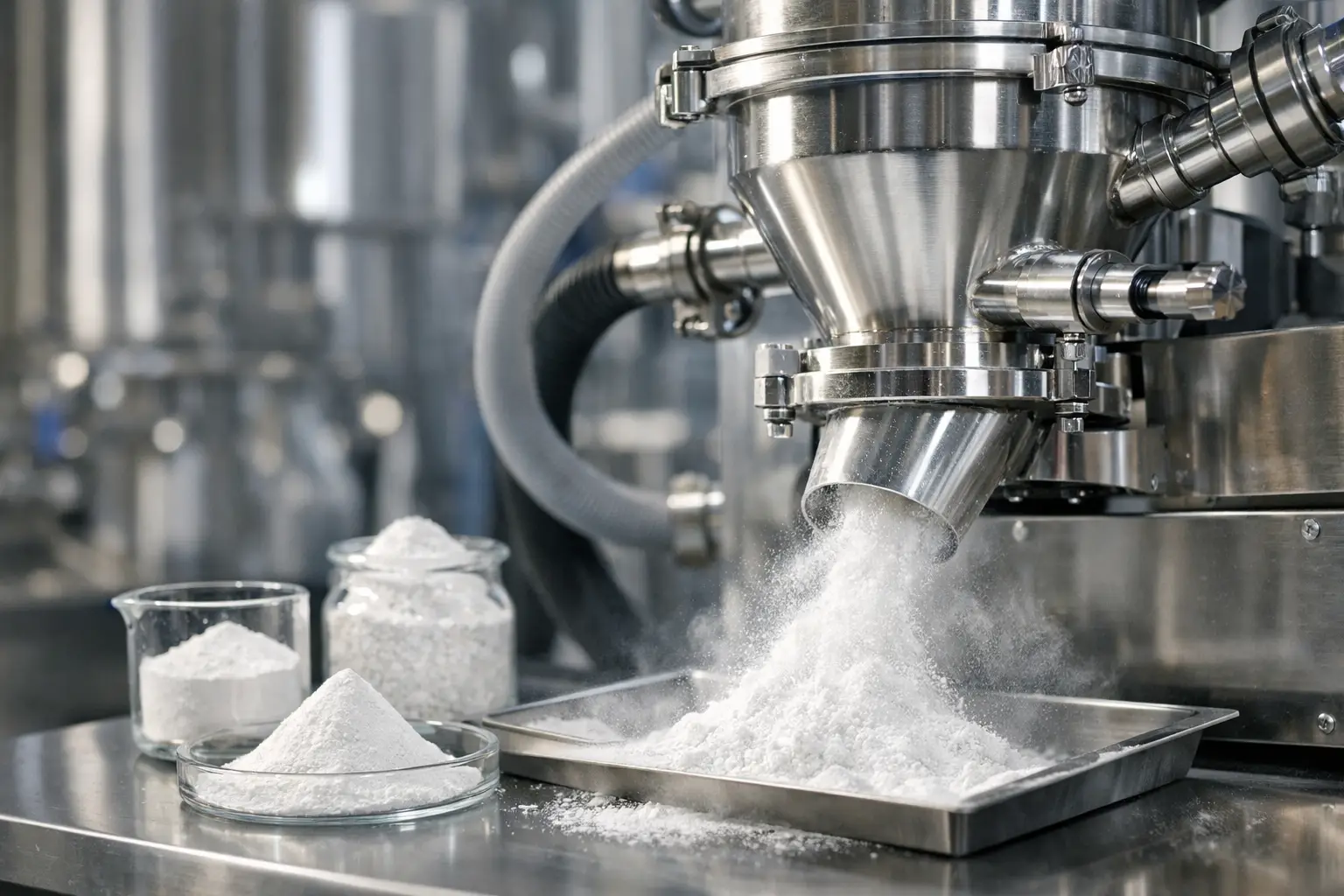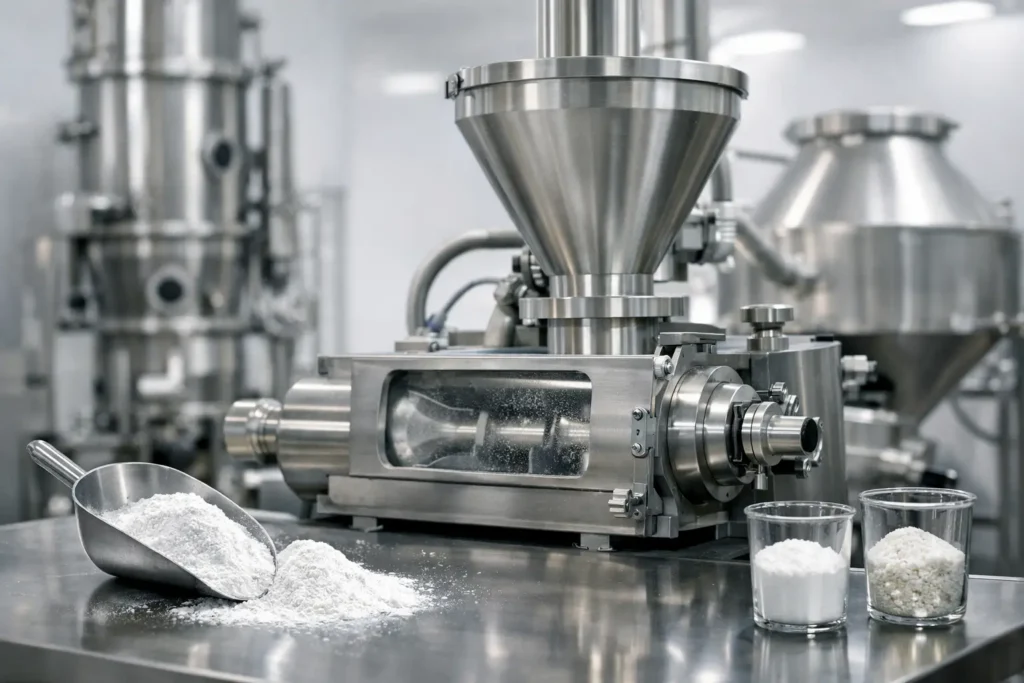
A milling system that works well on one chemical can fail quickly on another. The difference usually comes down to how the material behaves under stress, heat, airflow, and residence time. That is why selecting chemical powder processing equipment is rarely a matter of matching a nameplate capacity to a production target. For chemical manufacturers, the better question is whether the system can hold particle size, protect product integrity, control contamination, and run reliably under real operating conditions.
In chemical powder processing, small shifts in particle size distribution can create larger problems downstream. Flowability changes. Blending becomes less predictable. Dissolution rates move out of range. Dust loading increases. Packaging performance drops. Even a modest amount of heat generated during milling can alter sensitive compounds or create handling concerns with low-melting or reactive materials. Equipment selection has a direct effect on product quality, operating cost, and plant uptime.
What chemical powder processing equipment must do well
The most effective chemical powder processing equipment does more than reduce size. It must process material consistently, manage heat, maintain cleanliness, and support stable throughput over time. That sounds straightforward, but in practice, each of those requirements can pull the system design in a different direction.
A high-speed impact mill may deliver strong throughput, but it may also introduce more heat than the material can tolerate. A finer grinding solution may achieve the target top size, yet produce too many fines for the application. A system designed for flexibility may handle multiple products, but require more validation and cleaning effort between runs. There is no universal best machine. There is only the right configuration for the material, the specification, and the production environment.
For that reason, process engineers should evaluate equipment based on the full process requirement, not just final micron size. Feed condition, moisture, abrasiveness, bulk density, explosibility, and contamination sensitivity all matter. So do upstream and downstream constraints such as feeder stability, dust collection, conveying method, and packaging or reactor performance after milling.
Matching equipment type to material behavior
Different milling technologies solve different problems. The most reliable selection process starts with the material itself.
Jet mills for fine particle control and low contamination
Jet mills are often chosen when very fine particle size is required and contamination must be kept low. Because particle size reduction occurs through particle-on-particle impact in a high-velocity gas stream, there is limited mechanical contact with internal grinding components. That can be a major advantage for high-purity chemicals, abrasive materials, and applications where wear from metal surfaces is a concern.
Jet milling also helps when heat sensitivity matters. Compressed gas expansion can reduce temperature during processing, making the technology suitable for certain products that degrade under conventional impact milling. The trade-off is throughput and energy use. Jet mills can be the right answer for demanding specifications, but they should be selected with a clear view of operating cost and capacity requirements.
Air classifier mills for controlled top size and flexibility
Air classifier mills combine impact milling with internal classification, allowing the system to control top size more precisely than a basic impact mill alone. For many chemical powders, this creates a practical balance between fineness, throughput, and operational efficiency.
These mills are often well suited for applications where a tighter particle size distribution is needed without moving into the finer end of jet milling. They can also offer process flexibility across multiple products. Still, flexibility has limits. Changes in hardness, moisture, or feed behavior can affect internal classification performance, so actual material testing remains essential.
Hammer, pin, and universal mills for broader industrial duty
Hammer mills, pin mills, and universal mills remain important in chemical manufacturing because they handle a wide range of materials and production rates. For coarser reductions or intermediate grinding steps, they can provide dependable throughput with relatively straightforward operation.
Their suitability depends heavily on the application. A hammer mill may work well for friable materials but struggle where tighter particle control is needed. A pin mill can be effective for certain crystalline or brittle chemicals, yet may generate too much heat for temperature-sensitive products. Universal mills offer configuration flexibility, which can be valuable when processing multiple materials in the same facility. The key is to avoid treating general-purpose equipment as a universal solution.
Cryogenic grinding for heat-sensitive or elastic materials
Some materials simply do not process well at ambient conditions. Low-melting chemicals, waxy materials, and elastic products may smear, agglomerate, or coat the mill internals during conventional grinding. In those cases, cryogenic grinding can stabilize the process by making the material more brittle and easier to reduce.
Cryogenic systems introduce additional complexity and operating cost, so they are not the default choice. But when ambient milling leads to poor yield, unstable operation, or product degradation, the higher process control can justify the investment.
Process factors that matter more than equipment horsepower
When evaluating systems, horsepower often gets too much attention. It matters, but it does not tell you whether the process will be stable or whether the product will meet specification over extended production runs.
Feed uniformity is one of the most overlooked variables. Even high-performance mills struggle when feed rate fluctuates or feed particle size varies too widely. Inconsistent feeding changes residence time, internal loading, and final particle distribution. A well-designed system includes appropriate feeding, metering, and air handling rather than treating the mill as an isolated machine.
Heat generation is another critical factor. In chemical applications, temperature rise can affect more than product quality. It can change flow properties, increase sticking, accelerate wear, or create safety concerns. The right system may require controlled airflow, cooled process gas, lower tip speed, staged reduction, or cryogenic assistance.
Wear resistance should also be evaluated early. Abrasive chemicals can shorten component life quickly, which affects both maintenance cost and contamination risk. Material of construction, liner selection, and component accessibility all influence long-term performance. Lower purchase price does not mean lower operating cost when internal parts require frequent replacement.
Contamination control and system cleanliness
For many chemical producers, contamination control is as important as particle size. That includes metallic contamination from wear, cross-contamination between products, and environmental contamination from poorly contained powder handling.
Closed-loop or tightly integrated systems can improve containment, reduce housekeeping burden, and support safer operation with dusty or potentially hazardous powders. Depending on the application, contamination control may also require polished contact surfaces, specialized alloys, wear-resistant ceramics, or clean-in-place considerations.
Cleaning access should never be treated as a minor maintenance detail. If the process requires frequent product changeovers, sanitation checks, or internal inspection, equipment that is difficult to open and clean becomes a production constraint. The best design balances containment with serviceability.
Why system integration changes performance
A chemical milling line is rarely just a mill. Real production performance depends on how the feeder, mill, classifier, cyclone, filter, conveying equipment, controls, and discharge package work together. Poor integration creates bottlenecks that are often misread as equipment limitations.
For example, an undersized dust collector can reduce airflow stability and alter classification efficiency. A poorly selected feeder can cause surging that looks like milling inconsistency. Inadequate controls can make it difficult to hold repeatable operating conditions from batch to batch. That is why engineered process solutions often outperform standalone machine purchases, even when the core mill technology is similar.
Manufacturers evaluating new installations or upgrades should ask whether the supplier understands the total process. That includes startup behavior, maintenance access, control philosophy, operator interaction, and future scalability. At DP Pulverizer Americas Inc., that system-level perspective is often what separates a workable installation from one that performs reliably for years.
How to evaluate equipment before you buy
The most practical path is application-based testing supported by clear production goals. Material trials help determine achievable particle size distribution, throughput, temperature profile, and wear behavior before capital is committed. They also reveal process issues that may not appear in a specification sheet.
It helps to define success in operational terms, not just technical ones. Ask what throughput must be sustained at spec, how often the system will change products, what level of maintenance is acceptable, and how sensitive the material is to heat, moisture, or contamination. If the application may scale later, assess whether the selected platform can move from pilot to production without changing the product profile.
Procurement teams often focus on acquisition cost, while engineering teams focus on performance. Both are valid, but neither tells the full story on its own. The better measure is long-term operating value – reliable output at specification, with manageable maintenance, acceptable energy use, and minimal unplanned downtime.
Chemical manufacturers do not need more generic equipment options. They need systems built around how their materials actually behave in production. The right choice in chemical powder processing equipment is the one that supports stable performance when the process is running at full demand, not just when the brochure looks good.