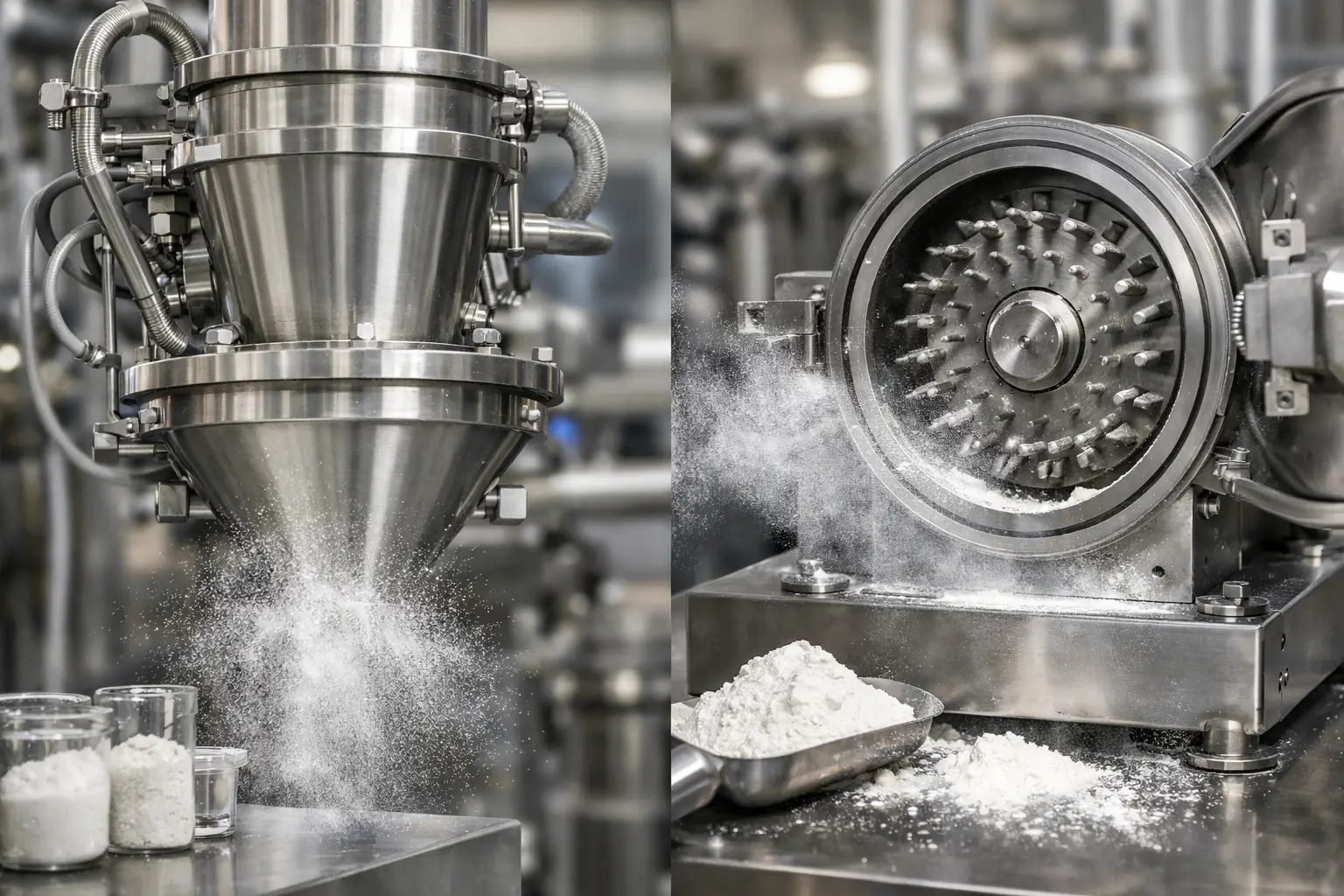
A jet mill performance review usually starts after production problems show up in numbers that are hard to ignore – broader particle size distribution, lower yield, more rejects, rising compressed air costs, or throughput that no longer matches demand. In high-value powder processing, jet mill performance is not defined by fineness alone. It is defined by how consistently the system reaches target particle size while protecting material integrity, supporting uptime, and fitting the realities of plant operation.
For process engineers and plant leaders, that distinction matters. A jet mill can produce excellent results on one formulation and become a bottleneck on another. It can reduce contamination risk in one application and create unnecessary energy cost in another. Reviewing performance correctly means looking past headline micron targets and evaluating how the entire system behaves under real production conditions.
What a jet mill performance review should actually measure
The most common mistake in a jet mill performance review is treating particle size as the only metric that matters. Final particle size is important, but it is only one part of the operating picture. A useful review should connect particle size distribution to throughput, yield, temperature sensitivity, contamination control, energy demand, and repeatability from batch to batch or run to run.
In practice, the best-performing jet mill is not always the one that produces the finest powder. It is the one that produces the required specification with the least process disruption and the best long-term operating value. If a system reaches an ultra-fine target but sacrifices throughput, increases compressed gas consumption, or creates unstable results across shifts, the apparent performance advantage can disappear quickly.
This is why manufacturers should review performance across the full process window. Feed rate, feed consistency, moisture, hardness, agglomeration tendency, and upstream conditioning all affect jet mill behavior. A mill that looks underpowered may actually be receiving poorly controlled feed. A system that appears energy-intensive may be compensating for an unrealistic target distribution.
Core factors that define jet mill performance
Particle size control and distribution
Jet mills are selected primarily for precise fine grinding, especially where low contamination and tight top-size control are required. But the real question is not whether the mill can produce fine particles. The question is how reliably it can maintain the target distribution at the required production rate.
For many applications, the distribution curve matters more than the average particle size. Pharmaceuticals, battery materials, specialty chemicals, and advanced minerals often require narrow particle size bands because oversized particles can affect performance, mixing behavior, dissolution, reactivity, or downstream handling. During review, manufacturers should compare not only D50 values, but also D90, top-size consistency, and the degree of variation across operating conditions.
Throughput under actual production conditions
Laboratory results can be misleading when scaled directly to production expectations. Throughput depends on more than installed mill capacity. Material flowability, bulk density, feed uniformity, and the required cut point all shape real output.
A practical jet mill performance review should ask whether the system can sustain target output without excessive recirculation, operator intervention, or quality drift. If throughput falls sharply when a tighter specification is required, that trade-off needs to be visible early. In some cases, a lower nominal fineness with better yield and higher line efficiency produces stronger overall economics.
Energy efficiency and compressed gas demand
Jet milling is effective because it uses high-velocity gas streams to create particle-to-particle impact. That mechanism is valuable for heat-sensitive and contamination-sensitive applications, but it also means utilities matter. Compressed air or inert gas consumption can become a major operating cost, especially in larger-scale continuous processes.
A strong review examines energy use per pound or kilogram of acceptable product, not just total utility draw. If the mill consumes significant energy to produce off-spec material that must be reworked, true performance is weaker than it appears. Energy review should also include support equipment such as air compressors, classifiers, cyclones, baghouses, and control systems.
Heat management and material integrity
Jet mills are often chosen because they can minimize heat compared with mechanical impact milling. That advantage is real, but it is not automatic. Some materials remain highly temperature-sensitive, and process conditions still need to be controlled carefully.
If a powder softens, smears, oxidizes, loses potency, or changes surface properties during micronization, the review must look at gas temperature, residence time, feed rate, and the possibility of inert operation. Performance is not just about reducing size. It is also about preserving the material characteristics that make the product commercially valuable.
Contamination risk and product purity
In industries where trace contamination is unacceptable, jet milling offers a strong advantage because it reduces direct mechanical contact with grinding surfaces. Still, contamination review should not stop at the mill chamber. Feed systems, valves, conveying, collector design, seals, and cleaning procedures all affect final purity.
This is especially relevant in pharmaceutical, nutraceutical, battery, and high-purity chemical applications. A jet mill performance review should assess wear surfaces, material of construction, cleanability, and the likelihood of cross-contamination between campaigns. When purity requirements are strict, system design details often matter as much as core milling technology.
Why performance varies by application
Material behavior changes everything
Jet mills do not process every material the same way. Friable materials often respond well and achieve fine targets efficiently. Tough, elastic, sticky, or moisture-sensitive products can behave very differently. Agglomerating powders may resist stable classification. Fibrous or plastic materials may require a different milling approach altogether.
That is why application fit should be central to any review. If the material has a tendency to cake, absorb moisture, or generate electrostatic issues, the system may need engineered adjustments in feed handling, gas selection, classifier settings, or downstream collection. There is no meaningful jet mill performance review without material-specific testing and process analysis.
The classifier and controls are part of the answer
Many jet mill evaluations focus too heavily on the grinding chamber and not enough on the classification and control strategy. In reality, classifier performance strongly influences final particle size consistency, yield, and throughput. Poor control logic or unstable feed presentation can make a capable mill perform poorly.
Automation also matters. When operators rely on manual adjustments to maintain target size, variation increases. A better system is one that responds predictably to changing conditions and gives the production team clear, repeatable control over process variables.
When a jet mill is the right choice – and when it is not
Jet milling is often an excellent choice for ultra-fine particle reduction, low contamination requirements, and temperature-sensitive materials. It is especially effective when manufacturers need narrow distributions and high product purity. For certain formulations, few technologies can match its combination of fineness and clean processing.
That said, jet milling is not always the most economical answer. If the target size is relatively coarse, if throughput requirements are very high, or if compressed gas costs are a major constraint, another milling technology may provide better value. Air classifier mills, pin mills, hammer mills, or cryogenic systems can outperform jet mills in specific use cases.
This is where engineering judgment matters more than equipment preference. The right review does not start with the assumption that a jet mill is always best. It starts with the required product outcome and works backward from there.
How manufacturers should approach a jet mill performance review
A credible review combines process data, application testing, and plant-level economics. Start with the specification that actually matters to the business: target particle size distribution, acceptable yield loss, contamination limits, thermal sensitivity, and required throughput. Then evaluate whether current or proposed jet mill performance supports those outcomes consistently.
Testing should reflect realistic feed conditions, not idealized samples prepared only for demonstration. Production teams should also review cleaning time, maintenance demands, wear part life, and the effect of process variation upstream. A mill that performs well in isolation can still create problems if it does not integrate cleanly with the rest of the line.
For manufacturers planning expansion, scalability deserves close attention. A successful pilot result is useful only if it can be translated into stable commercial production. This is one area where an engineering-driven supplier such as DP Pulverizer Americas often adds value – not by recommending a standard machine first, but by evaluating how the complete process needs to perform over time.
The real value of the review
A good jet mill performance review does more than confirm whether a machine can hit a micron target. It shows whether the system supports product quality, operational efficiency, and long-term manufacturing reliability at the same time. That is the standard worth using, especially in industries where powder performance directly affects margin, compliance, and customer trust.
If your review leads to a tighter specification, better yield, or lower contamination risk, that matters. If it also helps your team avoid an expensive mismatch between process requirements and equipment capability, it matters even more. The best milling decision is rarely about chasing the finest number on a data sheet. It is about building a process that performs predictably when production pressure is real.