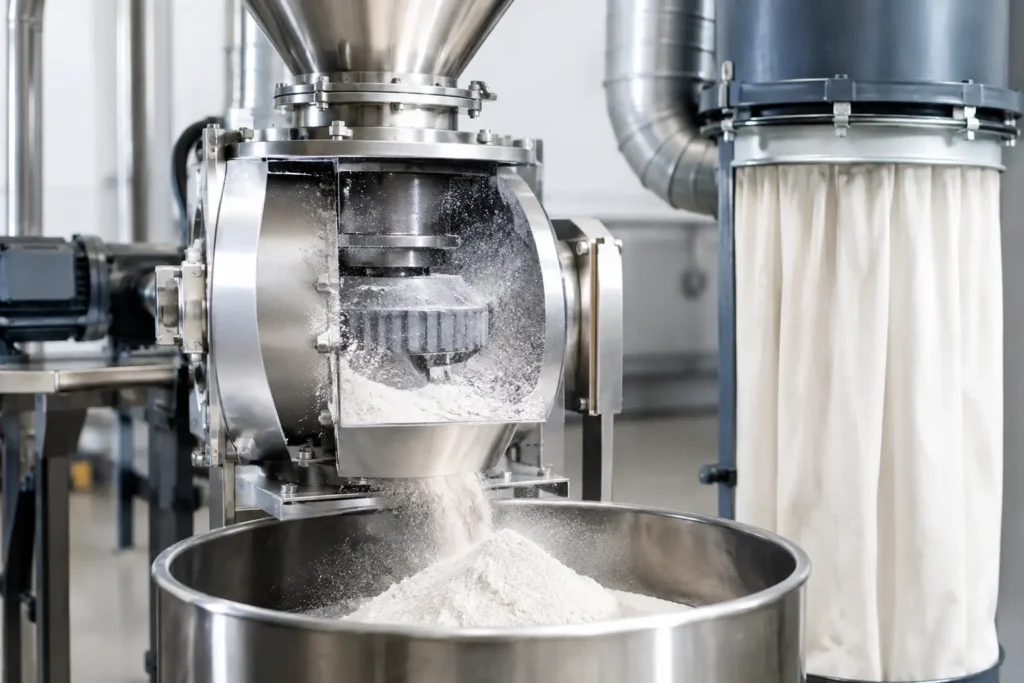
A fine powder escaping at a mill discharge is rarely an isolated housekeeping issue. It can signal lost yield, uncontrolled material transfer, filter loading, cross-contamination risk, or an airflow imbalance that will eventually interrupt production. Effective dust containment in milling must therefore be designed as part of the process, not added after a system is already operating.
For manufacturers processing pharmaceutical powders, food ingredients, chemicals, battery materials, minerals, or other high-value solids, the objective is straightforward: keep material within the intended process boundary from feed through collection and packaging. Achieving that objective requires more than placing a dust collector near the mill. It requires a clear understanding of how the material behaves, how the milling system moves air, and where pressure differences can pull dust into or out of the process.
Why Dust Containment Is a Milling System Issue
Milling creates conditions that make powder control difficult. Size reduction increases surface area, which can make material more dispersible and more likely to become airborne. Mechanical mills can generate pressure pulses, while pneumatic conveying and air classification introduce substantial process airflow. A small leak at a transition, gasket, rotary valve, or sampling point can become a visible dust release when the system is operating under positive pressure.
The consequences extend beyond the immediate work area. Escaped dust can reduce batch yield, contaminate adjacent equipment, increase cleaning time, and accelerate wear on surrounding components. In regulated applications, it can complicate validation and documentation. Where combustible dust is present, containment also supports the broader requirements of a properly engineered dust hazard management strategy.
The correct solution depends on the process. A low-density, highly aerated powder may demand a different collection and transfer approach than a dense mineral powder. Hygroscopic ingredients may bridge in collection hoppers. Heat-sensitive materials may require cooling strategies that affect airflow. The mill, feeder, classifier, collector, receiver, and discharge equipment must be evaluated as one connected system.
Start With Airflow and Pressure Control
Dust follows airflow. That principle should guide every containment decision.
A well-designed milling line establishes where air enters, where it travels, where it is filtered, and where pressure is relieved. In many systems, the goal is to maintain slight negative pressure at points where dust could otherwise escape, particularly around feed inlets, discharge interfaces, and material transfer stations. Negative pressure is not a universal answer, however. Excessive airflow can carry more fines into the collector, alter cut points in an air classifier, increase filter loading, or pull material out of the intended process stream.
Match Collection Capacity to the Process
Dust collectors should be sized for actual process airflow, not only for a nominal mill capacity. The design calculation must account for conveying air, classifier air where applicable, pickup points, leakage allowances, pressure drop through ductwork, and the resistance of filters as they load. An undersized collector can allow pressure to rise at the mill, driving powder through seals and connections. An oversized system can create unnecessary energy demand and disturb material behavior.
Filter media selection matters as much as collector capacity. Fine, cohesive, oily, moisture-sensitive, or electrostatically charged powders may require specialized media, surface treatments, or cleaning methods. Pulse-jet cleaning is common, but pulse frequency and intensity must be appropriate for the material. Aggressive cleaning can shorten filter life or release pressure fluctuations back into the process, while insufficient cleaning increases pressure drop and reduces airflow.
Keep Ductwork Practical and Cleanable
Duct design affects both containment and maintainability. Long runs, unnecessary elbows, and abrupt diameter changes add resistance and create locations where material can settle. For materials that tend to build up, cleanout access and geometry are essential. A duct system that performs well during initial commissioning but cannot be inspected or cleaned efficiently will become less reliable over time.
Where sanitary or high-purity production is required, smooth internal surfaces, appropriate finishes, and accessible connections support more effective cleaning. The appropriate construction standard depends on the application, but the underlying objective remains the same: prevent retained material from becoming a contamination source in a later run.
Seal the Material Path From Feed to Discharge
Containment is often lost at interfaces rather than within the mill itself. Feed hoppers, flexible connectors, rotary airlocks, screw conveyors, bag dump stations, and product receivers all need to maintain a controlled boundary while allowing reliable material movement.
Flexible connectors are useful for isolating vibration and accommodating equipment alignment, but they must be selected for the powder and operating conditions. A connector that is too thin may wear quickly. One that is poorly supported may collapse under vacuum or collect material in folds. Clamps, gaskets, and flange faces also require routine inspection because minor damage can create persistent leakage paths.
Rotary valves deserve particular attention. They are commonly used to discharge material from a collector or receiver while maintaining pressure separation, but actual performance depends on rotor clearances, material characteristics, rotational speed, and wear. Fine abrasive powders can enlarge clearances over time, increasing air leakage and reducing the valve’s ability to isolate pressure zones. In some applications, a double-valve arrangement, dense-phase transfer method, or alternative discharge system may provide better containment.
Design for the Material, Not Just the Mill Type
The same mill can process different materials with very different containment outcomes. A jet mill handling a fine, low-bulk-density powder may require precise control of process air and collection efficiency. A hammer mill processing a friable bulk solid may generate intermittent dust releases at the feed and discharge if the upstream and downstream equipment are not synchronized. Cryogenic grinding changes material brittleness and may reduce heat-related issues, but it also introduces temperature management and condensation considerations.
Material testing should examine more than target particle size. Bulk density, moisture content, flowability, electrostatic behavior, abrasiveness, explosibility characteristics, and sensitivity to heat all influence containment design. A powder that performs acceptably in a pilot trial may behave differently at production scale if transfer distances, feed rates, or collection velocities change.
This is why engineered process development is valuable before final equipment selection. It identifies whether the material needs a specific feeder, a particular receiver geometry, anti-static provisions, inerting, temperature control, or modified collection strategy. The cost of addressing these requirements early is generally lower than retrofitting a production line after recurring dust issues emerge.
Operational Practices That Protect Containment Performance
Even a well-engineered milling system needs disciplined operation. Filter differential pressure, collector discharge performance, airflow, and visible emissions should be part of normal operating review. A rising pressure drop can indicate filter blinding, while an unexpected pressure change at the mill may point to a blockage, a leaking valve, or a failed gasket.
Preventive maintenance should focus on the components most likely to degrade containment: filters, seals, flexible connectors, rotary valve tips, clamp connections, and dust collector cleaning mechanisms. Maintenance teams also need safe, defined procedures for opening equipment. Opening a receiver or filter housing before the system has fully settled can release accumulated powder and expose personnel unnecessarily.
Cleaning practices deserve equal attention. Compressed air used indiscriminately can redistribute fine powder rather than remove it. Vacuum systems designed for the material and hazard classification are usually a more controlled option. For products with strict cross-contamination requirements, cleaning verification should address difficult areas such as mill internals, discharge transitions, collector hoppers, and transfer connections.
Containment Must Support Production, Not Restrict It
The goal is not to create an overly complicated system that is difficult to operate. The best dust containment in milling supports throughput, product recovery, cleaning efficiency, and operator access at the same time. A completely enclosed line that frequently plugs, is difficult to inspect, or creates excessive pressure drop may introduce a different set of production problems.
Engineering trade-offs should be made deliberately. Higher conveying velocity can reduce settling in a line but may increase attrition or wear. Tighter seals can improve containment but may require more careful alignment and maintenance. Greater collection capacity can improve pressure control but adds capital cost and energy use. The appropriate balance comes from the material, the required particle size distribution, production rate, facility constraints, and quality expectations.
For new installations and upgrades, DP Mills approaches containment as part of the overall particle processing design. Integrating the mill with properly selected feeding, classification, collection, discharge, and control systems gives manufacturers a more reliable path to clean operation and consistent production.
A containment problem is often a process signal worth investigating. When a milling line holds pressure, transfers material predictably, and returns collected product where it belongs, operators spend less time reacting to dust and more time producing to specification.