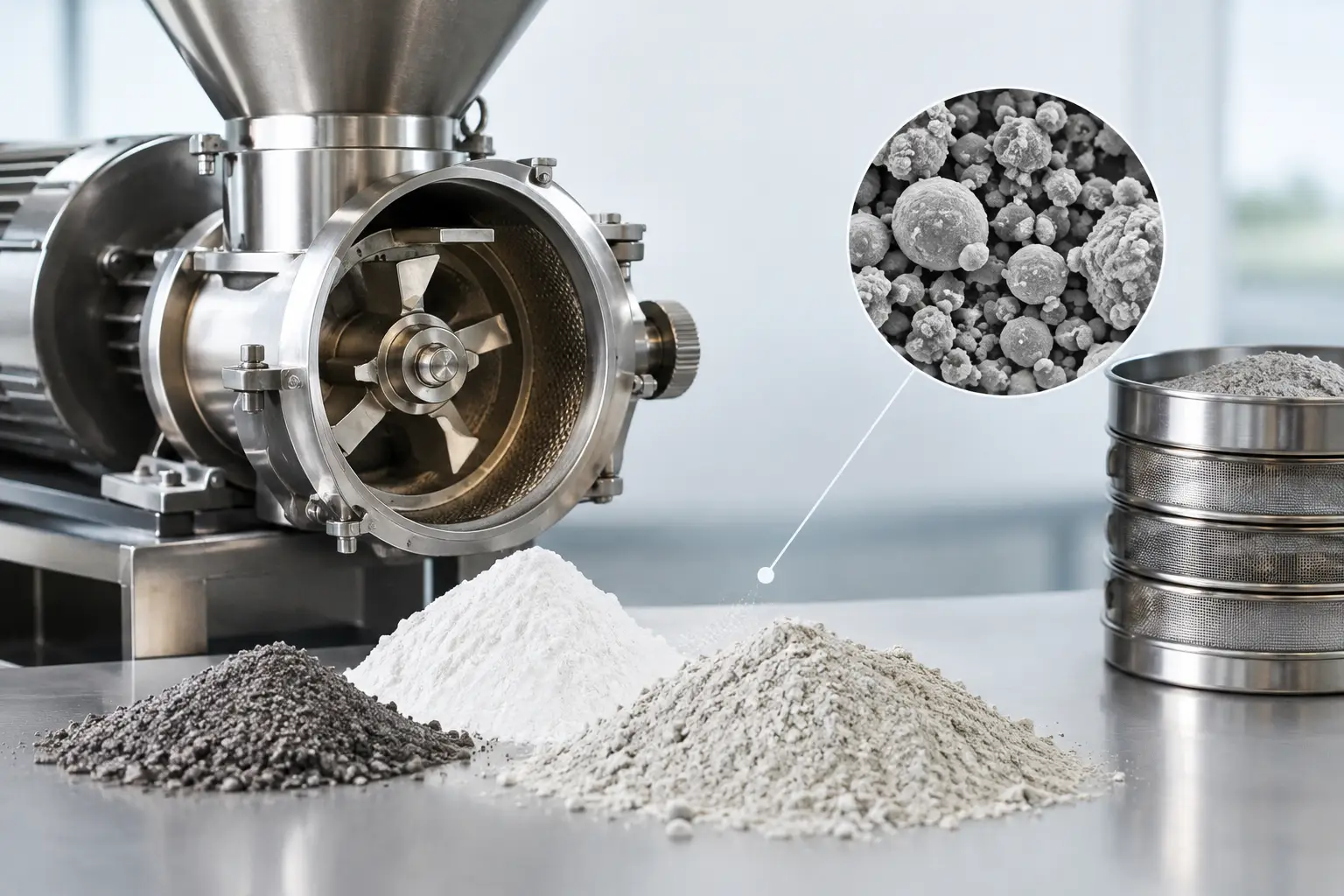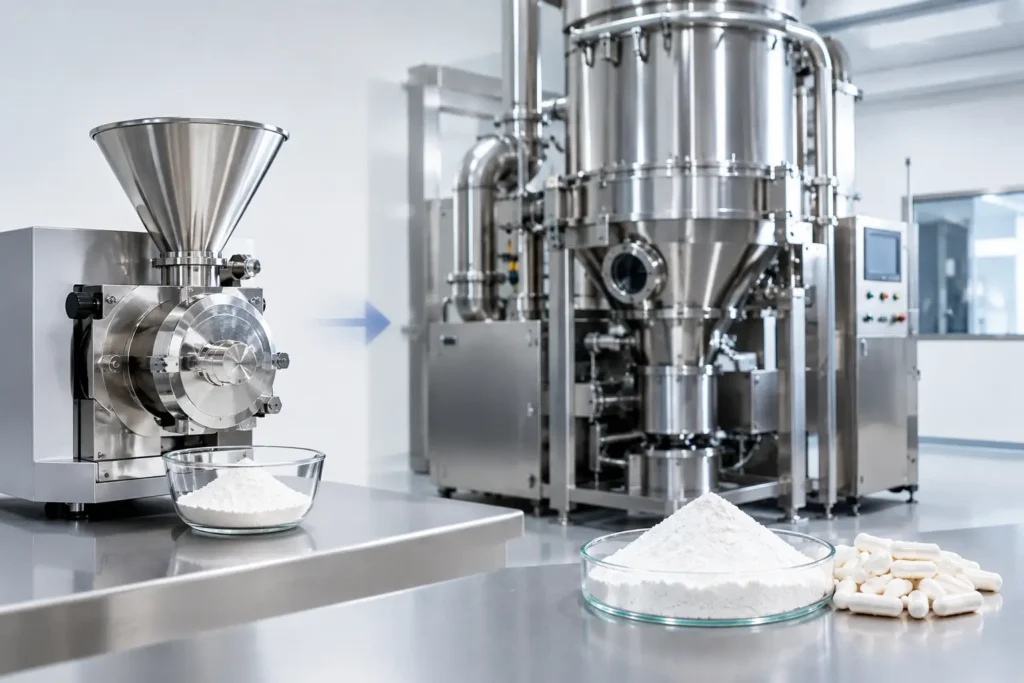
A successful pharma micronization scale up example rarely begins with a larger mill. It begins when the development team recognizes that a pilot result is a process data point, not a production recipe. A powder that reaches the required particle size distribution in a small jet mill may behave differently when feed rate, gas volume, equipment geometry, material handling, and campaign duration change at commercial scale.
For pharmaceutical manufacturers, the goal is not simply to reproduce a D50 value. The commercial process must consistently deliver the intended particle size distribution, yield, flow behavior, containment performance, and material quality at a throughput that supports the production plan. That requires scale-up work built around material behavior and process controls rather than nominal equipment capacity.
A practical pharma micronization scale up example
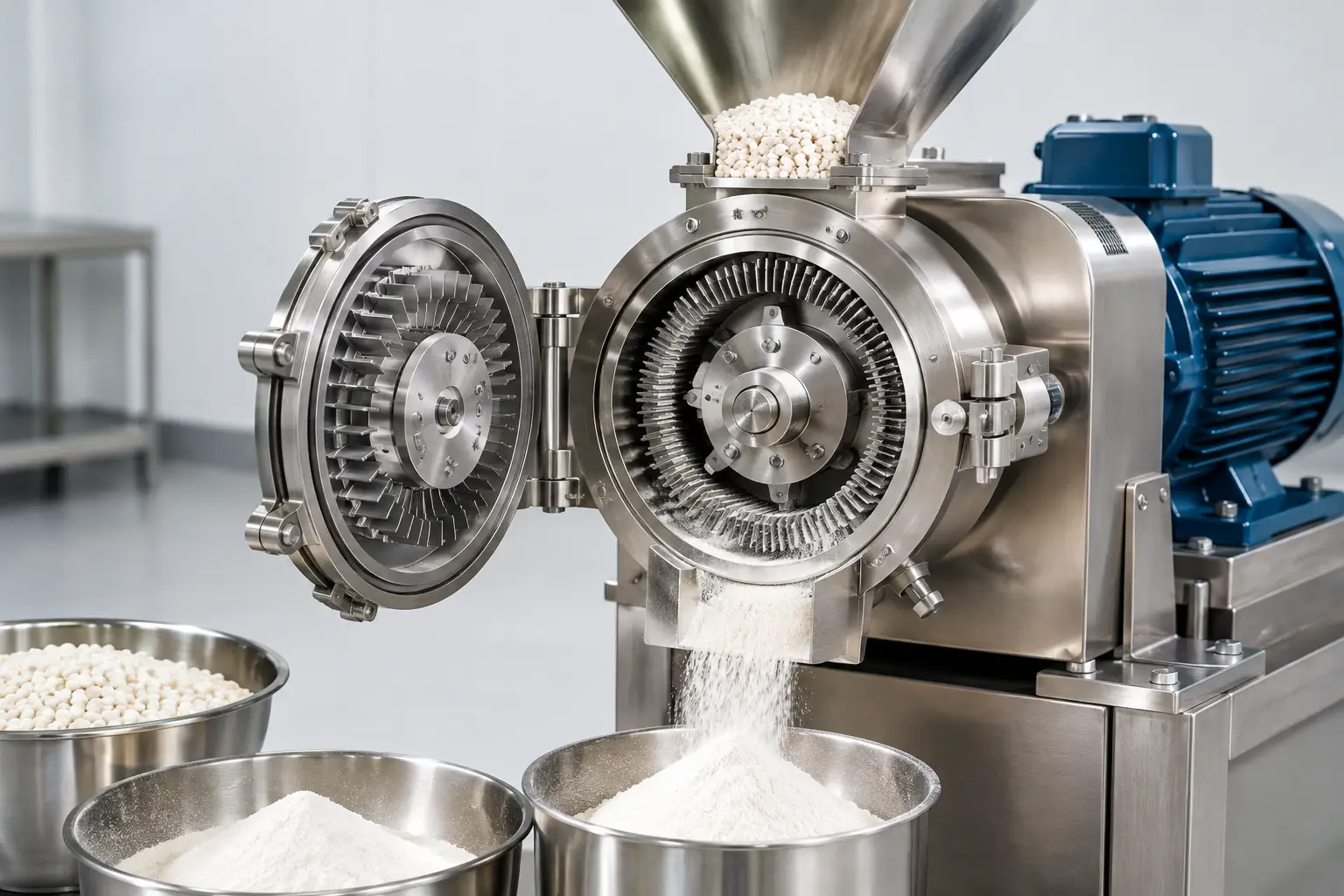
Consider a hypothetical development program for a poorly soluble active pharmaceutical ingredient. The target is a D90 below 10 microns to support dissolution performance in a solid oral dosage form. At pilot scale, the API is micronized in a fluidized-bed opposed jet mill at 5 kg/hr. The batch meets particle size specifications, and assay and impurity results remain acceptable.
The first commercial assumption might be that a mill rated for 10 times the throughput can operate at 50 kg/hr with the same settings. That assumption is risky. The commercial mill may have a different grinding chamber volume, classifier configuration, nozzle arrangement, air flow path, feeder design, and collection system. Each difference can influence particle residence time and the balance between particle fracture, classification, and removal from the mill.
A stronger scale-up plan starts by defining the process outcomes that must transfer. In this example, the team identifies D10, D50, and D90 targets; a limit on coarse particles; bulk density range; dissolution performance; residual moisture; related-substance limits; overall yield; and contained powder transfer requirements. Throughput is then treated as a controlled operating objective, not the only measure of success.
Establish the material’s operating window
Before increasing rate, the team evaluates the API’s behavior across a defined range of feed rates, grinding gas pressures, classifier settings, and feed conditions. A lab or pilot study may show that lower feed rates produce a finer D90 but reduce output substantially. At higher rates, particle loading in the chamber increases, classification becomes less selective, and the coarse tail grows.
The useful result is an operating window rather than one setpoint. For example, testing may establish that the API consistently meets its PSD target at a specific air-to-feed ratio, provided the feed material remains below a defined moisture limit and the feeder delivers a stable mass flow. This information is more valuable than a single successful pilot run because it identifies the conditions that protect product quality when normal manufacturing variation occurs.
Material properties matter throughout this work. Crystal habit, hardness, friability, electrostatic charge, moisture uptake, and tendency to agglomerate can all change mill response. A free-flowing API may scale predictably, while a cohesive material may require feeder agitation, controlled conditioning, or a different containment and transfer arrangement to prevent rate fluctuations.
What changes between pilot and commercial milling
Scale-up is not a matter of preserving every pilot setting. Some values should change because the equipment scale and process duty change. The engineering task is to preserve the process relationships that govern the final product.
In a jet milling application, grinding energy is associated with the process gas and particle collisions, but the result also depends on classifier performance and how quickly fine material leaves the milling zone. If the production system has more available gas volume but the feed rate rises faster than the effective classification capacity, the process can produce a broader distribution even when gas pressure appears comparable.
Feed control is often one of the most underestimated variables. A pilot feeder may operate steadily with a small batch, while a production-scale feeder must maintain consistent delivery through longer campaigns and larger intermediate bulk containers. Pulsing, bridging, rat-holing, or variable screw fill can cause PSD variation that appears to be a mill problem. In reality, the mill may be responding normally to an unstable feed profile.
Collection efficiency also deserves early attention. Fine pharmaceutical powders can adhere to filters, ducts, cyclone surfaces, valves, and transfer lines. A process that produces acceptable PSD at the mill outlet may still lose yield or experience segregation downstream. The production design should consider filter media, pulse-cleaning performance, line velocity, grounding, cleanability, and the number of powder-contact surfaces. For potent compounds, containment requirements add another layer of design work involving isolators, split butterfly valves, enclosed discharge, and safe filter handling.
Use comparable data, not nameplate capacity
A disciplined scale-up protocol compares pilot and production performance using normalized process data. Depending on the mill technology and material, useful measures can include feed rate, gas flow, gas pressure, classifier speed, mill differential pressure, product temperature, specific energy, and collection loss. The exact parameters vary by system, but the principle is consistent: correlate product quality with measurable process conditions.
For the hypothetical API, the team may run a commercial demonstration at 25 kg/hr, then 40 kg/hr, followed by a sustained run near the planned production rate. Particle size samples are collected at defined intervals rather than only at the beginning and end of the batch. This reveals whether the process drifts as the feeder, filter loading, or raw-material conditions change over time.
The resulting data may show that 50 kg/hr is technically possible but creates an occasional D90 excursion as the collection filters load. Operating at 42 kg/hr may provide a wider control margin, higher batch consistency, and better overall yield. That is not a scale-up failure. It is the kind of operating decision that protects commercial supply and reduces deviation risk.
Confirm downstream performance
Micronization should not be approved in isolation. The selected PSD must be evaluated in the next unit operation, whether that is blending, granulation, roller compaction, capsule filling, or tablet compression. Very fine particles can improve dissolution yet increase cohesion, reduce flow, raise dust generation, and complicate blend uniformity.
In the example, the micronized API meets its target PSD at the highest tested gas pressure, but the resulting powder has lower bulk density and performs poorly in direct blending. A slightly less aggressive milling condition produces a comparable dissolution outcome while improving downstream flow and reducing blend time. The preferred commercial setting should reflect the total process, not the milling step alone.
This is also where cross-functional review matters. Process development, analytical, engineering, quality, manufacturing, and EHS teams may evaluate different failure modes. Bringing those perspectives together before final equipment specification can prevent costly redesigns after installation.
Equipment selection should follow the process strategy
Jet mills are often well suited to pharmaceutical micronization when fine particle targets, low heat generation, and narrow PSD control are required. However, they are not the automatic answer for every material. An air classifier mill, pin mill, cone mill, or other technology may be more appropriate where the target size is coarser, throughput requirements differ, or the material has distinct sensitivity and handling characteristics.
The right production system is determined by the product specification and operating constraints: required PSD, throughput range, material abrasiveness, thermal sensitivity, containment level, cleaning validation needs, available utilities, and future product portfolio. A system designed only around today’s batch size can become a bottleneck when demand rises or when another product needs different processing conditions.
DP Mills approaches this decision as an integrated process question. The mill, feeder, air supply, classifier, collector, discharge method, controls, and containment interfaces must work as one production system. That engineering view is especially valuable when scaling a challenging API from development quantities to repeatable commercial output.
Build commercial confidence with a staged plan
The most reliable path is typically staged: characterize the material, establish the operating window at pilot scale, verify the process on production-representative equipment, and conduct a sustained confirmation run. Each stage should produce data that informs the next, including PSD trends, yield, mass balance, cleaning observations, and downstream performance.
A written scale-up plan should also define what constitutes an acceptable result before trials begin. If a team waits until after a run to decide whether a wider D90, lower yield, or reduced throughput is acceptable, the learning cycle becomes slower and less defensible. Clear acceptance criteria keep technical and operational decisions aligned.
Commercial micronization succeeds when production conditions are designed into the development process early. Treat the pilot result as the starting point, identify the variables that truly control particle size and powder behavior, and verify the entire material path under realistic operating conditions. That approach creates a process with room to run, not one that only works under ideal trial conditions.