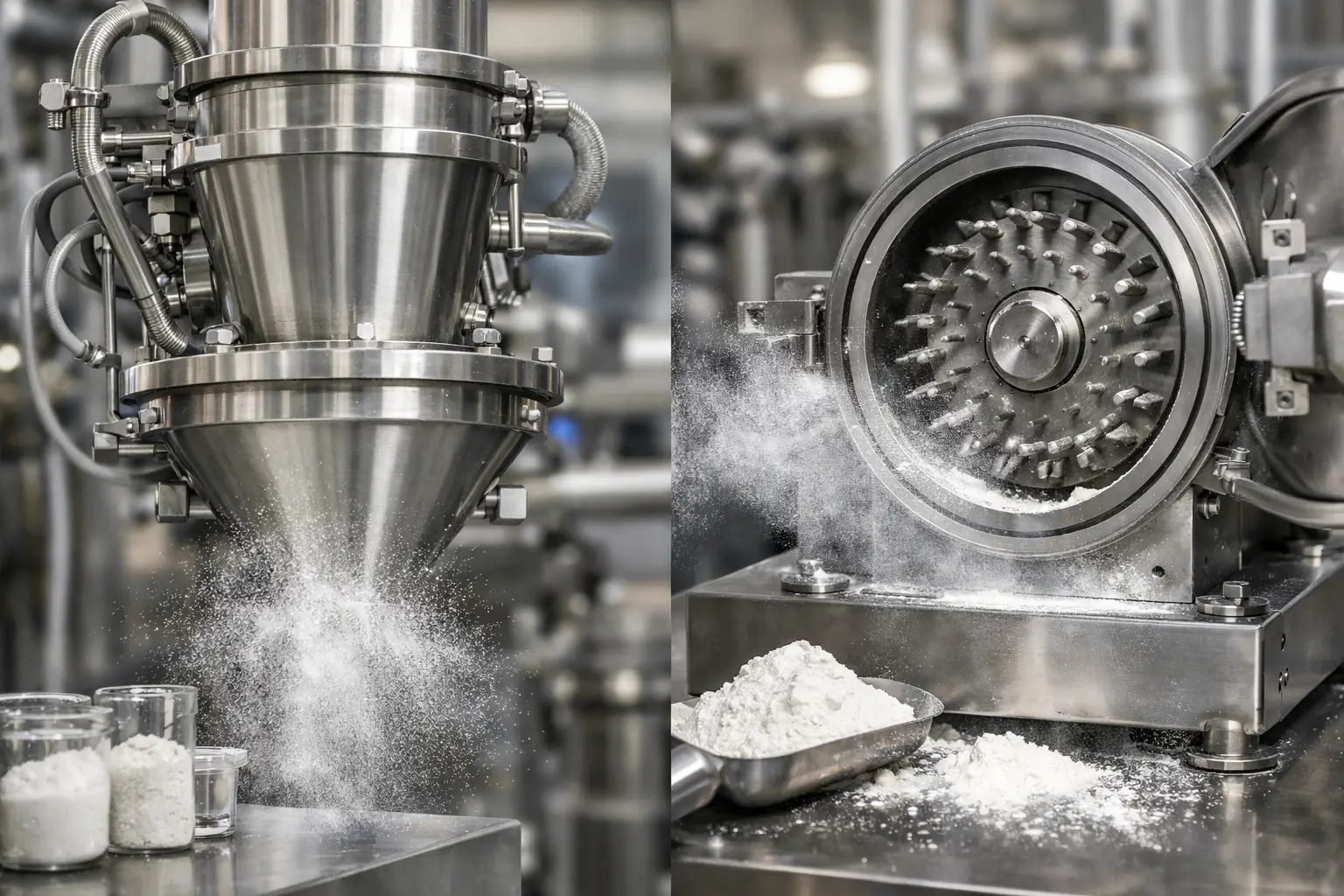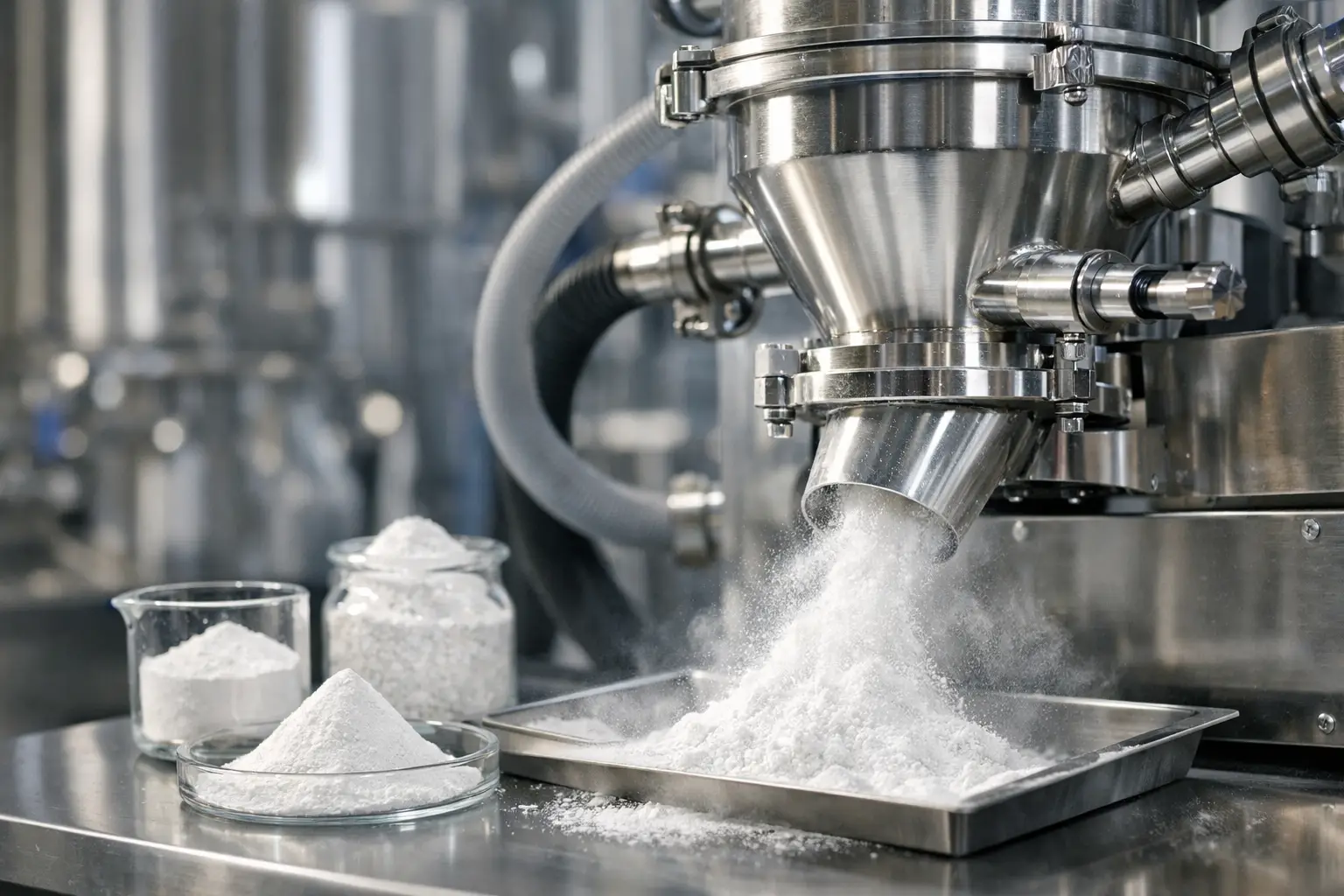
When a powder must be reduced to a tight micron or submicron range without exposing it to high mechanical contact, the jet milling principle becomes highly relevant. For many manufacturers, that need is not academic. It affects product performance, downstream flow behavior, blend uniformity, dissolution, reactivity, and the ability to hold a specification at production scale.
Jet milling is often described as a “no moving parts” grinding method, but that shorthand leaves out the part that matters most in real operations: how high-velocity gas flow, particle acceleration, and internal classification work together to control size reduction. Understanding that interaction is what helps engineers decide whether a jet mill is the right fit for a pharmaceutical API, a battery material, a specialty chemical, or an abrasive mineral.
What is the jet milling principle?
At its core, the jet milling principle relies on using compressed gas to accelerate particles to very high speeds inside a milling chamber. Rather than being crushed by mechanical grinding media or impacted by rotating hammers or pins, the particles collide with one another. Those repeated particle-to-particle impacts create fracture and size reduction.
This distinction is one of the main reasons jet milling is selected for demanding applications. Because the grinding energy comes primarily from fluid dynamics and inter-particle collision, the process can reduce contamination from mechanical wear and can limit heat generation compared with many conventional milling methods. That does not mean there is no wear or no temperature rise at all. It means the mechanism is fundamentally different, and in many cases better suited to materials that are heat sensitive, purity sensitive, or difficult to process with contact-intensive equipment.
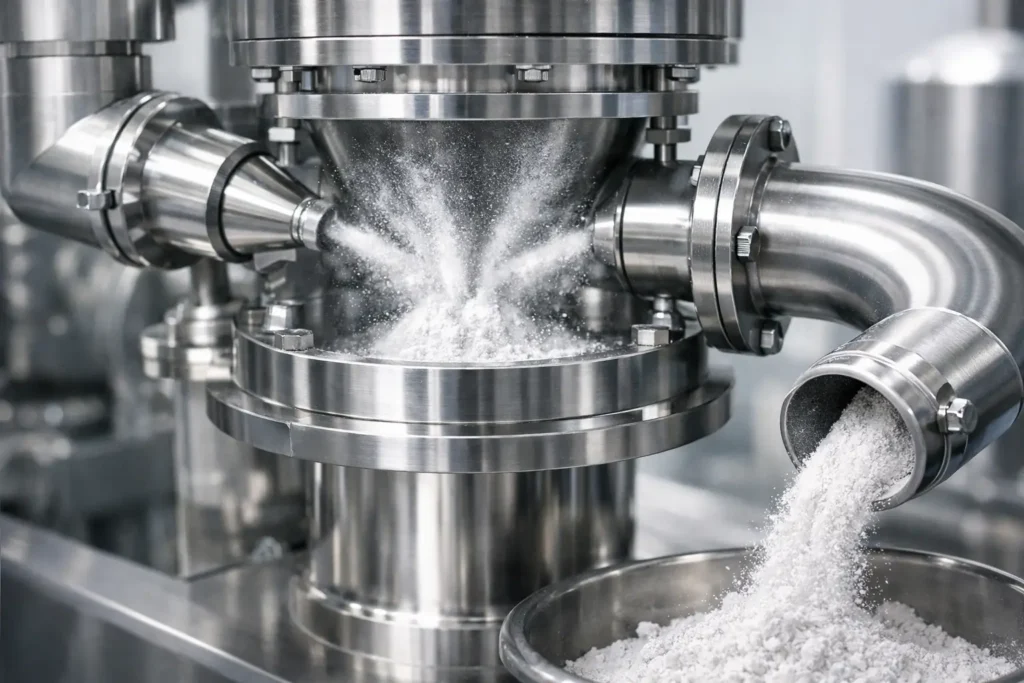
In a typical system, compressed air or an inert gas enters the grinding chamber through nozzles. As the gas expands, it creates high-velocity jets that entrain and accelerate the feed particles. Inside the chamber, those particles collide at sufficient energy to fracture along their natural weaknesses. Finer particles are then carried away by the gas stream, while coarser particles remain in the grinding zone longer until they are reduced further.
How size reduction actually happens inside a jet mill
The mechanics of jet milling are simple in concept but sensitive in practice. Particle size reduction depends on enough collision energy being generated and maintained inside the chamber. That energy is influenced by gas pressure, nozzle design, chamber geometry, feed rate, solids loading, and the physical behavior of the material itself.
Brittle materials generally respond well because they fracture when subjected to high-speed impact. Hard materials can also be processed effectively, although wear considerations and throughput expectations need to be evaluated carefully. Ductile, elastic, or highly fibrous materials may not fracture efficiently under the same conditions. In those cases, another milling technology or a modified process approach may be more effective.
Internal classification also plays a central role. Jet mills are not just reducing particle size randomly. They are continuously balancing breakage and particle removal. In many fluid energy mills, fine particles are carried out of the grinding zone once they reach a certain cut point, while oversized particles remain in circulation. In opposed jet mills or spiral jet mills with integrated classification behavior, this selective retention is what helps produce narrow particle size distributions.
That is why the jet milling principle is best understood as a combination of micronization and in-process classification, not just impact fracture alone.
Why jet milling performs differently from mechanical mills
The main process advantage of jet milling is not simply that it can produce fine particles. Several mill types can do that. The value is that jet milling can often achieve very fine sizes with tighter control over contamination, thermal exposure, and particle distribution.
Mechanical mills rely on direct contact between moving components and the material. That can be efficient and cost-effective for many applications, especially at coarser target sizes. But as target particle size drops, especially into the low micron range, conventional technologies can struggle with heat buildup, broader distributions, or excessive wear.
Jet mills address those limits by replacing high-contact grinding mechanisms with fluid energy. For manufacturers processing pharmaceuticals, high-purity chemicals, advanced ceramics, battery materials, pigments, or specialty minerals, that difference can directly affect yield, product quality, and compliance.
There are trade-offs. Jet mills typically require compressed gas, which has a real operating cost. Throughput can also be lower than some impact-based mills, depending on the material and target size. If the application does not require micronization, contamination control, or tight size classification, a jet mill may not be the most economical choice.
Key variables that affect jet milling performance
A jet mill can only perform as well as the process conditions allow. In production environments, results are shaped by a small set of variables that deserve close attention.
Gas pressure and gas type
Higher gas pressure generally increases particle velocity and impact energy, which can improve size reduction. But more pressure does not automatically mean better performance. Excessive energy can increase turbulence, reduce classification efficiency, or create unnecessary operating cost.
Gas selection matters as well. Compressed air is common, but nitrogen or other inert gases may be required when processing oxidizable, flammable, or highly reactive materials. In those cases, safety and product stability are part of the milling equation, not secondary concerns.
Feed rate and solids loading
Underfeeding a jet mill can reduce collision frequency and lower milling efficiency. Overfeeding can flood the chamber, disrupt particle acceleration, and broaden the particle size distribution. The right feed rate creates a stable concentration of particles in the grinding zone so collisions occur at the energy level needed for controlled fracture.
This is one reason pilot testing matters. The ideal operating window is material specific, and it often shifts when a process moves from development to commercial production.
Material properties
Hardness, brittleness, moisture content, density, surface energy, and agglomeration tendency all affect performance. A free-flowing brittle powder behaves very differently from a cohesive fine chemical intermediate. Materials that smear, cake, or absorb moisture may require upstream conditioning or an alternative milling strategy.
Classification behavior
Fine particle removal is essential to efficiency. If fine material remains in the grinding zone too long, energy is wasted on particles that are already on spec. If oversized particles escape too early, product quality suffers. Chamber design and classifier performance determine how well the system balances both outcomes.
Where the jet milling principle fits best
Jet milling is especially well suited for applications that require fine particle size, low contamination, and controlled thermal exposure. Pharmaceutical and nutraceutical manufacturers often use it for APIs and functional ingredients where particle size affects dissolution and bioavailability. Chemical producers may select it for pigments, catalysts, and specialty compounds that demand narrow distributions and purity control.
In battery and advanced material processing, particle morphology and size consistency can influence downstream blending, coating, and electrochemical performance. In mineral and ceramic applications, jet mills are often used when hardness is high and a fine finished product is required.
That said, application fit always depends on the process target. If the required size is relatively coarse, if energy cost is the primary decision factor, or if the material responds better to impact or shear, another mill type may be the stronger choice. Engineering selection should start with the material and the production objective, not with the equipment category alone.
Common misconceptions about jet milling
One common misconception is that jet mills generate no heat. In reality, energy is still being introduced into the system, and temperature effects still need to be monitored. The benefit is that the process often reduces localized heat caused by mechanical contact.
Another misconception is that jet mills can process any material effectively. They cannot. Materials that are too soft, too elastic, or too adhesive may not fracture efficiently through particle-to-particle collision alone.
It is also a mistake to assume that achieving the smallest possible particle size is always the goal. In many industrial processes, the real requirement is a controlled distribution that performs consistently downstream. Over-milling can hurt flowability, increase dusting, or change bulk density in ways that create new process problems.
Why system design matters as much as milling theory
The jet milling principle explains the mechanism, but production success depends on the total system. Feed delivery, gas handling, product collection, containment, controls, and wear-resistant construction all influence real-world performance. A well-engineered mill is only part of the answer. The surrounding process must support stable operation, repeatable classification, and reliable product recovery.
This is where application knowledge becomes critical. The same core jet mill technology can behave very differently depending on whether it is integrated into a pharmaceutical containment suite, a chemical production line, or a high-throughput mineral process. DP Pulverizer Americas approaches jet milling with that broader process view because equipment performance is inseparable from how the system is engineered around the material and the plant.
For manufacturers evaluating fine grinding technologies, the practical question is not just how a jet mill works. It is whether the jet milling principle aligns with the product, the specification, and the operating economics of the process. When it does, jet milling can deliver a level of particle control and product integrity that few other technologies can match. The best next step is usually to test the material under realistic conditions and let the data define the right process window.