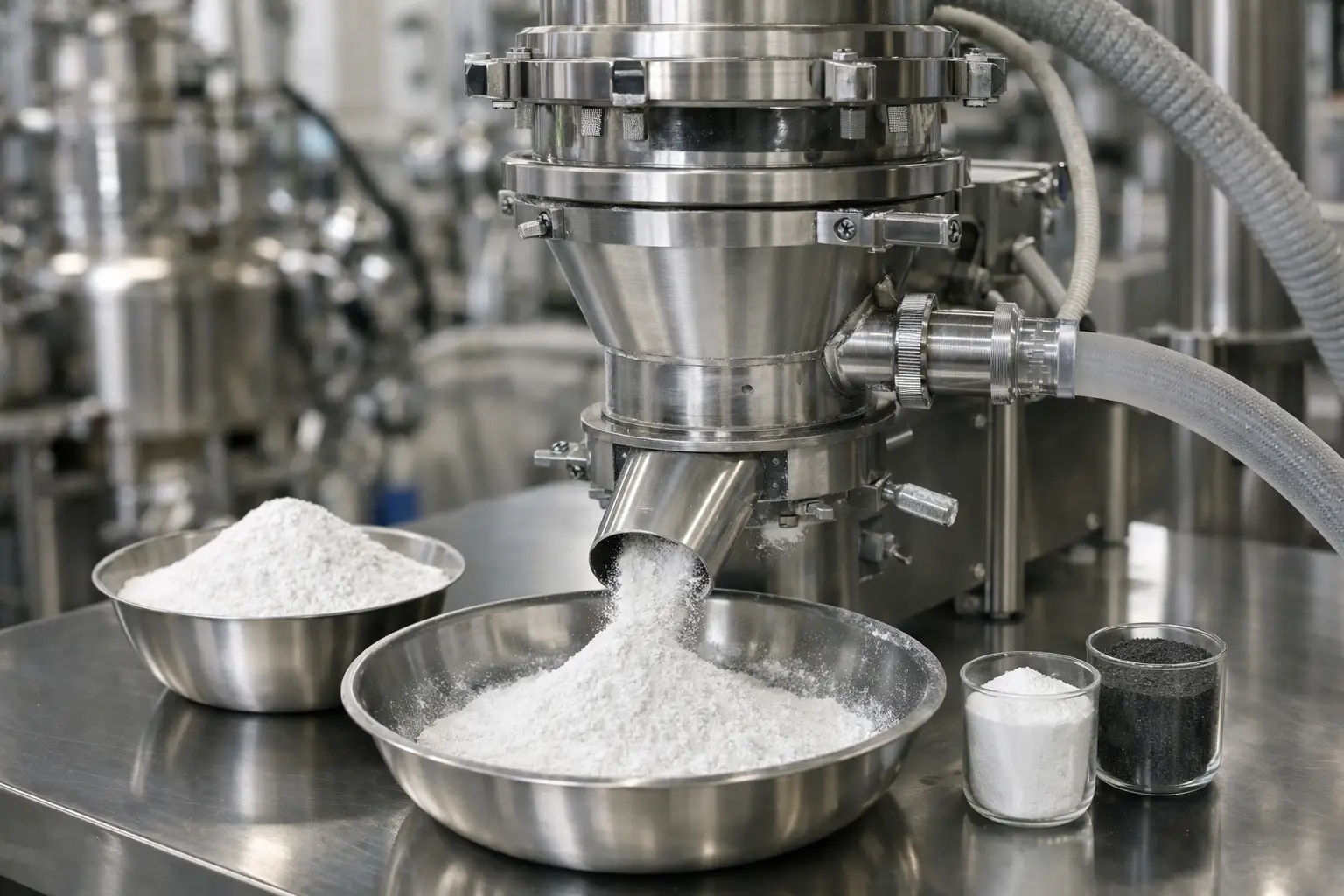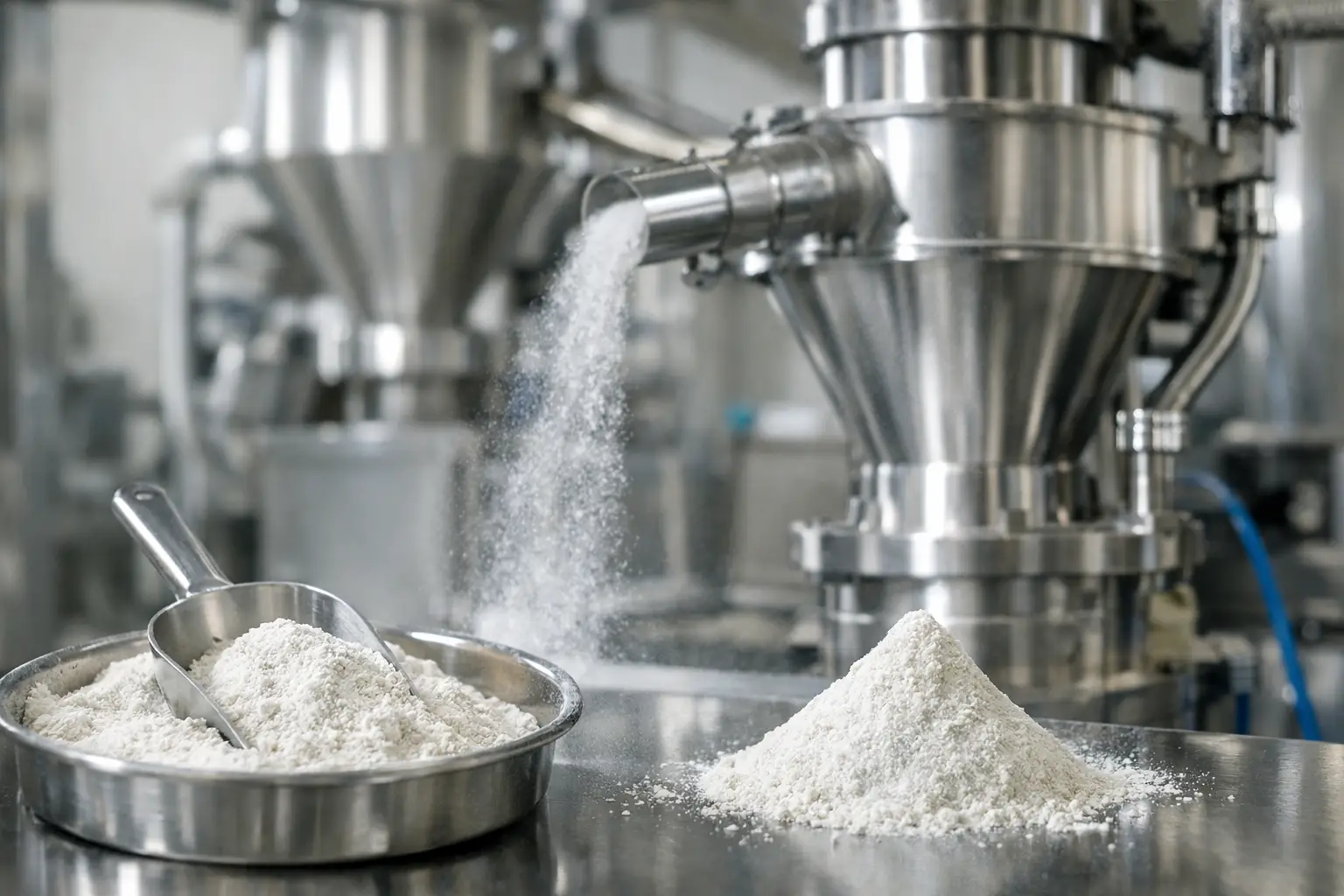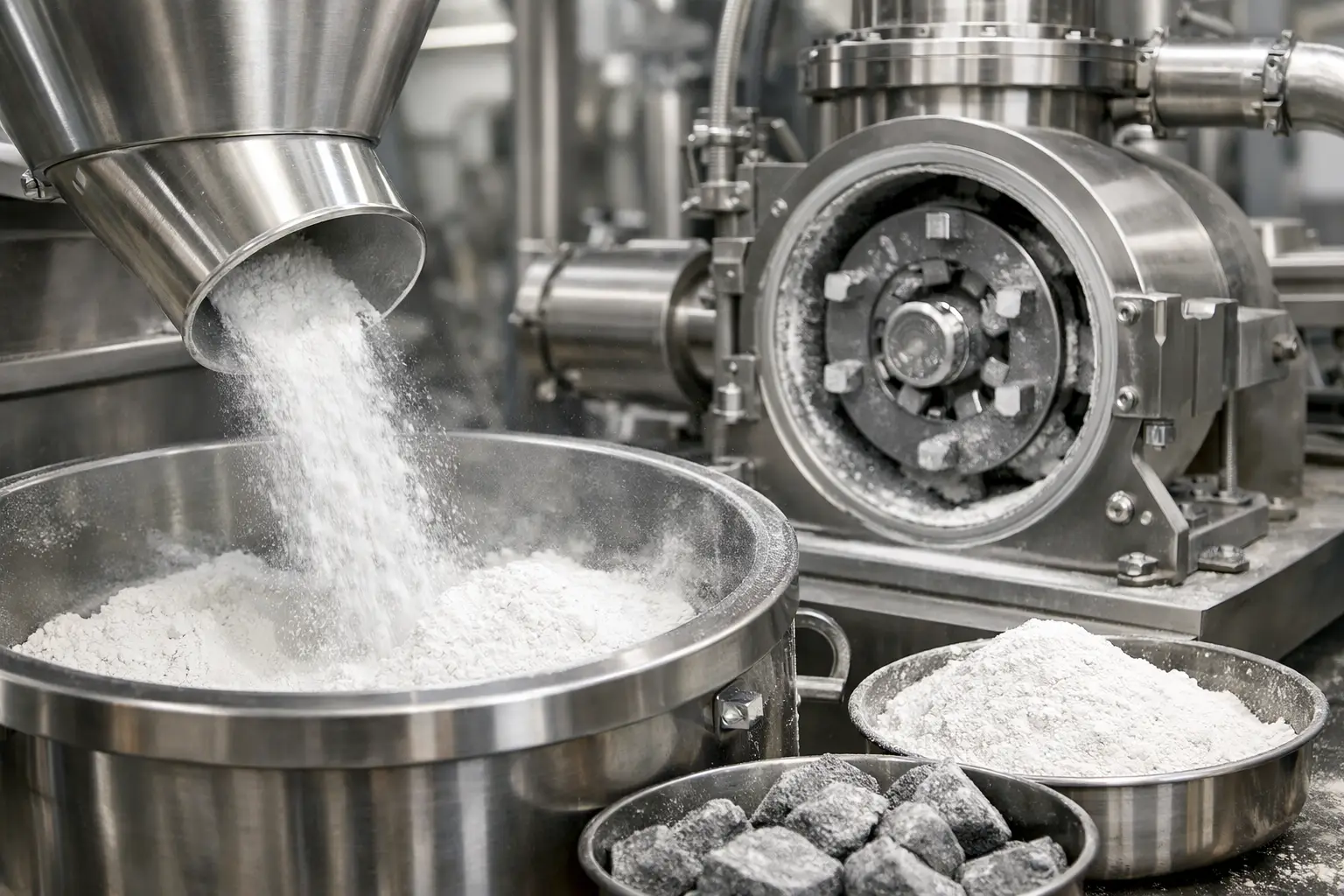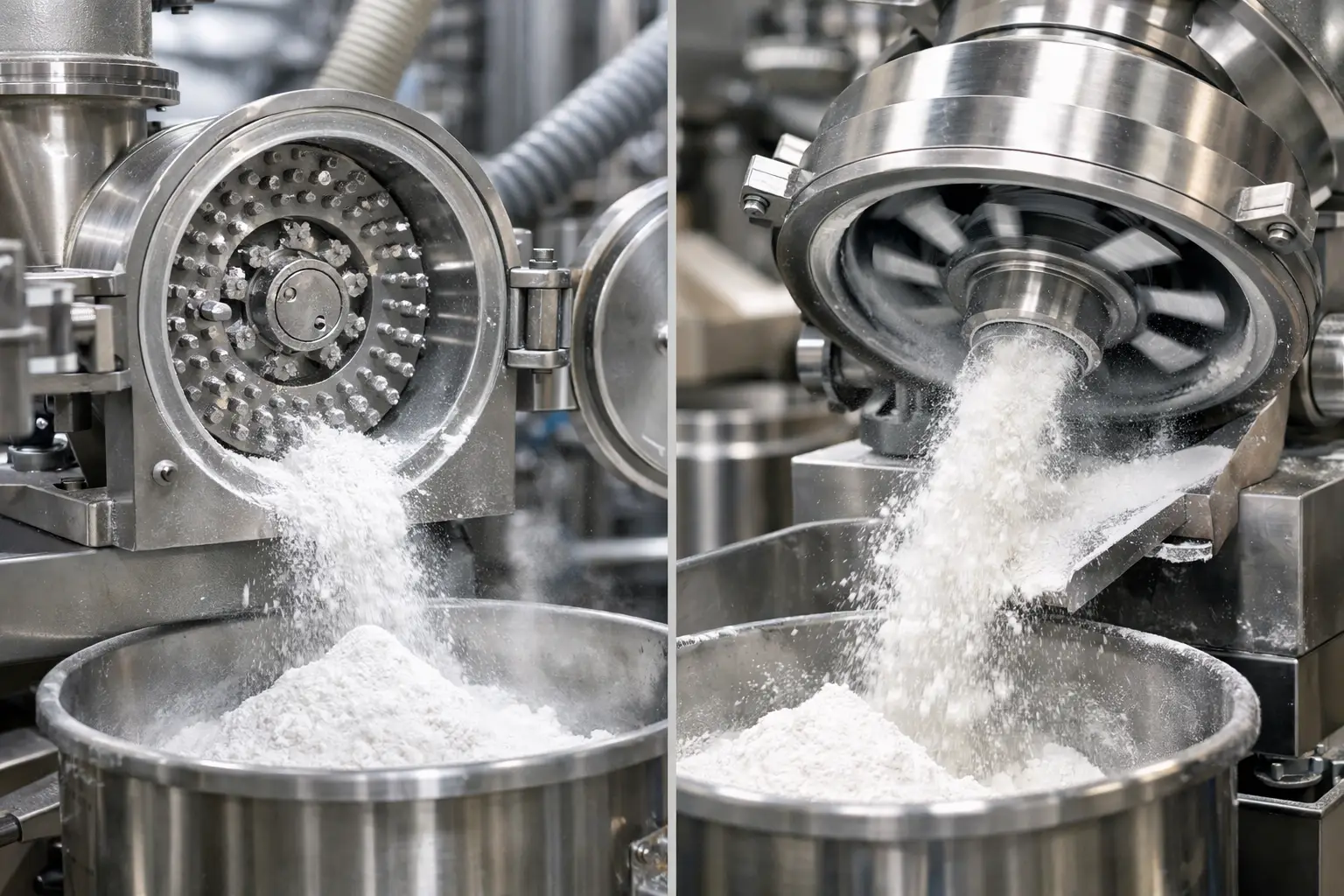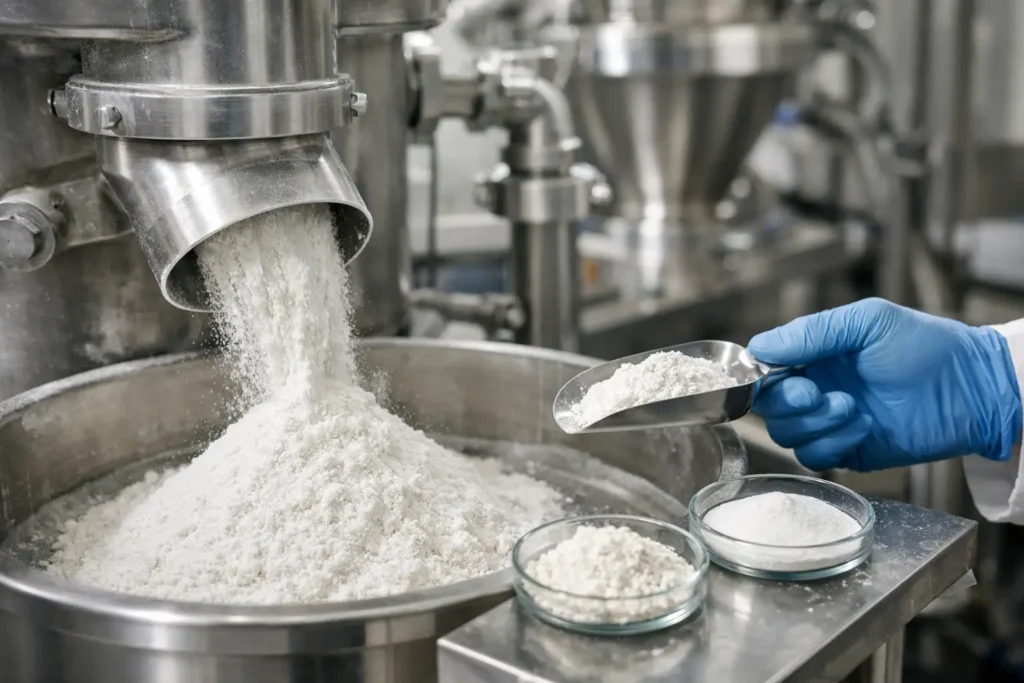
A powder can meet its average particle-size target and still create serious downstream problems. Wide particle-size distribution, segregated blends, variable moisture, agglomerates, and inconsistent bulk density can affect tablet weight, coating performance, dissolution, flow through hoppers, battery electrode quality, and finished-product appearance. Knowing how to improve powder uniformity starts with treating it as a process-wide requirement, not simply a milling result.
For manufacturers, the objective is not to produce the finest possible powder. It is to consistently produce material within a defined specification while maintaining throughput, material integrity, containment, and practical operating cost. That requires control of feed material, milling energy, classification, conveying, and verification methods.
Define What Uniformity Means for the Application
“Uniform powder” can describe several different characteristics. A pharmaceutical blend may require consistent active ingredient distribution and a narrow particle-size range. A food powder may need repeatable flow, instant dispersion, and controlled moisture. Battery, mineral, and advanced-material applications may place greater emphasis on particle morphology, low contamination, narrow top size, and stable tap density.
Before changing equipment settings, define the critical-to-quality attributes that affect the downstream operation. These commonly include particle-size distribution, often expressed as D10, D50, and D90 values; percentage of oversize or fines; bulk and tapped density; moisture; particle shape; and blend composition. The allowable range should reflect the performance of the final product, rather than an arbitrary laboratory target.
This distinction matters because tighter is not always better. Excessive fines can reduce flowability, increase dust loading, create handling losses, and make a material more prone to caking. In some applications, a controlled distribution with enough coarse fraction to support flow is more effective than an extremely narrow cut.
How to Improve Powder Uniformity at the Source
The most efficient corrections begin upstream. If incoming material changes from lot to lot, the mill is forced to compensate for differences in hardness, moisture, particle shape, temperature, or initial top size. That can produce variable results even when the equipment is operating correctly.
Establish incoming-material specifications that address the variables most relevant to the process. For example, hygroscopic powders may require a narrow moisture window before milling. Heat-sensitive materials may need controlled storage temperature and shorter residence time. Materials containing foreign matter, large lumps, or hard contaminants may require screening, magnetic separation, or pre-crushing before entering the primary mill.
Feed consistency is equally critical. An unstable feed rate changes the material bed, residence time, and energy applied to particles. Underfeeding may generate excess fines, while overfeeding can increase oversize, reduce classifier efficiency, and create temperature excursions. Use appropriately sized loss-in-weight feeders, screw feeders, rotary valves, or vibratory feeders based on the material’s flow properties. A feeder that bridges or pulses will transfer that instability directly into the finished powder.
Control Moisture and Agglomeration Before Milling
Moisture is a frequent source of apparent size variation. A powder may enter the mill as loosely agglomerated material, then break apart unpredictably during processing or transport. In other cases, moisture causes particles to adhere to machine surfaces, blind screens, or build deposits in ductwork.
Drying, conditioning, and environmental control should be considered part of the uniformity strategy. The right approach depends on the material. Some products benefit from dehumidified air and closed conveying. Others require cryogenic cooling because they soften, smear, or become tacky under ambient milling conditions. For materials that form soft agglomerates, a deagglomeration step may be more appropriate than aggressive size reduction.
Match Milling Technology to Material Behavior
Powder uniformity depends heavily on whether the selected mill produces the required breakage mechanism. A system that works well for brittle minerals may be unsuitable for heat-sensitive polymers, fibrous botanicals, or high-value pharmaceutical ingredients.
Hammer mills and universal mills can provide efficient reduction for many materials where a moderate particle-size range is acceptable. Pin mills are often effective for friable products and can offer higher-impact reduction. Cone mills are commonly selected for sizing, delumping, and low-energy conditioning where preserving material characteristics is a priority.
When fine powders and tighter distribution control are required, air classifier mills combine impact milling with internal classification. The classifier rejects particles that remain too coarse, returning them to the grinding zone until they meet the target cut. This can reduce oversize and improve consistency without relying entirely on fine screens.
Jet mills are often appropriate for ultra-fine applications, abrasive materials, and products where low contamination and minimal heat input are critical. Their performance depends on properly balanced grinding gas pressure, feed rate, classifier settings, and collection efficiency. They are not automatically the best choice for every fine-powder application, however. Compressed gas requirements and operating cost must be evaluated alongside quality benefits.
Cryogenic grinding can improve uniformity for materials that become elastic, oily, or thermally sensitive during conventional milling. Lower temperatures make many polymers, spices, nutraceuticals, and waxy materials fracture more cleanly. The trade-off is additional process complexity and cryogen consumption, which must be justified by the required product performance.
Use Classification to Control the Size Distribution
Milling alone reduces particle size. Classification determines which particles are allowed to leave the process. This distinction is central to controlling both oversize and excessive fines.
Screens can be effective for many applications, but their results depend on screen condition, open area, rotor speed, material flow, and the tendency of particles to agglomerate. Worn or damaged screens, partial blinding, and uncontrolled feed surges can widen distribution over a production run.
Air classification offers another level of control, particularly for fine powders. By adjusting air volume, wheel speed, and product feed rate, the process can set a more defined cut point and reduce coarse carryover. Air classification also supports closed processing, which can improve dust containment and protect materials from ambient humidity.
A practical system may use more than one separation stage. Pre-screening can remove foreign material and oversized lumps before milling, while post-mill classification controls the final top size. The right arrangement depends on throughput targets, allowable yield loss, material abrasiveness, and the value of the product being recovered.
Prevent Segregation After the Mill
A uniform mill discharge can become non-uniform before it reaches packaging or the next process step. Segregation occurs when particles separate by size, density, or shape during pneumatic conveying, gravity transfer, vibration, or bin filling. Fine particles may concentrate in one area while larger particles roll toward another.
Minimize unnecessary transfer points and long free-fall distances. Use mass-flow hopper design where appropriate, and avoid repeatedly filling and emptying intermediate containers. Pneumatic conveying velocity must also be balanced. Too little velocity can cause line buildup and unstable transport, while excessive velocity can create attrition, generate fines, and increase wear.
For blends, the order of addition and blending method require the same discipline as milling. A highly uniform blend can segregate during discharge if the equipment, container geometry, or transfer sequence is not designed around the powder’s properties. Sampling should therefore be performed at meaningful process locations, not only at the blender or mill outlet.
Validate with Representative Sampling and Data
Uniformity cannot be confirmed from a single sample. Powder processes naturally vary, and a sample taken immediately after startup may not represent material produced after hours of operation. Build a sampling plan that captures startup, steady-state production, and end-of-run conditions.
The most useful measurements typically include:
- Particle-size distribution, including fines and oversize fractions
- Bulk density, tapped density, and flow characteristics
- Moisture content and, where relevant, water activity
- Blend assay or component distribution for multi-ingredient products
- Product temperature, yield, and contamination indicators
Trend the data against operating parameters such as feed rate, rotor or classifier speed, air volume, mill temperature, differential pressure, and screen condition. This allows teams to identify cause and effect instead of relying on adjustments based only on operator experience.
Process analytical technology can add value where real-time measurement is justified. Online particle sizing, moisture monitoring, load measurement, and automated feeder control can reduce response time when the process begins to drift. For lower-volume operations, disciplined offline sampling and documented setpoints may provide sufficient control.
Build Uniformity into System Design
The best production results come from designing the complete system around the material, not selecting a mill in isolation. Collection equipment, air handling, feeder selection, dust containment, conveying layout, and controls all influence the finished powder. A poorly sized filter or unstable exhaust system can alter air-classification performance. Inadequate cooling can change the breakage behavior of the material. Hard-to-clean components can create cross-contamination risk between campaigns.
DP Mills approaches powder processing as an integrated engineering problem, evaluating the relationship between material characteristics, target specification, capacity, and downstream handling. Pilot testing is especially valuable when moving from laboratory quantities to continuous production because scale-up can change heat generation, residence time, air flow, and feed behavior.
The most productive next step is to document the current distribution, identify where variation enters the process, and test changes one variable at a time. That discipline turns powder uniformity from a recurring quality issue into a controlled manufacturing capability.