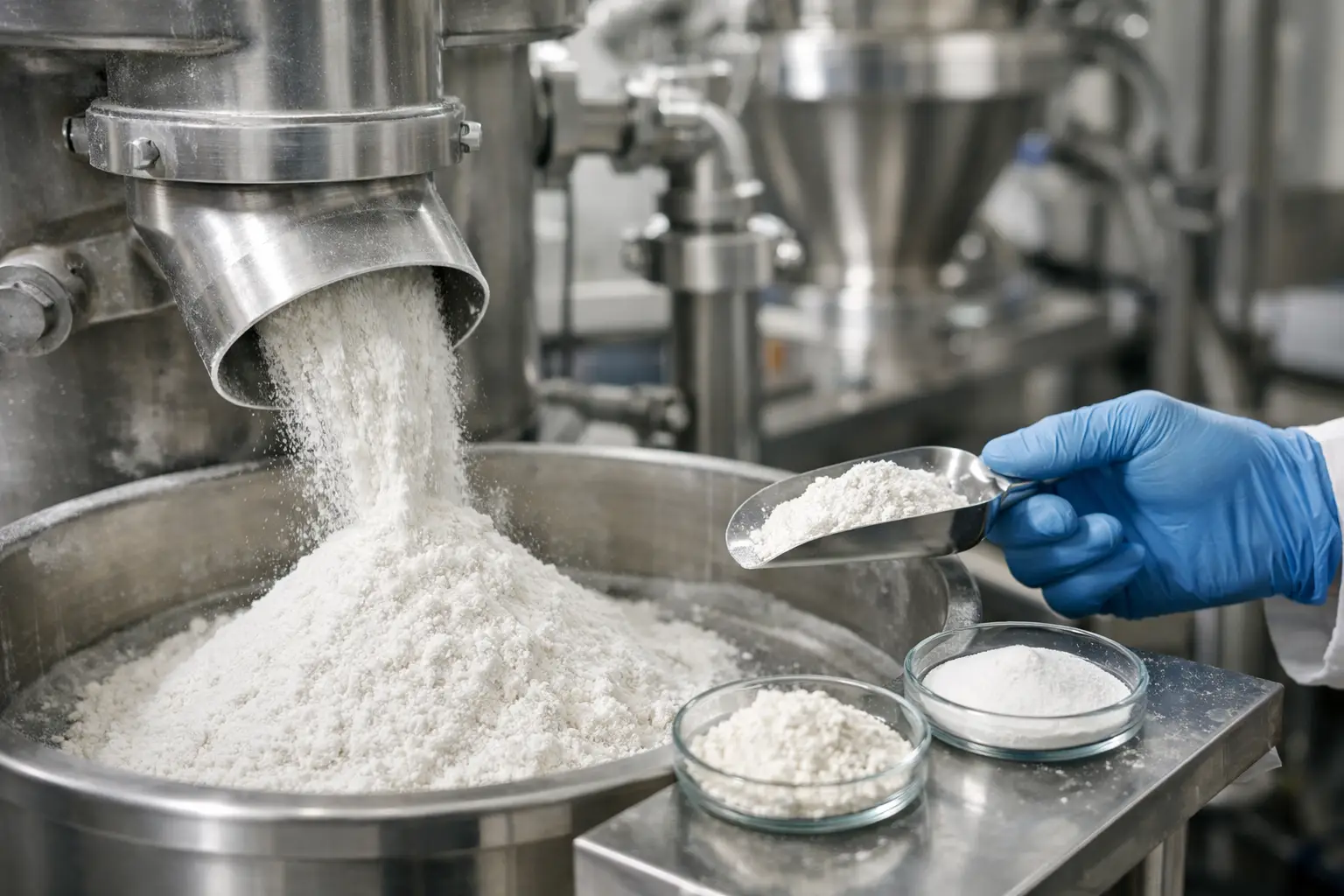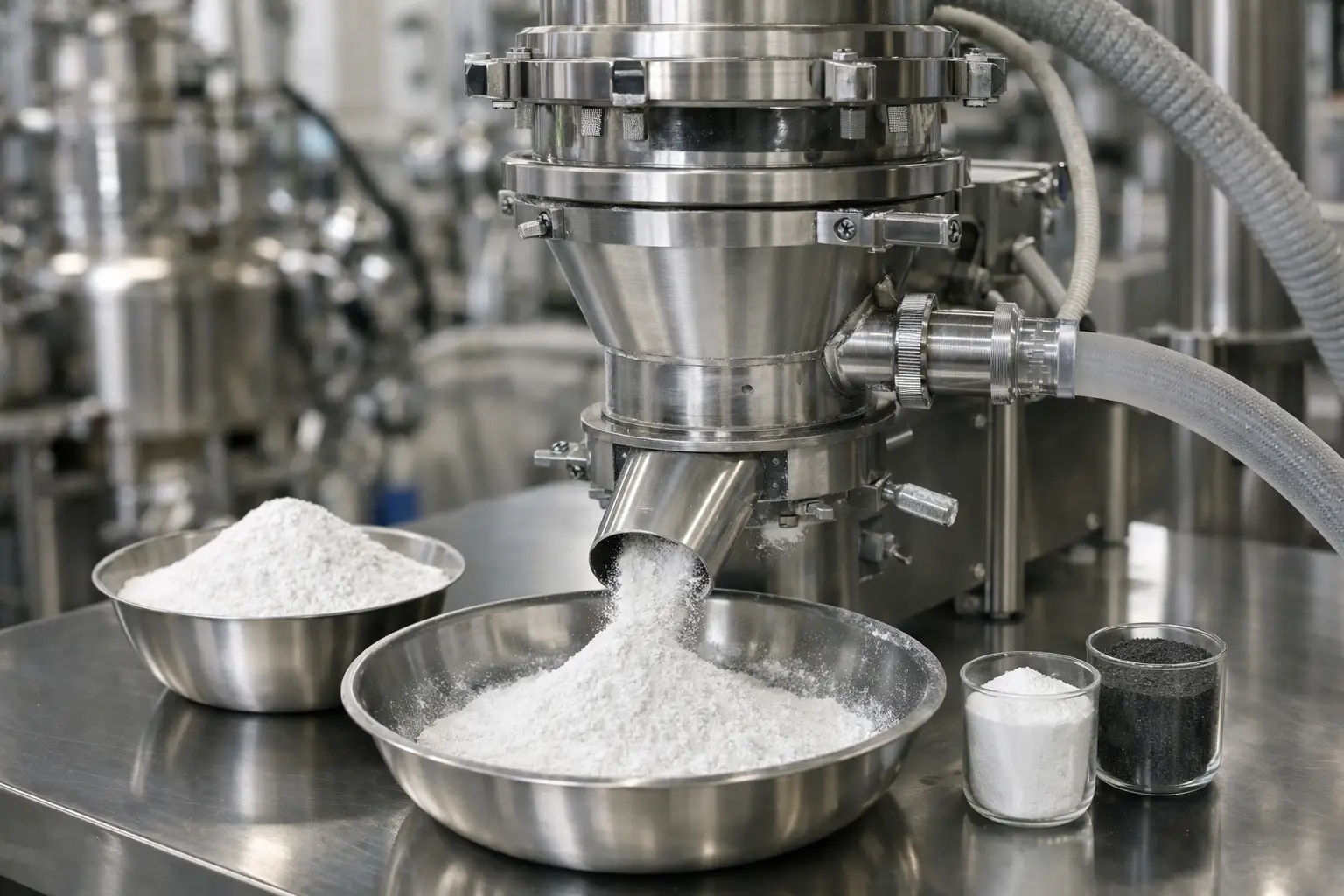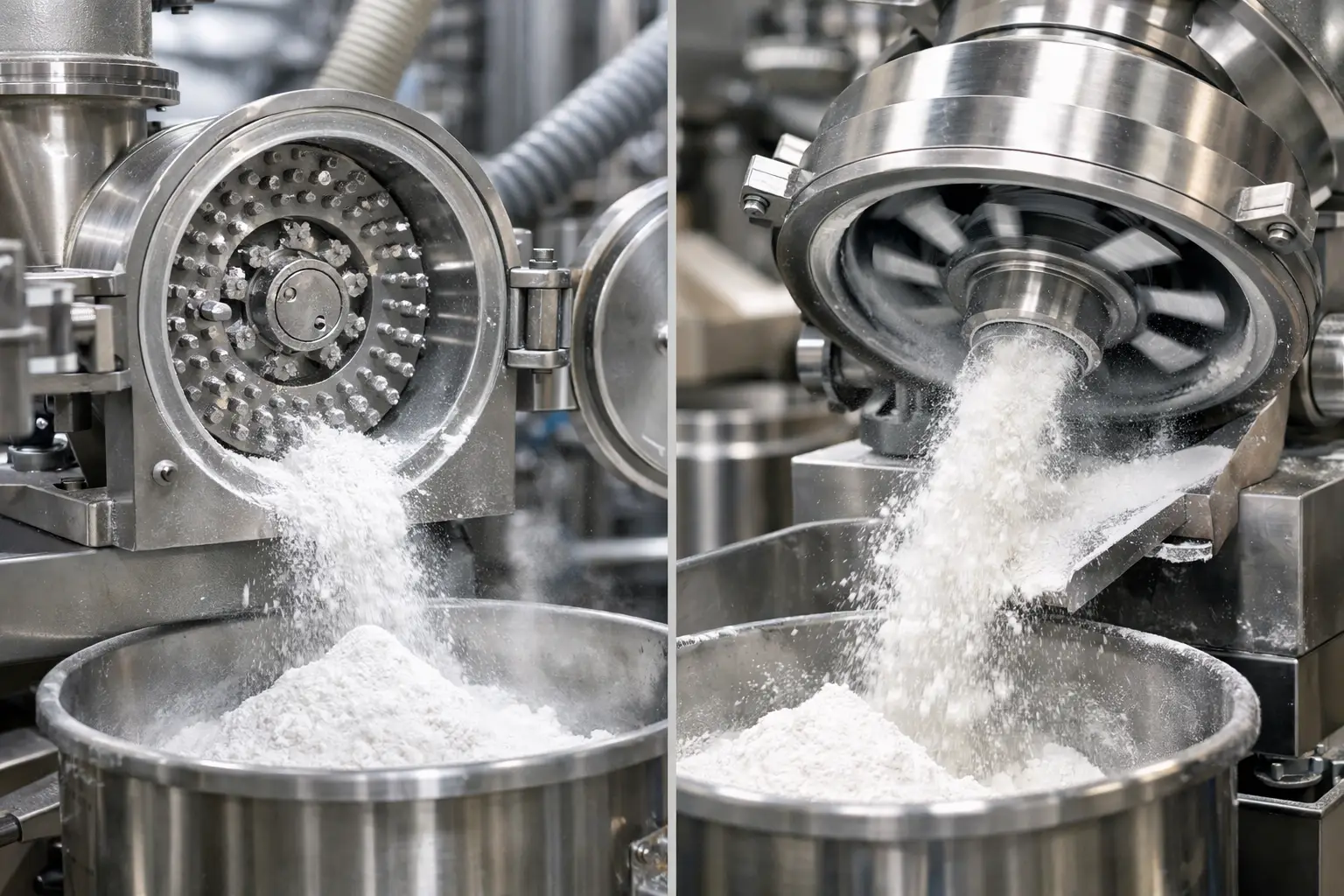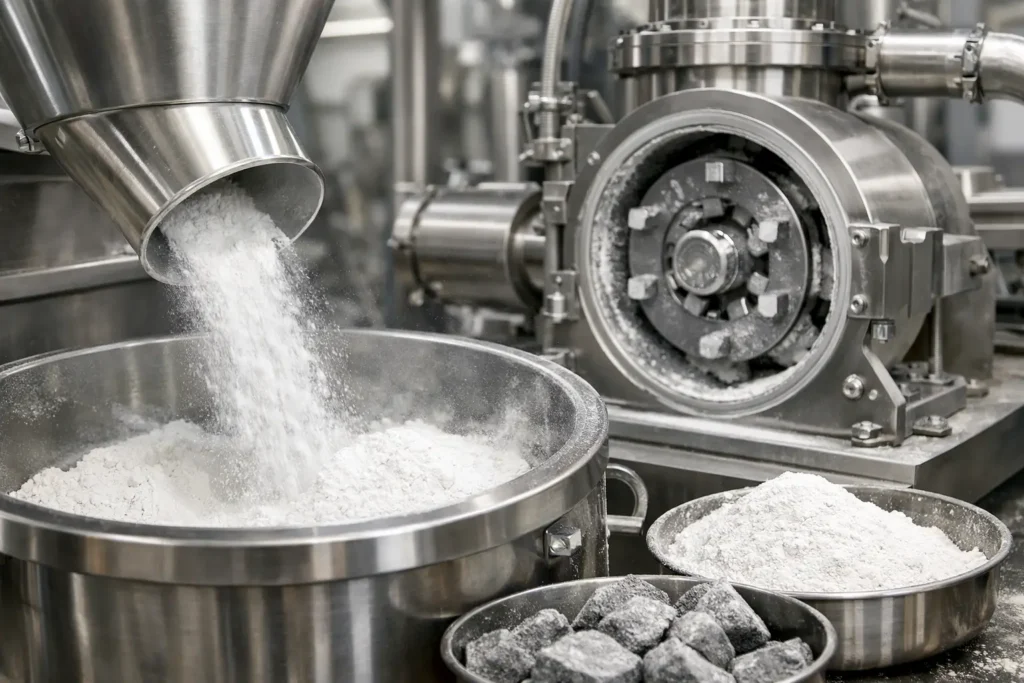
A mill that achieves the target median particle size but creates excessive heat, broadens the particle size distribution, or limits production capacity has not solved the process problem. Custom milling solutions are built around the full operating requirement: the material’s physical behavior, target particle specification, contamination limits, throughput demand, and the upstream and downstream equipment that determine real plant performance.
For manufacturers processing pharmaceuticals, food ingredients, battery materials, chemicals, minerals, and advanced powders, this distinction matters. Material behavior changes from one formulation, grade, or supplier lot to another. An effective milling system must control those variables without creating an expensive maintenance burden or a new production bottleneck.
Why Standard Mills Often Fall Short
A standard mill can be an appropriate starting point when the material is free-flowing, the particle target is broad, and production conditions are stable. The limitations appear when the process requires tighter control. Hygroscopic powders can build up in the chamber. Heat-sensitive materials can soften or degrade. Abrasive products can rapidly wear contact parts and introduce unacceptable foreign material. Fibrous ingredients may resist conventional impact grinding altogether.
Particle size is only one output. A process engineer may also need to manage fines generation, preserve particle shape, protect volatile components, improve bulk density, or maintain a narrow top-size limit. These requirements often conflict. Increasing rotor speed may improve size reduction, for example, while raising product temperature and increasing wear. Higher airflow may improve transport and classification, but it can alter residence time and collection efficiency.
Custom design addresses these trade-offs at the system level rather than treating the mill as an isolated machine. It establishes the operating window where the process can meet quality requirements consistently at the required rate.
What Custom Milling Solutions Should Address
The most effective system begins with a defined processing objective, not a preferred equipment type. Jet mills, air classifier mills, hammer mills, pin mills, turbo mills, universal mills, cone mills, and cryogenic grinding systems each use different reduction mechanisms. The correct selection depends on how the material fractures, flows, heats, and responds to impact, shear, attrition, or particle-on-particle collision.
Material behavior and size reduction mechanism
Hard, brittle minerals may respond well to impact or attrition. Heat-sensitive food ingredients, waxy compounds, and certain polymers may require low-temperature processing or cryogenic conditioning to prevent smearing and agglomeration. Fine chemical and pharmaceutical applications may require fluid energy milling where the absence of internal mechanical grinding components helps reduce contamination risk.
Feed condition is equally important. Moisture content, bulk density, initial particle size, oil content, and tendency to bridge can determine whether a process runs reliably. A mill cannot compensate indefinitely for inconsistent feeding. Custom systems may incorporate controlled metering, agitation, lump breaking, pre-screening, conditioning, or feed isolation to maintain a stable material load.
Particle size distribution, not just a single number
A specification such as D50 does not fully define milling performance. Many applications require limits on coarse particles, ultra-fines, or distribution width. In battery and advanced materials, particle size distribution can affect packing density, surface area, and downstream processing. In pharmaceutical and nutraceutical production, it can influence blend uniformity, dissolution, and tablet compression. In food applications, it can affect texture, dispersibility, and flavor release.
An integrated classifier can provide greater control where a narrow cut point is required. Rotor design, classifier speed, airflow, feed rate, and chamber geometry should be evaluated together. The goal is repeatable distribution control under production conditions, not an isolated laboratory result that cannot be sustained at scale.
Heat management and product integrity
Heat is a process variable, not an afterthought. Mechanical energy becomes thermal energy during size reduction, and product temperature can rise quickly when the feed is low melting, elastic, sticky, or difficult to fracture. A system designed for temperature-sensitive materials may use cooling air, chilled process gas, jacketed components, staged milling, or cryogenic grinding.
Cryogenic processing is especially useful when ambient grinding causes smearing, flavor loss, oxidation, or poor throughput. It is not automatically the most economical choice, however. Refrigerant consumption, insulation, material handling, and safety requirements need to be weighed against the improved grinding efficiency and product quality. For some materials, better airflow management or a different mill configuration can achieve the required result without full cryogenic operation.
Contamination control and cleanability
Contact material selection should reflect both the product and the regulatory environment. Stainless steel is common across sanitary and corrosion-sensitive applications, while hardened alloys, ceramic linings, or other wear-resistant surfaces may be needed for abrasive materials. The objective is to reduce wear-related contamination while maintaining practical serviceability.
Containment and dust control also require application-specific engineering. Fine powders can create housekeeping problems, worker exposure concerns, product loss, and cross-contamination risks. Proper enclosure design, sealed transfer points, dust collection, pressure balance, and clean-in-place or washdown considerations help protect both the product and the production environment.
Designing Around Throughput and Uptime
A pilot system that produces excellent material at a few pounds per hour does not automatically translate to a high-performing production line. Scale-up changes feed behavior, airflow, heat load, residence time, collection efficiency, and operator interaction. Custom milling solutions should account for the expected production range, including future capacity targets, rather than sizing equipment only for current average demand.
Throughput is also governed by what happens around the mill. An undersized feeder can starve the process. Poor discharge design can cause material accumulation. A filter with insufficient surface area can raise system resistance and change classifier performance. Downstream conveying or packaging limitations can force unnecessary stops. Reviewing the complete process path often identifies more meaningful capacity gains than simply selecting a larger mill.
Uptime depends on access and maintenance as much as on machine capability. Wear components should be selected for the material and designed for efficient replacement. Internal surfaces should be accessible for inspection and cleaning. Controls should provide clear operating feedback so operators can identify abnormal pressure, temperature, motor load, or feed conditions before quality drifts or a shutdown occurs.
A Practical Development Path for Custom Milling
The strongest projects move from material data to process validation in deliberate stages. Initial evaluation should document the feed characteristics, desired finished specification, production rate, acceptable temperature range, and any requirements for sanitation, containment, hazardous location operation, or regulatory compliance.
Test work then confirms how the material behaves in a selected milling technology. This stage should evaluate more than final particle size. It should examine yield, distribution shape, temperature, energy use, flowability, wear, collection efficiency, and the consistency of results across a practical operating range. For products with variable incoming quality, testing should include representative feed variation rather than an idealized sample alone.
After the process is defined, system engineering connects the mill with feeding, classification, conveying, dust collection, controls, and discharge. This is where details such as valve selection, access clearances, instrumentation, and cleaning procedures become operational advantages rather than late-stage corrections. DP Mills approaches these decisions as part of the process solution, helping manufacturers balance precision, capacity, reliability, and long-term operating cost.
Questions That Improve Equipment Decisions
Before approving a milling system, teams should be able to answer several practical questions. What is the full particle size specification, including top-size and fines limits? How much production variability can the process tolerate? What happens if feed moisture or density shifts? Which components will wear first, and how long will they last? Can the system be cleaned and returned to service within the available changeover window?
Procurement cost matters, but it should be considered alongside operating cost and process risk. A lower-cost machine that requires frequent cleaning, produces excessive off-spec material, or limits future growth can be more expensive over its service life. Conversely, an overly complex system may not be justified for a stable, low-volume application with broad particle requirements.
The right design is the one that gives operations a controllable, repeatable process with enough flexibility to handle normal variation. Define the real production problem first, then engineer the milling system around the material, the specification, and the plant conditions that will determine its performance every day.