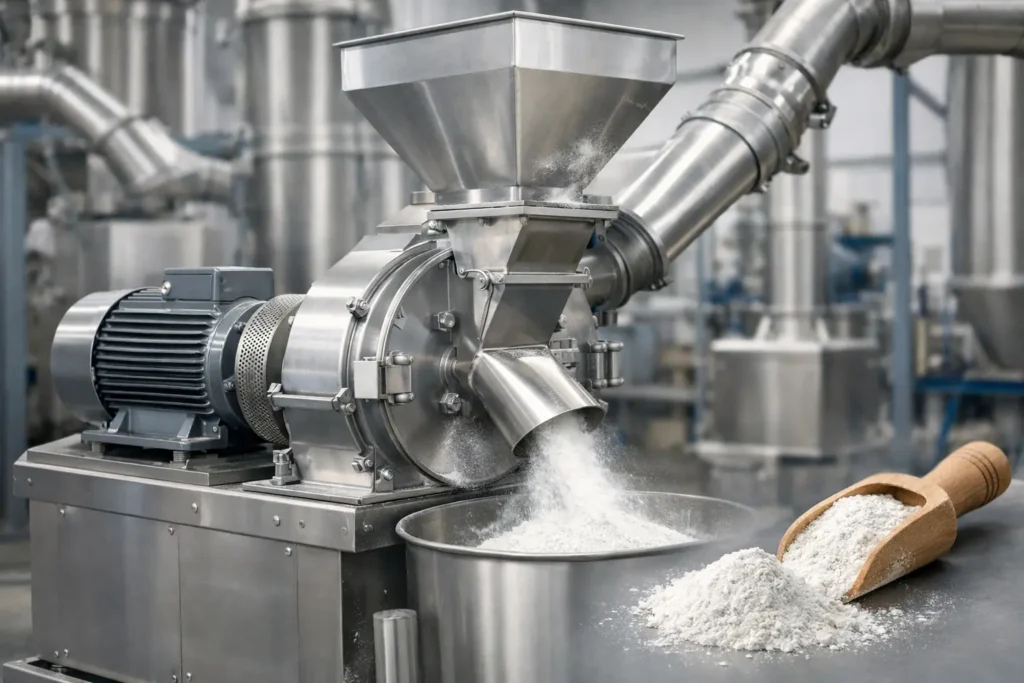
When a production line starts missing particle size targets, the problem is not always the material. Often, it is the milling method. A hammer mill for powder processing can be a highly effective solution when the application calls for dependable size reduction, strong throughput, and practical operating flexibility, but it performs best when the material, process goals, and system design are aligned.
In many industrial plants, hammer mills remain a proven choice because they handle a wide range of feed materials and can be configured for different production requirements. That does not mean they are the right answer for every powder processing challenge. For process engineers and operations teams, the real value comes from understanding where hammer mills perform well, where their limits begin, and what design factors have the biggest impact on final product quality.
What a hammer mill does in powder processing
A hammer mill reduces material size through repeated impact. Feed enters the grinding chamber and is struck by high-speed hammers mounted on a rotor. As particles collide with the hammers, breaker surfaces, and each other, they fracture into smaller sizes until they are fine enough to pass through a screen or exit classification zone.
That basic principle is straightforward, but actual performance depends on more than rotor speed. Hammer geometry, screen opening, tip speed, feed rate, airflow, chamber design, and material behavior all influence the final result. In powder processing, those variables determine whether the mill delivers a controlled, repeatable product or creates excess fines, heat, and inconsistency.
Hammer mills are commonly selected for applications where moderate to fine particle reduction is required and where throughput matters as much as particle size. They are widely used across food, chemical, mineral, agricultural, and certain nutraceutical processes. In the right duty, they offer a practical balance of capacity, simplicity, and operating cost.
When a hammer mill for powder processing is the right choice
A hammer mill for powder processing is typically a strong fit when the material is brittle or friable and fractures efficiently under impact. Sugars, grains, some chemicals, dried botanicals, minerals, and other non-fibrous solids often respond well. If the goal is to produce a consistent powder in a moderate particle size range at production scale, hammer milling can be highly efficient.
This technology is also attractive when a process requires flexible throughput. Hammer mills can be designed for continuous production and adapted to different feed rates with relatively predictable performance. For manufacturers dealing with bulk solids, this can reduce bottlenecks upstream and downstream.
Another advantage is mechanical simplicity. Compared with some ultra-fine milling systems, hammer mills are generally easier to understand, operate, and maintain. That matters in facilities where uptime, operator familiarity, and access to replacement wear components directly affect production economics.
Still, it depends on the target specification. If the required particle size is extremely fine, if tight top-size control is critical, or if the material is highly heat-sensitive, another milling technology may be a better fit. A hammer mill can produce powder efficiently, but it is not a universal answer for every demanding application.
How material behavior affects hammer mill performance
Material characteristics have more influence on hammer mill performance than many buyers expect. Hardness, friability, moisture content, oil content, bulk density, and stickiness all affect grinding efficiency and product quality.
Brittle materials typically fracture cleanly under impact, which supports efficient reduction and stable throughput. Fibrous or elastic materials behave differently. Instead of fracturing, they may deform, smear, or resist reduction, leading to screen blinding, heat buildup, and poor size uniformity. In those cases, a pin mill, universal mill, or cryogenic system may offer better control.
Moisture is another major variable. Slight moisture can sometimes be manageable, but as levels rise, materials may agglomerate in the chamber or pack against screens. That reduces effective capacity and changes the particle size distribution. Similarly, materials with high fat or oil content can coat internal surfaces and limit efficient impact action.
This is why application testing matters. On paper, two materials may look similar, yet their response inside a hammer mill can be very different. Process development should confirm not just achievable particle size, but also thermal behavior, flowability, yield, and repeatability under realistic operating conditions.
Key design factors that determine results
The difference between acceptable performance and reliable long-term production often comes down to mill design. Rotor speed is one factor, but not the only one. Higher tip speed increases impact energy, which can improve reduction, though it may also increase fines generation and heat. The right speed depends on the material and the target product.
Screen selection is equally important. A smaller screen opening generally produces a finer output, but it can also reduce throughput and increase residence time in the chamber. Longer residence time often means more heat and more opportunities for over-grinding. In some applications, chasing a finer screen size creates a less efficient overall process.
Hammer design also matters. Number of hammers, thickness, profile, and spacing affect impact frequency and breakage characteristics. Chamber geometry, liner design, and airflow further influence how particles move through the system. If airflow is poorly managed, the mill may retain material too long, which can worsen temperature rise and broad particle distribution.
For manufacturers processing regulated or contamination-sensitive products, construction details are just as important as grinding performance. Material of construction, sanitary design, wear resistance, and cleanout access can significantly affect quality assurance, changeover time, and long-term operating reliability.
Common advantages of hammer mills in industrial powder processing
When properly matched to the application, hammer mills deliver several practical benefits. They can process a broad range of feed sizes, support continuous operation, and provide strong production capacity relative to their footprint. For many plants, that combination makes them a productive first-stage or standalone milling solution.
They also tend to offer straightforward mechanical maintenance. Wear parts such as hammers and screens are service items, but they are familiar components that maintenance teams can manage with proper planning. This can simplify lifecycle support compared with more specialized fine grinding technologies.
Hammer mills are also adaptable within integrated systems. They can be paired with feeders, dust collection, pneumatic conveying, classifiers, and downstream packaging or blending equipment. That system-level integration matters because milling performance should not be evaluated in isolation. The surrounding process often determines whether the mill performs consistently shift after shift.
Where hammer mills can fall short
The main limitation of a hammer mill is control at the finest particle ranges. As target sizes become narrower and finer, impact milling alone may not deliver the required precision. Some applications need tighter particle size distribution than a screen-based hammer mill can reliably achieve.
Heat generation is another concern. Repeated impact and internal friction can raise product temperature, especially at high throughput or with difficult materials. For heat-sensitive ingredients, this may affect quality, potency, flavor, or downstream flow behavior. In those cases, airflow management, lower energy input, or an alternative milling method may be necessary.
Wear can also become a cost factor with abrasive materials. Minerals and hard inorganic compounds may accelerate wear on hammers, liners, and screens. That does not rule out hammer milling, but it does change the economic picture and often calls for upgraded materials of construction.
Noise, dust control, and housekeeping should not be overlooked either. Any size reduction process can create environmental and safety challenges if the system is not properly enclosed and supported by effective collection and containment measures.
Selecting the right hammer mill for powder processing
Choosing the right hammer mill for powder processing starts with the process objective, not the machine size. The first question is what the powder must do in the finished product or downstream operation. Required particle size, acceptable distribution range, throughput, bulk density, temperature sensitivity, and cleanliness standards should all be defined early.
From there, equipment selection should consider the full operating environment. Batch or continuous processing, available utilities, feed presentation, explosion protection requirements, sanitation expectations, and integration with upstream and downstream equipment all affect the right configuration. A mill that performs well in a test lab may need different engineering details to perform reliably on a full production floor.
This is where an engineering-driven approach becomes valuable. Rather than forcing a material into a standard design, the better path is to evaluate the material behavior and process target together. DP Mills works with manufacturers in exactly that way, aligning milling technology with production realities such as throughput, contamination control, maintainability, and scale-up confidence.
For many powder processing operations, a hammer mill is not the most complex option. That is often its strength. When the material is suitable and the system is properly engineered, it can deliver the kind of consistent, high-capacity performance that keeps production moving and quality on spec. The best results come from treating the hammer mill not as a commodity machine, but as a process tool that must be matched carefully to the application.
If your current system is producing too much variation, too much heat, or too much downtime, that is usually a sign to look deeper at application fit and mill design before making the next equipment decision.