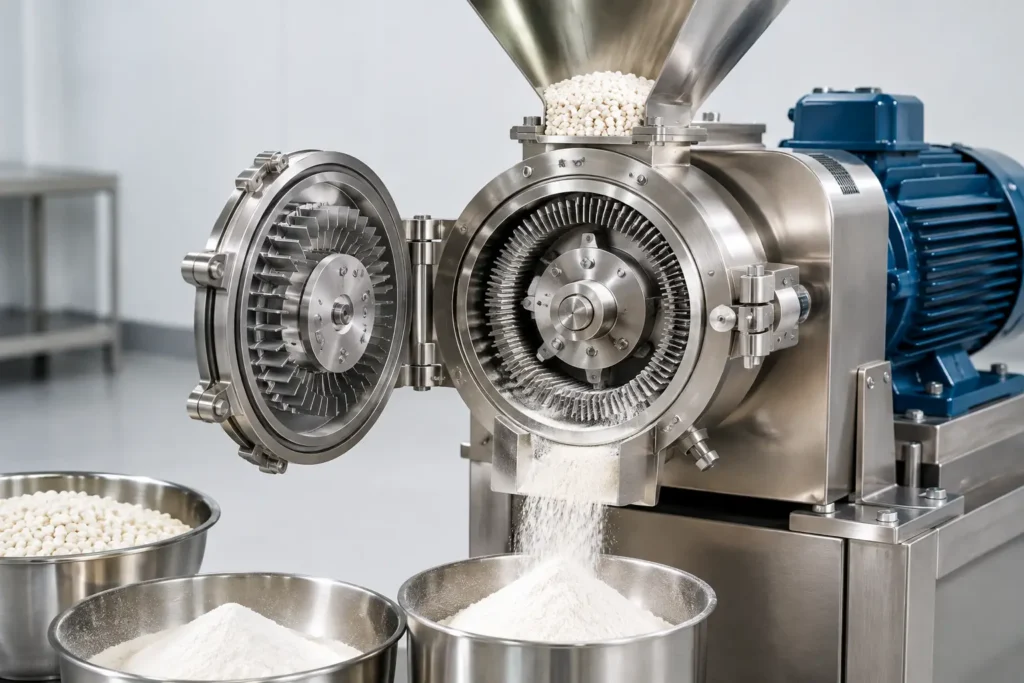
A pin mill is often selected when a process needs finer powder than conventional impact equipment can deliver, but the material does not require the extreme energy input or tight classification of a jet milling system. For manufacturers asking what is a pin mill, the useful answer is not simply that it is a grinder. It is a high-speed impact mill engineered to reduce dry, friable materials through repeated particle-to-pin and particle-to-particle collisions.
Its value lies in the combination of fine size reduction, relatively high throughput, and controllable process performance. When properly matched to the material and upstream or downstream equipment, a pin mill can support consistent powder production in food, chemical, mineral, nutraceutical, pharmaceutical, and advanced-material processing lines.
What Is a Pin Mill?
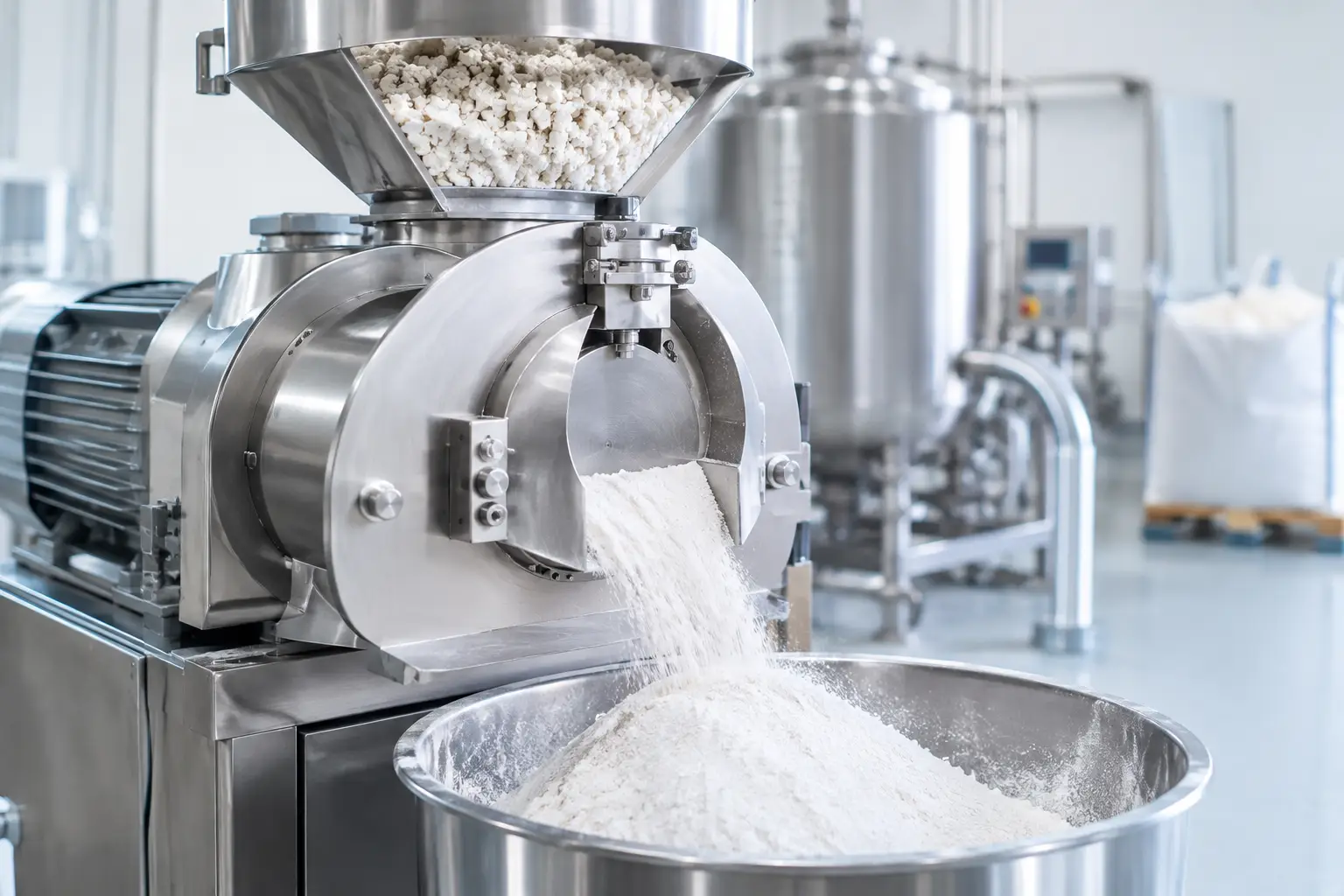
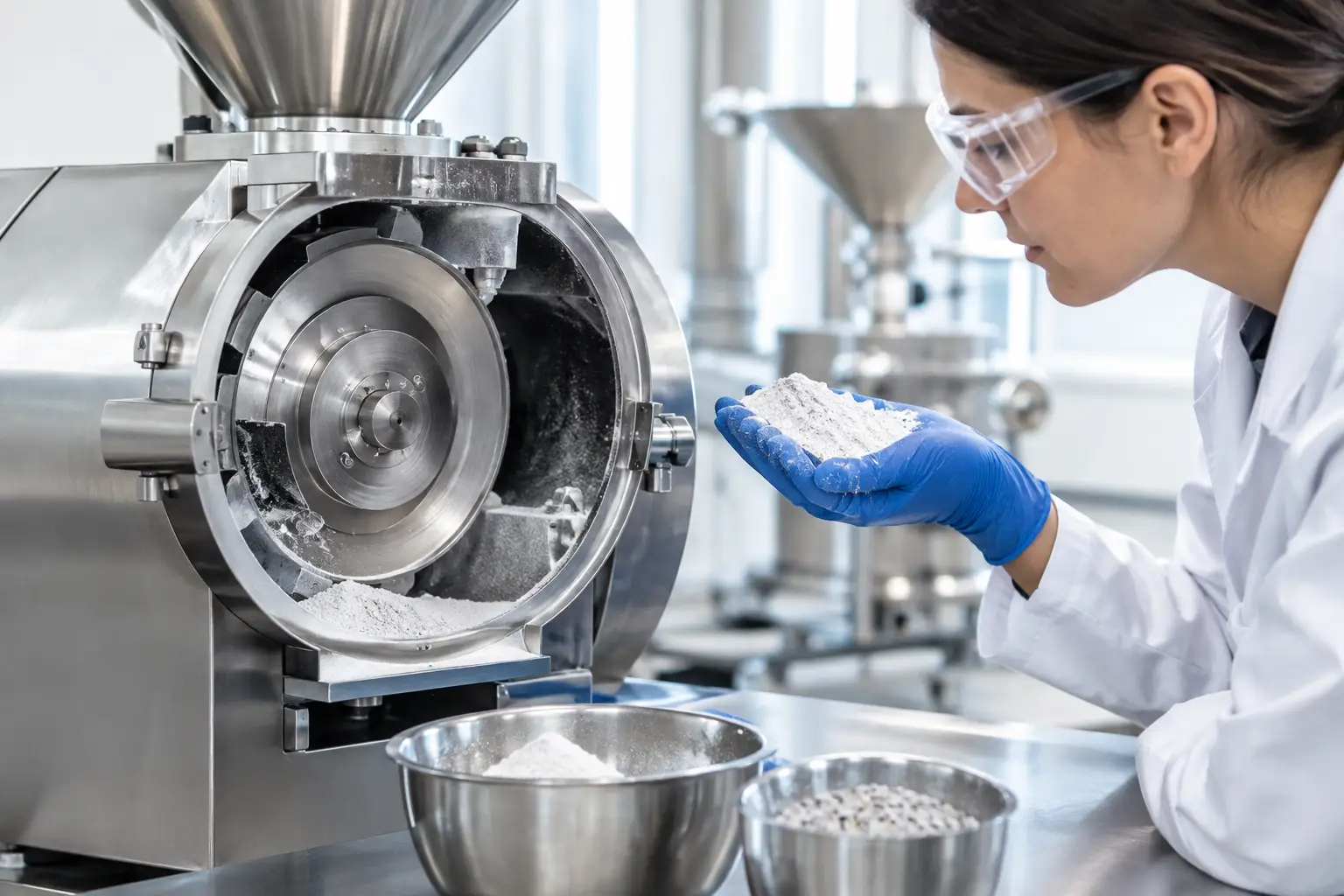
A pin mill is a mechanical impact mill containing one or two discs fitted with rows of hardened pins. Material enters the milling chamber and is accelerated into the path of these pins. Each collision fractures the particles, while turbulence within the chamber creates additional impacts until particles are small enough to exit through the discharge.
In many designs, one pin disc is stationary and the other rotates at high speed. Counter-rotating pin mills use two rotating discs moving in opposite directions. This raises the relative tip speed between the pins, increasing impact intensity and making the configuration suitable for applications that require a finer result or higher milling energy.
Unlike a hammer mill, which typically uses swinging hammers and may rely heavily on a screen to control the finished particle size, a pin mill uses closely spaced pins and high peripheral velocity. The resulting action is more concentrated and can produce a finer, narrower particle-size distribution for suitable materials.
How a Pin Mill Reduces Particle Size
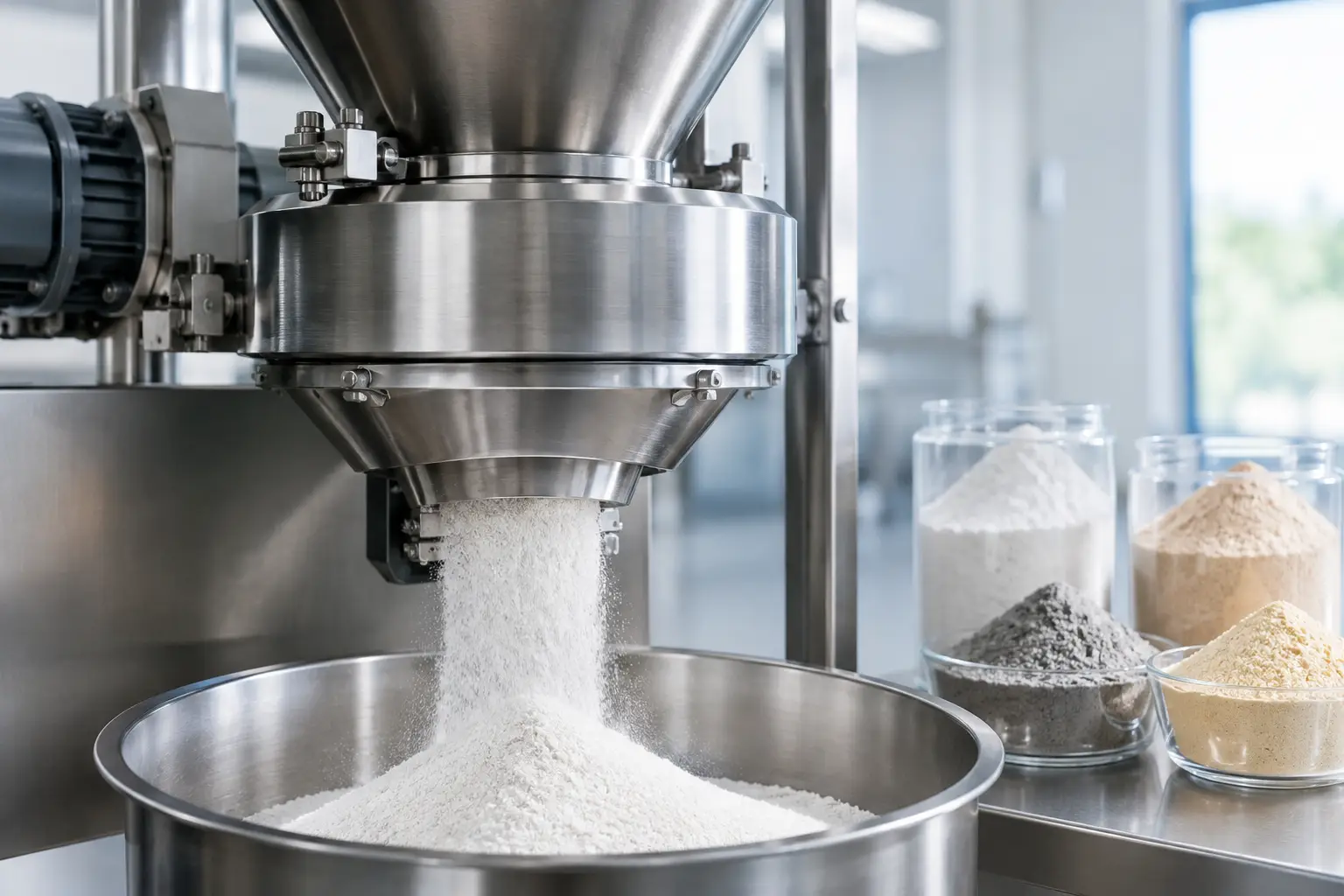
The milling process begins with controlled feeding. Material is introduced through a feed inlet, often by a screw feeder, rotary valve, or vibratory feeder, depending on bulk density, flow characteristics, and required feed consistency. Stable feeding matters because surges can overload the chamber, increase temperature, and broaden the particle-size distribution.
Once in the chamber, centrifugal force accelerates the material outward. Particles strike the pins, the mill housing, and other particles moving through the high-velocity air stream. Breakage occurs primarily through impact, although attrition contributes as particles circulate through the milling zone.
The final size is influenced by several operating variables, including rotor speed, pin configuration, feed rate, airflow, material hardness, moisture content, and the internal geometry of the mill. Higher rotor speeds generally increase impact energy and can reduce particle size, but that does not mean faster is always better. Excessive speed can create unnecessary heat, accelerate wear, increase fines, and reduce yield if the product is sensitive or prone to agglomeration.
Some systems use an external air classifier or an integrated classification stage to separate acceptable particles from oversize material. This can improve control where a tighter top size is required. In other applications, the pin mill discharges directly into a cyclone, bag filter, collection bin, or downstream blending system.
The Role of Tip Speed
Tip speed is a central performance factor because it determines the energy available at impact. Higher tip speeds can improve the milling of brittle, crystalline, or moderately hard materials. They can also increase heat generation, noise, and component wear.
The correct operating speed depends on the target specification and the behavior of the feed material. A sugar-based ingredient, for example, may need a different approach than a mineral powder, a heat-sensitive botanical, or a battery-material precursor. Successful sizing work evaluates the complete process window rather than treating speed as the only adjustment.
Materials and Applications That Fit Pin Milling
Pin mills perform best with dry, friable, crystalline, or brittle materials that fracture under impact. Common examples include sugars, spices, grains, salts, resins, pigments, chemicals, minerals, certain polymers, and many nutraceutical ingredients. They are also used for pre-milling, deagglomeration, and final grinding where a fine powder is needed before blending, packaging, compaction, or further processing.
For food and nutraceutical applications, the mill may be specified with sanitary construction, polished product-contact surfaces, clean-in-place features where appropriate, and containment arrangements designed around dust control and cleaning requirements. In chemical and advanced-material applications, material selection, abrasion resistance, sealing, and inert gas capability may become more significant.
A pin mill is less suitable for very fibrous, sticky, wet, or highly elastic materials. These materials may smear, coat the pins, bridge at the inlet, or build up in the milling chamber. Heat-sensitive products may also require chilled process air, lower operating speeds, shorter residence time, or cryogenic grinding. The equipment choice should follow material testing, not a generic assumption that every powder can be impact milled.
Pin Mill Performance Depends on the Complete System
A mill does not operate independently of the rest of the process. Feed conditioning, dust collection, conveying method, air balance, and product handling all affect output and consistency. A well-designed pin milling system considers these elements together.
Moisture is a frequent source of performance variation. Even a modest increase in moisture can make a formerly free-flowing powder cohesive, leading to feed instability and chamber buildup. Ambient humidity, storage conditions, particle temperature, and ingredient variability should be evaluated during development and production planning.
Dust handling is equally important. Fine powders can create housekeeping, yield-loss, and worker-exposure concerns if collection and containment are not engineered correctly. Depending on the material, the system may require dust collectors, explosion protection, grounding and bonding, isolation devices, or closed transfer equipment. Combustible dust risks must be evaluated on a material-specific basis rather than assumed from the product name alone.
For regulated applications, traceability and cleanability can drive the system design as much as throughput. Quick-access doors, appropriate seals, reduced dead zones, cleanable feed components, and validated material-contact finishes can reduce changeover time and support reliable operation.
Pin Mill vs. Other Milling Technologies
A pin mill occupies a useful position between coarse-impact equipment and ultra-fine grinding systems. It can often produce finer results than a standard hammer mill, particularly when processing dry, brittle materials. A hammer mill may remain the better choice when the target is relatively coarse, the material contains more fibrous content, or screen-controlled sizing is appropriate.
Compared with a jet mill, a pin mill typically has lower compressed-air demand and a simpler mechanical energy source. Jet mills are often preferred for very fine, tightly controlled powders, abrasive materials, or applications where minimizing metallic contamination is critical. However, their operating cost and system complexity can be higher.
Air classifier mills combine impact grinding with integrated classification, making them useful when control of the top particle size is especially important. A pin mill can be a more direct and economical solution when the product specification is achievable without internal air classification.
The right choice depends on the material, target particle-size distribution, hourly capacity, heat sensitivity, contamination limits, cleaning requirements, and total cost of ownership. Comparing only nominal horsepower or purchase price does not show how the system will perform over years of production.
Selecting a Pin Mill for Production
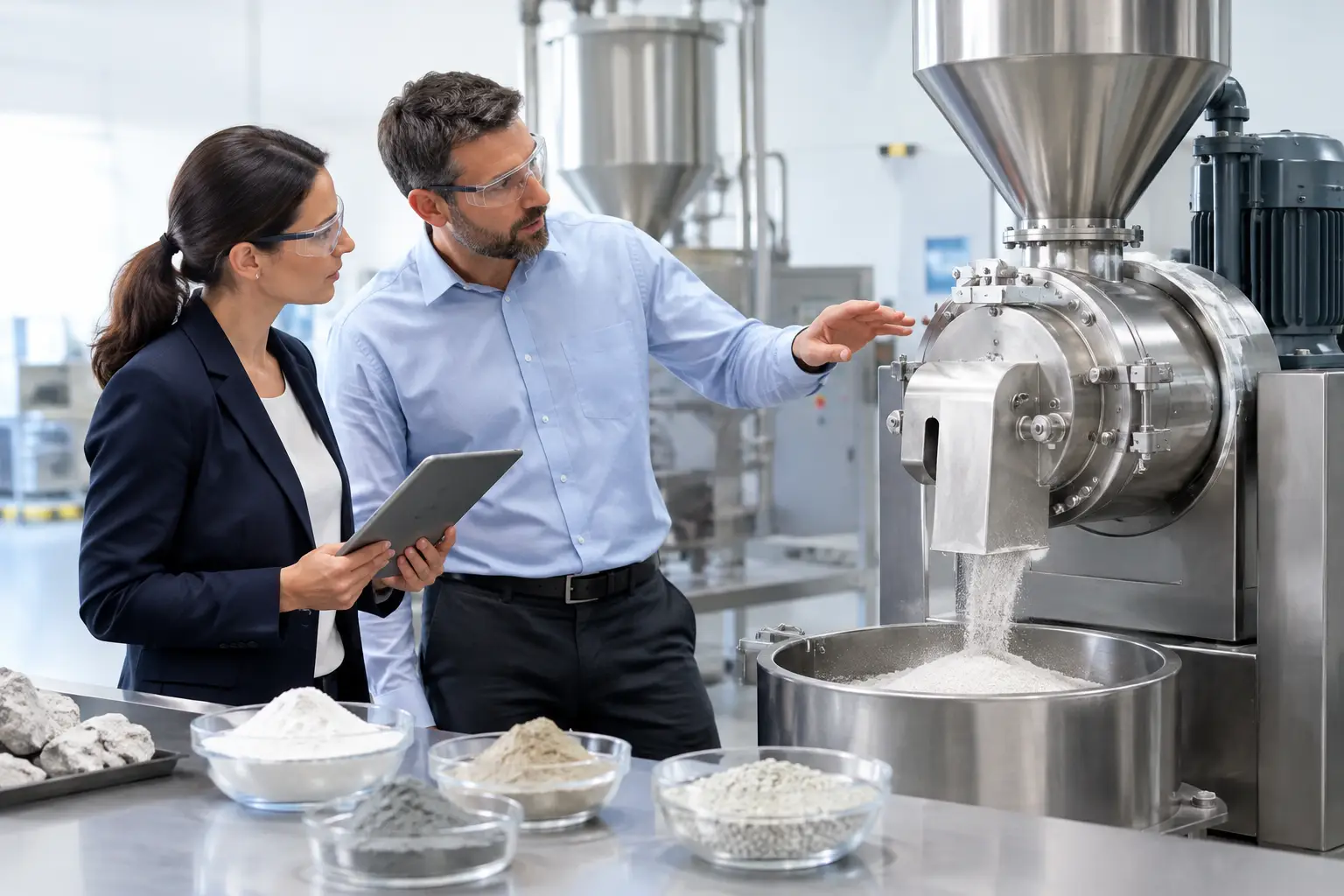
A productive selection process starts with representative material and a clear specification. The desired median size alone is not enough. Process teams should define the acceptable particle-size distribution, oversize limit, moisture range, bulk density, required throughput, temperature limit, and any restrictions on foreign-material contamination.
Pilot testing is especially valuable when material variability is high or when scaling from laboratory quantities to full production. Testing can identify whether the powder fractures cleanly, whether it generates excessive heat, how quickly the pins wear, and how feed rate affects particle size. It also provides data for specifying rotor speed, motor power, feeder design, air handling, and collection equipment.
Maintenance should be considered early. Pins, discs, liners, bearings, seals, and screens or classifiers where used are wear and service items. Abrasive products can change milling performance gradually as components wear. Designs that provide practical access for inspection and replacement help protect uptime and maintain product consistency.
DP Pulverizer Americas approaches pin mill selection as a process-engineering question, considering the material, operating environment, quality requirements, and downstream production goals together. That approach helps avoid the common mistake of installing a mill that can achieve a target size in a short test but cannot sustain it reliably at production rate.
A pin mill can be an efficient, high-performing answer for fine dry grinding, but only when the material and process conditions support impact milling. The most useful next step is to evaluate representative product under realistic feed, temperature, containment, and throughput conditions, then engineer the surrounding system to hold that performance shift after shift.