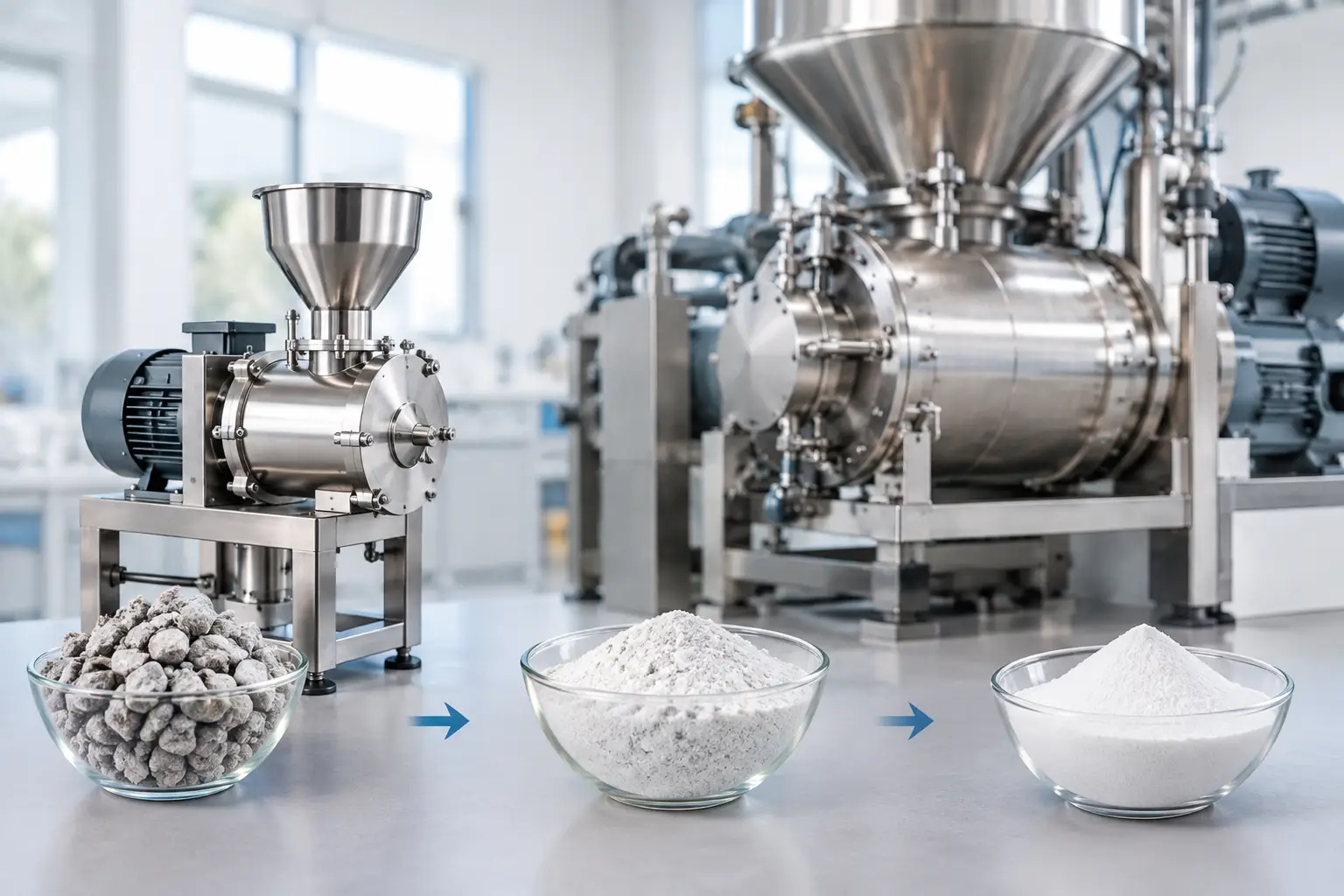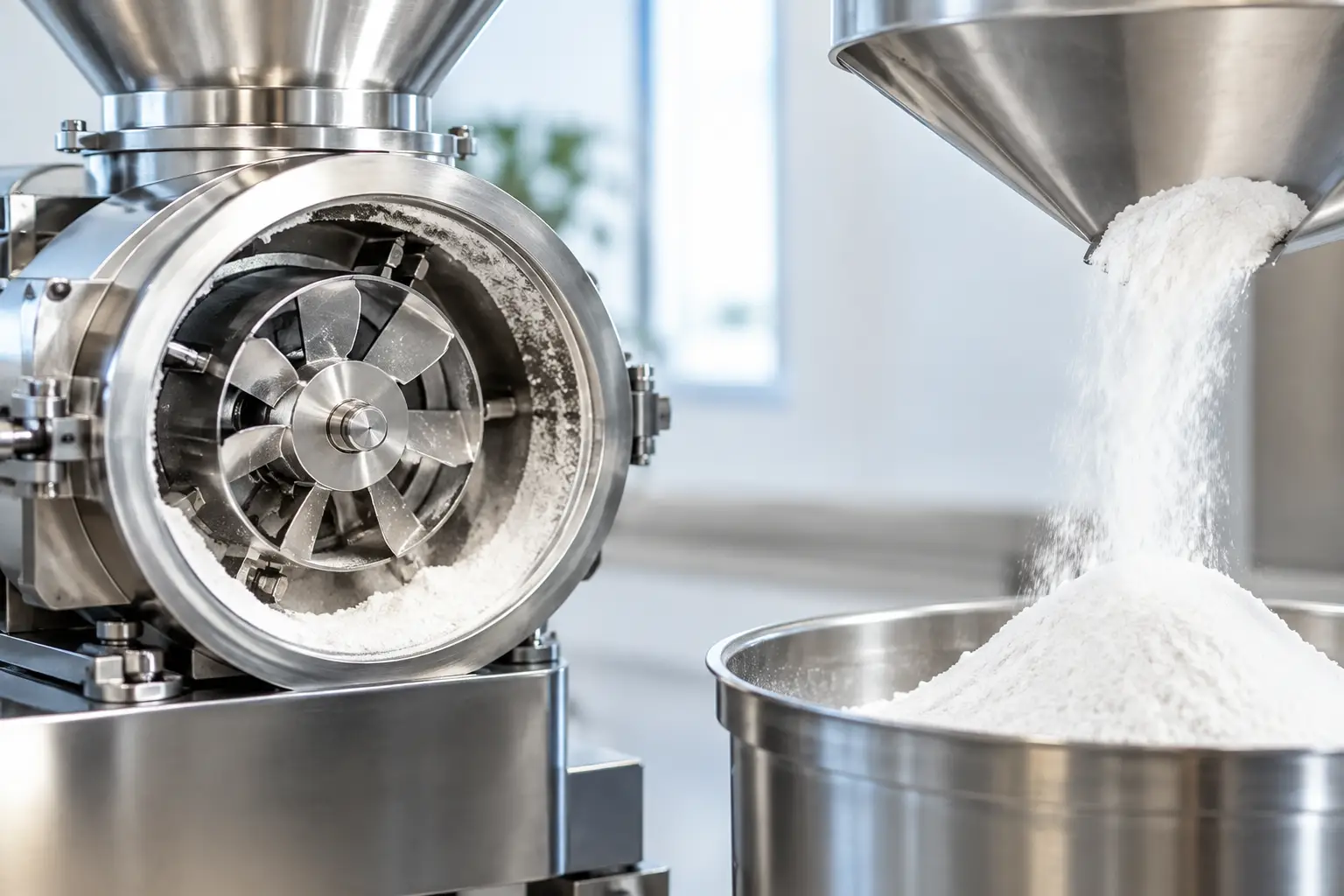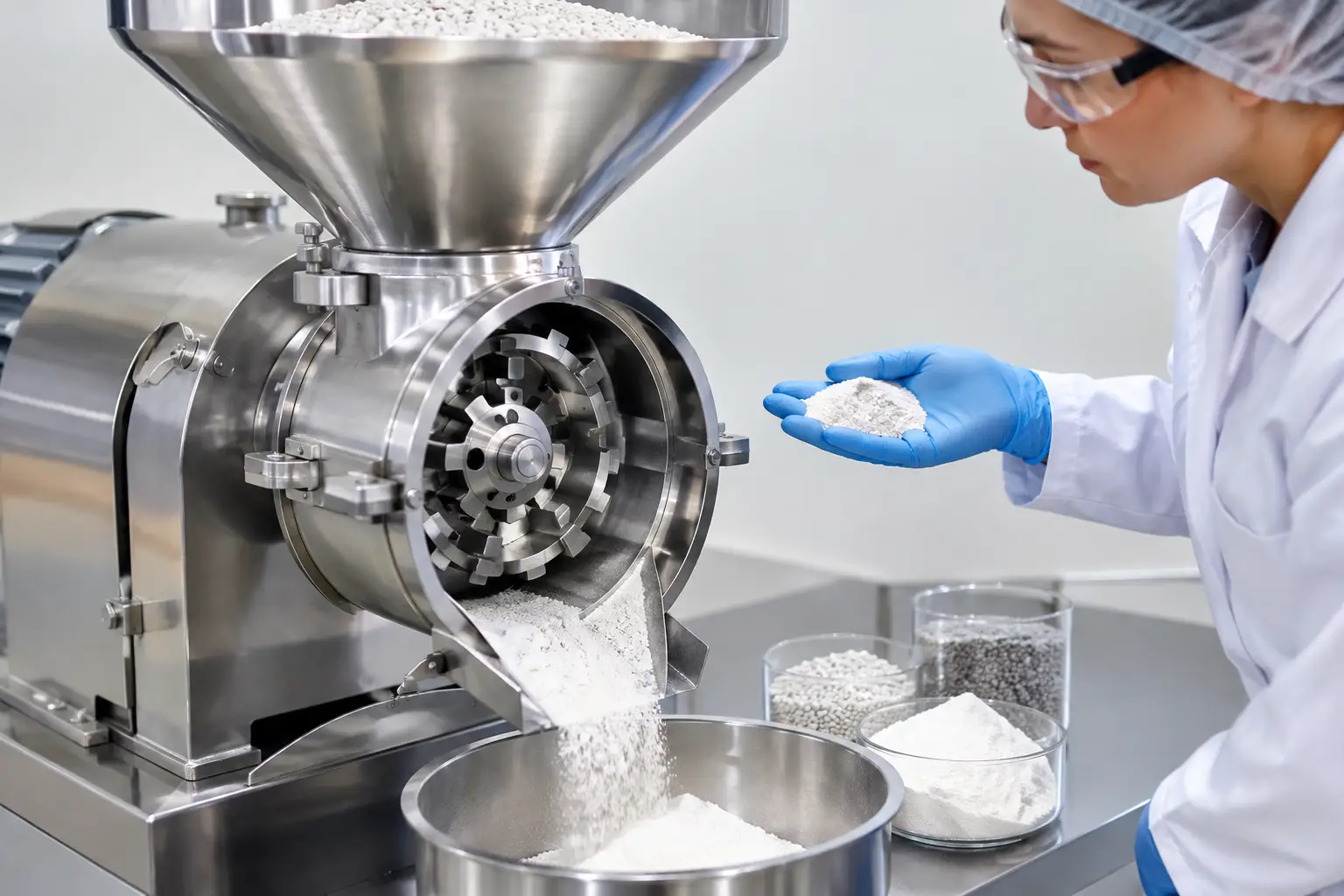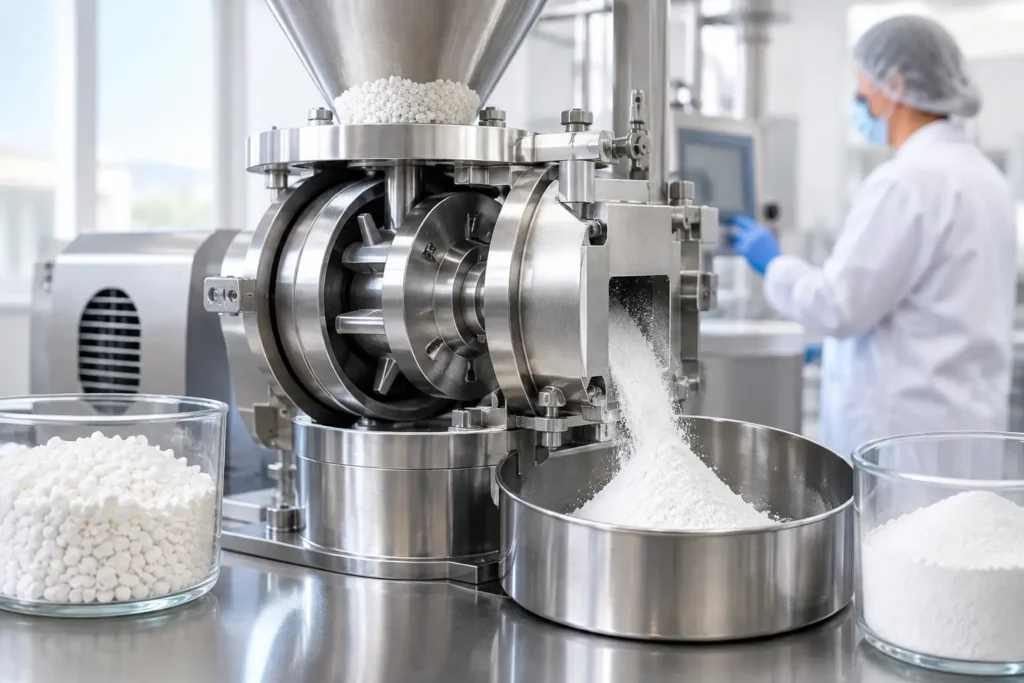
A pharmaceutical mill rarely becomes a problem all at once. Performance usually erodes through longer batch times, more screening rejects, recurring cleaning issues, rising maintenance demands, and particle size variation that operators must correct downstream. This pharma mill upgrade example illustrates how a structured equipment and process review can turn those symptoms into a measurable improvement plan without treating the mill as an isolated piece of equipment.
The scenario below is representative rather than a published customer case. Its purpose is to show the engineering decisions behind a successful pharmaceutical milling upgrade, including the trade-offs that should be evaluated before selecting a replacement system.
The Production Problem Behind the Upgrade
Consider a solid-dose pharmaceutical manufacturer processing a low-dose active pharmaceutical ingredient that required a tightly controlled fine particle distribution before blending. Its existing milling system had operated reliably for years, but demand had increased and the process was becoming harder to control.
The legacy mill could achieve the target median particle size on some batches, but the distribution was inconsistent. Oversize material increased during longer runs as wear developed and process conditions shifted. Operators compensated by reducing feed rate, making additional passes, and performing frequent inspections. Those interventions protected product quality, but they reduced effective capacity and made batch performance dependent on operator experience.
The mill also created secondary operational concerns. Product-contact components required time-consuming cleaning, powder transfer points created housekeeping demands, and the open handling steps made containment improvements difficult. The facility did not simply need a faster machine. It needed a milling system that could maintain particle size targets, support a more controlled material path, and fit within its existing quality and utility constraints.
Pharma Mill Upgrade Example: Defining the Real Requirement
The initial request was to increase throughput. Process testing showed that throughput alone was the wrong selection criterion.
The material had a narrow operating window. Higher feed rates increased the classifier load and allowed more coarse particles to pass through. More aggressive milling energy could improve fineness, but it also increased the risk of temperature rise, lower yield from fines collecting in the system, and longer cleaning cycles. The team therefore defined the upgrade around four linked requirements: particle size distribution, production rate, containment, and cleanability.
For this application, the target was not simply a specified D50. The process needed a controlled D10, D50, and D90 profile with limited batch-to-batch variation. That distinction matters. Two batches can have the same median size while behaving very differently in blending, flow, dissolution, and downstream compression if their coarse fraction or fine fraction changes.
The engineering review also examined material characteristics before equipment selection. These included feed particle size, bulk density, moisture sensitivity, hardness, friability, tendency to agglomerate, and heat sensitivity. A mill upgrade designed around only a lab particle size result can miss the behavior that determines production stability.
Selecting a Milling Technology That Fits the Process
Based on the required fine particle size and heat-sensitive material behavior, the manufacturer evaluated a classifier-controlled jet milling configuration rather than replacing the old mill with a similar design. An opposed jet mill uses high-velocity process gas to accelerate particles into controlled particle-to-particle collisions. A dynamic classifier limits the maximum particle size leaving the mill, returning oversized particles to the grinding zone until they meet the cut point.
This approach offered tighter control over the upper end of the particle size distribution and avoided mechanical grinding media or high-speed impact components in the product zone. It also provided a practical path for controlling process heat, depending on the selected gas conditions, feed rate, and material response.
That choice was not automatic. Jet milling can have higher compressed gas demand than mechanical milling, and its operating economics must be assessed against the value of the quality and yield improvement. For materials that only need deagglomeration or a relatively coarse, broad distribution, a conical mill, pin mill, or screen mill may be the more efficient choice. Equipment selection depends on the required product specification, not on selecting the most complex technology available.
In this case, the quality risk associated with oversize particles and rework justified the investment in a classifier-controlled system.
Designing Beyond the Mill Chamber
The project team treated the upgrade as a complete process system. The mill was paired with a controlled feed arrangement, appropriately sized air or gas handling, enclosed discharge, and collection equipment selected for the material’s flow and containment requirements. Each interface was reviewed because poor feeding, inadequate conveying, or unstable collection can undermine the performance of an otherwise well-designed mill.
A loss-in-weight feeder was specified to maintain a steady feed rate. This reduced the load swings that had contributed to particle size drift in the legacy process. The discharge path was designed to minimize hold-up, while product-contact surfaces, seals, and access points were selected with cleaning validation and inspection in mind.
Containment was addressed at the system level as well. Depending on the potency classification and facility requirements, this may include sealed charging, contained discharge, glovebox interfaces, split butterfly valves, local exhaust, or a dedicated isolator arrangement. The right level of containment depends on the exposure band, cleaning method, operator tasks, and the facility’s existing handling strategy. It should not be treated as an accessory added after the core mill is chosen.
Material construction, surface finish, gasket compatibility, documentation, and traceability were also included in the specification. In pharmaceutical processing, these details have a direct effect on validation, cleaning, maintenance, and long-term ownership cost.
Moving From Lab Results to Commercial Performance
A common failure point in upgrade projects is assuming that a small-scale trial will transfer directly to production. Lab trials are necessary, but they establish a starting process window rather than a final commercial answer.
For the representative project, development testing established the relationship among feed rate, classifier speed, grinding gas pressure, and particle size distribution. The team then used pilot-scale trials to evaluate residence time, yield, temperature, collection efficiency, and the stability of the process over an extended run. This step identified operating ranges that consistently met the particle size requirement instead of relying on a single successful sample.
Commercial commissioning focused on confirming those ranges with the installed feeder, collector, transfer system, and controls. Operators were trained to recognize the relationship between feed stability and particle size, while maintenance personnel received procedures for inspection of wear components, seals, and critical instrumentation.
DP Mills approaches this stage as process development, not just equipment startup. The strongest outcome comes when mill configuration, air handling, feeding, and material behavior are developed together.
What Changed After the Upgrade
The expected gains from the new system were not limited to nominal capacity. The controlled milling circuit provided a more repeatable upper particle size limit, reducing the need for corrective passes and downstream screening. With a stable feed system and defined operating parameters, the production team could run closer to its planned rate with fewer manual adjustments.
Cleaning and changeover also improved because the upgraded system reduced product hold-up areas and simplified access to product-contact parts. That improvement can be especially valuable in multiproduct facilities, where lost hours between campaigns often have a larger capacity impact than the milling rate itself.
The project also created better process visibility. Monitoring feed rate, gas pressure, classifier speed, product temperature, and differential pressure gave the team a clearer picture of when conditions were moving outside the validated range. This supports faster troubleshooting and reduces reliance on end-of-batch particle size results as the only indication of process performance.
The exact outcome will vary by material and specification. A difficult, cohesive API may prioritize yield and containment over maximum rate. A higher-volume excipient application may justify a different mill type and a stronger focus on energy use. The point of the upgrade is to improve the production constraint that matters most, while protecting product quality.
Questions to Ask Before Approving a Mill Upgrade
Before committing to a replacement system, manufacturers should establish whether the current bottleneck is truly milling or whether it sits in feeding, collection, cleaning, transfer, or quality release. They should also define particle size acceptance criteria beyond a single average value and evaluate the material across the full expected range of moisture, density, and feed condition.
It is equally important to plan for commercial operation early. Ask how the system will be cleaned, where powder can accumulate, how components will be inspected, what utilities are required, and how the design supports future capacity or containment needs. A mill that fits the current batch may not fit the next product launch or expanded production schedule.
A successful pharmaceutical milling upgrade starts with the process behavior that must be controlled. When the equipment is engineered around that reality, better particle size consistency and stronger production performance become practical operating results rather than hopeful specifications.