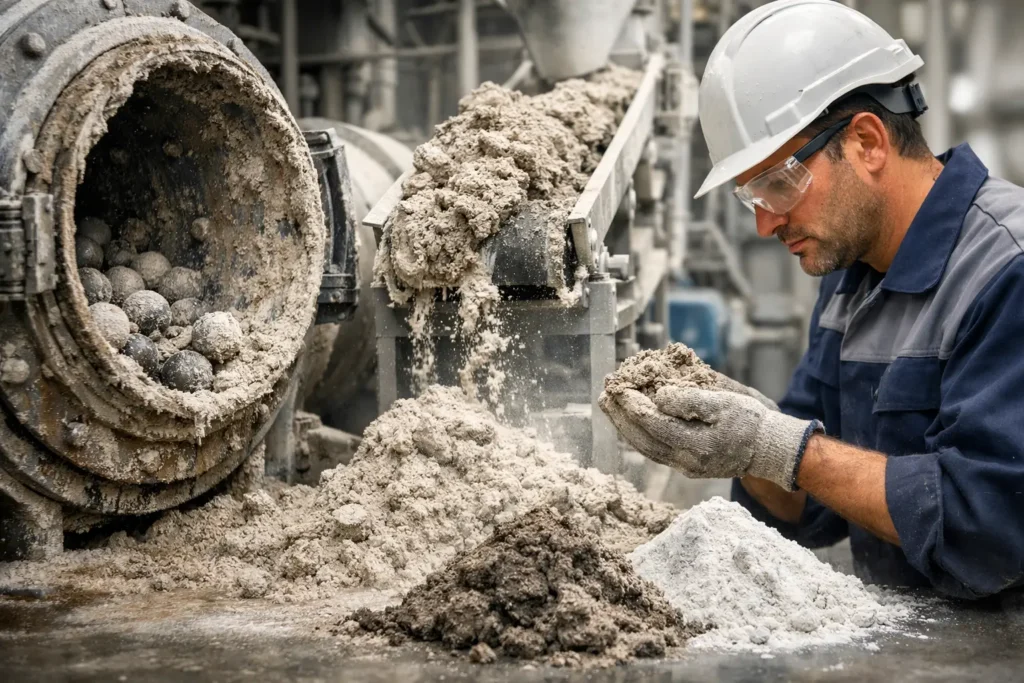
A mill can meet its target particle size during startup and still become the limiting step before the shift ends. Mill fouling often begins as a thin deposit on a rotor, screen, liner, classifier wheel, or discharge path. Left unmanaged, that deposit changes the machine’s internal geometry, restricts flow, generates heat, and turns a stable process into a recurring source of downtime, rework, and quality investigation.
For manufacturers handling cohesive powders, heat-sensitive materials, high-fat ingredients, hygroscopic chemicals, or fine specialty materials, fouling is not simply a housekeeping issue. It is a process-performance problem. The right response requires more than more frequent cleaning. It requires understanding why material adheres, where it accumulates, and how the milling system, upstream conditioning, and operating window interact.
What Mill Fouling Does to Production
Fouling occurs when processed material accumulates on surfaces where it should not remain. The buildup may be sticky and visible, such as a coating on a screen or rotor. It may also be a compacted layer inside a classifier, mill throat, conveying line, or discharge valve. In some operations, the first sign is not visible at all. Operators may see a gradual drop in throughput, a rise in motor load, wider particle size distribution, or an unexplained increase in product temperature.
The operational impact compounds quickly. A restricted discharge can increase residence time, which exposes material to additional impacts and friction. That can drive fines generation in a hammer, pin, or turbo mill. In an air classifier mill or jet mill, deposits can alter airflow patterns and classification efficiency, shifting the cut point or broadening the finished product distribution. Where product specifications are narrow, even a modest change in internal flow can create off-spec material.
Fouling also creates a contamination-control concern. Deposits can retain product through a batch changeover, break loose unpredictably, or become difficult to inspect during cleaning. In food, nutraceutical, pharmaceutical, and battery-material applications, that retained material may affect lot integrity, allergen management, cross-contamination risk, or traceability. In chemical and mineral processing, buildup can increase wear, create unstable operating conditions, and make planned maintenance less predictable.
Why Mill Fouling Happens
Material behavior is usually the starting point. Powders with low melting points, waxy components, oils, fats, sugars, moisture, or electrostatic charge are naturally more likely to adhere. Fine particles can be particularly challenging because they have high surface area relative to mass. They may cling to contact surfaces, agglomerate under pressure, or become entrained in low-velocity zones within the system.
Heat is another common driver. Every mechanical size-reduction process introduces energy, and some of that energy becomes heat. If mill speed, feed rate, residence time, or screen restriction pushes the material above a softening threshold, adhesion can accelerate sharply. A material that runs acceptably for 20 minutes may foul after two hours because internal surfaces gradually warm and the product begins to smear rather than fracture.
Moisture can produce a similar effect. Hygroscopic materials can absorb humidity before entering the mill, while wet cleaning followed by incomplete drying can introduce residual moisture into the equipment. Depending on the formulation, moisture may cause caking, promote surface adhesion, or change the powder’s flow characteristics enough to starve and surge the mill.
Equipment condition matters as well. Worn beaters, dull pins, damaged screens, rough welds, misaligned components, and worn classifier parts create locations where material can lodge. Excessive clearance or poor sealing may allow product to recirculate or accumulate outside the intended process path. A fouling issue that appears after years of dependable operation may point to wear or a process change rather than an inherently unsuitable mill type.
The Relationship Between Fouling and Mill Selection
No milling technology is immune to fouling, but each handles difficult material differently. The best choice depends on required particle size, thermal sensitivity, feed characteristics, throughput, hygiene requirements, and the material’s tendency to soften or agglomerate.
Hammer mills and universal mills are effective workhorses for many friable products, but screen selection, rotor speed, and discharge performance strongly influence their fouling behavior. A screen with insufficient open area can retain material and raise temperature. A screen that is too fine for the required production rate can turn a straightforward milling step into a recirculation problem.
Pin mills and turbo mills offer efficient impact and shear for many powders, yet they can require close attention when processing sticky or temperature-sensitive products. High peripheral speed can deliver the desired reduction but also increase heat. In these cases, lower speed, controlled feed, chilled process air, or a different mill configuration may provide a better balance between particle size and run time.
Air classifier mills combine impact grinding with internal classification, making them well suited for applications requiring controlled fine powders. However, the classifier system depends on stable airflow and clean rotating components. Material deposits on the classifier wheel or within air passages can change the classification result before a major blockage becomes apparent.
Jet milling can reduce mechanical contact and is often favorable for high-purity or heat-sensitive applications. It is not a universal answer. Cohesive materials can still accumulate in feed systems, nozzles, classifiers, or downstream collection equipment if feed conditioning, air balance, and powder handling are not properly engineered.
For materials that soften near ambient processing temperatures, cryogenic grinding can be a decisive option. Lowering product temperature makes many polymers, food ingredients, elastomers, and waxy materials more brittle and less adhesive. The trade-off is added process complexity, cryogen consumption, insulation requirements, and the need to manage condensation. It is justified when conventional milling cannot maintain stable performance or product quality.
Finding the Root Cause Before Changing the Process
Cleaning a fouled mill restores production, but it does not establish why the fouling occurred. A useful investigation starts by comparing the process at startup with the process immediately before cleaning is required. Document feed rate, motor load, product and exhaust-air temperatures, differential pressure where applicable, airflow, rotor or classifier speed, and particle size results over time.
The location and character of the deposit provide valuable evidence. A soft smear on high-energy contact surfaces often indicates heat-related softening. A hard compacted ring near the discharge may indicate restricted flow, inadequate conveying velocity, or a screen bottleneck. Fine, dusty accumulation in non-product areas may suggest air leaks or poor dust-collection balance. A buildup concentrated at a single mechanical feature can point to wear, surface damage, or an inaccessible dead zone.
It is also essential to review upstream changes. A new supplier, seasonal humidity shift, different particle size of incoming material, revised formulation, storage condition, or higher feed moisture can all move a process outside its proven operating range. Plants sometimes respond by increasing mill speed or tightening the screen, which may temporarily improve size reduction while making fouling worse.
Process signals worth trending
Four patterns deserve attention: declining throughput at constant settings, rising product temperature, increasing motor amperage, and gradual particle size drift. These signals are more useful when trended by batch, material lot, and run duration rather than treated as isolated events. The goal is to identify the point at which the process begins to depart from its normal thermal and mechanical behavior.
Practical Controls That Reduce Buildup
The most reliable fouling-control strategy combines material preparation, suitable mill design, and disciplined operating control. Drying or conditioning the feed may be necessary for hygroscopic powders. Temperature control can include chilled feed, cooled process air, jacketed equipment, or cryogenic milling. For sticky materials, controlling the feed rate is often more effective than simply increasing rotational speed.
Equipment geometry should support the material’s flow path. Smooth, appropriately finished product-contact surfaces reduce opportunities for adhesion. Adequate discharge capacity prevents excessive residence time. Properly sized screens, classifier settings, and conveying systems help keep the product moving instead of recirculating inside the mill. In hygienic applications, clean-in-place capability or rapid access for validated cleaning may be as important as peak throughput.
Air management deserves special attention in pneumatic and classified systems. Insufficient air can allow fines to settle and compact. Excessive air may reduce effective grinding time, overload downstream collection, or disturb classification. Stable airflow, balanced pressure, and correctly sized dust collection help maintain a consistent process environment.
Preventive maintenance should focus on the parts that influence internal flow and energy transfer. Inspect screens for blinding and damage, verify rotor and classifier condition, check seals and gaskets, and address product-contact surface defects before they become accumulation points. Cleaning intervals should be based on demonstrated run time and process risk, not only on calendar schedules.
Treat Fouling as an Engineering Constraint
The objective is not always to eliminate every trace of material inside a mill. Some applications will naturally require planned cleaning, especially when processing highly cohesive or low-melting products. The practical objective is to establish a stable, repeatable run length that meets throughput, particle size, sanitation, and labor requirements without unexpected intervention.
That requires making trade-offs explicitly. A finer target size may increase heat and cleaning frequency. A lower rotor speed may reduce fouling but require a larger mill or longer processing time. Cryogenic processing may increase operating cost while preventing product loss and downtime that cost far more. The correct answer depends on the material and the full production system, not a single machine specification.
DP Pulverizer Americas approaches these decisions as process-engineering work: characterize the material, identify the fouling mechanism, and match the milling technology and controls to the actual operating requirement. When a mill remains clean because the process is correctly designed, the result is more than better uptime. It is a more predictable manufacturing operation, with product performance that holds from the first pound of the run to the last.


