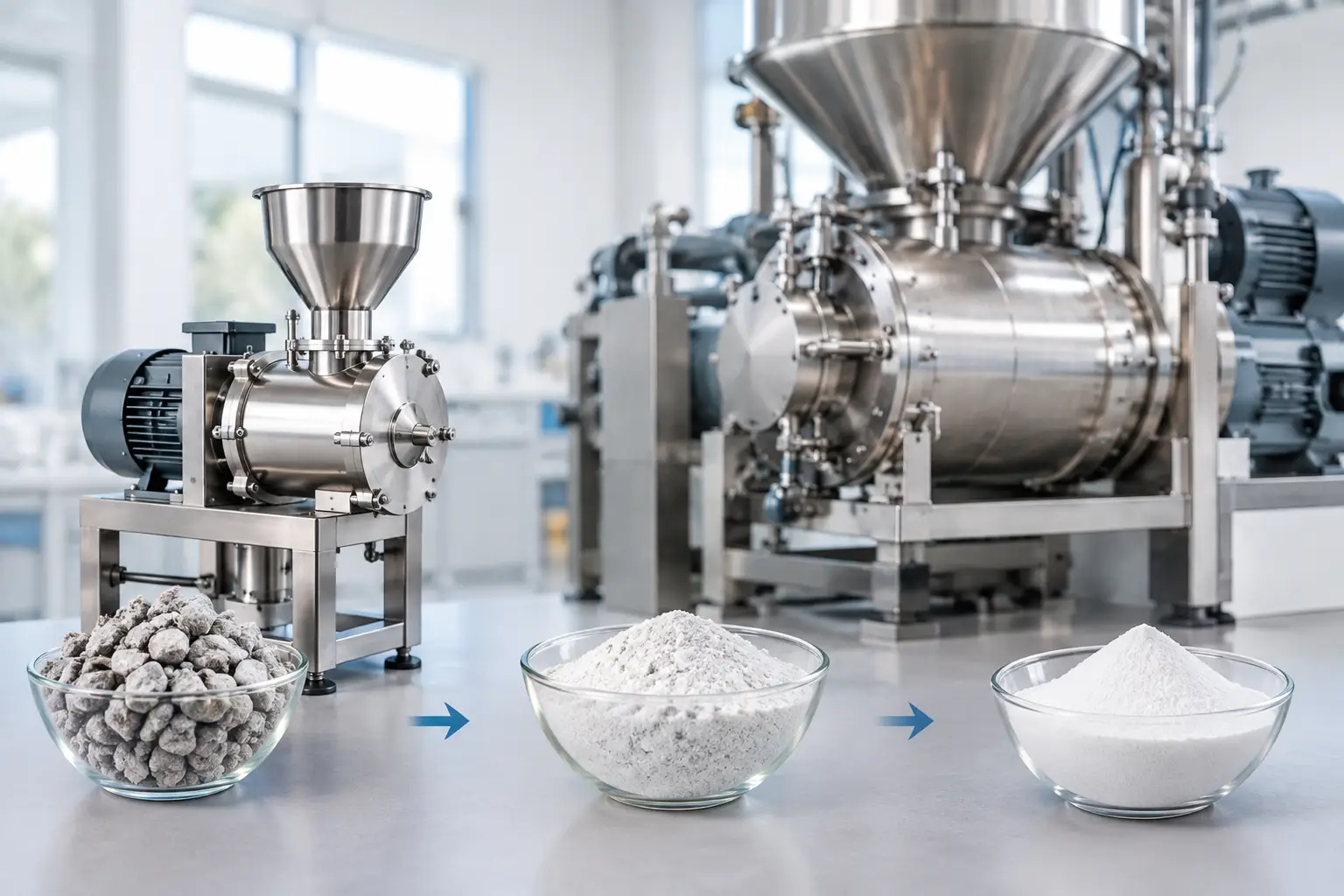
A mill that produces the right average particle size can still be the wrong production solution. If it overheats a heat-sensitive ingredient, creates too many fines, contaminates a high-purity powder, or cannot sustain required throughput, the process will underperform. Searches for “how to size reduction equipment” often point to a simple capacity question. In practice, proper sizing is an application-engineering exercise that begins with the material and ends with verified process performance.
Start With the Required Product Specification
Equipment selection should begin with the finished product, not the available mill footprint or a catalog capacity rating. Define the target particle size distribution, not only a single median value such as D50. Depending on the application, the critical requirement may be the top size limit, the percentage of fines, flowability, bulk density, surface area, dissolution behavior, or downstream classification performance.
A pharmaceutical formulation may require tight control of oversized particles and minimal thermal exposure. A battery material may require a narrow distribution while avoiding metallic contamination. In food and nutraceutical production, flavor retention, moisture behavior, sanitation, and heat generation may drive the decision as much as final micron size. Mineral and chemical applications may prioritize high throughput, wear life, and consistent product at a specified cut point.
The needed particle size range immediately narrows the technology options. Coarse reduction may be well served by a hammer mill, universal mill, cone mill, or turbo mill. Fine grinding often calls for a pin mill, air classifier mill, or jet mill. When the material becomes elastic, sticky, or prone to melting at ambient temperature, cryogenic grinding may be the more reliable route. The correct technology depends on the combination of size target and material response, not micron rating alone.
Specify the Feed as Carefully as the Product
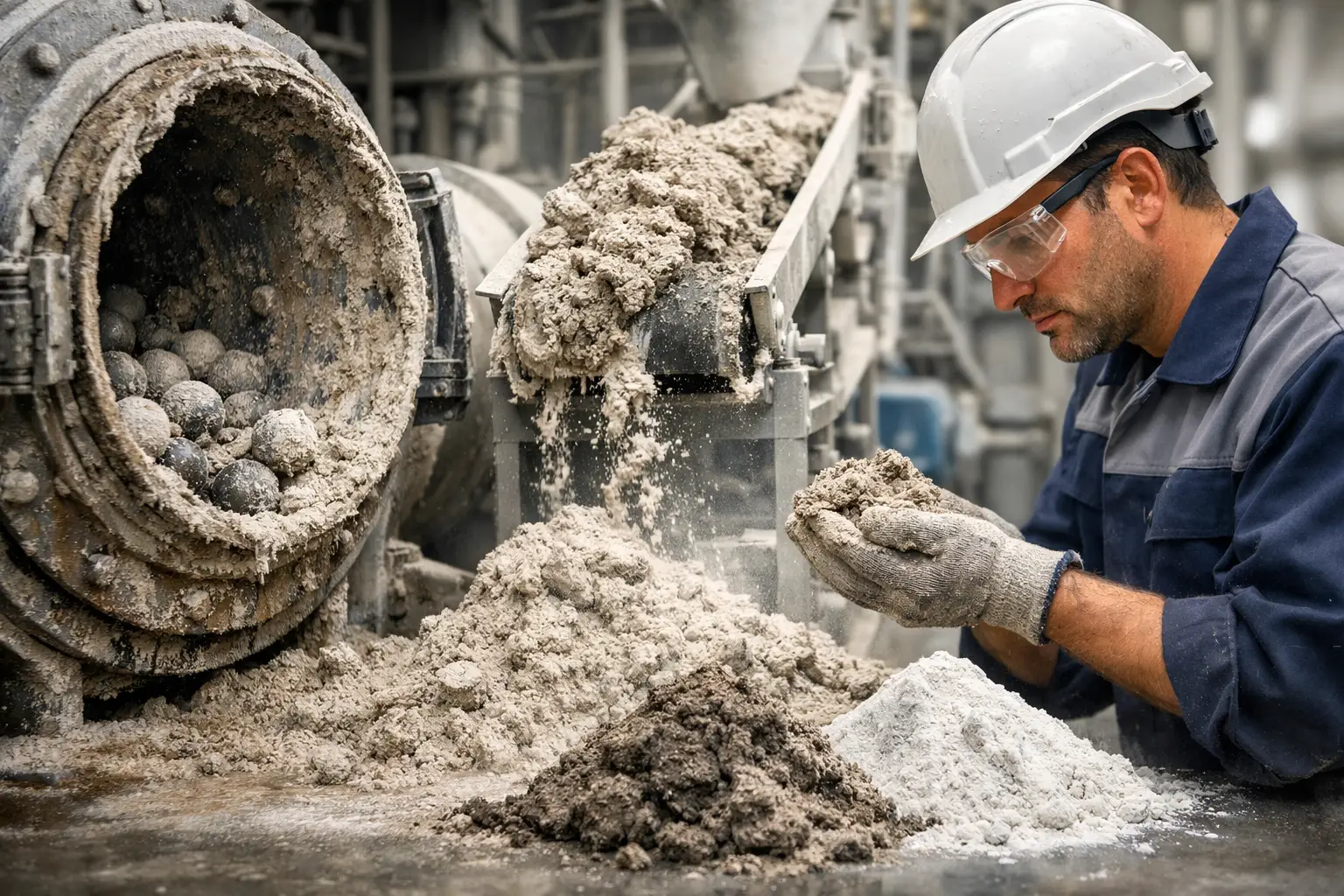
Feed condition determines how effectively a mill can operate. Document the maximum feed size, typical size distribution, bulk density, moisture content, temperature, and feed-rate consistency. Also identify whether the material is friable, fibrous, abrasive, oily, hygroscopic, cohesive, ductile, or heat sensitive.
A machine may achieve the desired particle size in a short pilot trial yet fail to do so consistently when feed moisture rises or incoming particle size becomes less uniform. For this reason, sizing should account for normal feed variation, not ideal laboratory samples. Upstream screening, lump breaking, drying, metering, and magnetic separation can be as important to milling performance as the mill itself.
How to Size Reduction Equipment for Throughput
Required throughput should be expressed as a sustained production rate, with clarity about the operating schedule. A target of 2,000 pounds per hour means something different for a system expected to run one shift than for a process operating continuously with planned cleaning, changeovers, and maintenance.
Avoid sizing directly to average demand. Build capacity around peak requirements, expected availability, and a reasonable operating margin. A mill operated continuously at its maximum practical load can experience unstable product quality, elevated wear, higher energy consumption, and more frequent intervention. Conversely, excessive oversizing can increase capital cost, footprint, air demand, cleaning time, and low-load process instability.
The relationship between throughput and particle size is rarely linear. Driving product finer generally requires more energy and may reduce capacity substantially. In classifier-based systems, tightening the cut point can lower throughput or require changes to classifier speed, airflow, and process configuration. In impact mills, screen selection, rotor speed, and airflow affect both output and distribution. A capacity figure without a stated material, feed size, target distribution, and test condition is only a starting reference.
Account for Yield and Recirculation
Nameplate feed rate is not necessarily finished-product rate. If oversize material is returned for additional processing, or if a classifier removes a fraction that does not meet the specification, calculate the system around net acceptable product yield. Dust collection losses, screening rejects, and product retained in conveying equipment also affect practical output.
For operations with tight specifications, it is often more useful to define capacity as pounds per hour of in-spec product. That measure connects equipment sizing to the production result that matters.
Match the Milling Mechanism to Material Behavior
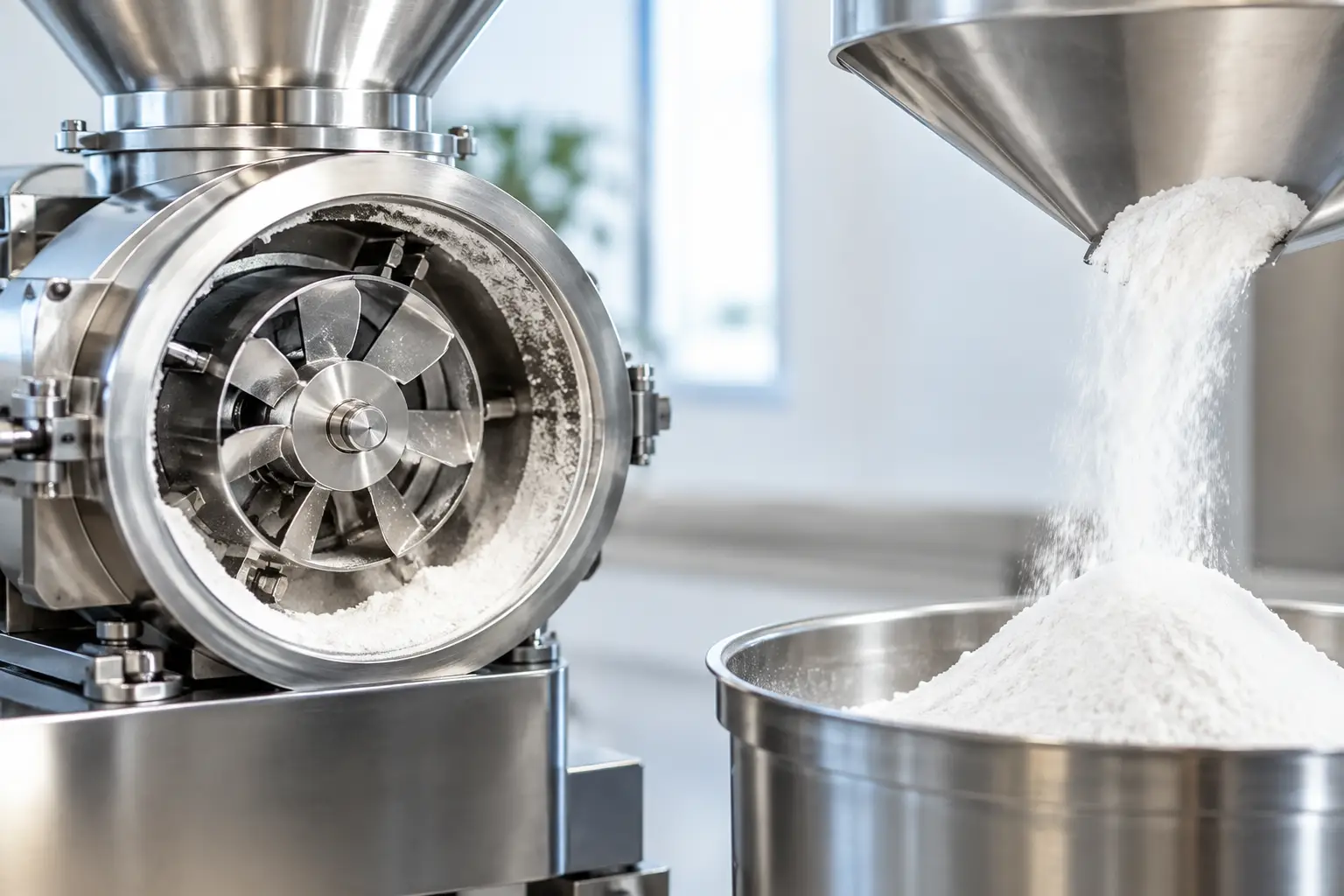
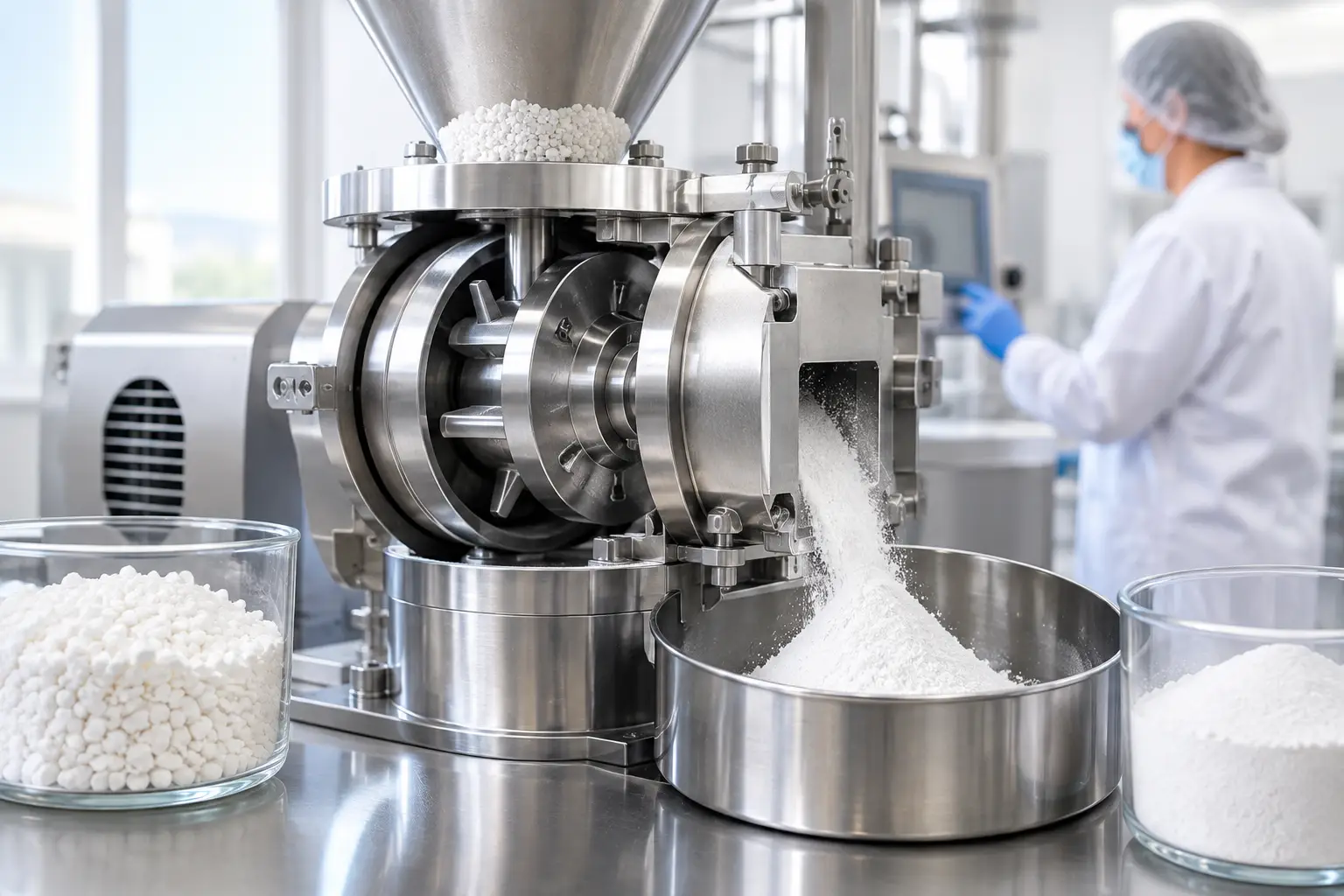
Each size-reduction method applies energy differently. Hammer mills and universal mills use impact and shearing action and can be effective for many dry, friable materials. Pin mills provide high-speed impact for finer applications but may introduce heat depending on material and duty. Air classifier mills combine grinding and internal classification, helping control top size and reduce unnecessary overgrinding. Jet mills use particle-on-particle impact and are particularly useful where very fine sizes, low contamination, or minimal mechanical contact are required.
The trade-off is that high-energy processing can increase heat, air consumption, noise, wear, or operating cost. Cryogenic systems can preserve materials that soften, smear, or lose volatile components under ambient grinding, but they add cooling-media use and process complexity. Abrasive materials may require hardened or ceramic wear components, while highly pure applications may require specialized contact materials and closed handling.
No equipment type should be selected solely because it has performed well on another powder. Two materials with similar hardness can behave very differently due to moisture, morphology, fat content, melting point, electrostatic charge, or tendency to agglomerate.
Size the Complete Process, Not Just the Mill
The mill is one component in a connected processing system. Feed equipment must deliver a stable, controllable rate. Air conveying, blowers, filters, cyclones, classifiers, and product collection must be sized to maintain the required air balance and material flow. An undersized collector or poorly matched conveying line can restrict output, increase product hold-up, and make cleaning difficult even when the mill itself is capable of the duty.
Containment and dust control also belong in the initial sizing discussion. Fine powders can create operator-exposure, housekeeping, cross-contamination, and combustible-dust concerns. The appropriate design may include sealed transfer points, dust collection, pressure management, inerting, explosion protection, or isolatable process sections. Requirements vary by material hazard, facility design, and applicable codes, so they should be evaluated early rather than treated as an add-on.
For regulated industries, consider cleanability and validation from the outset. Contact surface finish, access for inspection, gasket design, clean-in-place capability, and material traceability can influence both equipment configuration and the time required between campaigns.
Use Testing to Replace Assumptions
Material trials are the most reliable way to confirm a sizing decision, especially when the product has strict specifications or unusual handling behavior. A useful test program evaluates more than particle size. It should measure achievable throughput, particle size distribution, product temperature, energy use, yield, screen or classifier settings, wear tendency, and the effect of normal feed variability.
Pilot-scale work is also where teams can compare process routes. A pin mill may deliver acceptable particle size, while an air classifier mill may produce a tighter distribution with less oversize. A cryogenic system may preserve product integrity that cannot be maintained with ambient impact milling. The best answer is the one that meets production requirements at a defensible total operating cost.
DP Mills approaches testing and equipment selection as process development, using application data to align milling technology, ancillary equipment, and controls with the intended production duty. That approach reduces the risk of scaling a laboratory result into a process that is difficult to operate or maintain.
Plan for Scale, Maintenance, and Change
Production requirements rarely remain fixed. Consider whether future demand will require longer run times, a second shift, parallel processing, or a larger mill. A modular system may offer a practical growth path, but only if utilities, controls, dust collection, and material handling are planned with expansion in mind.
Maintenance requirements deserve the same attention as initial performance. Ask how often screens, pins, hammers, liners, classifiers, seals, and filters require inspection or replacement. Evaluate access time, spare-parts strategy, cleaning labor, and the consequences of wear on product consistency. For abrasive materials, a lower-cost machine can become expensive quickly if component wear drives frequent downtime or contamination risk.
The right size-reduction system is not the largest mill or the lowest initial-cost option. It is the system that produces in-spec material at the required rate, with stable operation, manageable maintenance, and room for the process to evolve. Start with representative material, measurable product requirements, and realistic operating conditions. That is where dependable milling performance begins.