A pin mill versus turbo mill decision is rarely settled by a target micron size alone. Two materials with the same starting size and nominal production rate can behave very differently under high-speed impact. Friability, moisture, fat content, heat sensitivity, abrasiveness, dust behavior, and required particle-size distribution all affect which machine will deliver stable, economical performance.
For process engineers and plant teams, the practical question is not which mill is universally better. It is which milling mechanism matches the material, the quality specification, and the operating constraints of the production line.
Pin Mill Versus Turbo Mill: The Core Difference
Both pin mills and turbo mills reduce size primarily through high-speed impact. Material enters the milling chamber and encounters rapidly moving components that accelerate particles into impact surfaces, other particles, or the mill housing. The difference lies in rotor geometry, airflow behavior, and the way each design balances impact, attrition, residence time, and classification.
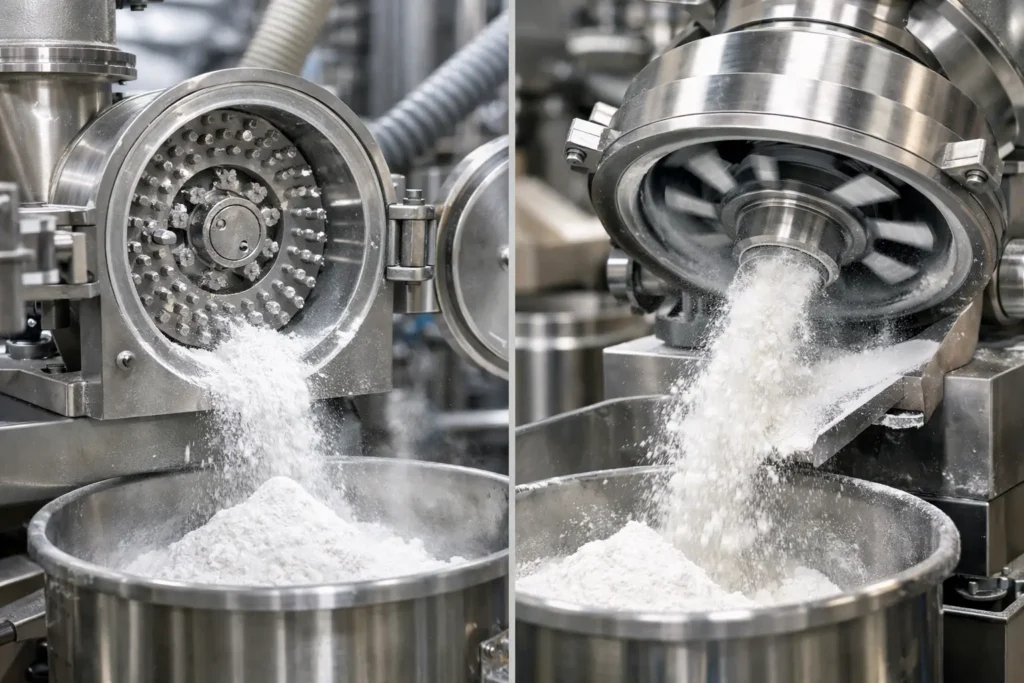
A pin mill uses rows of pins mounted on one or two discs. In a single-disc design, a rotating pin disc works against stationary pins. In a counter-rotating configuration, two pin discs rotate in opposite directions, creating very high relative tip speeds. Particles are fractured by repeated impact as they travel outward through the pin field.
A turbo mill typically uses a high-speed turbine-style rotor with blades, beaters, or other profiled elements. Depending on the configuration, the rotor creates an intense impact zone while generating airflow that carries finer material toward discharge. Many turbo mill systems can be paired with, or incorporate, air classification to control the upper end of the particle-size distribution.
The term turbo mill is not used identically by every equipment manufacturer. Rotor design, classifier arrangement, feed system, and air handling can vary substantially. For that reason, an equipment comparison should begin with the actual machine configuration and process objective, not the equipment name alone.
When a Pin Mill Is the Better Fit
Pin mills are often selected when a material is brittle, friable, and responsive to direct impact. They can produce fine powders with relatively narrow particle distributions when feed rate, rotor speed, screen or classifier configuration, and airflow are properly controlled.
The high-energy pin field is particularly effective for dry materials that need a meaningful reduction from a granular or crystalline feed to a fine powder. Common applications include sugar, salts, spices, chemicals, minerals, pigments, pharmaceutical intermediates, and nutraceutical ingredients. The best results occur when the product flows consistently and does not readily soften, smear, or coat the internal components.
Particle Size and Product Uniformity
A pin mill can provide strong particle-size reduction without the large grinding media associated with other milling approaches. Counter-rotating pin mills can generate especially high impact velocity, which may improve breakage of hard or brittle materials.
However, finer is not always better. Higher rotor speeds and longer residence times can increase fines, broadening the lower end of the distribution or reducing yield if the process requires a tightly defined cut. When a narrow top size is critical, the mill often benefits from controlled air sweep and external classification rather than relying on rotor speed alone.
Sanitation and Changeover Considerations
For food, nutraceutical, and pharmaceutical production, cleanability can be a major advantage of a well-designed pin mill. Accessible internal components, smooth product-contact surfaces, and a layout suited to dry cleaning or validated wet cleaning can reduce changeover time and cross-contamination risk.
The actual result depends on the design details. Pin density, chamber geometry, shaft seals, and access points all affect cleanout. Materials that bridge, retain moisture, or form sticky deposits will still require a process-specific sanitation plan.
When a Turbo Mill Is the Better Fit
Turbo mills are often a strong choice where throughput, airflow management, and continuous control of coarse particles are central to the application. Their rotor geometry can promote intensive particle acceleration while moving product efficiently through the chamber.
This makes the technology useful for many dry bulk solids, including chemical powders, minerals, agricultural materials, food ingredients, polymers, and engineered materials. A turbo mill may be especially valuable when the process needs to prevent oversize particles from reaching discharge or when an air-classification stage can improve product consistency.
Airflow and Classification Matter
In many turbo mill applications, airflow is not simply a means of conveying product. It is part of the size-reduction process. Air can help cool the milling zone, move fines out of the chamber, and limit the residence time of particles that have already reached the desired size.
When integrated with a classifier, the system can return oversized particles to the grinding zone while allowing acceptable fines to exit. This recirculation can improve top-size control and reduce the need for downstream screening. It can also increase system complexity, requiring careful coordination of airflow, classifier speed, fan capacity, collection equipment, and feed consistency.
Throughput and Thermal Management
For operations seeking continuous production at higher rates, a turbo mill can offer a favorable balance between impact energy and material transport. The moving air stream can reduce buildup and help carry heat away from the product. This is valuable for materials that are moderately heat sensitive, although it does not eliminate the need to measure product temperature under real load.
A material with low melting point, high oil content, or strong tendency to soften may still require chilled process air, preconditioning, cryogenic grinding, or an entirely different milling technology. No high-speed impact mill should be selected based on no-load temperature alone. Temperature must be evaluated at the intended feed rate, moisture level, and particle-size target.
Compare the Material Before Comparing the Mill
The most reliable way to evaluate a pin mill versus turbo mill is through the material’s processing behavior. Hardness and feed size matter, but they are only part of the assessment. A practical evaluation should also consider moisture, bulk density, flowability, fat or wax content, abrasiveness, electrostatic behavior, and the potential for agglomeration.
A brittle crystalline chemical may mill efficiently in either machine, with the final decision driven by throughput and particle-size distribution. A fibrous botanical material may require a rotor and airflow arrangement that resists screen blinding and product buildup. A highly abrasive mineral may call for hardened or ceramic contact surfaces, even if the milling performance of either design appears acceptable in an initial trial.
Product quality requirements are equally important. If the specification defines a maximum particle size, an air classifier may be more valuable than a modest increase in grinding intensity. If color, flavor, potency, or active ingredient stability is sensitive to heat, a lower-energy approach or a cooled process may protect product quality better than forcing a finer result through higher rotor speed.
System Design Determines Real Production Performance
Mill selection should account for the complete process system. Feed equipment must deliver a stable, metered supply. An inconsistent screw feeder or rotary valve can create pressure fluctuations, variable residence time, and erratic particle-size distribution regardless of the mill selected.
Dust collection also has a direct effect on performance. Inadequate air balance can lead to poor discharge, elevated chamber temperature, product carryover, and housekeeping concerns. For combustible powders, the system design must address dust hazard requirements through appropriate containment, venting, isolation, grounding, and operational controls.
For regulated applications, material traceability, surface finish, cleanability, and validation requirements should be addressed early. Retrofitting sanitary features or containment provisions after equipment selection is usually more difficult and expensive than incorporating them into the original design.
Maintenance, Wear, and Long-Term Operating Cost
A pin mill’s pins are wear components, especially when processing abrasive materials. Worn pins can change impact performance, reduce efficiency, and shift the final particle-size distribution. Inspections should focus on pin condition, rotor balance, bearing health, seals, and buildup inside the chamber.
Turbo mill maintenance depends on its rotor, classifier, and airflow arrangement. Blades or beaters can wear, while classifier components may require adjustment or replacement to maintain a consistent cut point. Fans, filters, valves, and conveying equipment also become part of the maintenance equation in air-swept systems.
Energy use should be evaluated as energy per unit of acceptable product, not simply motor horsepower. A machine that produces more fine material but creates excess fines, recirculation, or reject product can have a higher true operating cost than a lower-intensity system with better yield. The same applies to uptime: quick access and predictable replacement parts can be more valuable than a small difference in initial equipment cost.
A Better Selection Process
The most productive selection process starts with representative material and a clearly defined acceptance standard. Establish the feed-size range, desired particle-size distribution, moisture level, target throughput, allowable product temperature, and any contamination or sanitation constraints. Then test the material at operating conditions that reflect production, rather than ideal laboratory conditions.
A meaningful trial measures more than average particle size. It should document distribution shape, oversize content, product temperature, throughput, mill power draw, yield, dust collection behavior, cleanout effort, and signs of buildup or wear. Those results give engineering teams the information needed to size the system and identify any necessary controls, cooling, classification, or containment features.
DP Pulverizer Americas works from this application-first perspective because milling performance is determined by the interaction between material and machine. The right equipment choice is the one that delivers the required particle specification repeatedly, at a practical operating cost, without creating a new bottleneck elsewhere in the process.
A pin mill can be the direct, efficient answer for brittle materials needing fine impact grinding. A turbo mill can be the stronger option when airflow, continuous throughput, and classification are central to controlling the result. The final decision should come from production-representative testing and a system design built around the material’s actual behavior.