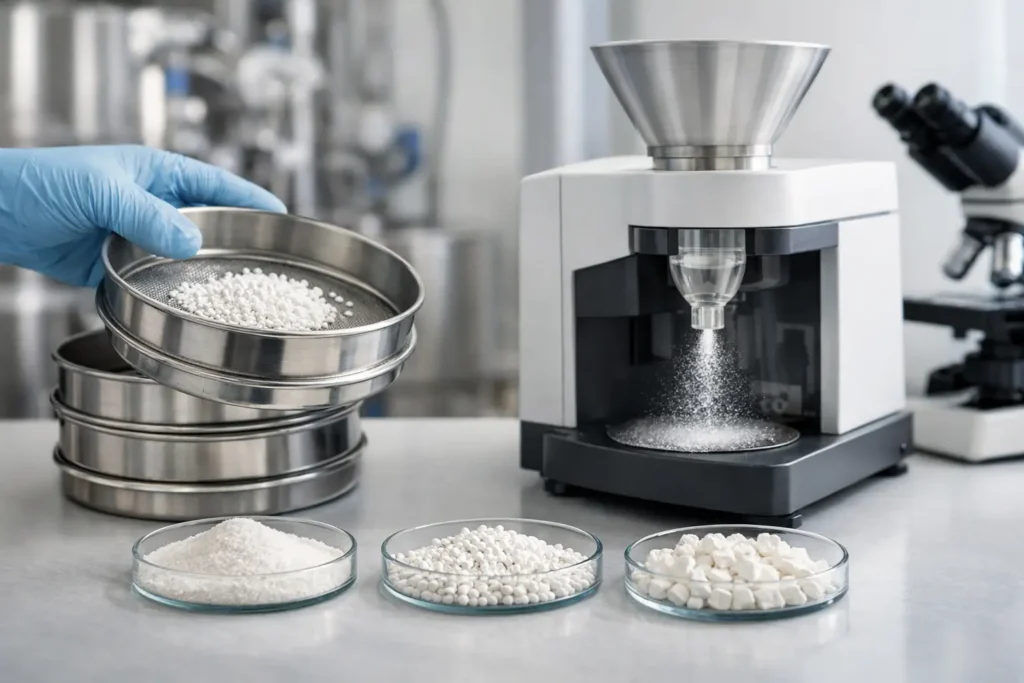
A powder that meets an average micron target can still create costly production problems. Oversized particles may compromise dissolution, coating quality, or downstream blending. Excess fines can increase dust, reduce flowability, alter bulk density, and overload collection systems. Effective particle size control methods address the full particle size distribution, not just a single reported median value.
For manufacturers in pharmaceutical, food, chemical, battery, mineral, and advanced-material applications, the right approach begins with material behavior and ends with a repeatable, measurable process. Milling equipment matters, but it is only one part of the control strategy.
Define the particle size distribution that the process requires
Particle size is often described by values such as D10, D50, and D90. These points show the particle diameter below which 10%, 50%, and 90% of the sample falls. A D50 target is useful, but it cannot confirm whether the coarse tail or fine fraction is acceptable.
Consider a product specified at a D50 of 50 microns. Two batches may both meet that median value, while one contains a significant number of particles above 150 microns and the other has excessive material below 10 microns. Their downstream performance can differ substantially. The first may produce defects in a coating or screen, while the second may create poor handling, dusting, or changes in dissolution behavior.
A practical specification should define the particle size range that matters to the product and process. That may include a median target, a maximum coarse fraction, a limit on fines, moisture requirements, bulk-density expectations, and material temperature limits. The specification should also account for the sampling and analytical method. Laser diffraction, sieve analysis, image analysis, and air-jet sieving can produce different results because they measure particle characteristics differently.
Select the right particle size control method for the material
Different materials fracture, deform, agglomerate, melt, or become electrostatically charged in different ways. The most effective milling technology depends on hardness, brittleness, elasticity, moisture, oil content, heat sensitivity, abrasiveness, feed size, and required throughput.
Impact milling for efficient coarse-to-medium reduction
Hammer mills and turbo mills use high-speed impact to break material down efficiently. They are often effective for materials that fracture readily and for applications requiring a relatively broad or moderate particle size range. Screen selection, rotor speed, airflow, and feed consistency strongly influence the result.
The trade-off is that impact milling can generate heat and may produce a wider distribution than a classified system. For heat-sensitive materials, sticky products, or applications requiring a tightly controlled upper particle limit, a standard impact mill may need cooling, lower energy input, or a different process configuration.
Pin and universal mills for controlled fine grinding
Pin mills and universal mills offer a versatile approach to fine grinding. Material is reduced through impact and shear between rotating and stationary components. These systems can be well suited to many food, chemical, and nutraceutical powders where a finer product is required without moving into the ultrafine range.
Control comes from the relationship between rotor speed, feed rate, internal geometry, and air movement. Higher speed does not always improve results. It can increase fines, raise product temperature, and reduce capacity if the material begins to soften or recirculate inside the mill.
Air classification for tighter distributions
Air classifier mills combine size reduction with an internal classification stage. Fine particles exit with the air stream, while oversized material remains in the grinding zone until it is reduced sufficiently. This provides more direct control of the coarse end of the distribution than screen-based milling alone.
Classifier speed, airflow, grinding energy, and feed rate must be balanced. Raising classifier speed generally produces a finer cut, but it can also lower throughput and increase energy use. The best operating point is not necessarily the finest possible setting. It is the setting that meets the product specification with stable capacity and acceptable operating cost.
Jet milling for ultrafine and high-purity applications
Jet mills use high-velocity gas streams to accelerate particles into collisions with one another. With no mechanical grinding media in the product zone, they can support low-contamination processing and ultrafine particle reduction. They are commonly considered when product purity, low heat exposure, or very fine particle targets are critical.
Jet milling is not a universal answer. It requires compressed gas, and its energy demand can be significant. Feed material must also be suitable for particle-to-particle fracture. Materials that are highly elastic, tacky, or difficult to fluidize may require conditioning or a different method.
Cryogenic grinding for heat-sensitive or elastic materials
Some materials resist ambient-temperature milling because they soften, smear, melt, or deform under mechanical energy. Cryogenic grinding lowers the material temperature, commonly with liquid nitrogen, so it becomes more brittle and easier to fracture. This can be particularly useful for polymers, spices, rubber-like materials, waxes, and other heat-sensitive products.
The added utility and handling requirements must be justified by the application. Cryogenic processing can improve yield, preserve sensitive attributes, and reduce agglomeration, but it introduces operating complexity that is unnecessary when ambient milling can meet the specification.
Control the feed before it reaches the mill
Many particle size problems begin upstream. An inconsistent feed rate changes residence time and grinding load. Oversized lumps can overwhelm a mill designed for a narrower feed range. Changes in moisture, temperature, or bulk density can alter how material moves through feeders and how it responds to impact or shear.
A reliable system uses controlled feeding matched to the mill’s capacity. Screw feeders, vibratory feeders, rotary valves, loss-in-weight systems, and pre-breakers each serve different material-handling needs. The objective is stable mass flow without segregation, bridging, surging, or excessive air leakage.
Preconditioning may be equally important. Drying can improve fracture behavior and reduce buildup. Deagglomeration may be needed before classification. Cooling may prevent softening. For cohesive powders, proper hopper design and agitation can be more valuable than simply increasing mill speed.
Use classification, screening, and recirculation deliberately
Particle size control methods become more precise when the process separates acceptable material from out-of-spec fractions. Screens provide a physical cutoff and can be effective for coarser products, although screen wear, blinding, and near-size particle passage require attention. Air classification is often better suited to fine powders and can avoid the limitations of fine screens.
Closed-loop milling and classification can improve yield when a narrow distribution is required. Coarse particles are returned for additional reduction, while finished material is collected. However, recirculation must be designed carefully. Too much internal recycle can increase residence time, generate excess fines, elevate temperature, and reduce overall throughput.
A practical system evaluates both the mill and the separation stage as one process. The collection equipment, ducting, blower performance, and air balance influence classifier behavior and product recovery. A well-selected mill can still perform poorly if the pneumatic system is not engineered around the application.
Measure performance with a disciplined control plan
Particle size control is not achieved by a single commissioning test. Material lots change, wear components gradually alter grinding conditions, and operators need clear limits for responding to normal process variation. A control plan connects product testing to operating parameters that can be adjusted in real time.
Critical parameters typically include feed rate, rotor or classifier speed, airflow, inlet temperature, differential pressure, gas pressure for jet milling, and product temperature. The relevant settings depend on the technology, but the principle is consistent: measure the variables that drive particle size, establish proven operating ranges, and trend them over time.
Sampling deserves the same discipline. Powder segregation can make a sample unrepresentative, especially when the material contains a broad range of sizes. Samples should be collected from defined locations and times, using a method that reflects the actual production stream. Testing a convenient sample from the top of a drum may not reveal variation in the batch.
Preventive maintenance also protects particle size consistency. Worn hammers, pins, liners, screens, classifier wheels, and seals affect grinding and may introduce contamination risk. Inspection intervals should be based on material abrasiveness, run hours, product quality trends, and equipment condition rather than a calendar alone.
Design for scale-up, containment, and long-term operation
A successful pilot result does not automatically translate to production capacity. Larger equipment changes airflow, residence time, heat transfer, feeder behavior, and material handling. Scale-up should be based on process data, not only geometric assumptions or motor horsepower.
For regulated or sensitive products, cleanability and containment are part of particle size control. Product buildup can change internal mill conditions and create cross-contamination concerns. Dust leakage affects both safety and yield. Material-contact construction, access for cleaning, seal design, dust collection, and automated controls should be evaluated alongside micron targets.
DP Mills approaches equipment selection as an integrated processing decision. The most effective solution may involve a mill, classifier, feeder, cooling strategy, collection system, and controls engineered around the material rather than a single machine selected from a catalog.
The right target is not the smallest particle size or the highest possible throughput. It is a stable operating window that delivers the required distribution, protects product integrity, and remains practical for operators to run shift after shift.