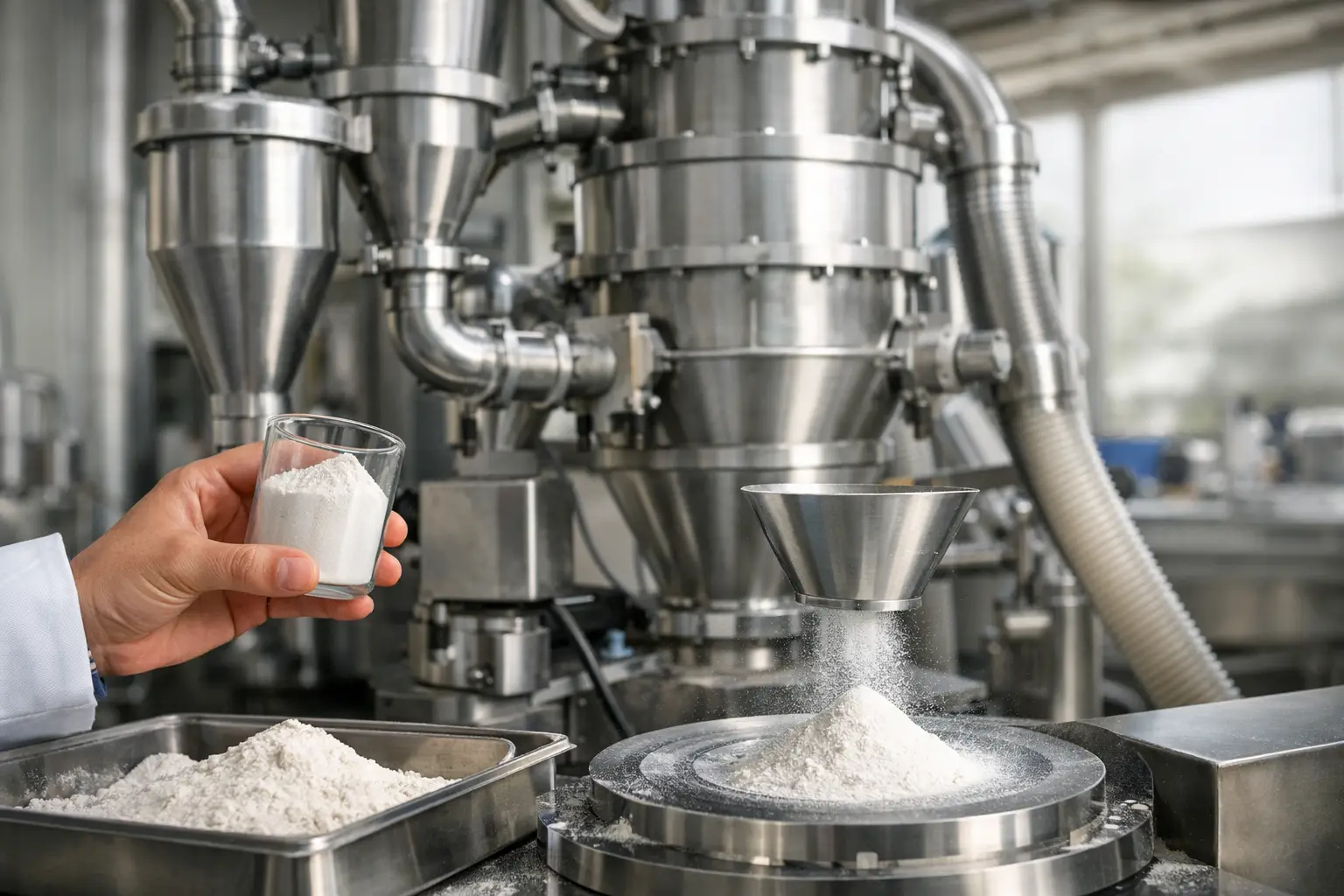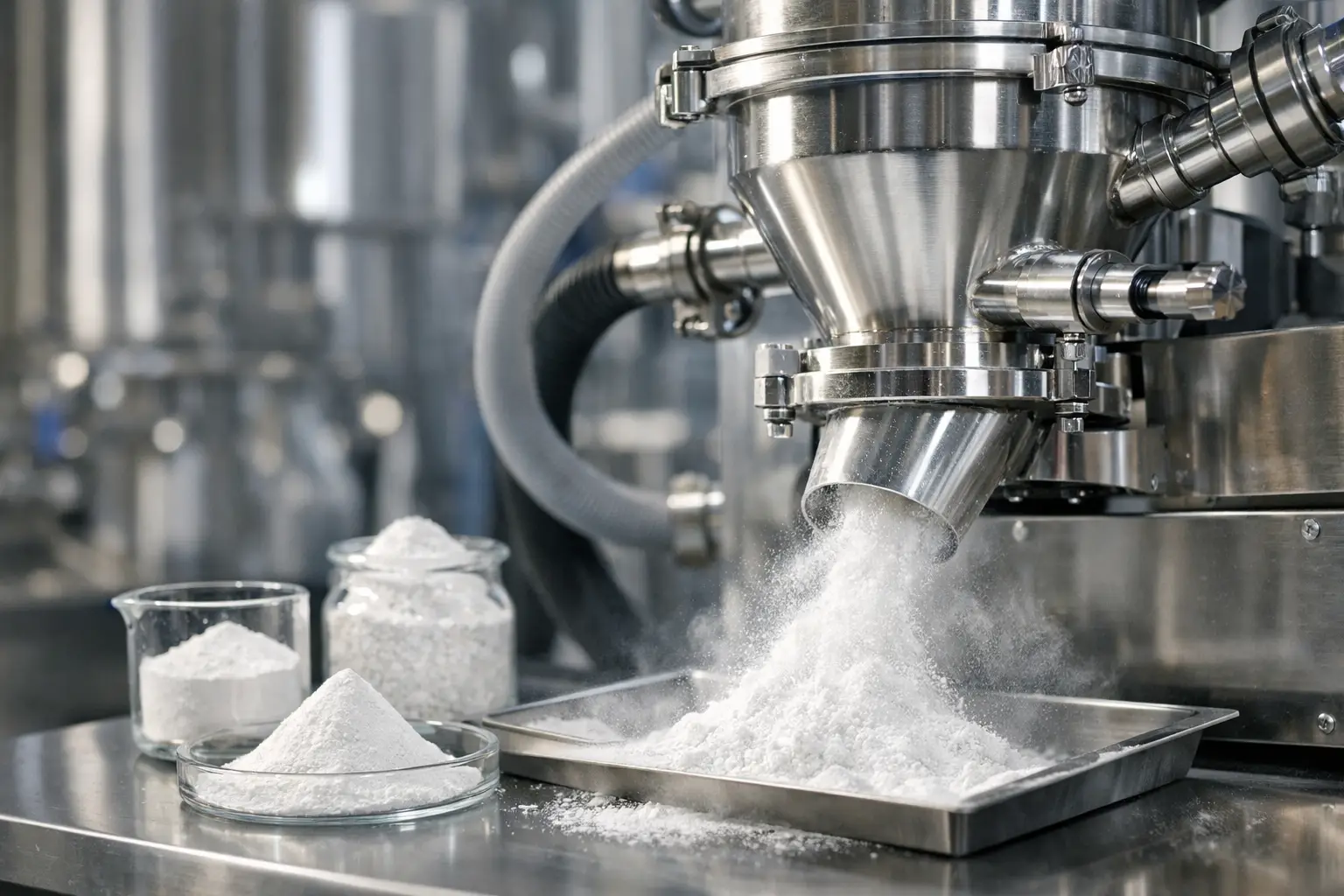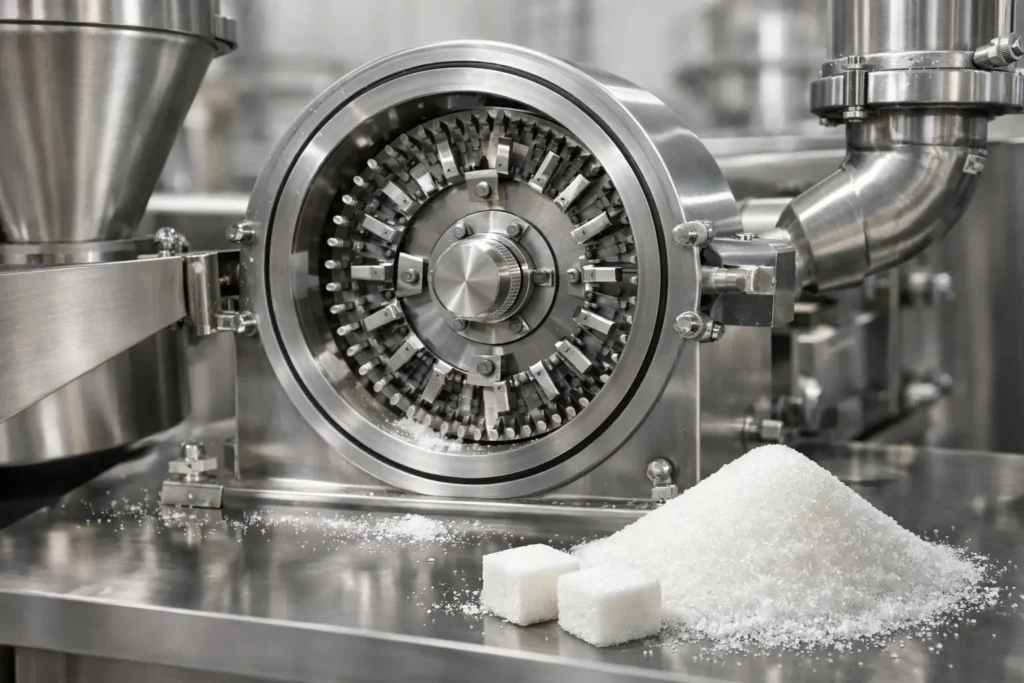
A sugar line usually starts showing problems at the same point – when particle size stops being predictable. One batch runs fine, the next creates excess fines, poor flow, dust loading, or inconsistent performance downstream in blending, coating, or packaging. In many of these cases, a pin mill for sugar grinding is worth a serious look because it offers high-speed impact reduction with tight process control and strong production flexibility.
Sugar may seem straightforward to grind, but in production environments it behaves more like a process-sensitive material than a simple commodity. Crystal size, moisture pickup, temperature, feed consistency, and target fineness all affect milling performance. Choosing the right mill is less about whether sugar can be reduced and more about whether it can be reduced efficiently, repeatably, and without creating new operating problems.
Why a pin mill for sugar grinding fits many applications
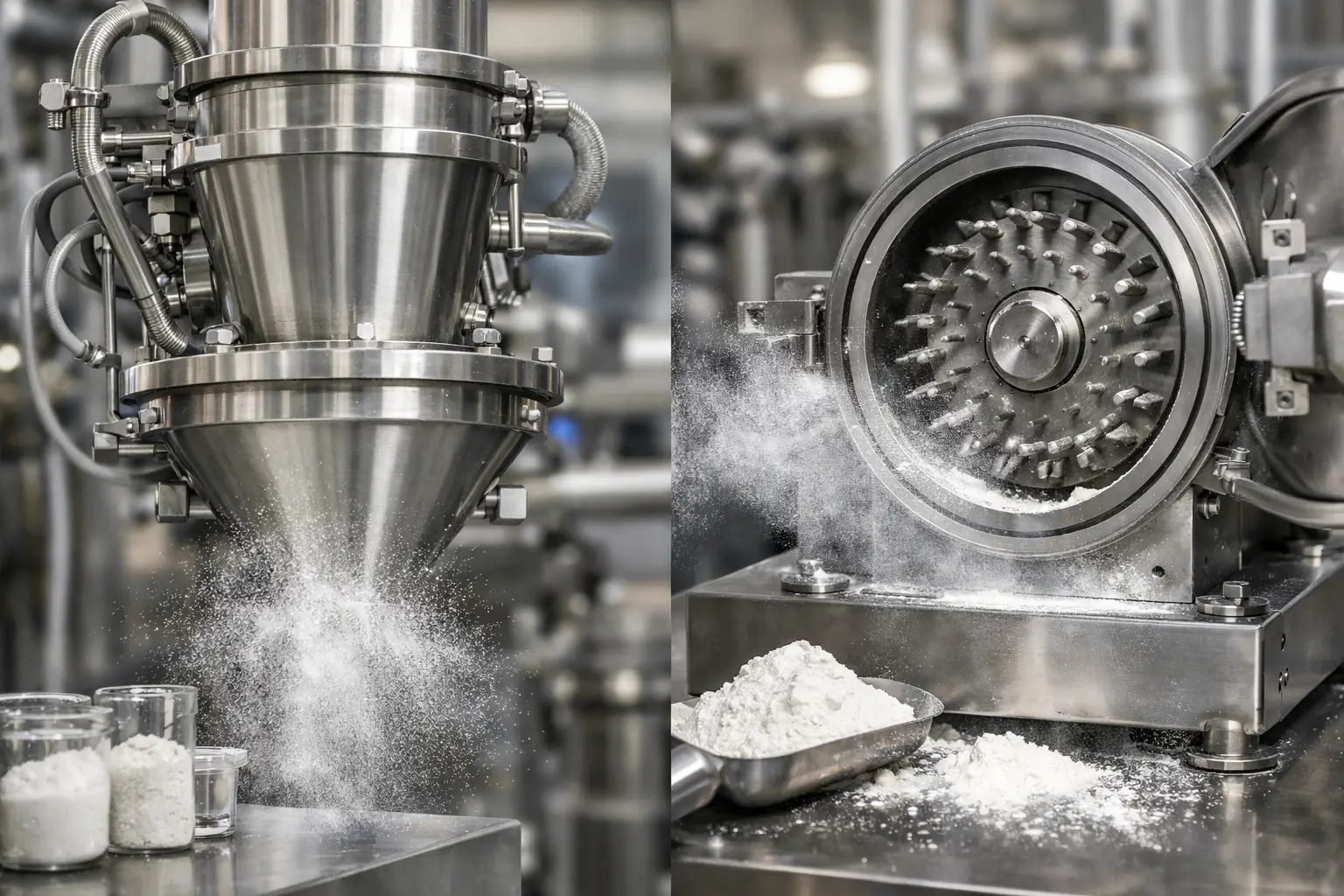
A pin mill uses two discs fitted with intermeshing pins or one rotating disc working against a stationary disc. As sugar enters the grinding zone, it is reduced through repeated high-speed impact and attrition. This basic design is well suited for friable materials like sugar because the crystals fracture cleanly and can be processed to a fine, consistent powder.
For manufacturers producing powdered sugar, specialty bakery ingredients, premixes, confectionery components, or fine sugar used in coatings and dusting operations, the main advantage is control. A properly engineered pin mill can produce narrow particle size distributions while maintaining practical throughput. That balance matters when product appearance, flowability, dissolution, or bulk density affect downstream performance.
Compared with lower-speed mechanical reduction methods, pin mills typically achieve finer particle sizes more efficiently. Compared with some air-based technologies, they can offer a more economical solution when the application does not require ultrafine micronization. That is where the trade-off starts. The right choice depends on target size, production volume, thermal sensitivity, sanitation requirements, and the full process around the mill.
What performance factors matter most
When evaluating a pin mill for sugar grinding, the discussion should go beyond rotor speed and motor size. Milling results are shaped by the interaction of several process variables.
Particle size target and distribution
If the goal is standard powdered sugar, a pin mill is often an effective fit. If the specification becomes extremely tight or reaches into very fine ranges, the system may need additional classification, air handling, or screening support. The mill alone does not define final quality. Feed condition and system configuration matter just as much.
A common mistake is focusing only on average particle size. In sugar processing, the spread of the distribution can be equally important. Excess coarse material affects texture and appearance, while excess fines can increase dust, reduce flow, and create handling issues in packaging or pneumatic transfer.
Heat generation
Sugar is sensitive to heat in practical terms, even if it is not the most fragile product in the plant. High grinding energy can increase product temperature, which may contribute to caking, sticking, or process instability in humid environments. This becomes more relevant when fine targets require higher tip speed or multiple impacts.
That does not mean pin mills are too hot for sugar. It means the system should be engineered with realistic expectations around feed rate, residence time, airflow, and ambient conditions. In some cases, controlled air assistance or integrated cooling strategies improve process stability significantly.
Throughput and production efficiency
A mill that meets particle size targets in lab trials may not hold the same performance at full production rates. Sugar grinding often looks simple until operators try to increase feed rate and particle size begins to drift. The grinding chamber geometry, pin configuration, drive capacity, and feeding method all influence whether the mill can sustain output without compromising consistency.
For high-volume operations, the question is not just how fine the sugar can be ground. It is whether the system can deliver that result hour after hour with manageable wear, stable amperage, and acceptable maintenance intervals.
Contamination control and sanitation
In food and nutraceutical manufacturing, contamination reduction is not optional. Equipment design should support clean operation, material compatibility, and straightforward access for inspection and cleaning. Sugar also tends to expose small design weaknesses quickly because buildup, dust, and residue are easy to spot once the process is running continuously.
A well-designed pin mill system should account for hygienic construction, dust containment, and practical cleanout procedures. For facilities changing products or grades, cleanability may matter just as much as grinding performance.
Where pin mills outperform other options
Pin mills are especially strong in applications where manufacturers need fine sugar with good uniformity and efficient throughput, but do not need the complexity or operating cost of more specialized micronizing systems. They are also attractive when space is limited and the process benefits from a compact, high-speed impact mill.
Compared with hammer mills, pin mills generally provide finer size reduction and tighter control for sugar applications. Hammer mills can be useful for coarser reduction or less demanding particle size targets, but they often produce a broader distribution. If the final application is sensitive to mouthfeel, surface coverage, or visual consistency, that difference can become important.
Compared with jet mills, pin mills are usually more practical for sugar when the target does not justify compressed gas energy use or ultrafine capability. Jet milling has advantages for highly exacting fine particle applications and low-contamination environments, but it is not automatically the best answer for every sugar process.
This is why equipment selection should start with the manufacturing objective, not the machine category. The best mill is the one that meets the actual process requirement with the fewest compromises.
Process considerations that affect results
Feed condition
Sugar that has absorbed moisture behaves very differently from free-flowing dry crystals. Feeding consistency affects grinding stability, power draw, and final particle size. If upstream storage or conveying allows moisture pickup, even a correctly sized mill can underperform.
This is one reason integrated system thinking matters. The hopper, feeder, air handling, and collection equipment all influence the mill’s real-world performance.
Dust management
Fine sugar processing creates combustible dust concerns along with housekeeping and product loss issues. A pin mill system should be evaluated as part of a complete dust-controlled process, including containment, collection, and safe operating design. The milling chamber is only one part of the risk profile.
Wear and maintenance
Sugar is not the most abrasive material, but maintenance still affects uptime. Pin geometry, material of construction, balancing, and access design influence how easy the mill is to inspect and maintain. In high-throughput operations, even modest reductions in maintenance time can improve total equipment effectiveness.
Scalability
Pilot success does not always translate directly to commercial production. Scale-up should consider not just horsepower and chamber size, but airflow, feeding behavior, discharge handling, and thermal effects. An engineering-driven supplier will usually look at the complete process rather than treat the mill as an isolated component.
When a pin mill may not be the best choice
A pin mill for sugar grinding is highly effective in many applications, but not every one. If the product is extremely heat sensitive, highly sticky, or requires an ultrafine distribution beyond the practical range of impact milling, another technology may be a better fit. The same applies if the process requires very narrow top-size control without additional classification.
There are also cases where upstream crystallization or drying issues are the real source of performance problems. Replacing the mill will not fix inconsistent feed material. That is why process evaluation should include the full production line.
For manufacturers comparing technologies, the most useful approach is usually application testing tied to measurable outcomes: particle size distribution, throughput, temperature rise, energy use, cleanability, and product behavior downstream. That data provides a far better basis for decision-making than general equipment claims.
Choosing the right system design
The strongest results usually come from matching the mill design to the application rather than forcing the application into a standard platform. Rotor speed, pin arrangement, feed method, discharge design, and ancillary equipment all influence sugar grinding performance. In some facilities, a standalone mill is sufficient. In others, the better solution includes controlled feeding, air classification, dust collection, and integrated conveying.
This is where an engineering-focused partner adds value. DP Pulverizer Americas Inc., for example, approaches milling selection around process requirements such as target fineness, throughput, contamination control, and operating reliability rather than a one-size-fits-all machine recommendation.
For sugar processors under pressure to improve consistency, reduce waste, and scale production without sacrificing quality, the real question is not whether a pin mill can grind sugar. It is whether the system has been engineered to do it predictably in your plant, with your material, under your production conditions.
That is usually the difference between a mill that runs and a mill that performs.