Peptide Milling & Size Reduction
From advanced pharmaceuticals and regenerative medicine to sports recovery, longevity research, cosmetics, and nutraceutical innovation, peptides are rapidly becoming one of the fastest-growing categories in modern manufacturing and biotechnology.
But while the spotlight is often on the science behind peptides, very few companies talk about one of the most critical parts of peptide production:
How they are processed, milled, protected, micronized, and handled.
That’s where DP Pulverisers comes into the conversation.
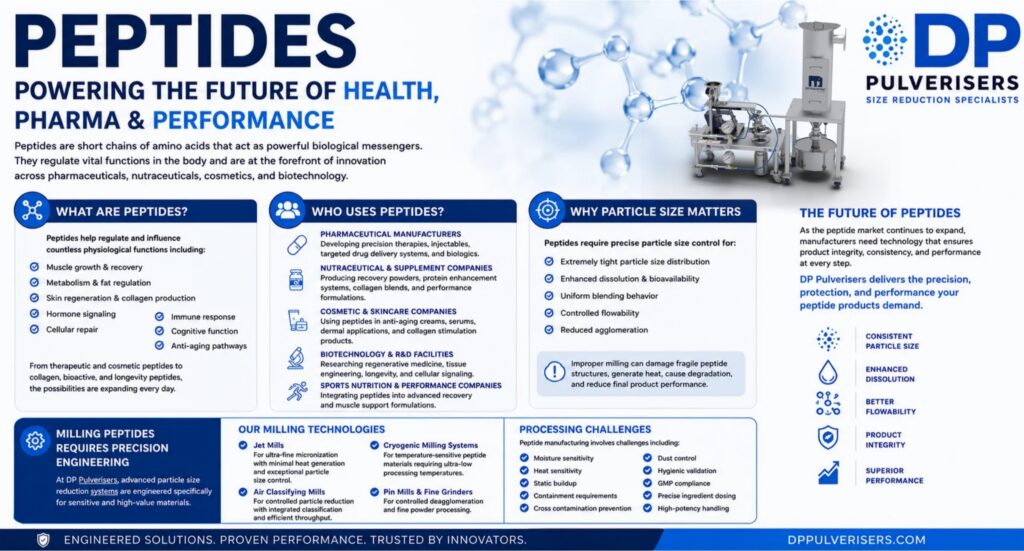
What Are Peptides?
Peptides are short chains of amino acids that act as biological messengers within the body. In simple terms, they help regulate and influence countless physiological functions including:
- Muscle growth & recovery
- Metabolism & fat regulation
- Skin regeneration & collagen production
- Hormone signaling
- Cellular repair
- Immune response
- Cognitive function
- Anti-aging pathways
Many peptides are naturally produced in the human body, while others are synthesized for pharmaceutical, cosmetic, medical, and nutraceutical applications.
Some of the most discussed peptide categories today include:
- Therapeutic peptides
- Cosmetic peptides
- Collagen peptides
- Bioactive peptides
- Injectable pharmaceutical peptides
- Sports recovery peptides
- Longevity & regenerative peptides
Who Uses Peptides?
The peptide industry has expanded far beyond pharmaceutical laboratories.
Today, peptides are widely used by:
Pharmaceutical Manufacturers
Developing precision therapies, injectables, targeted drug delivery systems, and biologics.
Nutraceutical & Supplement Companies
Producing recovery powders, protein enhancement systems, collagen blends, and performance-focused formulations.
Cosmetic & Skincare Companies
Using peptides in anti-aging creams, serums, dermal applications, and collagen stimulation products.
Biotechnology & R&D Facilities
Researching regenerative medicine, tissue engineering, longevity, and cellular signaling.
Sports Nutrition & Performance Companies
Integrating peptides into advanced recovery and muscle support formulations.
Why Particle Size Matters in Peptide Manufacturing
One of the most overlooked aspects of peptide processing is particle size control.
Peptides often require:
- Extremely tight particle size distribution
- Enhanced dissolution characteristics
- Improved bioavailability
- Uniform blending behavior
- Controlled flowability
- Reduced agglomeration
Improper milling can:
- Damage fragile peptide structures
- Generate excessive heat
- Cause degradation
- Create inconsistent dosing
- Reduce final product performance
This is why advanced milling technology becomes essential.
Milling Peptides Requires Precision Engineering
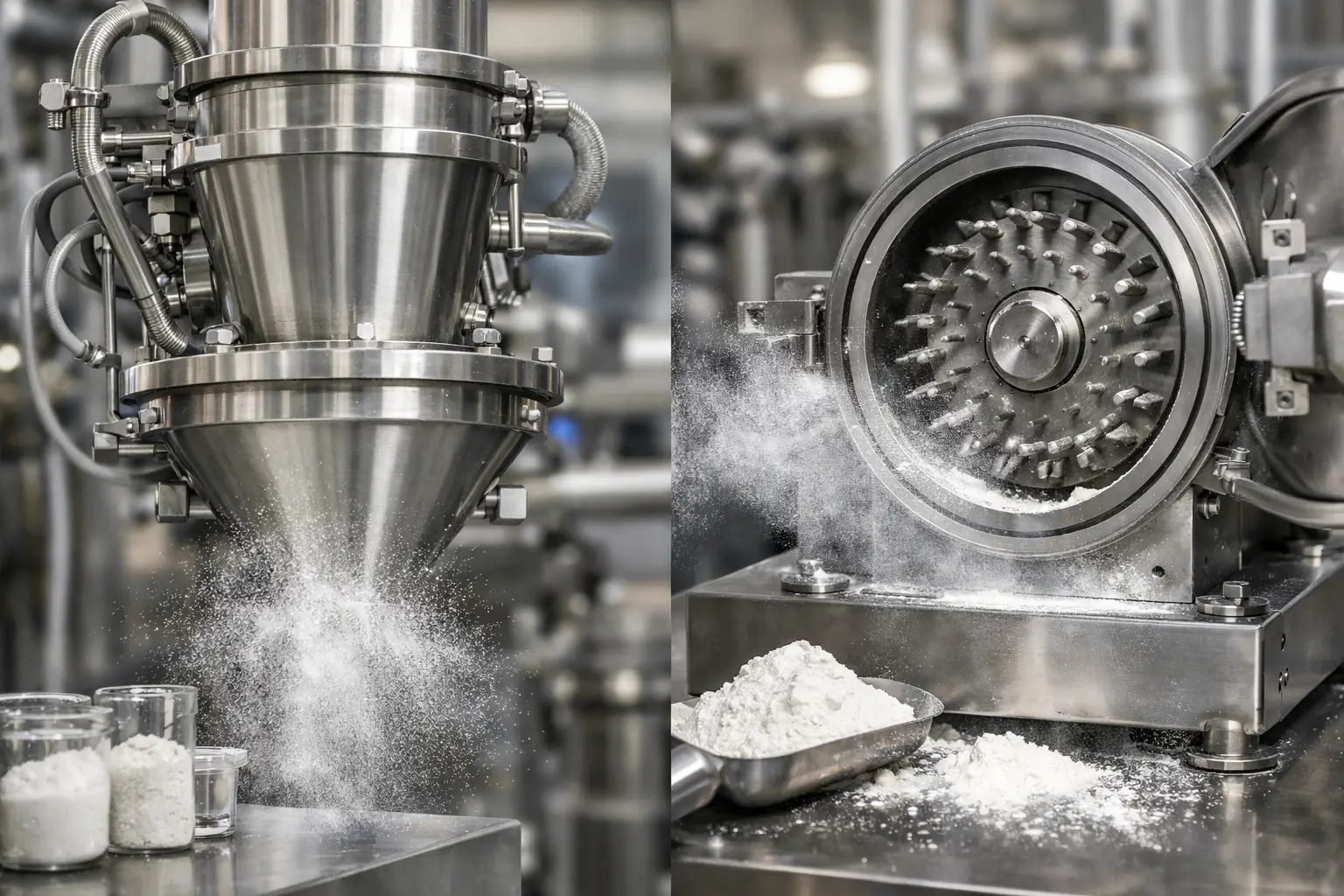
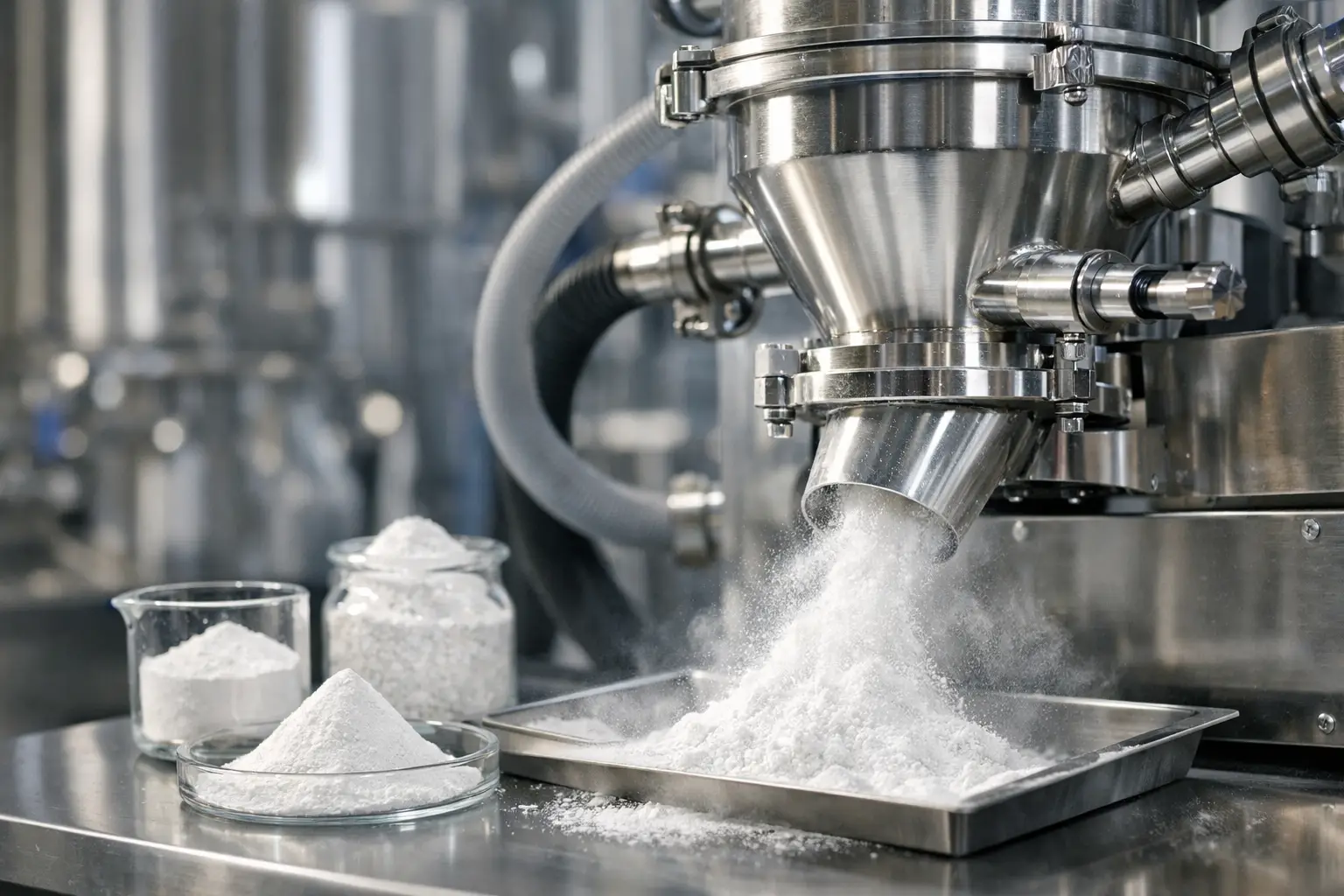
At DP Pulverisers, advanced particle size reduction systems are engineered specifically for sensitive and high-value materials.
Depending on the peptide application, manufacturers may utilize:
Jet Mills
For ultra-fine micronization with minimal heat generation and exceptional particle size control.
Air Classifying Mills
For controlled particle reduction with integrated classification and efficient throughput.
Cryogenic Milling Systems
For temperature-sensitive peptide materials requiring ultra-low processing temperatures.
Pin Mills & Fine Grinders
For controlled deagglomeration and fine powder processing.
The goal is not simply to make powders smaller.
The goal is to protect product integrity while improving performance, consistency, dispersion, and downstream processing efficiency.
Pharmaceutical & Nutraceutical Processing Challenges
Peptide manufacturing is not just about particle reduction.
Manufacturers also face challenges involving:
- Moisture sensitivity
- Heat sensitivity
- Static buildup
- Containment requirements
- Cross contamination prevention
- Dust control
- Hygienic validation
- GMP compliance
- Precise ingredient dosing
This is especially critical when processing:
- High-potency ingredients
- Injectable-grade formulations
- Sports nutrition powders
- Functional nutraceuticals
- Cosmetic actives
- Research compounds
DP Pulverisers engineers advanced processing systems designed to help manufacturers achieve:
- Consistent particle size distribution
- Better product flowability
- Improved dissolution
- Enhanced dispersion characteristics
- Efficient downstream blending
- Repeatable production performance
The Future of Peptides
The peptide market is projected to continue expanding aggressively over the next decade as industries push further into:
- Personalized medicine
- Longevity science
- Advanced therapeutics
- Functional nutrition
- Regenerative healthcare
- High-performance wellness products
As formulations become more advanced, manufacturers will require:
- Better containment
- Better particle control
- Better homogenization
- Better validation
- Better process repeatability
The future of peptide manufacturing will not be driven by chemistry alone.
It will also be driven by precision processing technology.
The Next Generation Of Particle Size Reduction
At DP Pulverisers, advanced micronization and milling systems are helping pharmaceutical, nutraceutical, biotech, and specialty chemical manufacturers push the boundaries of modern powder processing technology.
Because in high-value industries like peptides, precision is everything.