Why Ceramic Powder Milling Is One of the Most Challenging Size Reduction Applications in Manufacturing
Advanced ceramics are helping shape the future of manufacturing.
From semiconductor substrates and battery materials to aerospace components, armor systems, fuel cells, and technical ceramics, manufacturers are increasingly relying on engineered ceramic powders to achieve performance levels that traditional materials simply cannot match.
However, producing those powders presents a unique challenge.
Unlike softer minerals and chemicals, advanced ceramics often possess hardness levels approaching 9 on the Mohs scale, making them among the most difficult materials to process efficiently while maintaining product purity.
At DP Pulverizers, a division of Proc-X Manufacturing Group, we frequently work with manufacturers seeking to reduce ceramic materials from coarse granules into precisely controlled powder specifications suitable for downstream processing.
The Challenge: Hard Materials, Tight Specifications
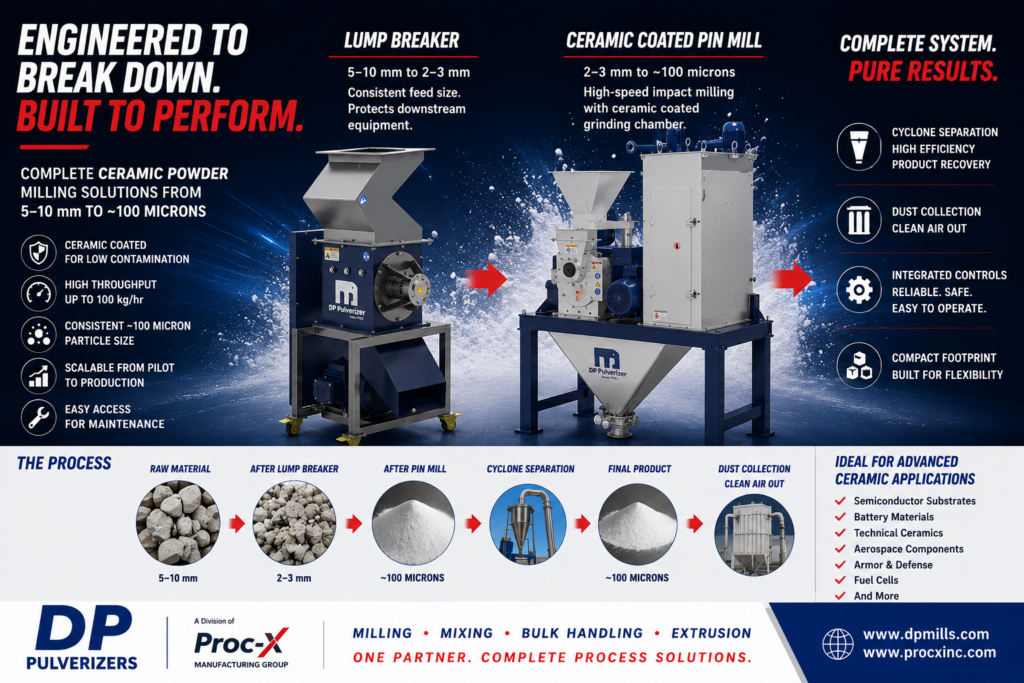
A typical ceramic milling application may require reducing feed material from 5-10 mm down to approximately 100 microns while maintaining:
• Consistent particle size distribution • High throughput rates • Minimal contamination • Controlled heat generation • Repeatable batch-to-batch performance
While these objectives may sound straightforward, they become increasingly difficult when processing highly abrasive ceramic materials.
Every impact inside a grinding chamber creates wear. Every wear surface introduces the possibility of contamination. Every particle size target affects energy consumption and production throughput.
For many manufacturers, the challenge is not simply making powder—it is making the right powder.
Why Pre-Conditioning Matters
One of the most overlooked aspects of ceramic powder processing is feed preparation.
Large feed particles entering a fine grinding system create unnecessary stress on the mill while reducing overall efficiency.
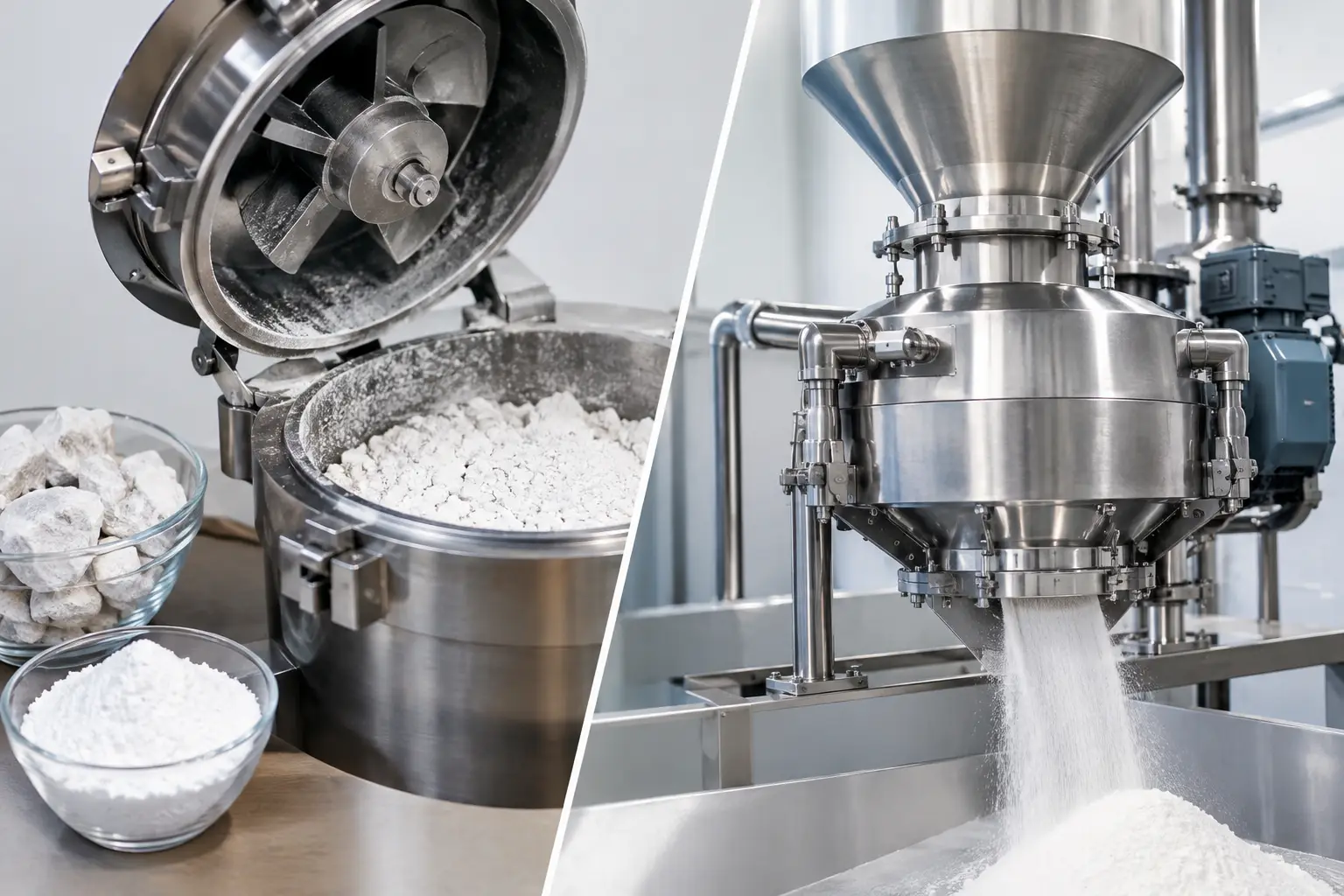
For this reason, many ceramic processing systems utilize a lump breaker ahead of the fine grinding stage.
The lump breaker reduces incoming material from approximately 5-10 mm down to a controlled 2-3 mm feed size, creating a more uniform material stream entering the mill.
The benefits include:
✔ Improved milling efficiency
✔ Reduced wear on grinding components
✔ Lower energy consumption
✔ Improved particle size consistency
✔ Increased throughput
The result is a more predictable and scalable process.
Why Pin Mills Are Often an Ideal Solution
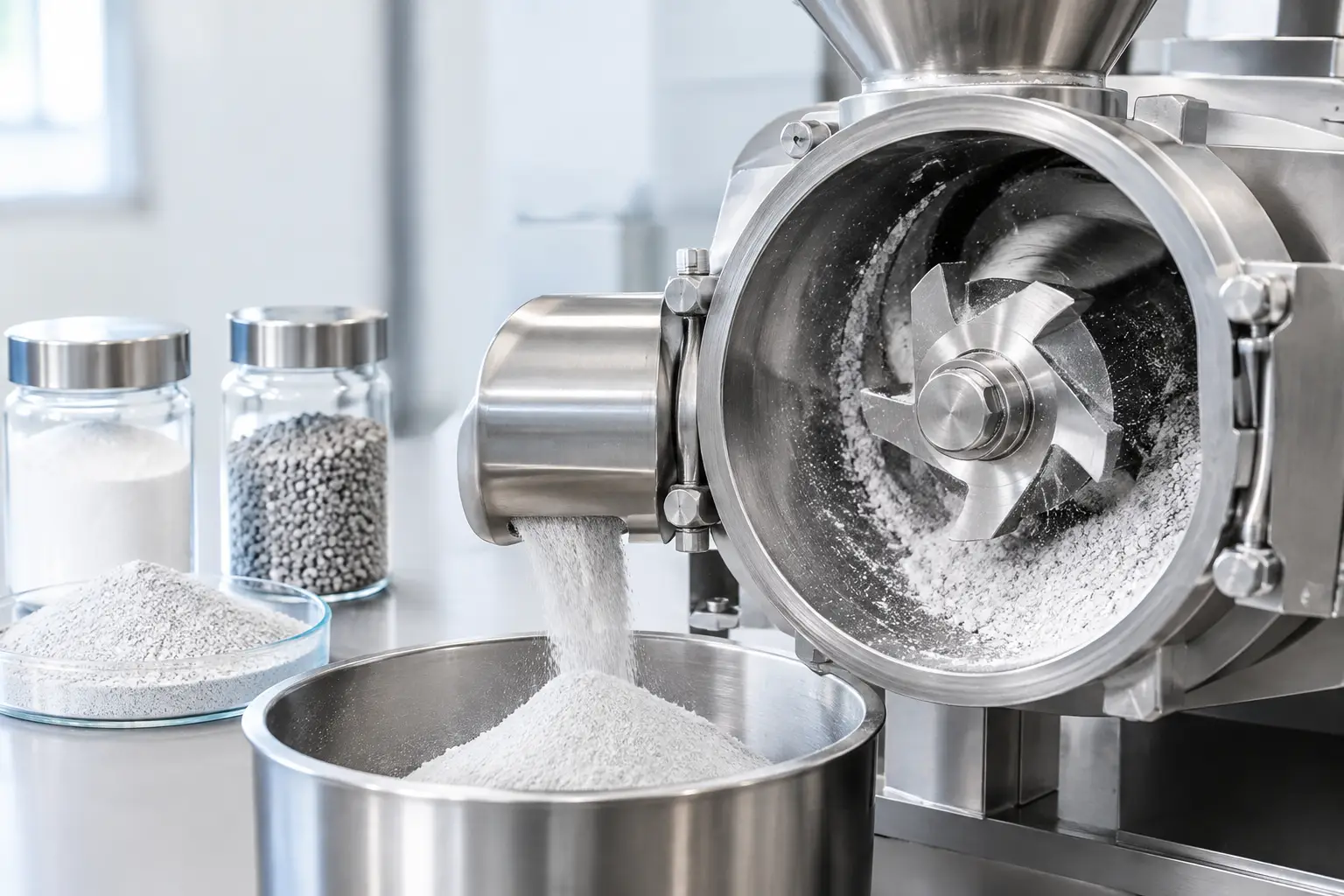
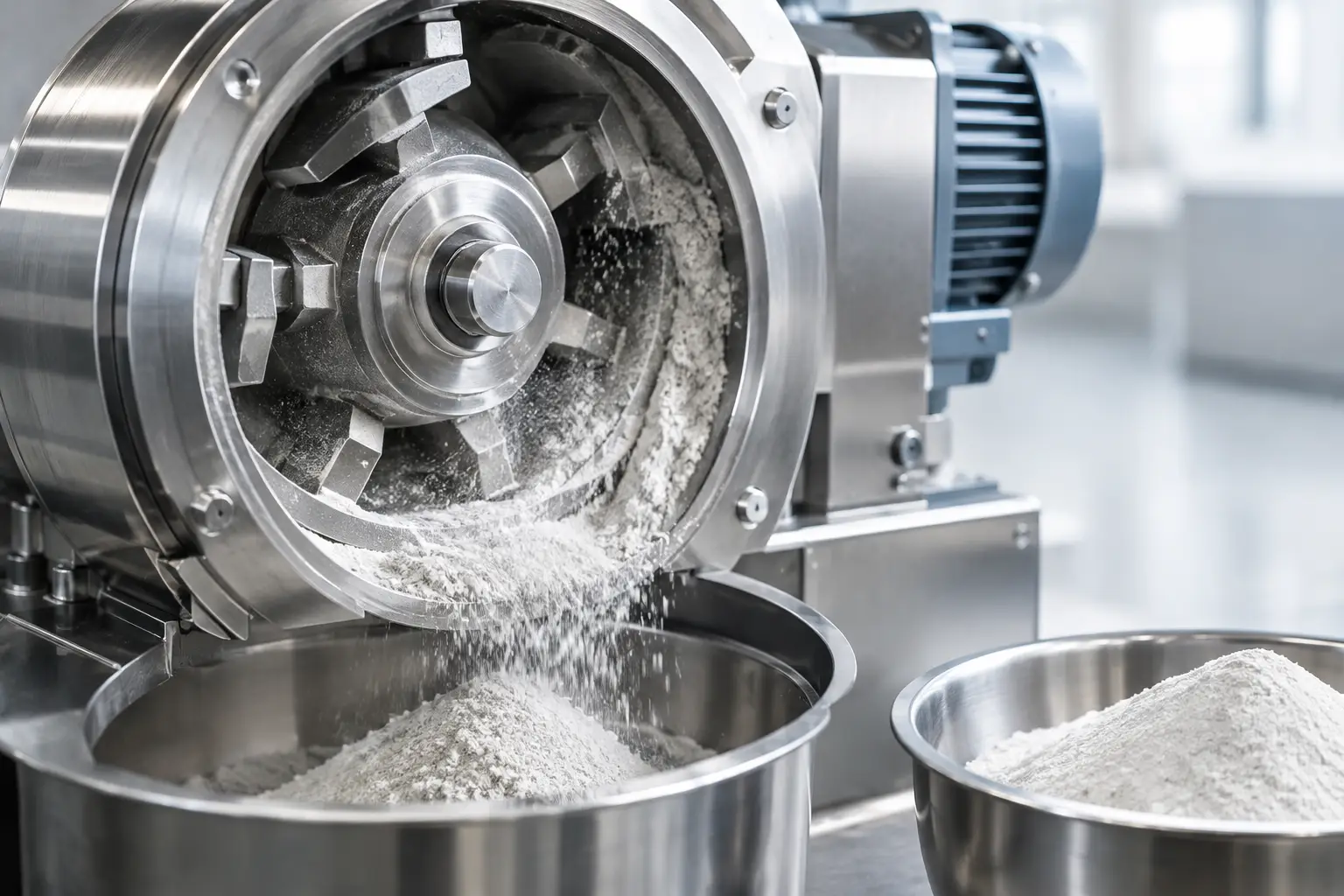
For applications targeting approximately 100 microns, pin mills frequently provide an excellent balance between throughput, energy efficiency, and particle size control.
Pin mills utilize high-speed impact forces generated between stationary and rotating pins to rapidly reduce particle size.
For ceramic materials, specially engineered wear-resistant configurations can be employed, including:
• Ceramic-coated grinding chambers
• Ceramic-coated impact surfaces
• Wear-resistant liners
• Specialized rotor designs
These enhancements significantly reduce contamination while extending component life in highly abrasive environments.
Contamination Control Is Critical
In advanced ceramic manufacturing, contamination can become a major concern.
Even trace levels of metallic contamination can affect:
• Electrical conductivity
• Sintering behavior
• Product purity
• Material performance
• Final product quality
This is why many advanced ceramic processors specify ceramic-lined or ceramic-coated product contact surfaces throughout the milling process.
The goal is not only to achieve particle size reduction but to preserve the integrity of the material itself.
Designing for Scale-Up
Many ceramic powder projects begin at pilot scale.
The challenge is ensuring that successful pilot results can be replicated at commercial production volumes.
A properly engineered milling system should allow manufacturers to:
• Establish process parameters
• Measure wear rates
• Evaluate contamination levels
• Validate throughput expectations
• Develop scale-up data
This approach reduces risk while accelerating commercialization.
The Future of Ceramic Powder Processing
As industries continue to demand higher-performance materials, ceramic powder processing technology must continue to evolve.
Manufacturers increasingly require:
• Greater particle size precision
• Reduced contamination
• Higher throughput
• Longer wear life
• Improved process efficiency
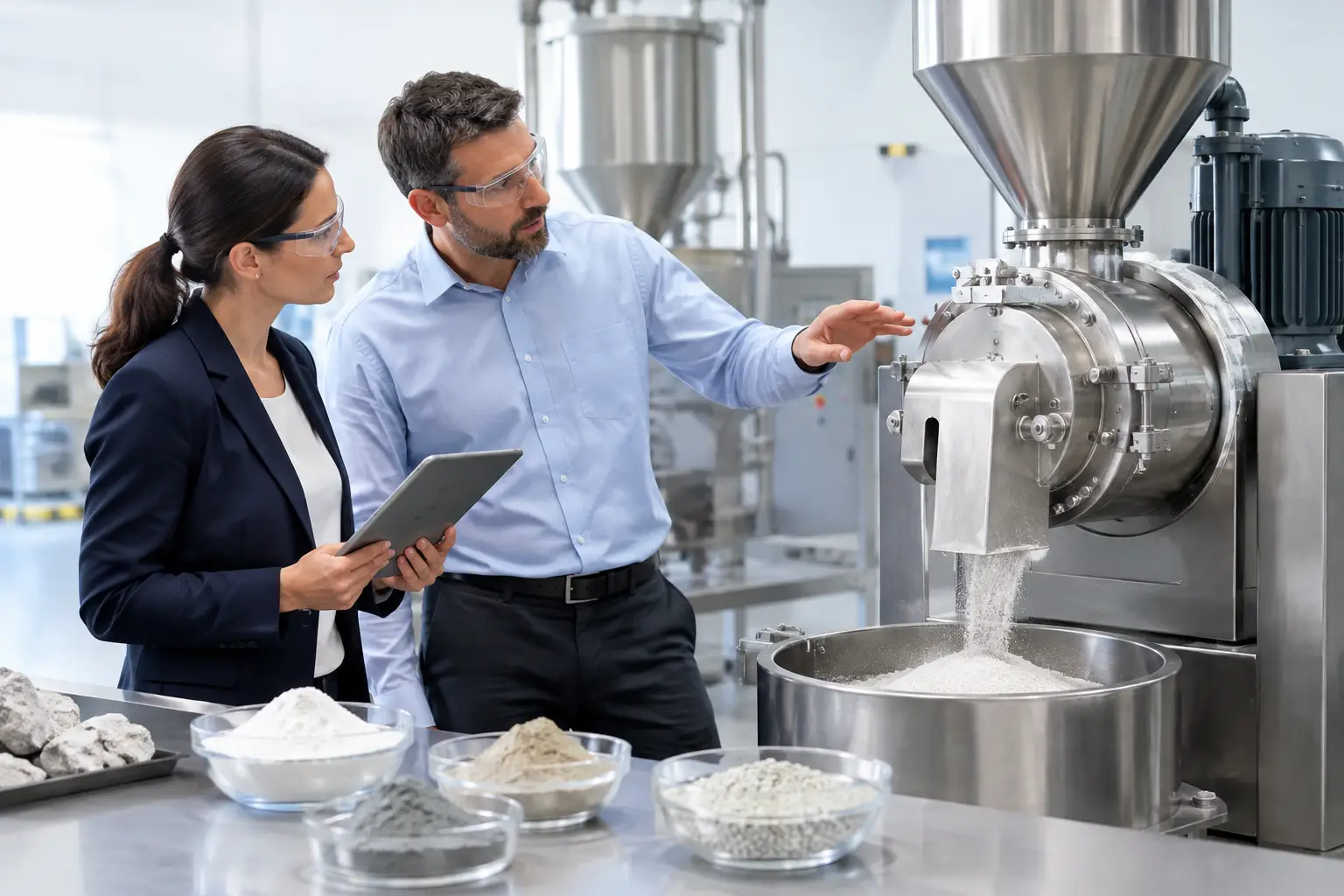
The most successful projects are those that view milling not as a standalone machine but as a fully integrated process combining feed preparation, size reduction, product recovery, dust collection, and contamination control.
At DP Pulverizers and Proc-X Manufacturing Group, we work closely with manufacturers to engineer complete powder processing solutions designed around the unique challenges of advanced materials.
Because when it comes to ceramics, the difference between a successful process and an unsuccessful one is often measured in microns.
#Ceramics #AdvancedMaterials #PowderProcessing #ParticleSizeReduction #SizeReduction #PinMill #IndustrialMilling #Manufacturing #Engineering #BatteryMaterials #SemiconductorManufacturing #TechnicalCeramics #ProcX #DPPulverizers #QuantumXSee content credentials