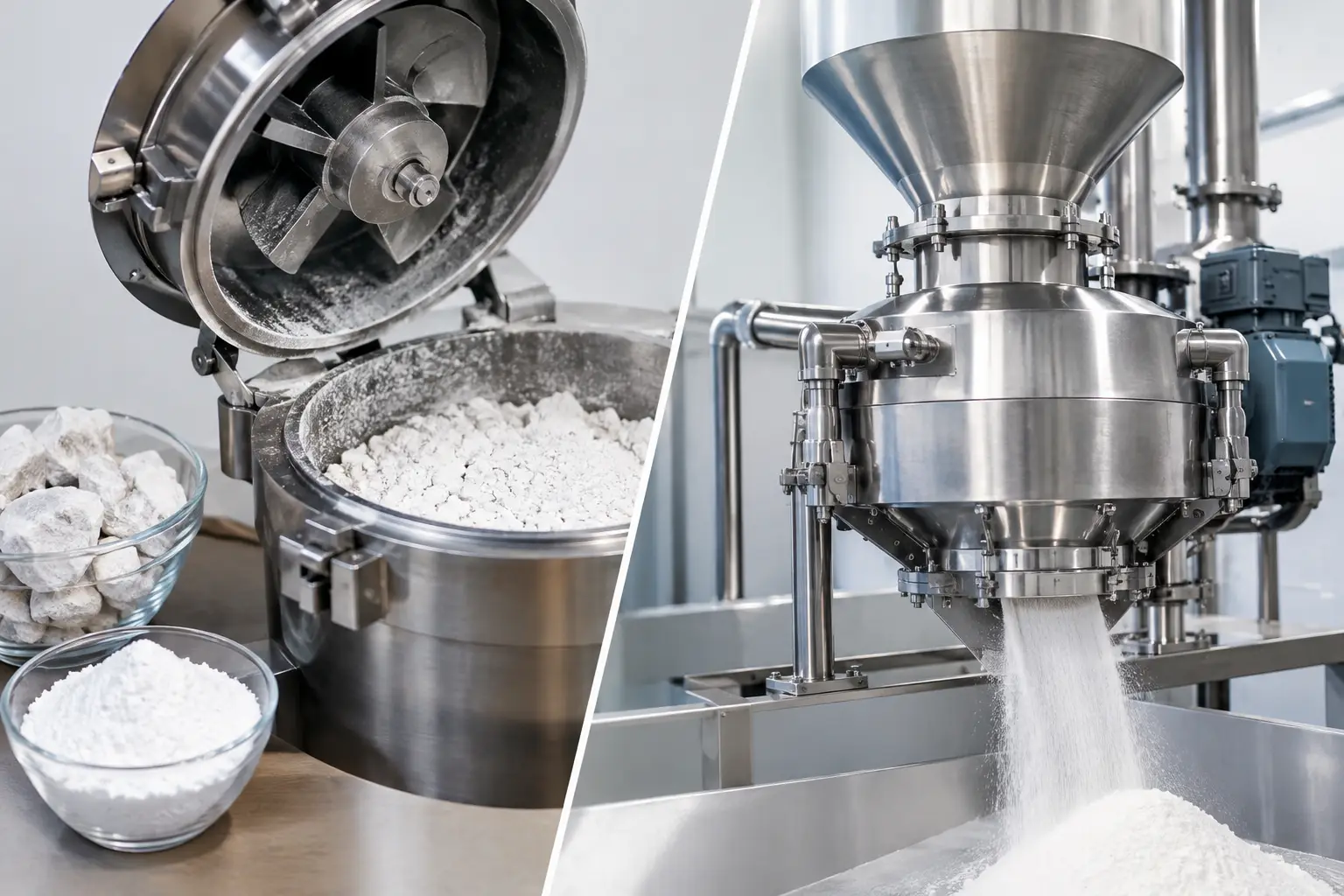
A turbo mill review should begin with the material, not the machine brochure. In production, a mill that performs well on a dry, free-flowing powder may become a source of heat, wear, wide particle distribution, or downtime when the feed becomes fibrous, abrasive, cohesive, or variable. For manufacturers evaluating turbo milling, the relevant question is whether the system can produce the required particle size and throughput while protecting product quality and maintaining predictable operating costs.
Turbo mills are high-speed impact mills designed for size reduction of dry materials. Their performance comes from the interaction of a rapidly rotating rotor, stationary impact surfaces, airflow, and an internal screen or classification arrangement, depending on the configuration. That combination can make them highly effective for many food ingredients, chemicals, minerals, polymers, nutraceuticals, and related powders. It also means results are closely tied to application details.
Turbo Mill Review: What the Machine Does Well
A turbo mill reduces particles primarily through impact, collision, and attrition. Material enters the milling chamber and encounters high-velocity rotating elements. The resulting impacts fracture particles until they are small enough to pass through the selected discharge path. Air movement helps convey material through the chamber and can assist with heat removal and product discharge.
For suitable materials, this design offers a practical balance of fine grinding capability and production capacity. Turbo mills are often considered when a conventional hammer mill cannot consistently achieve the desired fineness, but a jet mill may be more capability than the process requires. They can provide a compact, mechanically driven solution for applications requiring controlled powder size without relying solely on compressed air.
The strongest performance case is typically a dry, brittle or moderately friable feedstock with stable moisture content and a well-defined target size. In these conditions, the mill can support consistent reduction with relatively straightforward operation. Rotor speed, screen geometry, feed rate, air volume, and internal component design can be adjusted to influence the final result.
However, particle size is only one measure of success. A useful review also considers the width of the particle size distribution, fines generation, yield of in-spec material, temperature rise, dust collection performance, cleaning time, and component life. A system that reaches a nominal median size but creates excessive fines or requires frequent replacement of wear parts may not be the best operating choice.
Where Turbo Milling Can Become Difficult
Turbo milling is not a universal solution. The same high-energy impact that makes it effective on brittle solids can create processing problems with materials that soften, smear, or agglomerate under heat and mechanical force. Heat-sensitive ingredients, waxy materials, high-fat products, hygroscopic powders, and feeds with elevated moisture deserve careful evaluation.
When material begins to coat the rotor or chamber, effective impact decreases and throughput can fall quickly. The process may then show higher amperage, a rising product temperature, unstable discharge, or a widening particle size distribution. In some cases, lower rotor speed or a different screen helps. In others, the material may require conditioning, cooling, a different feed method, or an alternate milling technology such as cryogenic grinding, air classification milling, or pin milling.
Abrasive feeds create a different trade-off. Turbo mills can process mineral and technical materials effectively, but rotor elements, liners, screens, and other internal surfaces may experience significant wear. Wear does more than increase maintenance costs. As geometry changes, it can alter impact intensity, airflow patterns, and final particle size. For applications with strict contamination limits, the metallurgy and wear-resistant construction of product-contact components should be evaluated early.
Sticky or highly cohesive products also require attention to system design beyond the mill itself. A poorly designed feed arrangement can create surges, bridging, or inconsistent loading that no rotor adjustment can correct. Likewise, insufficient conveying air or an undersized dust collector can restrict product discharge and distort the mill’s apparent performance.
Heat Is a Process Variable, Not a Footnote
Mechanical energy that does not become particle fracture becomes heat. In a turbo mill, product temperature is influenced by rotor speed, residence time, feed rate, air volume, chamber design, and the material’s physical behavior. Reducing a material to a finer target generally increases energy demand and can increase thermal exposure.
For heat-sensitive products, temperature should be measured at the mill discharge during representative runs, not assumed from short no-load trials. Cooling air, chilled process air, jacketed components, staged milling, or cryogenic processing may be appropriate depending on the material and required product attributes. The right approach depends on whether the concern is melting, volatile loss, flavor change, potency loss, oxidation, or safety.
Performance Factors That Matter in a Purchase Decision
A meaningful equipment evaluation starts with the specification the process must meet. The target should identify not only a nominal particle size, but also the acceptable distribution, maximum oversize, allowable fines, moisture range, temperature limit, and required production rate. Without those parameters, a turbo mill comparison can become overly focused on horsepower or catalog capacity.
Throughput must be evaluated at the target size, not at a coarse demonstration condition. As fineness requirements increase, capacity can decline substantially because particles need more impacts and longer residence time before discharge. A mill rated for a particular material at one screen size may deliver a very different production rate with a finer screen, higher-moisture feed, or more demanding particle specification.
Feed consistency matters just as much. A stable gravimetric feeder can improve repeatability by controlling the material load entering the milling chamber. For low-bulk-density powders, fibrous feedstocks, or materials that bridge, the feeder, hopper geometry, agitation, and inlet design often determine whether the mill sees a smooth process load or repeated upset conditions.
Air handling is another critical part of the review. The mill, conveying line, cyclone or filter receiver, and dust collector should be treated as one system. Airflow affects heat removal, discharge efficiency, dust containment, and in some configurations the effective cut of the final powder. Inadequate dust collection can reduce capacity and create housekeeping or exposure concerns. Excessive airflow can increase fines carryover or place unnecessary demand on downstream filtration.
For regulated or sensitive applications, sanitation and containment must be designed into the system. Product-contact finish, access to internal surfaces, gasket selection, cleanout features, validation requirements, and dust-tight construction affect both operational reliability and changeover time. Pharmaceutical, nutraceutical, battery, and specialty chemical operations may also require a formal assessment of cross-contamination risk, material traceability, and containment strategy.
How to Test a Turbo Mill Before Committing
Representative testing is the fastest way to separate theoretical suitability from real process performance. The sample should reflect actual feed conditions, including expected moisture, particle size, lot variation, packaging condition, and any upstream treatment. Testing only an idealized sample can produce misleading results.
During a trial, document more than the final particle size. Record feed rate, rotor speed, screen or classifier settings, mill amperage, inlet and discharge temperatures, air volume, differential pressure, product recovery, and observable buildup. Screen the product or perform laser diffraction analysis to understand distribution, not merely a single reported value.
The test should also include a practical inspection after the run. Look for product coating, screen blinding, abnormal wear, retained material, difficult cleanout areas, and evidence of degradation. If the process will run multiple shifts, a short trial should be followed by an assessment of how the configuration will behave over a longer campaign.
A well-designed supplier trial can identify whether a turbo mill is the right primary technology, whether it needs a cooling or classification component, or whether another process route will provide lower total operating cost. DP Pulverizer Americas approaches this evaluation as a system-level question because the feeder, mill, air handling, collection, controls, and downstream packaging all influence production results.
When Another Mill May Be Better
A turbo mill may not be the best choice when the product requires extremely fine particles with a narrow distribution, especially when classification is central to the specification. An air classifier mill or jet mill may offer better control in those cases. When the feed is highly heat-sensitive or rubbery, cryogenic grinding can preserve material behavior that conventional ambient milling cannot.
For coarser reduction of tough materials, a hammer mill may offer a more economical path. Pin mills can be effective for certain crystalline or friable products where high-speed impact is desirable but the internal geometry better suits the material. The objective is not to select the most aggressive machine. It is to select the process that meets the specification with the fewest quality compromises and the most stable operating window.
The best turbo mill decision is usually made after the production team defines the material behavior, particle target, throughput requirement, sanitation standard, and long-term maintenance expectations. When those inputs are clear, equipment selection becomes an engineering decision rather than a horsepower comparison.