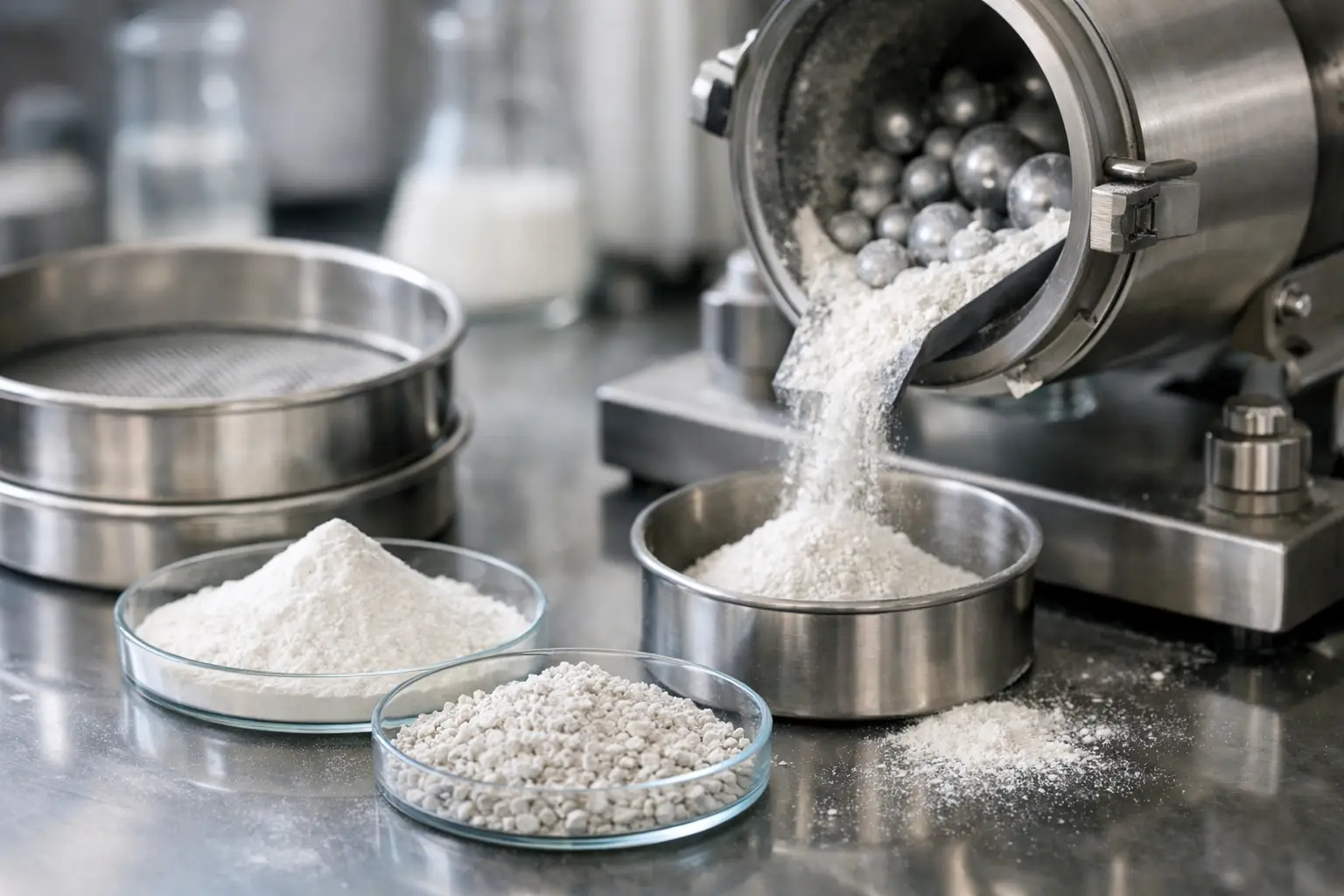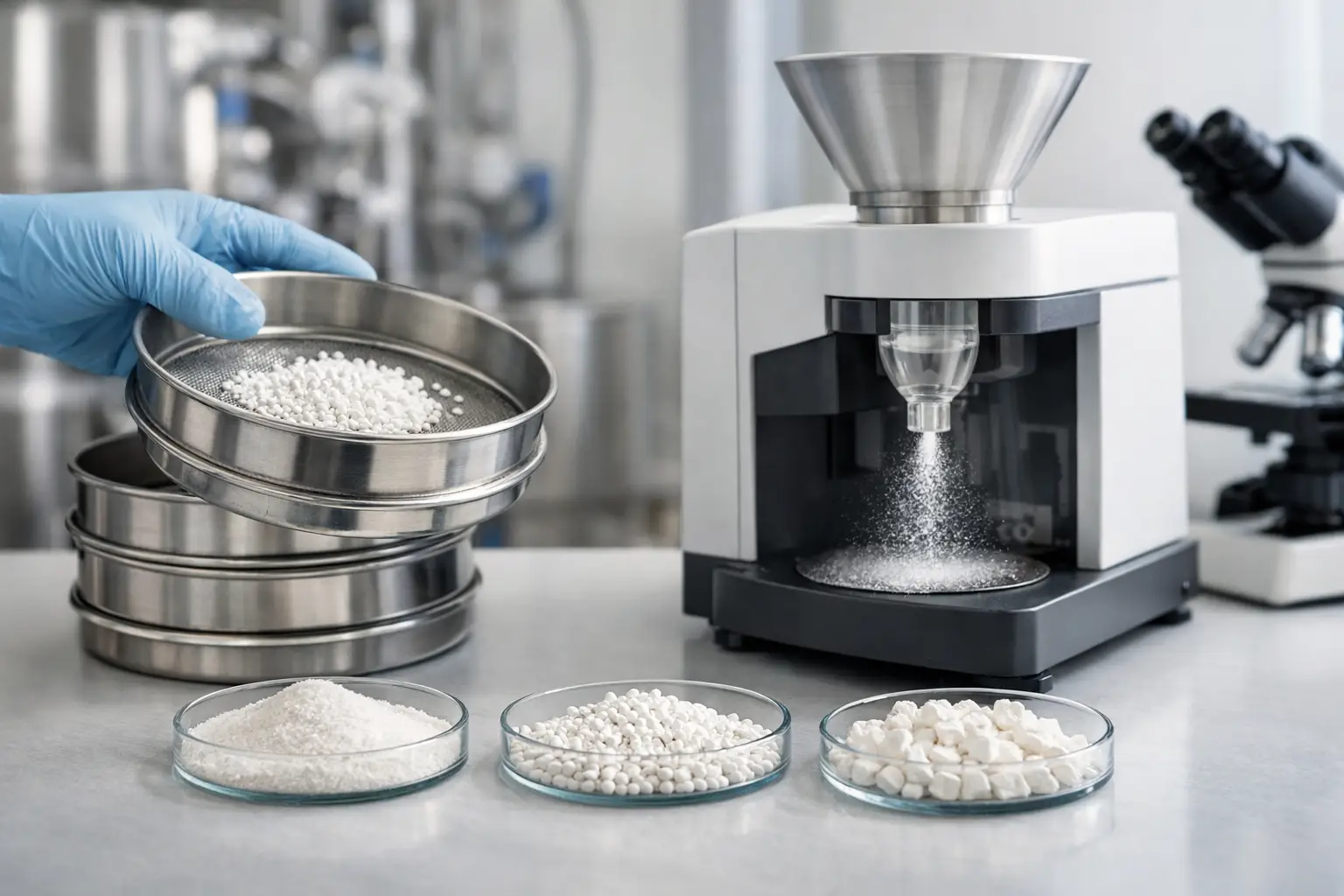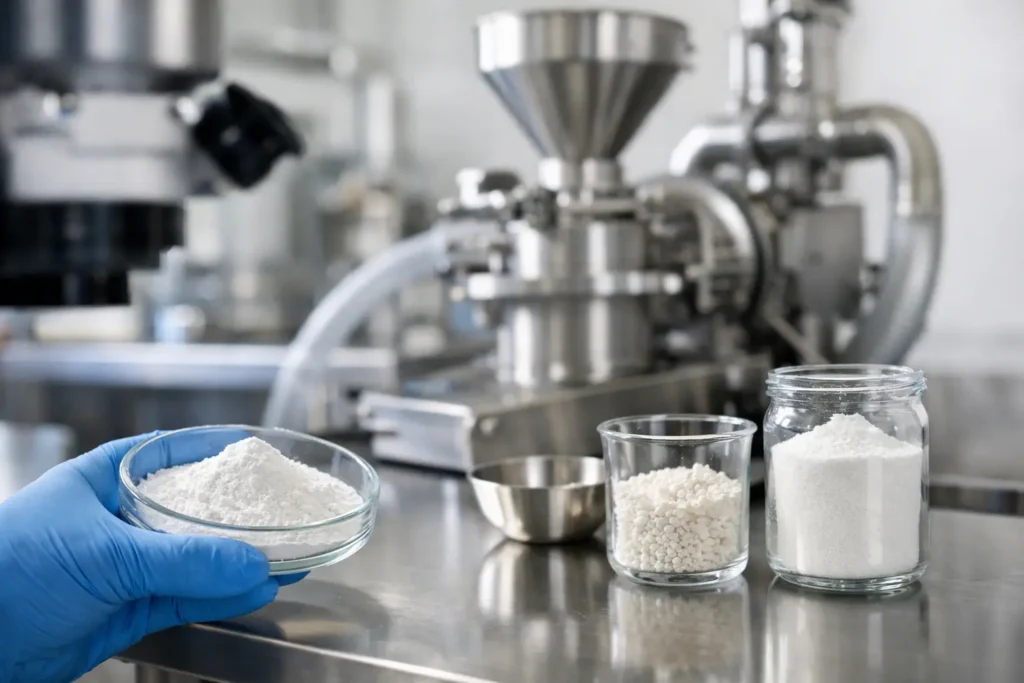
A particle size reduction guide is only useful if it reflects what actually happens on a production floor. A target particle size on paper means very little if the process generates excess heat, broad distribution, contamination, poor yield, or unplanned downtime. For manufacturers working in pharmaceuticals, food, chemicals, minerals, batteries, and advanced materials, particle size reduction is not a single equipment decision. It is a process decision that affects product quality, throughput, downstream performance, and total operating cost.
What particle size reduction really controls
Most teams begin with a micron target, but size reduction affects much more than the final number. Particle size distribution influences flowability, blend uniformity, dissolution rate, reactivity, surface area, compaction behavior, and packing density. In many applications, the shape of the distribution matters as much as the average particle size.
That is where process selection becomes critical. A mill that can physically break material down to a target range may still be the wrong solution if it creates too many fines, raises product temperature, degrades active ingredients, or introduces wear contamination. The right system balances particle size control with material integrity, throughput, and reliable operation.
A practical particle size reduction guide starts with the material
The most common mistake in mill selection is choosing equipment before understanding how the material behaves under stress. Hardness matters, but it is only one variable. Friability, elasticity, moisture content, fat content, stickiness, abrasiveness, bulk density, and thermal sensitivity all influence how a material responds inside a mill.
A brittle mineral and a heat-sensitive nutraceutical may require completely different reduction methods even if the target size is similar. A fibrous botanical may resist clean size reduction in a system that performs well with crystalline chemicals. A battery material may demand tight contamination control that rules out certain contact surfaces or impact mechanisms.
Feed size also matters more than many specifications suggest. Large, inconsistent feed can reduce milling efficiency and increase recirculation, while a controlled feed size can improve stability and final particle uniformity. When evaluating a process, the full picture includes feed characteristics, required throughput, moisture conditions, temperature limits, and the acceptable top size and fines fraction.
Matching milling technology to the application
Different milling technologies reduce particles in different ways – impact, attrition, compression, shear, or particle-on-particle collision. That mechanism affects both performance and suitability.
Jet mills are often selected for ultra-fine applications where tight particle size control and low contamination are priorities. Because they rely on high-velocity gas rather than high-speed mechanical contact at the grinding zone, they are often well suited for heat-sensitive or high-purity materials. The trade-off is that they are not always the most economical choice for coarser targets or very high bulk throughput.
Air classifier mills combine impact milling with internal classification, making them useful when a narrower particle size distribution is required without adding a separate downstream classifier. They offer flexibility across many powder processing applications, but actual performance depends heavily on classifier settings, airflow balance, and material characteristics.
Hammer mills are often effective for coarser reduction and high-throughput applications, especially where the material is relatively friable and the process can tolerate a broader distribution. They are practical and widely used, but they may not be ideal where precise control, low fines generation, or minimal heat rise is required.
Pin mills are frequently chosen for moderate size reduction with strong throughput potential, particularly in food, chemical, and powder processing environments. They can perform very well with certain dry, brittle, or crystalline materials, but sticky or high-fat products may challenge performance.
Universal mills and turbo mills offer flexibility across a broad range of materials and can be configured for different reduction objectives. Cone mills are commonly used for deagglomeration, sizing, and gentle milling, especially where product integrity matters more than aggressive particle reduction. Cryogenic grinding systems become important when conventional milling causes smearing, softening, oxidation, or thermal degradation.
The best choice depends less on what is most common and more on which technology aligns with the process window.
Throughput and particle size are always linked
Many production problems begin when a mill is expected to deliver the finest target size at the highest possible throughput with no compromise. In practice, there is almost always a trade-off. As particle size targets become finer, energy demand rises, residence time may increase, and throughput can decline.
That does not mean finer grinding is inefficient. It means the system has to be designed around the actual production requirement. If the line needs a narrow distribution at a fine cut point, airflow, classifier speed, feed rate, and system pressure drop all become part of the solution. If the process only needs controlled top size reduction, a simpler and more efficient mill may be the better choice.
This is why pilot testing and application evaluation are so valuable. They reveal where the practical operating window sits between desired fineness, throughput, yield, and product quality.
Heat, contamination, and product integrity
Particle size reduction creates energy, and some portion of that energy becomes heat. For many materials, modest temperature rise is manageable. For others, it changes the product. Heat can melt fats, soften polymers, degrade active ingredients, alter flavor compounds, increase caking, or shift moisture behavior.
Contamination is another major consideration, especially in pharmaceutical, battery, food, and advanced material applications. Wear from internal components, cross-contamination from previous batches, or poor dust containment can quickly turn a capable mill into a quality risk. In these environments, the design of the entire system matters – not just the rotor or grinding chamber, but also seals, liner materials, cleanability, and dust handling.
A strong process design addresses both issues early. That may mean selecting a lower-heat technology, using cryogenic grinding, optimizing tip speed, choosing wear-resistant construction, or integrating classification to reduce over-grinding.
Why classification matters as much as grinding
Grinding alone does not guarantee a controlled finished product. In many demanding applications, classification is what makes the process commercially viable. Internal or external classification separates fine product from oversized material, allowing the system to limit over-processing and tighten distribution.
Without effective classification, a process may continue grinding already-fine particles while larger particles remain in the mix. That tends to increase fines, waste energy, and broaden the distribution. When the target specification is tight, classifier performance becomes central to both quality and efficiency.
This is especially relevant in applications where downstream behavior depends on consistency. Blending, coating, compaction, suspension stability, and reaction rate can all shift when particle distribution drifts beyond acceptable limits.
Scale-up requires more than a larger machine
A process that works in the lab does not automatically work at production scale. Material flow, heat buildup, air handling, feed consistency, and classifier behavior can all change as capacity increases. One of the most costly mistakes in particle processing is assuming that scale-up is linear.
A well-engineered scale-up plan considers more than motor horsepower. It looks at how the material feeds, how long it stays in the grinding zone, how the system handles fines, and how the process can be cleaned and maintained under full operating conditions. It also accounts for utilities, dust collection, explosion protection where applicable, and the realities of plant integration.
This is where an engineered approach adds value. Equipment should fit the process, not force the process to fit a standard machine.
What to evaluate before selecting a system
The strongest equipment decisions come from asking the right technical questions upfront. What particle size distribution is actually required, not just what is preferred? How sensitive is the material to heat, impact, or shear? What level of contamination can the application tolerate? Is the priority throughput, fine particle control, deagglomeration, or a balance of all four?
It is also worth defining what success looks like after installation. That may include tighter quality control, lower waste, easier cleaning, reduced maintenance, faster changeovers, or room to scale production later. A mill that meets the size target but creates bottlenecks elsewhere is not really solving the problem.
For manufacturers evaluating new systems, the most reliable path is to combine application knowledge, process testing, and realistic operating criteria. At that point, equipment selection becomes less about comparing generic categories and more about building a process that performs consistently.
DP Mills approaches particle size reduction from that process perspective because production performance is rarely determined by the mill alone. The interaction between material behavior, system design, classification, containment, and operating conditions is what determines whether a solution works over time.
The right particle size reduction strategy should make production more predictable, not more complicated. When the process is matched to the material and the application, manufacturers gain something more valuable than a finer powder – they gain control.