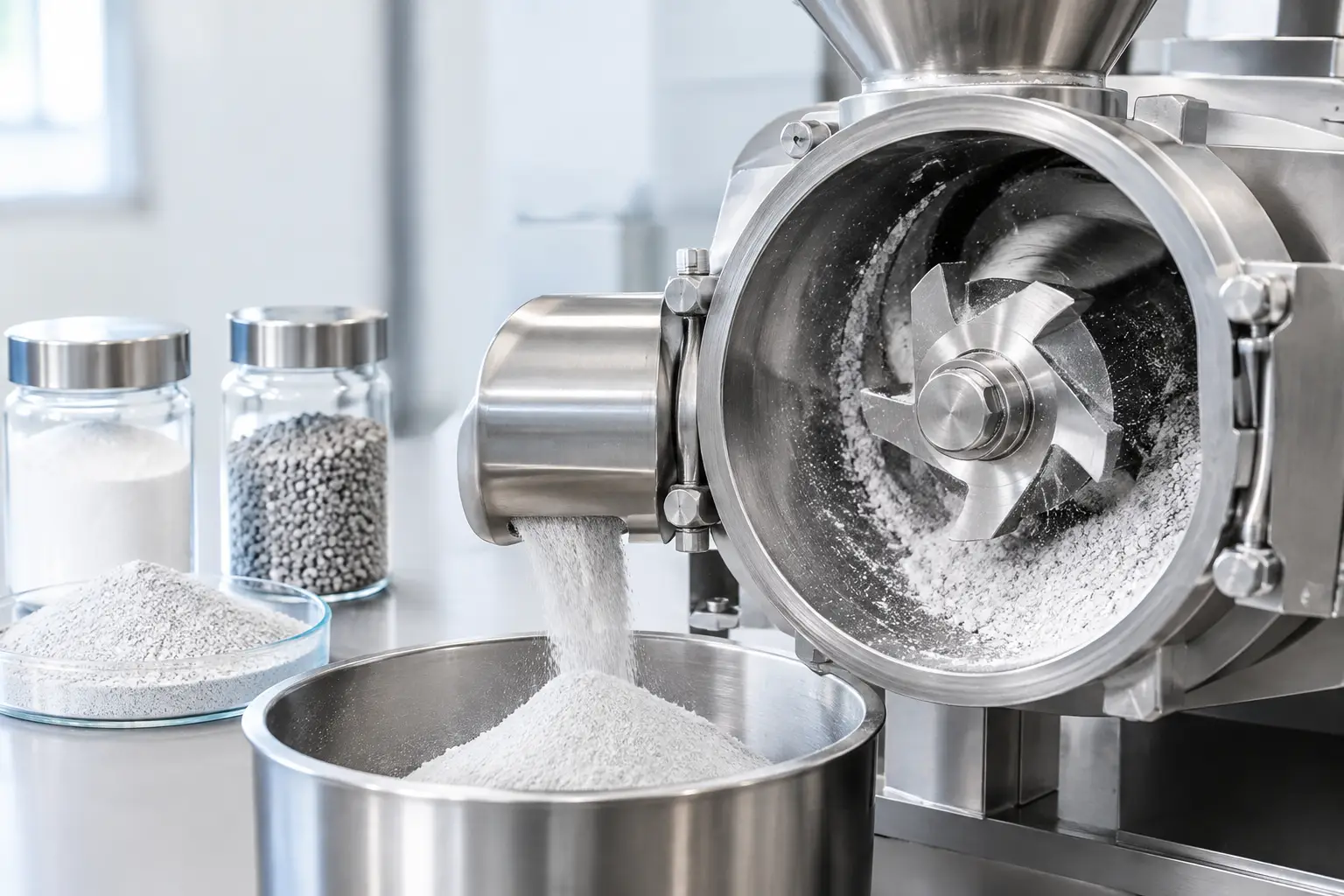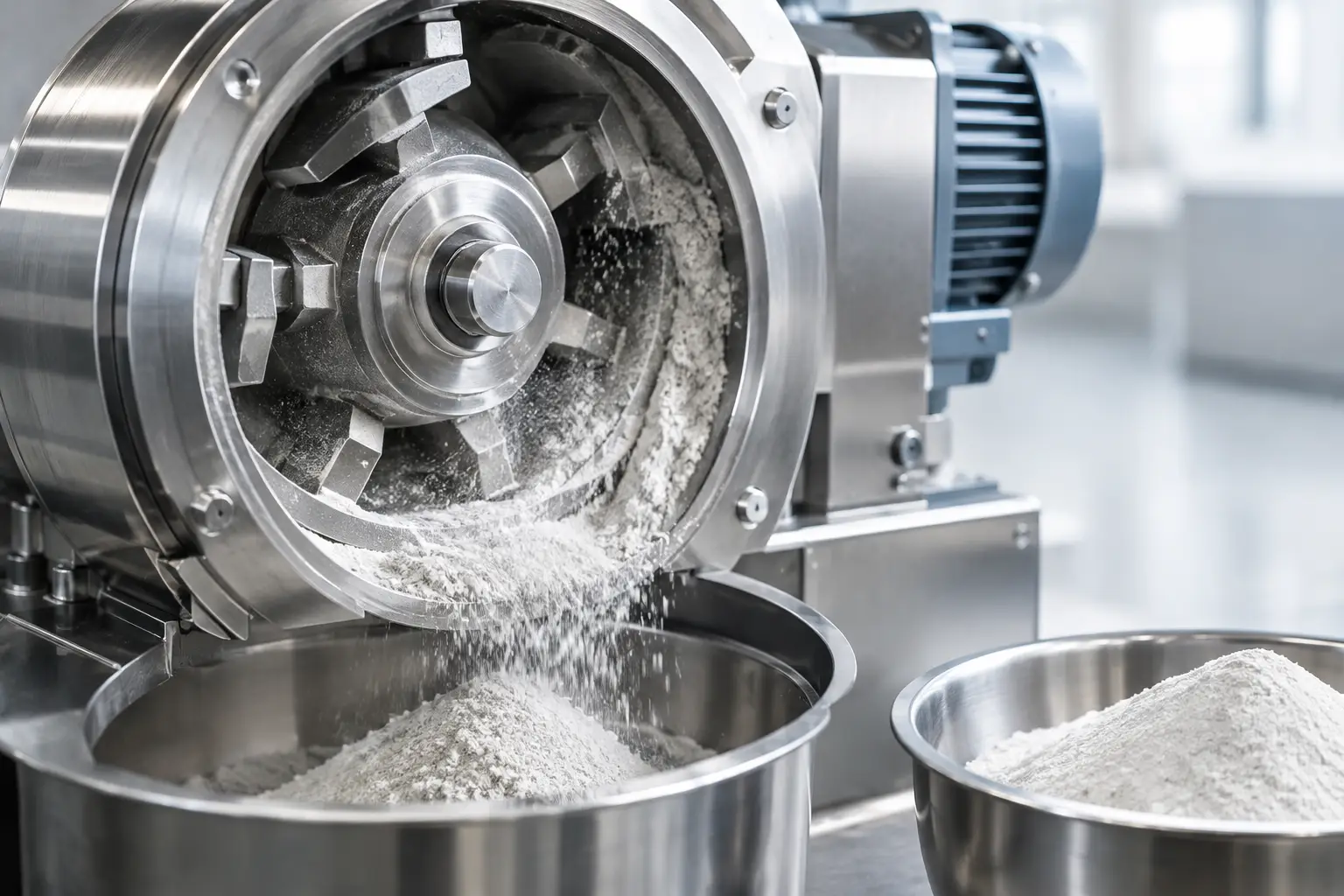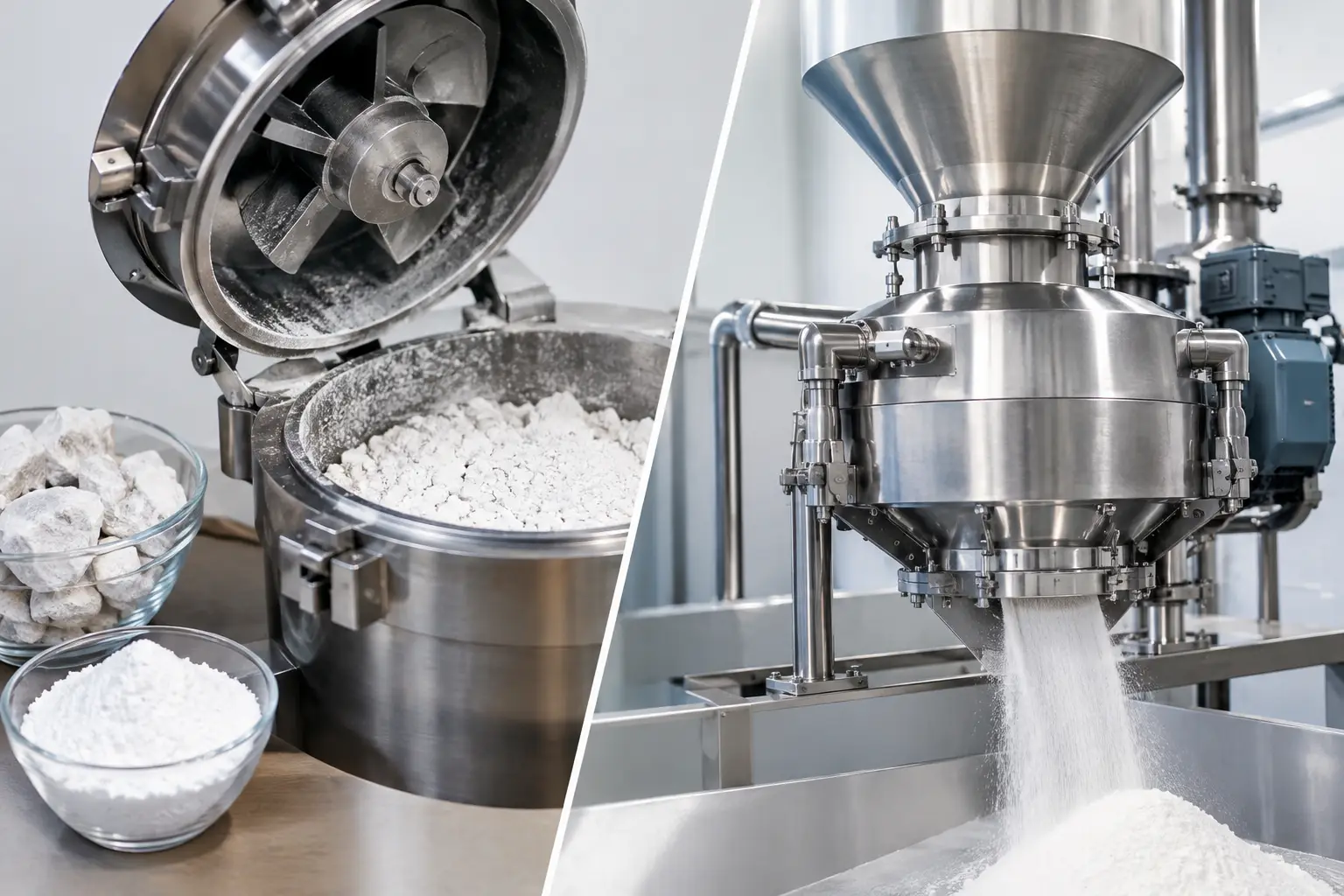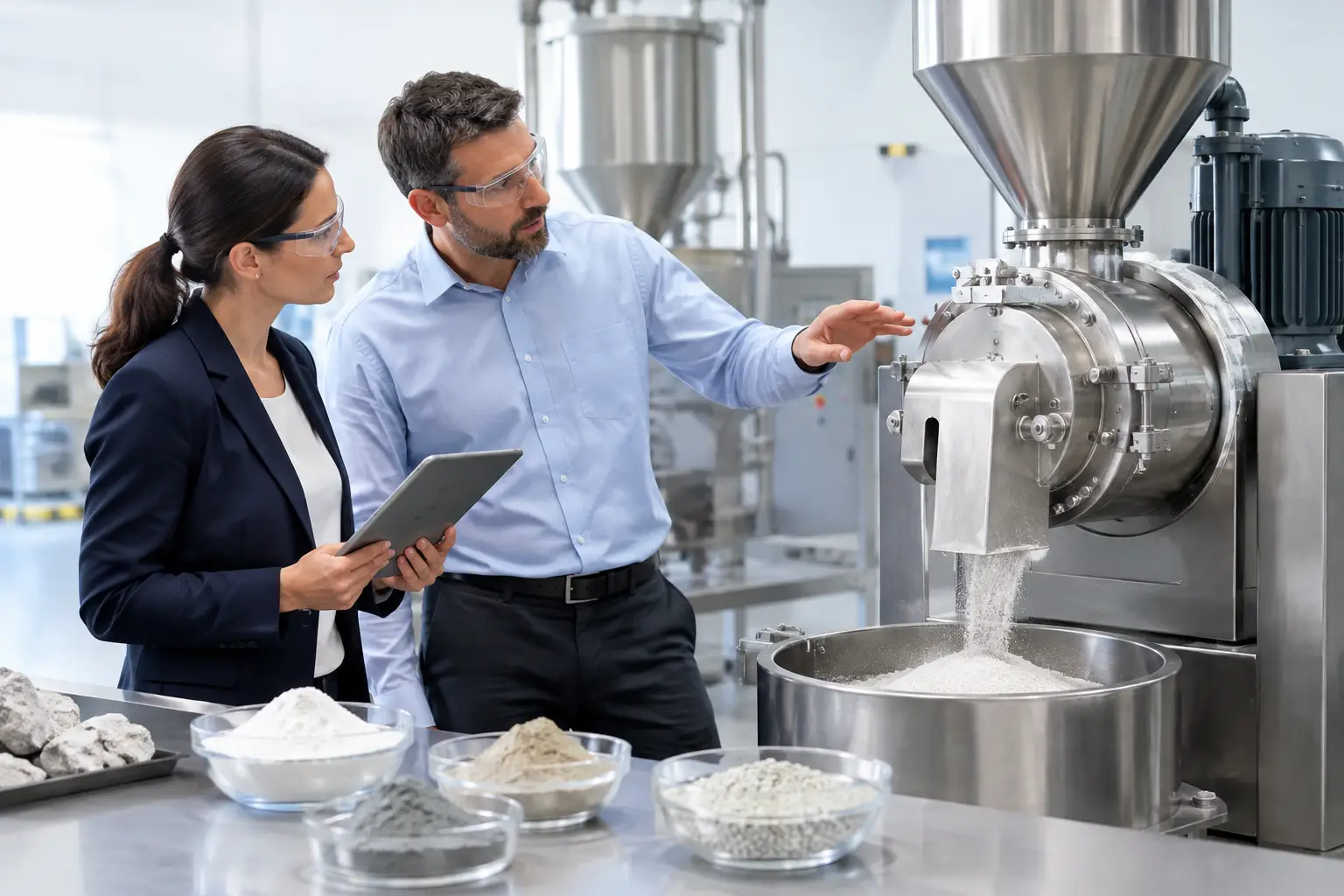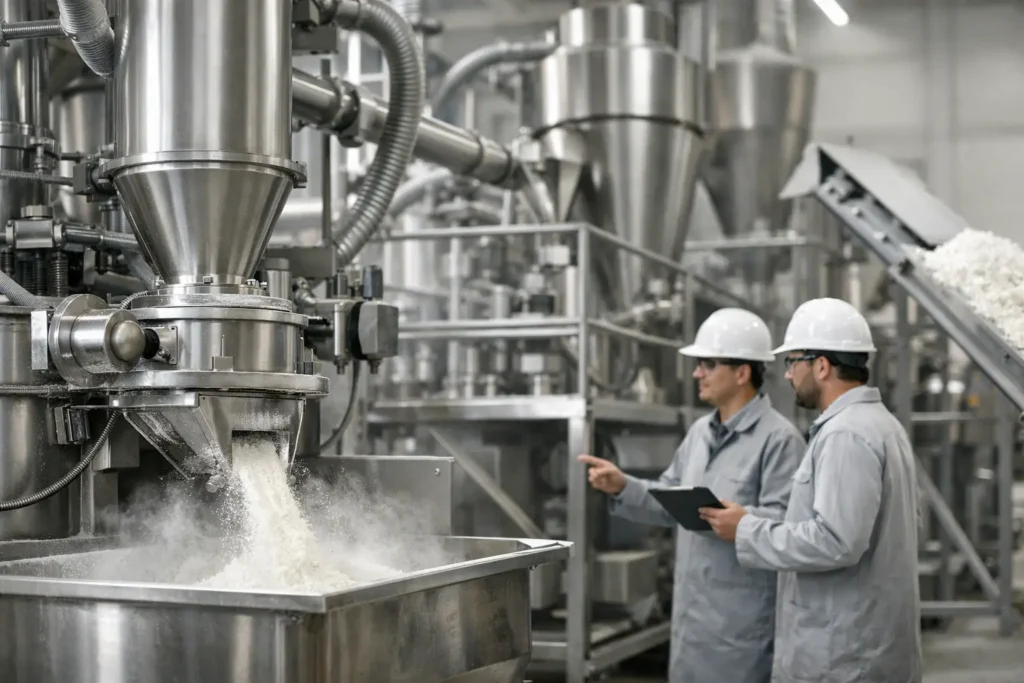
A mill can produce excellent results in a controlled test and still underperform on the plant floor. The difference is often not the milling chamber itself. Industrial milling system integration determines how material enters the process, how air and fines move through it, how product is collected, and how operators control the entire line under real production conditions.
For manufacturers processing pharmaceuticals, food ingredients, chemicals, battery materials, minerals, and other performance-sensitive powders, these interfaces directly affect particle size distribution, yield, contamination risk, throughput, and uptime. An integrated system treats the mill as one critical component in a connected process rather than an isolated machine.
What Industrial Milling System Integration Must Solve
A complete milling line has to do more than reduce particle size. It must feed material consistently, manage air correctly, separate product from process gas, contain dust, protect personnel, and deliver finished material in a form that downstream equipment can handle. Each requirement affects the others.
A variable feeder, for example, can cause surging at the mill inlet. That surge may widen the particle size distribution, increase mill load, reduce classification efficiency, and create inconsistent collection performance. Adding more mill power rarely fixes a feed control problem. The engineering question is whether the entire material path is stable at the required operating range.
The same principle applies to product handling. A fine powder may meet target size at discharge but compact in a hopper, bridge in a receiver, or segregate during transfer. If the downstream blender, packaging line, reactor, or tableting process receives inconsistent material, the milling system has not delivered the production result the operation needs.
Start With Material Behavior, Not Equipment Names
Selecting a jet mill, air classifier mill, hammer mill, pin mill, turbo mill, universal mill, cone mill, or cryogenic grinding system starts with the material. Hardness, moisture sensitivity, abrasiveness, friability, melting point, bulk density, flow characteristics, and target particle size all influence the proper technology and supporting equipment.
Some materials require high-energy impact to reach the desired reduction. Others need controlled attrition and internal classification to limit oversize particles. Heat-sensitive products may require chilled air, liquid nitrogen, or another thermal management strategy. Abrasive mineral or advanced material applications may call for wear-resistant contact surfaces and a maintenance plan built around predictable replacement intervals.
An engineered system also accounts for material variation. Feedstock can change by supplier lot, moisture level, temperature, or particle morphology. A process designed only for ideal material may operate poorly when those variables shift. Establishing an acceptable operating window is usually more valuable than optimizing around a single best-case test result.
Build the System Around the Process Flow
The most effective process layouts define the full path from raw-material receipt through final collection before individual components are specified. This approach identifies bottlenecks early and prevents equipment choices that conflict with cleaning, containment, or access requirements.
Feeding and Preconditioning
Consistent feeding is foundational. Depending on the powder and required accuracy, the line may use a screw feeder, vibratory feeder, rotary valve, loss-in-weight feeder, or a combination of bulk handling equipment. The selected method must deliver a stable mass flow without damaging the product or creating erratic pressure conditions at the mill inlet.
Preconditioning may be equally important. Screening removes tramp material and large agglomerates that can disrupt the mill. Deagglomeration can improve feed uniformity. Drying, cooling, or conditioning may be required when moisture changes flowability or makes a material prone to buildup. For cryogenic processing, the system must maintain the necessary temperature through feed preparation, grinding, and collection rather than relying on a cold mill alone.
Milling, Air Management, and Classification
In pneumatic milling systems, air is part of the process, not merely a utility. Airflow influences material transport, residence time, heat removal, classification performance, and dust capture. The wrong air volume can reduce throughput, shift the cut point, or cause unstable operating behavior.
Air classifier mills and jet mills particularly depend on the relationship among feed rate, airflow, classifier speed, pressure, and product target. These variables should be controlled as a coordinated operating recipe. If operators must make frequent manual adjustments to maintain size, the process likely needs better instrumentation, control logic, or feed stability.
For impact mills such as hammer, pin, and turbo mills, rotor speed, screen selection, mill geometry, and feed rate establish the practical balance between capacity and size reduction. Pursuing the finest possible grind may reduce throughput, increase energy consumption, generate excess heat, and accelerate wear. The right specification is the particle size distribution the downstream process actually requires, produced at a commercially useful rate.
Collection and Product Transfer
Cyclones, bag filters, cartridge collectors, and product receivers must be sized for the powder characteristics and airflow of the complete system. Collection efficiency, pressure drop, cleanability, and discharge behavior all matter. A collector that handles coarse product well may be unsuitable for very fine, low-bulk-density powder.
Product transfer also deserves close attention. Long horizontal runs, abrupt elbows, and poorly designed transitions can cause buildup, particle degradation, or material segregation. Dense-phase or dilute-phase conveying may be appropriate depending on distance, powder fragility, and desired transport rate. In some applications, gravity transfer with properly designed hoppers is the better answer because it reduces handling steps and simplifies cleaning.
Containment, Cleaning, and Contamination Control
Containment requirements should shape the system layout from the beginning. Retrofitting dust control after equipment installation often creates difficult-to-clean connections, excessive pressure losses, and operator workarounds. The containment strategy must address material charging, milling, collection, discharge, sampling, and maintenance activities.
For food, nutraceutical, and pharmaceutical applications, hygienic design and cleanability can be as significant as milling performance. Contact materials, surface finish, gasket selection, quick-release connections, access doors, and clean-in-place or wash-in-place requirements should match the product and validation strategy. A design that minimizes retained powder can reduce cross-contamination risk and shorten changeover time.
Chemical, battery, and advanced material operations may prioritize closed-loop handling, inerting, explosion protection, or high-efficiency filtration. The required safeguards depend on the dust hazard analysis, material reactivity, solvent presence, oxygen limits, and facility standards. These decisions cannot be separated from equipment selection because enclosure design, pressure relief, isolation, grounding, and ventilation affect how the line operates and is maintained.
Controls Turn Equipment Into a Repeatable Process
An integrated control strategy converts engineering intent into daily consistency. At a minimum, operators need clear visibility into feed rate, motor load, process air pressure or flow, temperature, differential pressure, classifier speed where applicable, and critical alarms. Data collection should support troubleshooting, batch records, preventive maintenance, and continuous process improvement.
The level of automation depends on the application. A development-scale system may benefit from flexible manual control and detailed data capture. A high-volume production line may require recipe-based automation, interlocks, automated sequencing, and integration with plant-level manufacturing systems. Neither approach is automatically better. The appropriate level is the one that reduces variability without making routine operation unnecessarily complex.
Controls should also protect the equipment from predictable failure modes. Interlocks can prevent a mill from starting without verified airflow, stop feed when a collector reaches a high differential pressure, or shut down the process when temperature exceeds a defined limit. These functions protect product quality and help avoid the costly chain reaction that begins with a minor upset.
Plan for Maintenance Before Installation
A system that is difficult to inspect or service will eventually become unreliable, regardless of its original performance. Plant teams need access to wear components, filters, classifiers, screens, rotors, bearings, and seals without excessive disassembly. Maintenance clearance, lifting points, spare-parts strategy, and isolation procedures should be reviewed during design, not after commissioning.
Wear is not a defect in many milling applications. It is an expected operating condition that should be managed. Abrasive products can change internal clearances and shift performance over time. Documenting baseline operating data after startup gives maintenance teams a reference for recognizing when wear is affecting particle size, capacity, or energy use.
Commissioning should include performance verification across the intended operating range, not only a single production point. Confirm the achievable throughput, particle size distribution, product temperature, yield, dust control performance, and stable control settings. Train operators on how variables interact so they can distinguish a feed issue from a classification, airflow, or mechanical issue.
DP Pulverizer Americas approaches integrated milling projects with this system-level perspective: matching size reduction technology and support equipment to the material, production target, and operating constraints. The result should be a process line that performs predictably beyond initial acceptance testing.
The most useful question for a new or upgraded milling line is not, “Which mill should we buy?” It is, “What process must reliably arrive at the next production step?” Define that outcome clearly, and the right integration decisions become far easier to make.