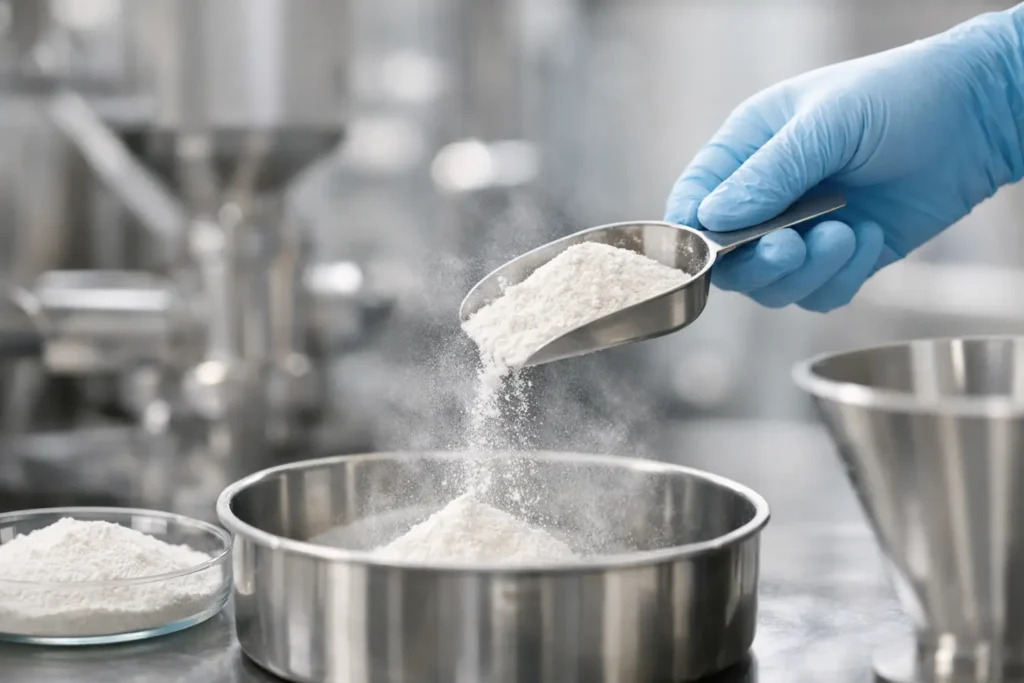
A contamination event in powder processing rarely starts with a dramatic failure. More often, it begins with a small inconsistency – worn contact surfaces, poor transfer design, residual product in dead zones, or airborne fines moving where they should not. By the time quality issues show up in test results or finished product performance, the source may already be embedded somewhere in the process. That is why knowing how to reduce powder contamination is not just a quality topic. It is a system design, equipment selection, and operational discipline issue.
For manufacturers in pharmaceutical, food, nutraceutical, chemical, battery, mineral, and advanced materials production, contamination risk carries different consequences, but the operational pressure is the same. Product integrity, batch consistency, uptime, compliance, and yield all depend on maintaining a controlled powder environment. The challenge is that contamination can come from multiple directions at once: foreign material, cross-batch carryover, metal wear, ambient dust, moisture intrusion, and even operator handling.
How to reduce powder contamination starts with source control
The most effective way to reduce contamination is to identify where it enters the process and remove those opportunities at the source. That sounds straightforward, but in practice many plants focus too heavily on downstream detection instead of upstream prevention.
In most powder operations, contamination sources fall into a few categories. Equipment-generated contamination includes wear particles from mills, classifiers, feeders, seals, valves, and conveying lines. Process-generated contamination can come from agglomeration, degraded product caused by heat, or fines migration between stages. Environmental contamination often enters through open handling points, poor dust containment, unfiltered air, or inadequate room segregation. Then there is cross-contamination, which is especially critical in multi-product facilities where residue from one run can carry into the next.
Each category requires a different response. If metal wear is the issue, material-of-construction and equipment speed may need attention. If carryover is the problem, the answer is usually in cleanability, changeover procedure, and system layout. If airborne contamination is recurring, containment and air management deserve closer analysis than the mill itself.
Equipment design has a direct impact on contamination risk
Powder contamination is often treated like a housekeeping problem when it is really an engineering problem. Equipment with hard-to-clean internals, excessive friction, dead pockets, or inconsistent feed behavior creates avoidable contamination risk even when operators follow procedure.
Milling technology selection matters here. A high-impact mill may deliver required throughput, but if it generates excessive heat or accelerates internal wear with abrasive materials, product integrity can suffer. In contrast, a system designed around lower contamination contact surfaces, tighter classification control, and application-specific internals can reduce both wear generation and off-spec material.
The right answer depends on the material. Brittle products behave differently than elastic or heat-sensitive ones. Abrasive minerals demand a different wear strategy than nutraceutical blends. Battery materials may require much tighter contamination control than bulk industrial powders. This is where one-size-fits-all equipment tends to create long-term issues. The mill has to match the feed characteristics, target size distribution, throughput requirement, and contamination tolerance of the application.
Contact materials also matter. Stainless steel may be suitable for many processes, but not all. In higher-purity applications, hardened alloys, ceramics, specialized liners, or contamination-resistant internal components may be justified. The trade-off is cost, and in some cases maintenance complexity. Still, when contamination carries a high downstream penalty, better material selection usually pays for itself.
Layout and material flow often create hidden contamination points
Even well-designed equipment can underperform in a poorly designed process line. Transfer points, hoppers, feed screws, pneumatic conveying loops, and packaging stations all create opportunities for contamination if powder flow is not controlled.
One common issue is product hold-up. If material collects in transitions, flexible connections, valve cavities, or oversized hoppers, it can degrade, bridge, or remain behind between batches. That residue becomes a future contamination source. Another issue is uncontrolled dusting. Fine powders can escape at charging stations or transfer points, settle on surrounding surfaces, and re-enter the process later.
A cleaner layout usually means shorter, more contained product paths and fewer unnecessary transitions. Enclosed conveying, properly designed inlets and outlets, dust-tight connections, and predictable discharge behavior all reduce the chances that material ends up where it should not. In many facilities, contamination reduction comes less from adding more equipment and more from simplifying the way powder moves through the system.
How to reduce powder contamination through maintenance discipline
Maintenance is one of the most overlooked contamination controls because its effect is gradual. Internal wear surfaces do not fail all at once. Seals do not always leak visibly. Screens, pins, hammers, liners, and classifier components slowly change condition, and that change can introduce contamination well before throughput declines enough to trigger action.
A contamination-focused maintenance program should go beyond standard uptime checks. It should track wear by material type, operating hours, and production intensity. Abrasive materials may require shorter inspection cycles. Heat-sensitive applications may need close monitoring of bearing condition and rotor balance to prevent excess friction. In sanitary or high-purity environments, gasket integrity and cleaning verification become just as important as mechanical performance.
The goal is to replace parts before they become contamination contributors, not after they become obvious problems. That approach does increase preventive maintenance planning, but it usually reduces both unplanned downtime and product loss.
Cleaning method is equally important. If operators cannot fully access contact areas, residue remains. If cleaning procedures vary by shift, contamination control becomes inconsistent. Dry cleaning may be preferred in some powder environments to avoid moisture introduction, while wet cleaning may be necessary in others for complete removal. The right protocol depends on the material, the equipment, and the production schedule.
Operating conditions can create contamination even without foreign material
Not all contamination is external. Sometimes the product itself changes during processing in ways that effectively contaminate the batch. Excessive heat, over-grinding, oxidation, or moisture pickup can alter the powder enough to affect downstream performance.
This is especially relevant in fine grinding and high-energy milling. If rotor speed, feed rate, airflow, or classification settings are not balanced correctly, the system may create too many fines, broaden the particle size distribution, or thermally stress the material. In pharmaceutical and food applications, that can affect functionality and stability. In battery and advanced material processing, it can alter electrochemical or physical properties in ways that are unacceptable.
That is why process control is part of contamination control. Stable feed presentation, controlled residence time, appropriate mill speed, and effective temperature management all help preserve material integrity. In some cases, cryogenic grinding or inert processing is the best route because it reduces thermal and atmospheric exposure while improving grind behavior.
Environmental controls matter more as powders get finer
As particle size decreases, contamination risk from the surrounding environment usually increases. Fine powders are more mobile, more likely to become airborne, and more difficult to contain once dispersed.
Air handling strategy is critical. Pressure differentials, filtration performance, and room segregation influence whether contaminants stay isolated or circulate through adjacent areas. In facilities processing allergenic foods, potent compounds, fine chemicals, or high-value active materials, this becomes a plant-wide design concern rather than an equipment detail.
Operator practices also play a role, but process design should not depend entirely on perfect human behavior. If open charging, manual dumping, or frequent intervention is required, contamination risk rises. Better containment, automation, and ergonomic access points reduce that dependence and improve repeatability.
The best contamination strategy is application-specific
Manufacturers often ask for a single best method for how to reduce powder contamination, but the practical answer is that it depends on the material, the purity target, and the production environment. A food processor focused on allergen separation faces a different challenge than a battery manufacturer concerned with trace metal contamination. A toll processor running frequent changeovers needs different priorities than a dedicated single-product line.
What remains consistent is the need for a system-level view. The mill, feeder, classifier, conveyor, dust collection, cleanout access, air handling, and maintenance plan all influence contamination risk together. Solving only one piece rarely delivers consistent long-term results.
This is where engineering support has real value. An experienced processing partner can evaluate whether the issue is coming from equipment wear, material behavior, system design, or operating practice. Companies such as DP Mills approach contamination reduction through that broader process lens, because the most effective solution is usually not just a machine upgrade. It is a better-matched processing system.
If powder contamination continues to appear as a quality problem, it is worth treating it as a design signal instead of an isolated event. The cleaner process is usually the more stable one, and stable processes are the ones that scale with less waste, fewer shutdowns, and more confidence from batch to batch.