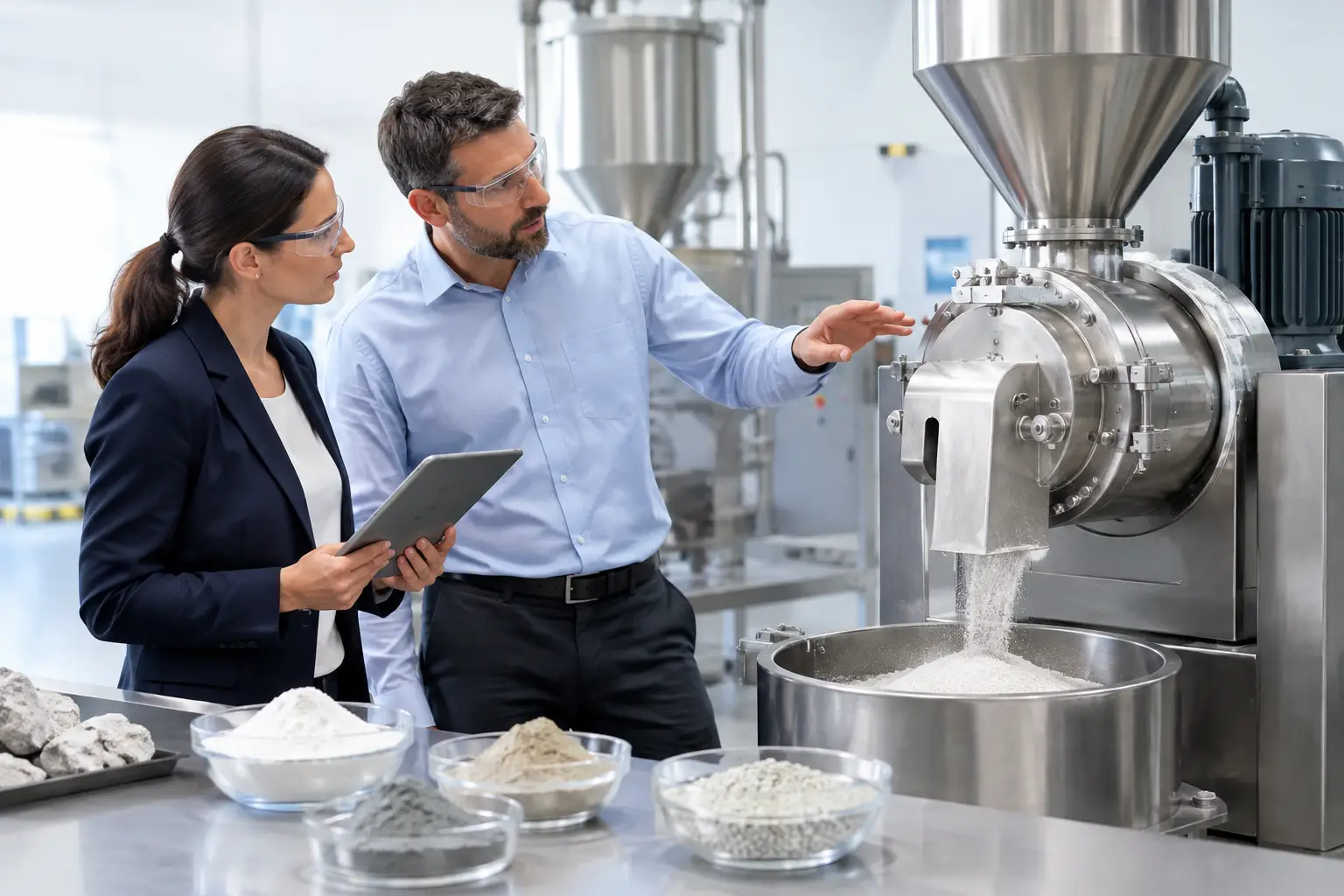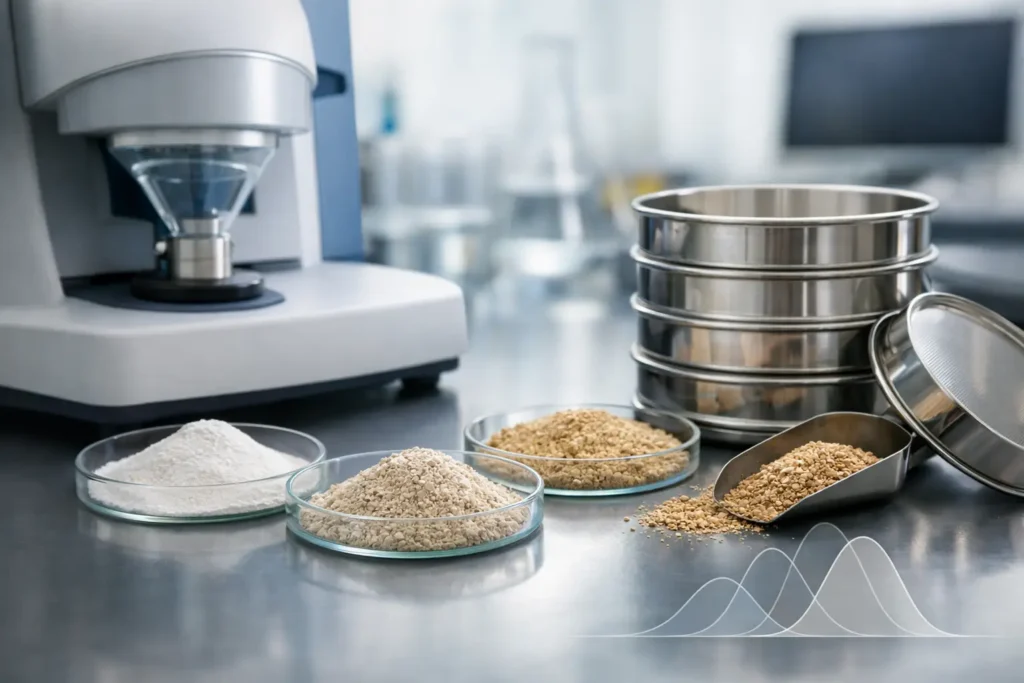
A mill can hit the target D50 and still create production problems. If the tails are too broad, fines are too high, or oversize keeps circulating, the result is often poor flow, inconsistent blending, reduced yield, dust issues, and unstable downstream performance. That is why manufacturers asking how to optimize particle size distribution are usually solving a much bigger process problem than particle size alone.
In real production environments, particle size distribution is a quality, throughput, and reliability issue at the same time. The right distribution depends on what the material must do next – dissolve, compact, disperse, react, coat, blend, convey, or meet a strict finished-product specification. Optimization starts when the process is built around that end-use requirement rather than a single lab number.
What particle size distribution optimization really means
Particle size distribution optimization is not simply making particles smaller. It means producing the particle range your process actually needs, as consistently as possible, at the required throughput and with acceptable operating cost. For some applications, a narrow distribution is critical. In others, a controlled broader distribution improves packing density, bulk behavior, or process economics.
That distinction matters across industries. In pharmaceutical and nutraceutical processing, too many fines can affect blend uniformity, tablet compression, and content consistency. In food applications, distribution can change mouthfeel, dispersion, and handling. In battery and advanced materials, PSD directly influences surface area, reaction behavior, density, and final performance. In minerals and chemicals, yield, classification efficiency, and recirculation load often determine whether the system is commercially viable.
The practical goal is to control the full curve, not just one point on it. D10, D50, and D90 all matter, but they only become useful when tied to actual process outcomes.
How to optimize particle size distribution in production
The fastest way to lose control of PSD is to treat milling as an isolated step. Distribution is shaped by the interaction of feed properties, mill mechanics, classifier settings, system airflow, temperature, and recirculation behavior. If one variable drifts, the curve changes.
A disciplined optimization effort usually begins with the specification itself. Many operations define a target too loosely at first, then chase inconsistency later. If the requirement is only stated as an average size, operators may unknowingly produce a wide spread with excess fines or oversize. A better starting point is to define acceptable ranges for key cut points, along with the downstream issues that must be prevented.
Start with the material, not the machine
Every material responds differently to size reduction. Hardness, friability, moisture, fat or oil content, temperature sensitivity, density, stickiness, and abrasiveness all affect how particles break. A brittle mineral may fracture cleanly, while a polymer or botanical may smear, agglomerate, or generate heat that shifts the distribution during the run.
That is why the same equipment can perform very differently across applications. Before adjusting process settings, manufacturers need to understand whether the material tends to shatter into fines, resist breakage, soften under heat, or build a wide spread during repeated impacts. Feed consistency is equally important. Variation in upstream feed size or moisture often shows up later as PSD instability that operators mistakenly attribute to the mill.
Match the milling technology to the target distribution
The best answer for how to optimize particle size distribution often starts with equipment selection. Different milling technologies create fundamentally different breakage patterns.
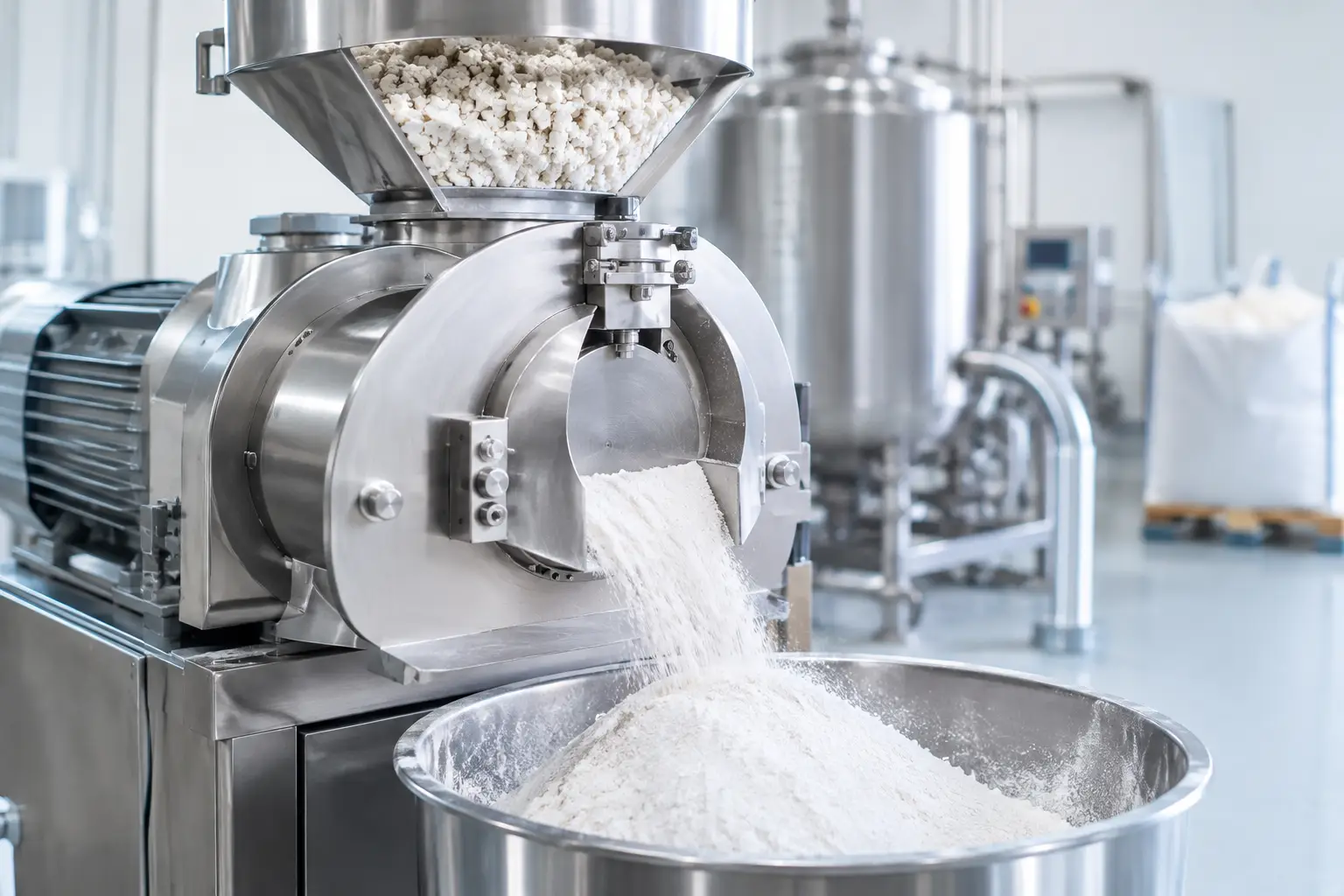
Jet mills are often selected when very fine particle sizes, low contamination, and tighter top-size control are required, especially for heat-sensitive or high-purity applications. Air classifier mills combine impact grinding with internal classification, which makes them effective when tight control and efficient fine grinding are needed in one system. Hammer mills and pin mills are often practical for higher-throughput applications, but depending on the material, they may produce broader distributions than a classifying system. Cone mills and universal mills can be strong choices for controlled deagglomeration, granule sizing, or gentler reduction where excessive fines are a concern. Cryogenic grinding becomes important when ambient milling causes softening, smearing, oxidation, or other thermal problems.
There is no universal best mill. The right choice depends on the target curve, required capacity, material behavior, and contamination tolerance.
Process variables that tighten or broaden PSD
Once the right technology is in place, optimization becomes a matter of controlling the variables that most influence particle breakage and classification.
Feed rate and residence time
Higher feed rates can improve throughput, but they may also reduce effective grinding energy per particle or overload the classifier. That often broadens the distribution and increases coarse material. Lowering feed rate may tighten the PSD, but at the expense of capacity. The correct setting is the point where the system maintains the desired distribution without creating an unacceptable production bottleneck.
Residence time matters in a similar way. If particles remain in the grinding zone too long, fines can increase sharply. If they exit too quickly, top size drifts upward. Stable residence time depends on both the mill and the air handling system.
Rotor speed, grinding energy, and impact intensity
Increasing speed generally increases size reduction, but it does not always improve the final distribution. At some point, the process begins to overgrind the easy-to-break fraction while the harder fraction remains relatively coarse. The result is a wider spread, not a tighter one.
This is a common trade-off in impact-based systems. More energy can push the median size down, but may also generate unnecessary fines, heat, wear, and dust. Optimization means finding the energy input that supports the specification without damaging process efficiency.
Airflow and classification settings
In classifying mills, airflow is one of the most important PSD control tools. Proper air volume helps transport particles, remove fines efficiently, and support stable separation. Poor airflow can cause material hold-up, heat build-up, and inconsistent cut points.
Classifier speed has a direct effect on top-size control. Higher classifier speed typically rejects more coarse particles and produces a finer product, while lower speed allows larger particles to pass. But there is a limit. If classifier settings are too aggressive, yield can drop and internal recirculation can rise, increasing energy use and reducing throughput. A tighter distribution is only valuable if the system remains productive.
Temperature and moisture control
Many PSD problems are actually thermal problems. As product temperature rises, some materials become more elastic, sticky, or prone to agglomeration. That can distort the distribution and make process results difficult to repeat from batch to batch.
Moisture behaves the same way. Even modest changes in feed moisture can alter particle breakage, flowability, and classification efficiency. In difficult applications, inlet air conditioning, product cooling, or cryogenic grinding may be necessary to hold the target distribution consistently.
Measurement matters as much as milling
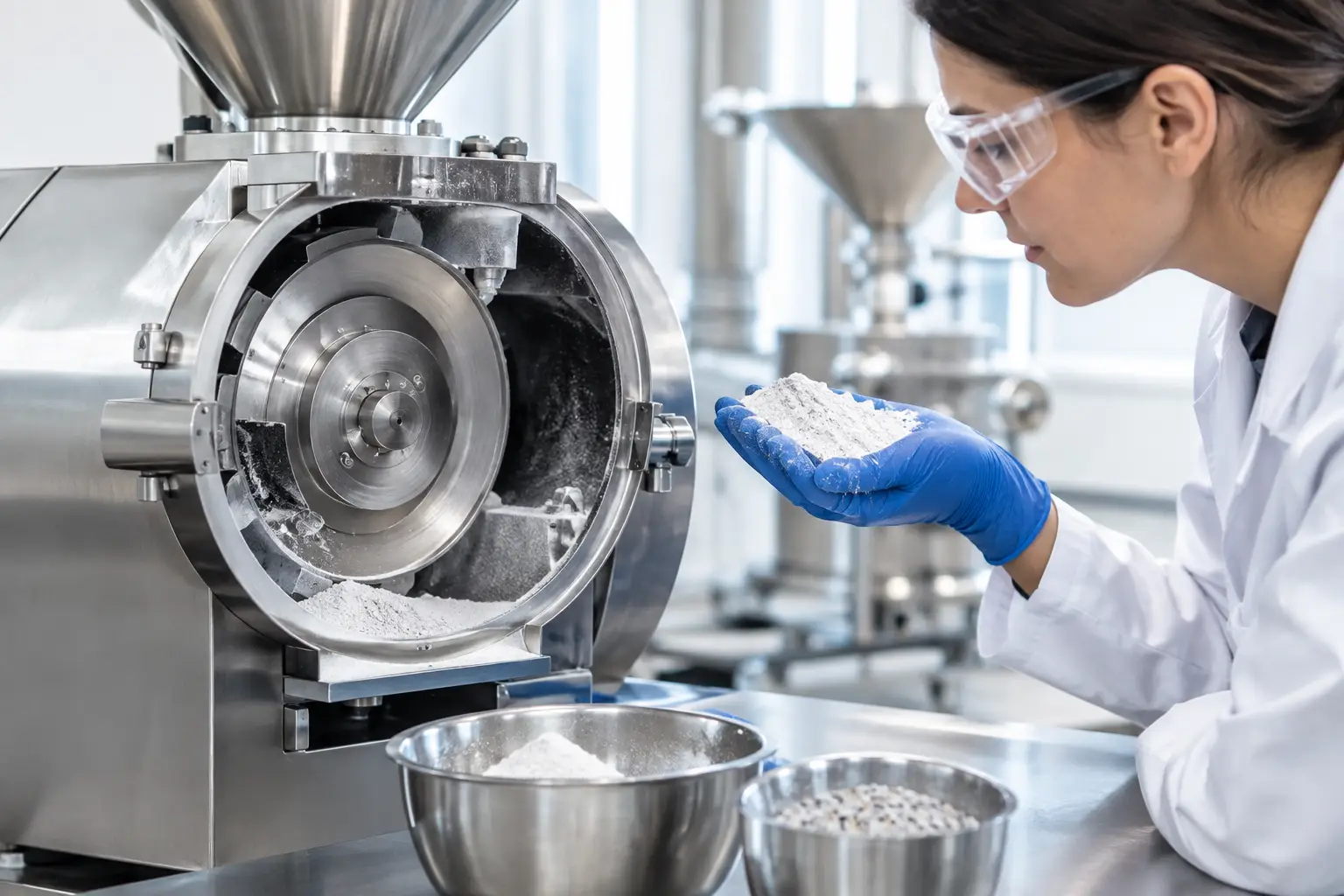
You cannot optimize what you do not measure correctly. PSD data must be repeatable, relevant, and aligned with the actual product requirement. That sounds obvious, but many operations still compare results from different sampling methods, different instruments, or different dispersion conditions and assume the variation is process-related.
Representative sampling is the first requirement. Powders segregate easily, especially when a distribution includes both very fine and relatively coarse fractions. If the sample is not representative, the analysis is misleading. The second requirement is consistency in the measurement method. Laser diffraction, sieve analysis, image analysis, and other techniques can all be valid, but they do not always produce identical results because they describe particles differently.
For production control, trending often matters more than any single test result. When operators can see how PSD shifts with feed rate, temperature, classifier speed, or upstream changes, the process becomes easier to stabilize.
Common reasons PSD stays out of spec
When particle size distribution will not hold, the cause is rarely a single setting. More often, it is an interaction problem.
One common issue is inconsistent feed preparation. Another is selecting a mill that can achieve the target size in a lab, but not at full production rate. Worn internal components can also change breakage efficiency and classification behavior over time. In air-based systems, inadequate dust collection or unstable airflow can create PSD drift that looks like a milling issue but is really a system balance issue.
Scale-up can be another point of failure. A process that works in pilot runs may shift when production demands higher throughput, longer runs, or different lot-to-lot material variation. That is why engineered process development matters. Equipment should be selected and configured around the actual operating window, not the best-case result from a short trial.
Build optimization around the full process
The most effective approach to how to optimize particle size distribution is to treat it as a system objective. Milling, classification, feeding, conveying, dust collection, temperature control, and downstream handling all influence the final curve. A narrow lab result is not enough if the production line cannot maintain it reliably.
For manufacturers running demanding applications, the strongest gains usually come from combining the right mill technology with application-specific testing, stable process controls, and a system designed for the material’s actual behavior. That is where an engineering-driven partner such as DP Mills adds value – not by forcing a standard machine into every application, but by aligning equipment and process design with the performance the operation needs.
If your PSD target keeps moving, the best next step is often to stop asking what setting to change and start asking what the material, system, and specification are each telling you.