Biochar is often discussed in terms of carbon sequestration, soil improvement, or waste valorization. In production environments, however, its commercial value depends just as much on how consistently it can be processed. Particle size, bulk density, moisture, dust behavior, and contamination risk all influence whether biochar performs predictably in downstream applications or creates handling and quality problems.
That distinction matters for manufacturers moving beyond pilot batches. A biochar product may look acceptable in a lab sample and still fail in full-scale operations because the material is too coarse for blending, too dusty for safe handling, too variable for dosing, or too inconsistent for end-use specifications. For operations teams, biochar is not just a carbon-rich material. It is a difficult-to-process powder that requires disciplined particle engineering.
What biochar is and why processing matters
Biochar is a solid carbonaceous material produced by heating biomass under oxygen-limited conditions. Feedstocks range from wood waste and agricultural residues to manure, paper sludge, and other organic byproducts. Because the source material and thermal conversion conditions vary widely, the resulting biochar can differ significantly in hardness, friability, porosity, ash content, and residual moisture.
Those differences are not academic. They directly affect milling performance, classification efficiency, flow behavior, and final product consistency. A highly porous, brittle biochar may fracture easily and generate excess fines. A denser or ash-rich grade may require more energy to reduce. Material that carries elevated moisture can smear, agglomerate, or reduce throughput in conventional milling equipment.
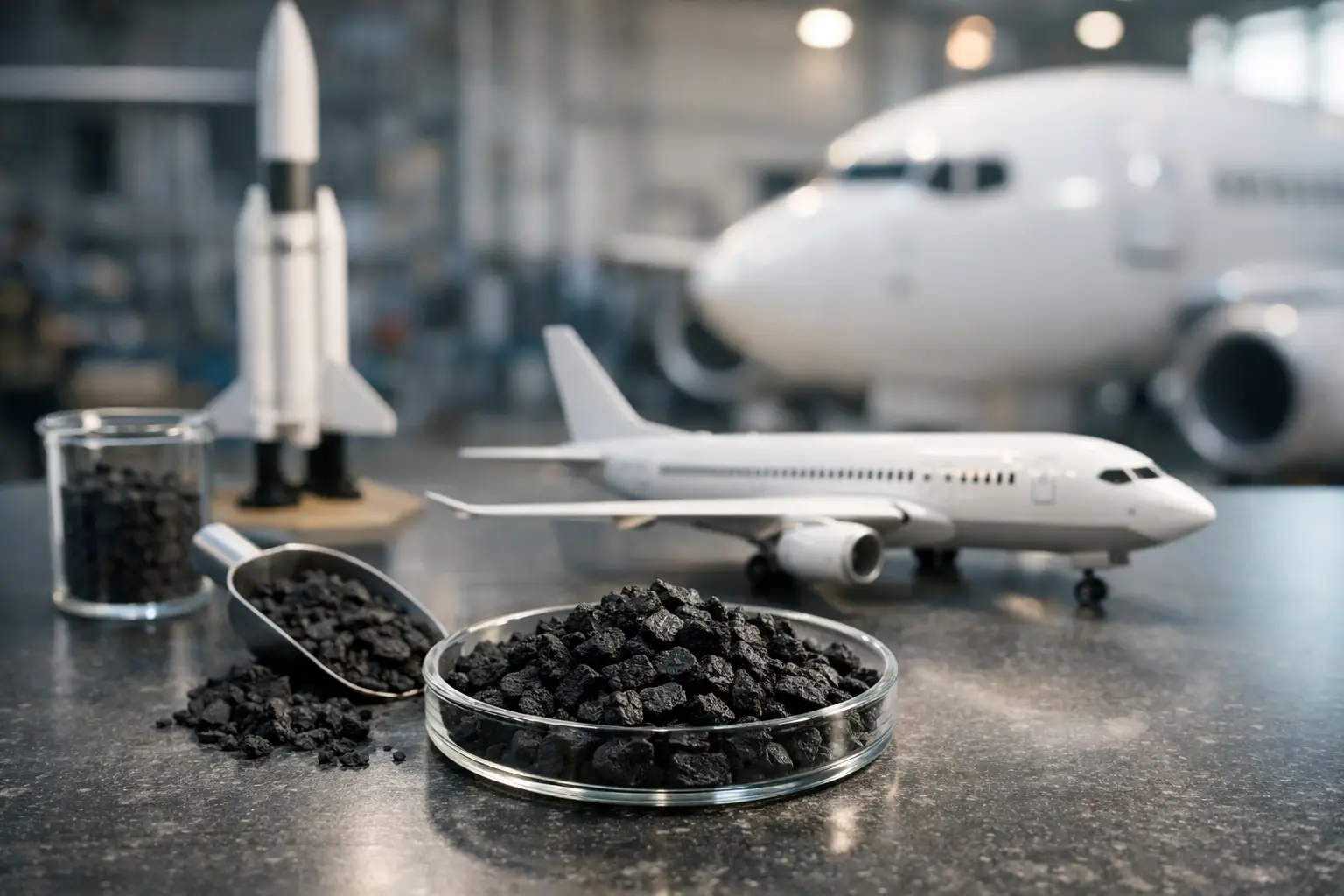
For manufacturers supplying soil amendments, fertilizers, animal feed additives, filtration media, construction materials, battery precursors, or specialty industrial formulations, those variables need to be controlled. Product acceptance depends on repeatable particle size distribution and stable handling characteristics, not just pyrolysis yield.
Biochar applications place different demands on size reduction
There is no single ideal particle size for biochar. The right target depends on the application and how the material is introduced into the next process.
In soil and agricultural markets, coarser material may be acceptable when the objective is bulk amendment and slower physical breakdown in the field. Even then, oversize particles can reduce spreading uniformity, while excessive fines may increase dusting during packaging and application. In fertilizer blends, biochar often needs tighter particle sizing to support homogeneous mixing and more predictable nutrient distribution.
For industrial compounds and engineered materials, tolerances are usually narrower. If biochar is being used as a filler, adsorbent, conductive additive, or functional carbon source, uncontrolled particle distribution can affect dispersion, surface interaction, bulk density, and downstream conversion performance. In these cases, milling is not simply a finishing step. It is part of the product design.
That is why process selection should begin with the end-use specification. Throughput targets, allowable fines, top size limits, contamination sensitivity, and dust containment requirements all shape the most effective size reduction strategy.
Challenges in biochar milling
Biochar presents several characteristics that make size reduction more complex than it first appears. Its low density and porous structure can limit efficient feed presentation. Its friability can drive uncontrolled fine generation. Depending on production conditions, it may also contain hard mineral fractions, partially carbonized particles, or foreign matter that affects wear and consistency.
Dust is one of the most persistent operational issues. Fine biochar can become airborne quickly during conveying, feeding, and discharge. That creates housekeeping concerns, affects yield recovery, and may introduce combustible dust considerations depending on the specific material and operating environment. A system that reduces size effectively but does not address containment and collection can create as many problems as it solves.
Heat can also be a factor, although the effect depends on the material and target size. Some grades tolerate conventional impact milling without issue. Others degrade in quality or produce unwanted ultrafines when exposed to excessive mechanical energy. This is where process testing becomes important. Two biochar products from different feedstocks may respond very differently in the same mill.
Choosing the right biochar processing approach
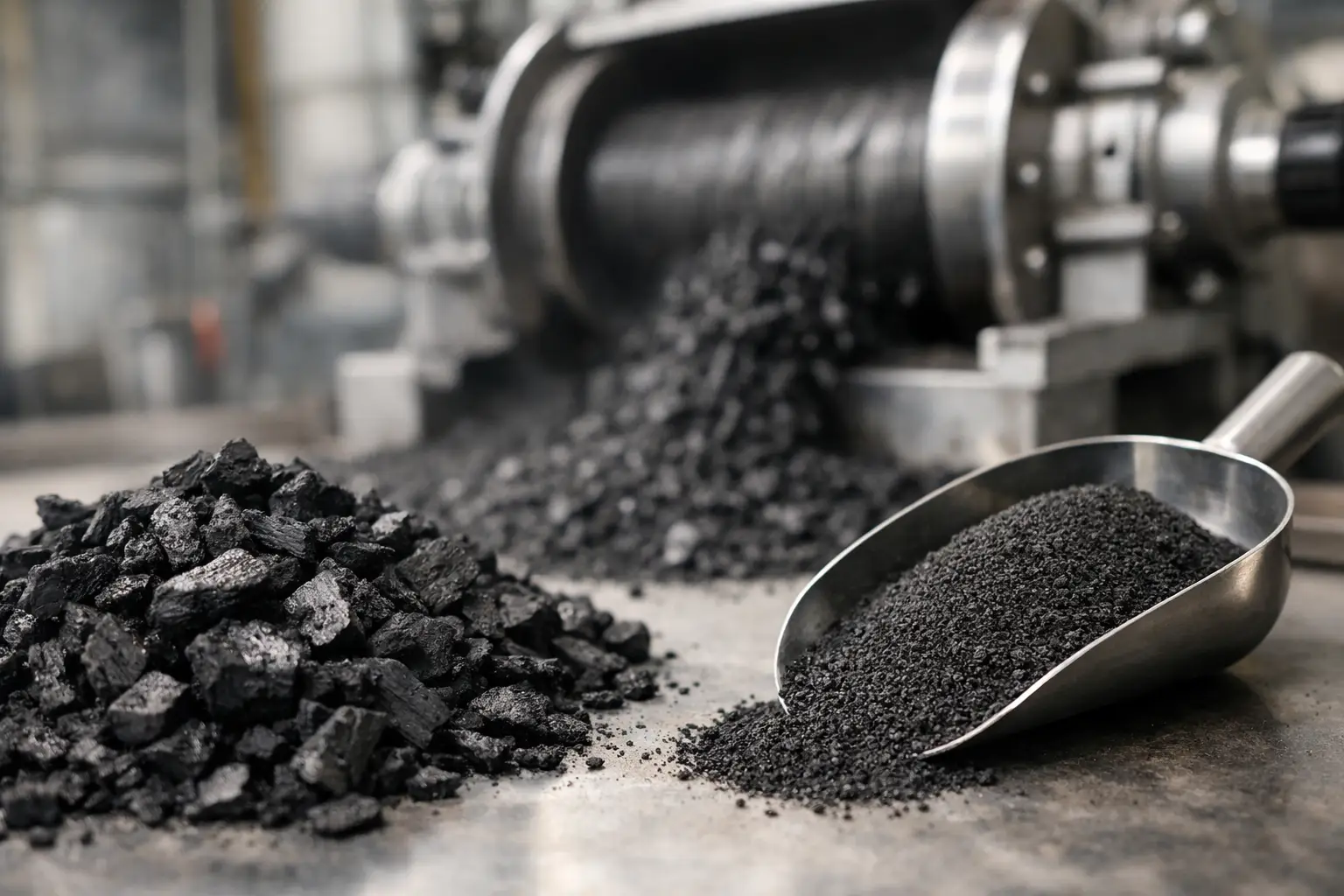
Equipment selection for biochar should be driven by the material’s behavior, not by broad assumptions about carbon products. Hammer mills may offer an efficient first-stage reduction for larger or more irregular feed. Pin mills and universal mills can be effective where moderate particle control is needed and the material remains free-flowing. Air classifier mills may provide a better path when tighter top size control is required and excessive fines must be managed within a single integrated process.
For very fine applications, fluid energy or jet milling may be considered, particularly where contamination reduction and heat sensitivity are important. That said, not every biochar product justifies that level of energy input. In many cases, the most efficient solution is a staged process that combines coarse reduction, controlled milling, and classification.
This is where many projects either gain or lose long-term efficiency. An undersized or overly aggressive mill may achieve the target particle size in a test run while sacrificing throughput, raising maintenance, or creating too much unusable fine material. A well-matched system balances size reduction with yield, uptime, and downstream handling performance.
Particle size control is only part of the equation
Manufacturers sometimes focus narrowly on the final screen size or nominal micron target. In practice, particle size distribution matters more than a single number. Two biochar products with the same average particle size can behave very differently in blending, dosing, pelletizing, or packaging if one contains a broad spread of fines and overs.
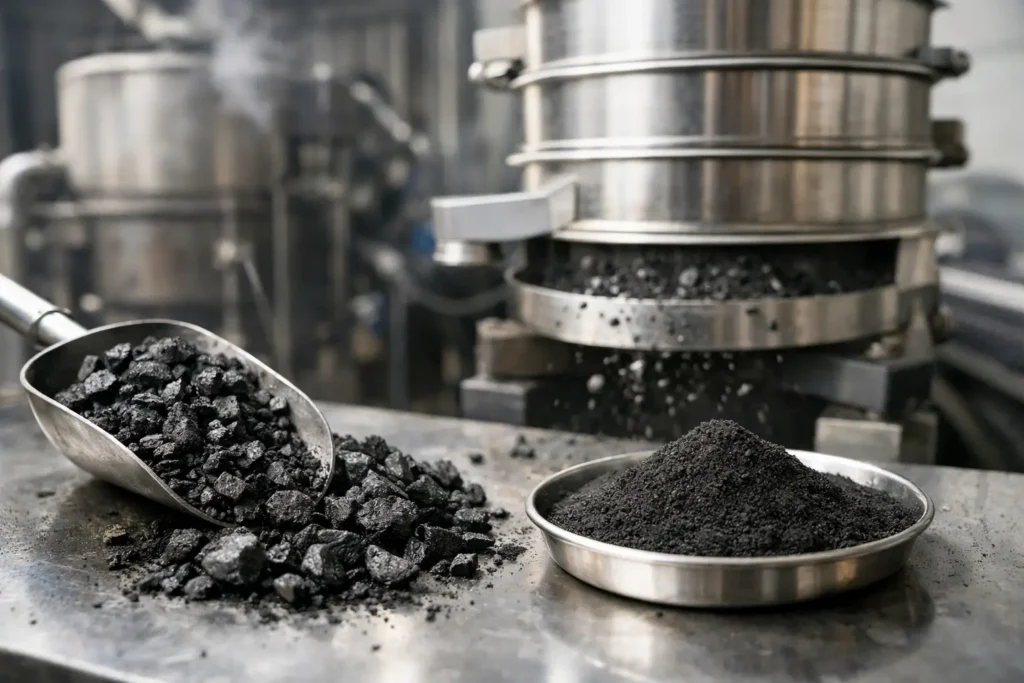
Classification plays a central role here. Whether integrated into the mill or added as a separate step, classification allows producers to narrow the distribution and improve product consistency. That can translate into better flow, more reliable feeding, and less variation in customer performance.
Bulk density and flowability should also be evaluated alongside size reduction. Milling changes the physical structure of biochar, not just the particle dimensions. As particles become finer, they may pack differently, feed less predictably, or become more difficult to convey. If the final product must move through augers, loss-in-weight feeders, or automated packaging systems, that behavior needs to be accounted for during process design.
Contamination, wear, and system design
For higher-value biochar applications, contamination control becomes a serious consideration. Metallic pickup from wear surfaces, inconsistent feed contaminants, and poor dust collection design can all reduce product quality. This is especially relevant when biochar is destined for specialty formulations or performance-sensitive industrial markets.
Material construction, mill geometry, and wear component selection should align with both the biochar characteristics and the purity requirements of the end product. In some cases, abrasion from ash or entrained mineral content may call for more durable internal components. In others, the priority may be reducing metal contact and simplifying cleanout between production campaigns.
Feeding and discharge design deserve equal attention. Because biochar can bridge, flood, or aerate depending on its condition, the upstream and downstream equipment often determine whether the mill performs consistently. A strong process design includes controlled feeding, effective dust collection, and discharge handling that preserves product integrity while supporting continuous operation.
Scaling biochar from pilot to production
Many biochar businesses start with a strong concept and a workable small-scale product. The gap appears when demand increases and process variability starts to affect commercial performance. What worked in batch grinding or small pilot equipment may not translate cleanly into production throughput, operator safety, or maintenance expectations.
Scale-up should account for more than hourly capacity. Residence time, air handling, feeding stability, dust collection efficiency, and classification accuracy all become more critical at higher throughputs. A process that produces acceptable particle size in a pilot environment may generate excessive dust loading or poor yield recovery when pushed to industrial rates.
This is why application testing and engineered system design are so valuable. Manufacturers need to know not only whether a biochar can be milled, but how it behaves across operating ranges and where the practical limits appear. A process partner with experience in difficult powders can help define those boundaries before they become production problems.
For companies evaluating commercial biochar processing, the priority should be straightforward: treat particle size reduction as a process control function, not a secondary packaging step. The more variable the feedstock and the more demanding the end use, the more that distinction affects cost, consistency, and market credibility.
As biochar moves into broader industrial use, the winners will not be defined only by feedstock access or pyrolysis capacity. They will be the producers that can deliver a material with repeatable physical properties, reliable handling, and performance that holds up from batch to batch.