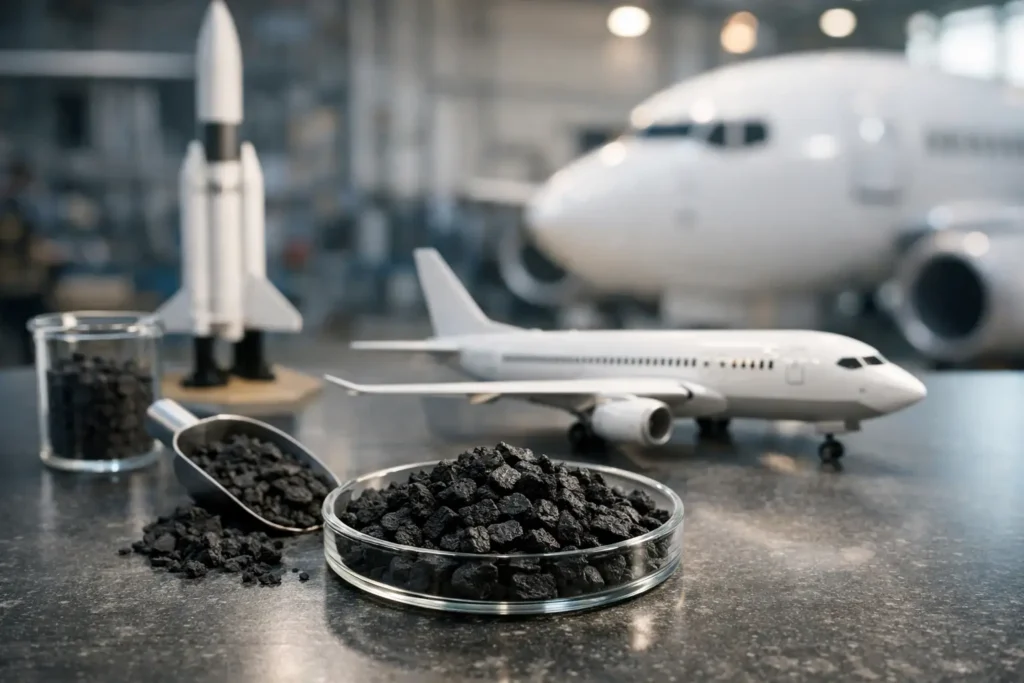
Aerospace materials teams do not have the luxury of chasing novelty for its own sake. If a new carbon-based material cannot deliver repeatable particle characteristics, controlled purity, and predictable performance in demanding environments, it does not move past the lab for long. That is exactly why biochar in aerospace is attracting interest – not as a marketing concept, but as a material platform that could support lightweight structures, thermal management, filtration, and lower-impact carbon sourcing when processing is done correctly.
The opportunity is real, but the gap between a promising feedstock and an aerospace-ready material is wide. Biochar is not a single material. It is a broad category of carbon-rich solids produced by thermochemical conversion of biomass, and its properties change significantly with feedstock selection, pyrolysis conditions, post-processing, ash content, porosity, and final particle size distribution. For aerospace manufacturers, that variability is the first issue to solve.
Why biochar in aerospace is getting attention
Aerospace has been built on advanced carbon materials for decades. Carbon fiber, graphite, activated carbon, carbon-carbon systems, and conductive fillers already play critical roles across aircraft, spacecraft, and supporting infrastructure. Biochar enters the discussion because it offers a potential route to engineered carbon materials derived from renewable feedstocks, with tunable structure and chemistry.
That matters for three reasons. First, weight and multifunctionality remain major design priorities. A low-density carbon material that can contribute to conductivity, thermal behavior, adsorption, or reinforcement has value if it integrates well with the overall system. Second, supply chain pressure is pushing more industries to look at alternative raw material pathways. Third, sustainability claims in aerospace only hold up when materials also support real production performance. If biochar can be processed into a consistent, application-specific powder, it becomes far more interesting than a generic biomass byproduct.
Still, no one should confuse potential with readiness. Aerospace qualification standards are unforgiving, and material variation that might be acceptable in agriculture or commodity plastics can become disqualifying in high-performance composites or thermal systems.
Where biochar may fit in aerospace applications
The most realistic uses of biochar in aerospace today are not necessarily direct replacements for premium structural carbon fiber systems. More often, biochar is being considered as a functional additive, precursor material, or specialty carbon component in applications where microstructure and surface properties can be engineered for purpose.
Polymer composite fillers and lightweight components
One of the more practical avenues is biochar as a filler in polymer composites. In the right formulation, fine biochar powders may improve stiffness, alter electrical behavior, influence thermal conductivity, or reduce resin consumption. In non-primary or semi-structural components, that can be useful.
The catch is dispersion. Poorly controlled particle size or broad distributions can create agglomeration, inconsistent wet-out, and weak points in the matrix. Surface chemistry also affects bonding with thermosets and thermoplastics. A biochar filler that looks promising on paper can underperform quickly if it is not milled and classified for consistent integration.
Thermal insulation and heat management
Certain biochars exhibit porous structures and thermal characteristics that make them candidates for insulation systems or engineered thermal barriers. In aerospace, this could apply to secondary thermal protection concepts, internal heat shielding, or specialty housings where low density matters.
But thermal performance is highly process-dependent. Pyrolysis temperature, residence time, and feedstock composition all affect pore architecture, volatile content, and stability at elevated temperatures. If those variables are not tightly controlled, the resulting material may drift too far from specification for serious use.
Adsorption and filtration media
Cabin air treatment, environmental control systems, and specialized filtration applications are another area worth watching. Carbon materials are already used for adsorption, and biochar could serve as a precursor or alternative in selected filtration media where pore structure and surface area can be tailored.
For this use case, ash content and contamination control become central. Aerospace systems cannot tolerate unpredictable trace minerals, residual organics, or off-spec fines. Post-processing, purification, and particle classification are not optional steps here. They are what determine whether the material behaves like an engineered product or an inconsistent carbon powder.
Conductive additives and multifunctional systems
Biochar is also being studied as a conductive additive for coatings, polymer systems, and energy-related components. Depending on how it is produced and refined, it may support electromagnetic interference shielding, static dissipation, or conductivity tuning in lightweight assemblies.
Again, the phrase is may support, not automatically deliver. Conductive performance depends on carbon structure, graphitic ordering, particle morphology, and dispersion quality. Two biochars with similar bulk appearance can behave very differently in a finished formulation.
The processing challenge behind biochar in aerospace
For aerospace applications, biochar is less a raw material story than a process control story. Feedstock selection starts the chain, but downstream size reduction, deagglomeration, classification, and contamination management are what make the material usable in precision manufacturing.
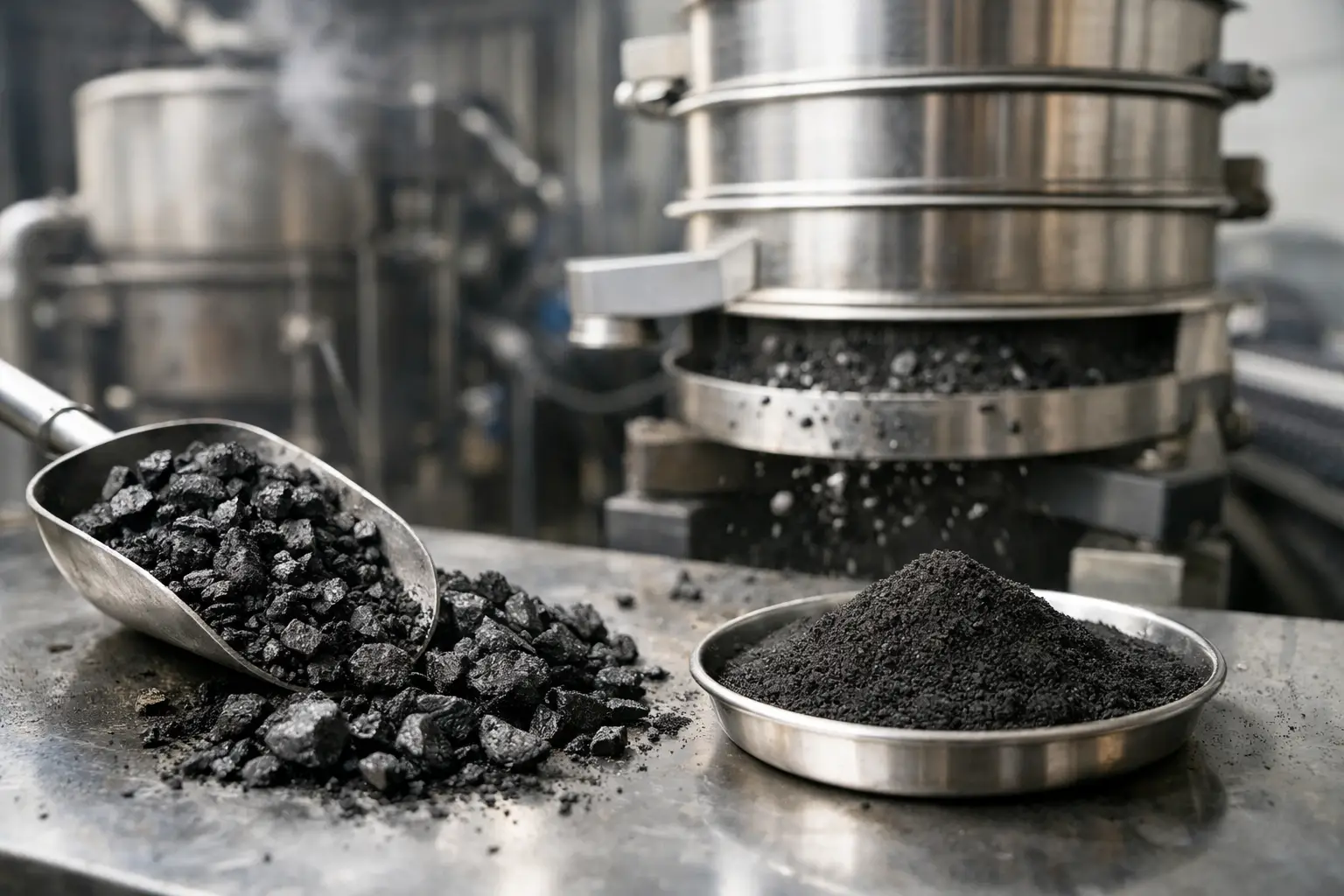
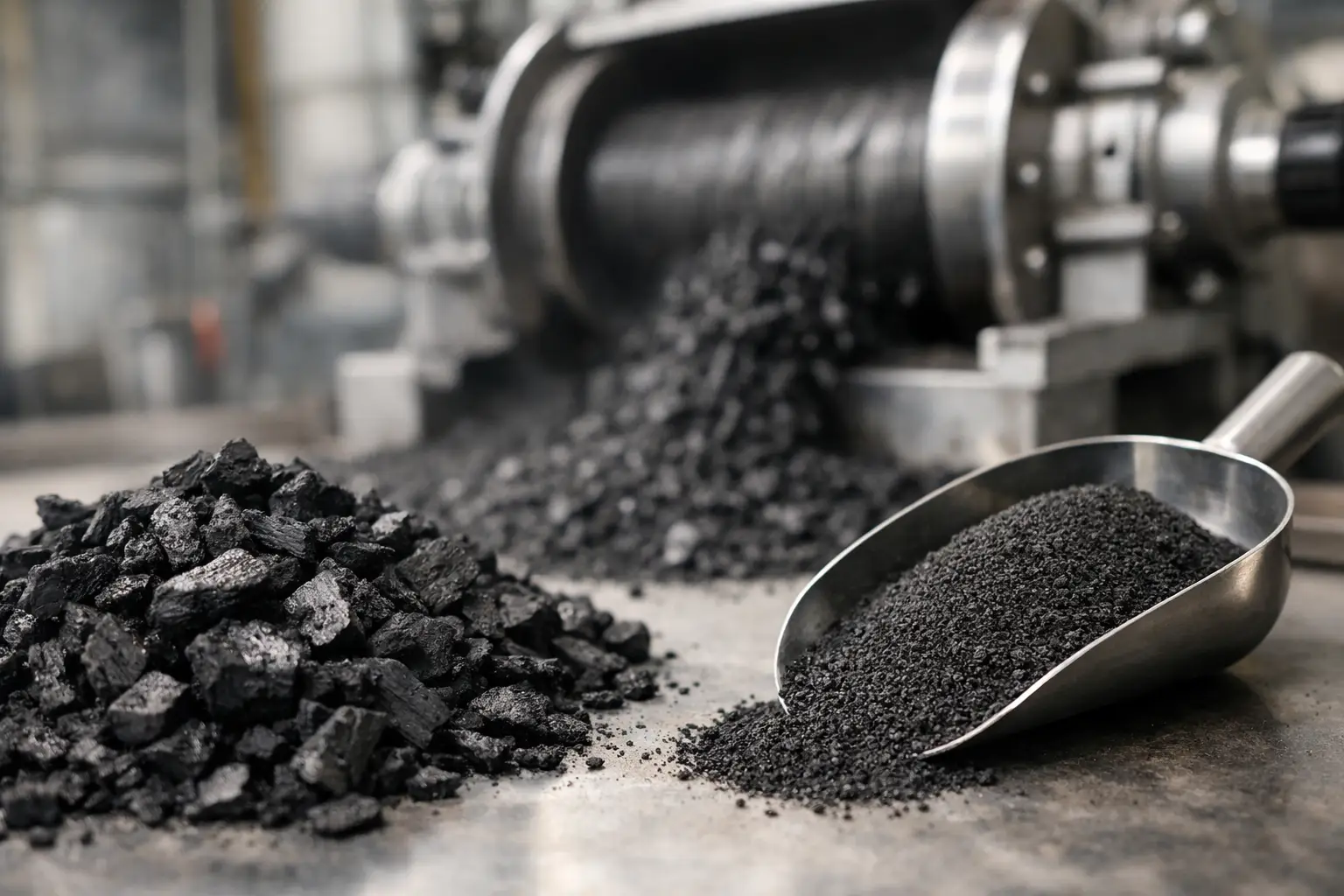
Raw biochar often exits pyrolysis as an irregular, friable, heterogeneous solid. It may contain oversized particles, fibrous remnants, hard mineral inclusions, and a broad spread of fines. That is a problem for any application that depends on controlled packing density, reproducible dispersion, or narrow performance windows.
Particle size reduction must be approached carefully. Biochar can be brittle, dusty, and sensitive to heat buildup depending on its structure and residual volatile content. Over-processing can destroy useful porosity or generate an excess of ultrafines that hurt flowability and handling. Under-processing leaves coarse fractions that interfere with blending and performance. This is where milling strategy matters.
Jet milling, classifier milling, pin milling, and other impact-based or fluid-energy approaches may each have a place depending on target size, feed characteristics, contamination concerns, and throughput requirements. In some cases, integrated classification is just as important as milling itself because removing out-of-spec fractions is what tightens downstream consistency. The right system is application-specific, especially when the end use involves high-value composite, coating, or filtration formulations.
Moisture management also matters more than it first appears. Biochar can adsorb moisture from the environment, which affects flow, agglomeration, and blending. For aerospace manufacturers, poor powder handling is not a small inconvenience. It can compromise dosing accuracy, line efficiency, and final part consistency.
Material consistency is the real barrier to scale
The most significant limitation for biochar in aerospace is not a lack of interesting concepts. It is the difficulty of producing a repeatable material at scale. Aerospace buyers are not evaluating a story about renewable carbon. They are evaluating lot-to-lot uniformity, impurity profile, PSD control, bulk density, surface area, and long-term process reliability.
This is where many early-stage materials lose momentum. A biochar produced from one biomass stream under one set of conditions may test well in a development program. Scaling that result across changing feedstocks, commercial production rates, and stricter quality requirements is another matter.
Ash is a particularly important issue. Depending on the source biomass, biochar can carry inorganic residues that may interfere with electrical performance, wear process equipment, affect thermal behavior, or create contamination concerns in finished parts. Even when the carbon fraction is acceptable, the mineral fraction may not be.
There is also a trade-off between sustainability goals and processing intensity. A lower-impact feedstock does not automatically remain lower impact if the material requires extensive purification, multiple milling passes, classification, and energy-intensive post-treatment to meet spec. Aerospace teams need to assess the full manufacturing picture, not just the origin of the carbon.
What manufacturers should evaluate before adopting biochar
If biochar is being considered for aerospace use, the right question is not whether the material is sustainable or novel. The right question is whether it can be engineered into a stable, specification-driven input for production.
That means evaluating feedstock traceability, pyrolysis control, impurity levels, particle size targets, flow behavior, dispersion requirements, and storage stability together. It also means deciding early whether the intended role is structural, semi-structural, thermal, adsorptive, or conductive, because each path demands a different processing window.
Pilot-scale trials are especially valuable. A powder that performs well in benchtop mixing may behave very differently in higher-throughput milling, conveying, and compounding systems. Manufacturers should also expect that some biochar formulations will need custom processing approaches rather than standard off-the-shelf powder handling assumptions. That is often where application knowledge and engineered milling support become decisive.
For companies evaluating advanced carbon materials, the practical future of biochar in aerospace will depend less on headlines and more on disciplined process development. If the material can be produced with controlled chemistry, narrow particle distribution, and reliable handling characteristics, it has real potential in selected aerospace applications. If not, it remains a lab curiosity. The difference is made in processing.