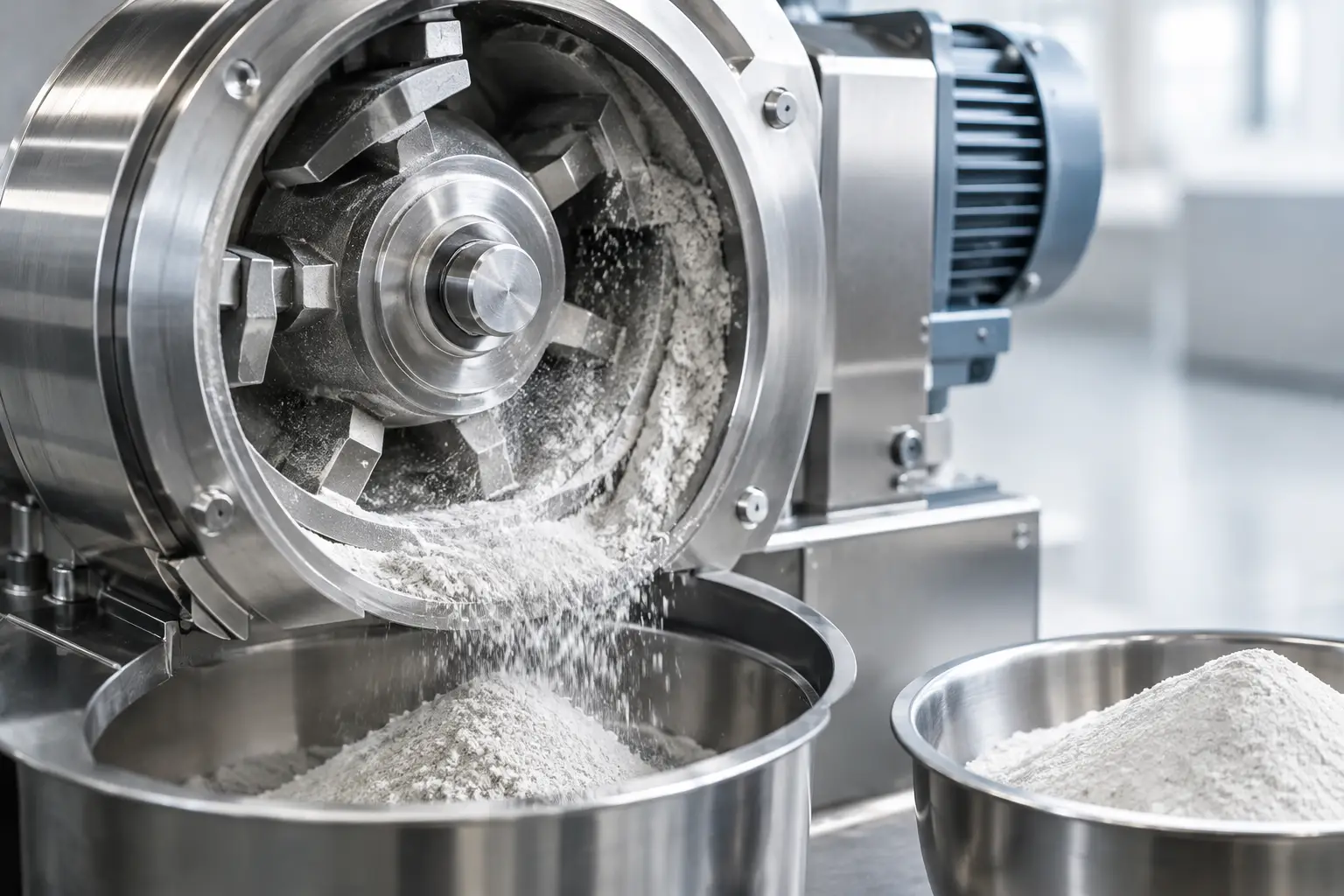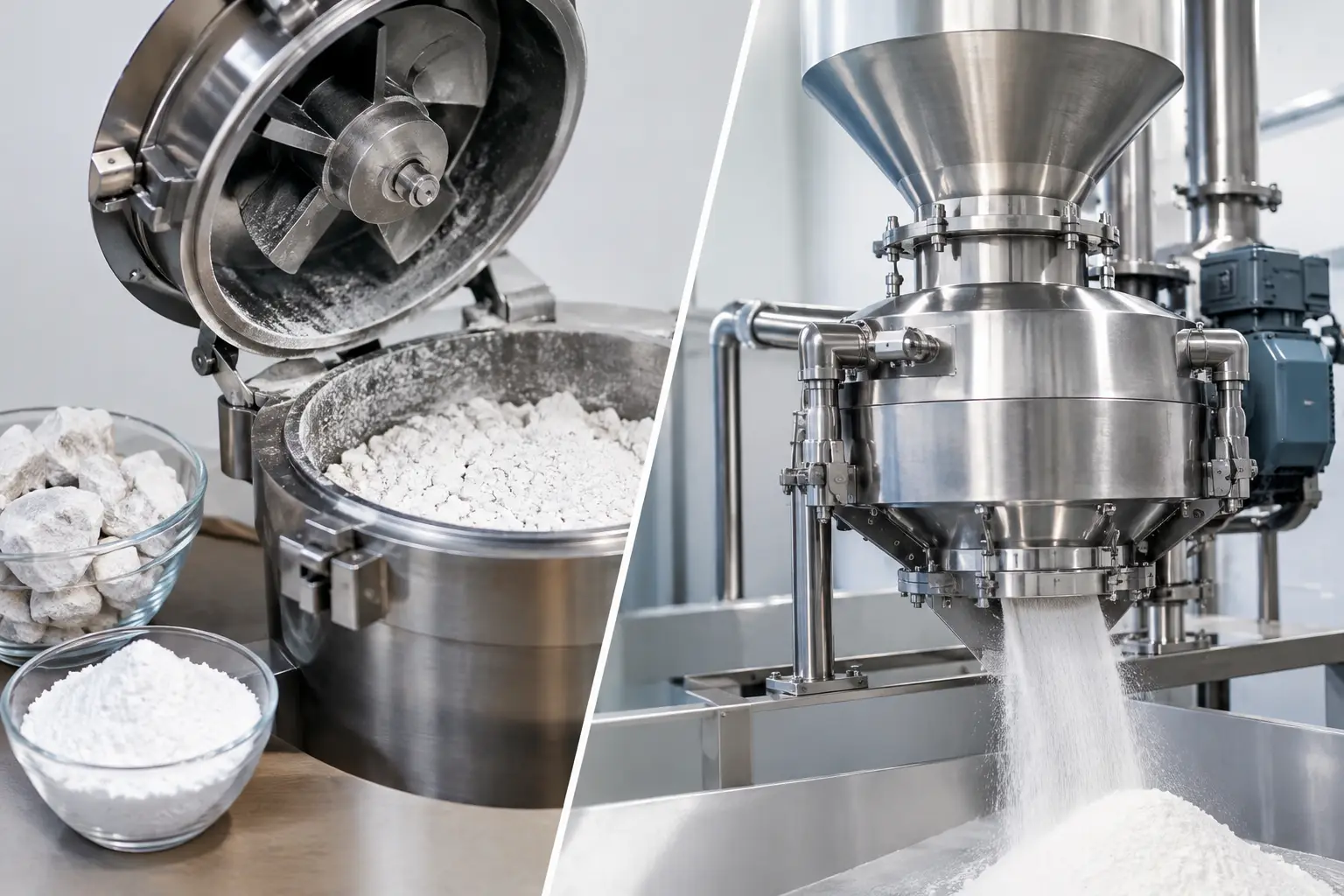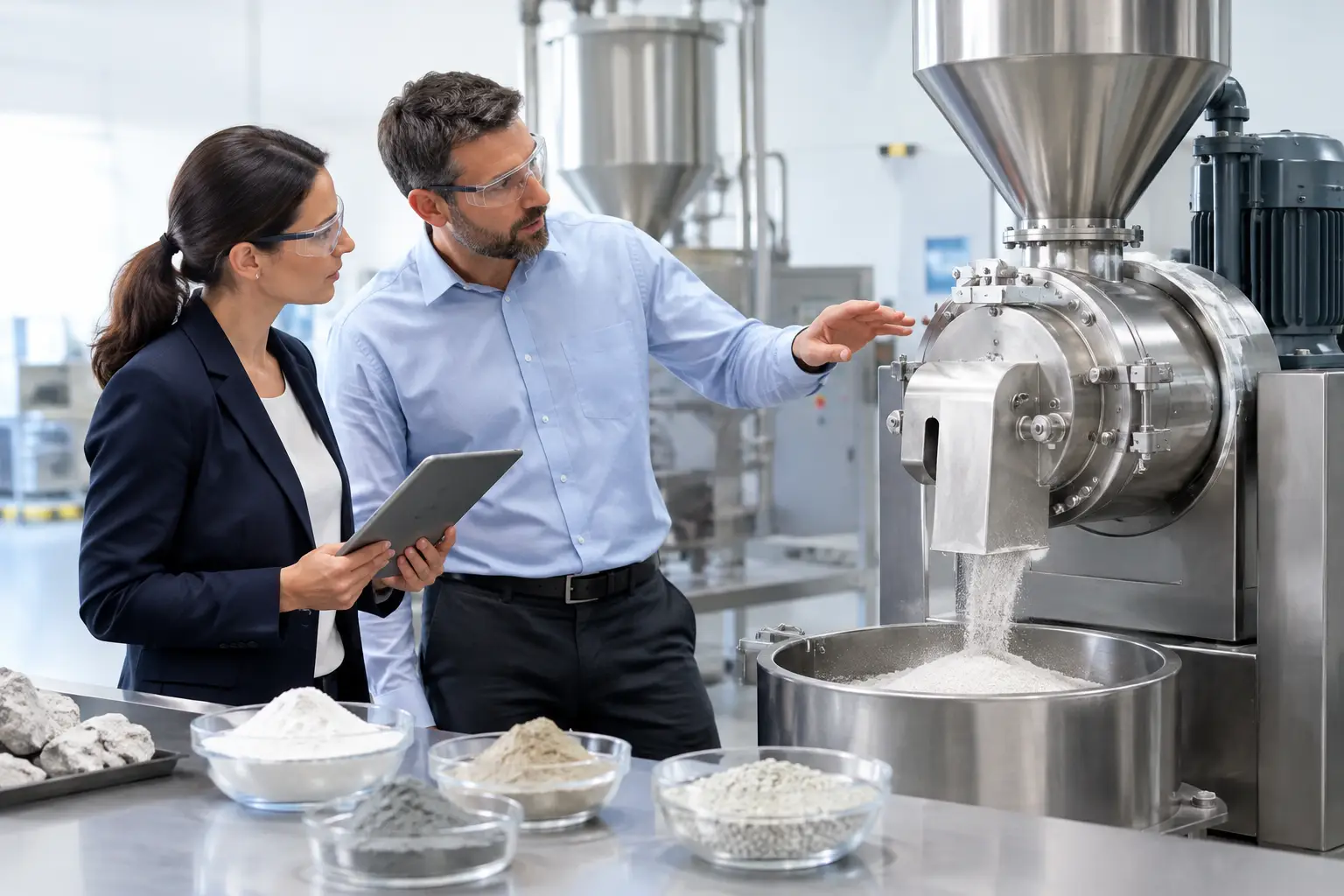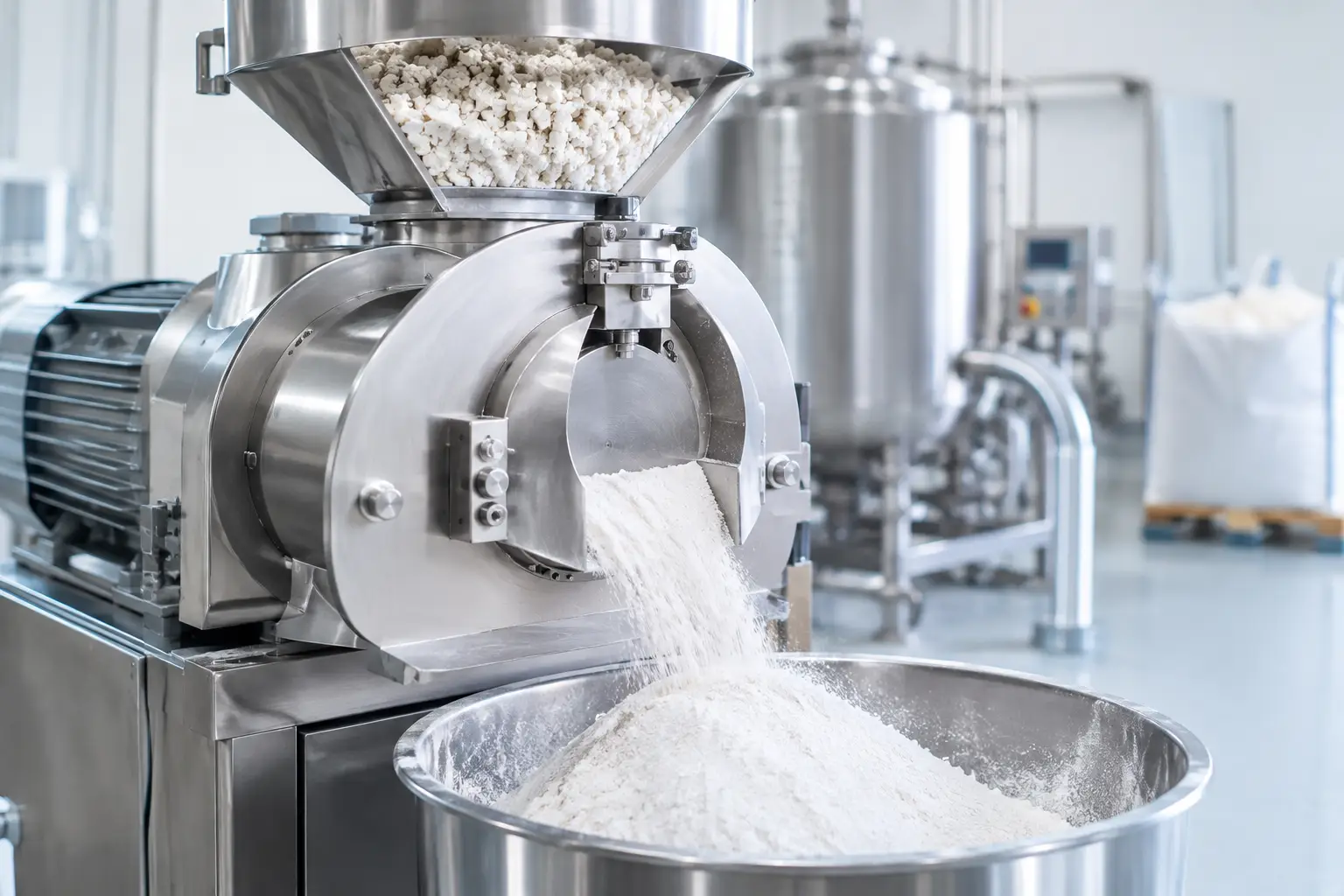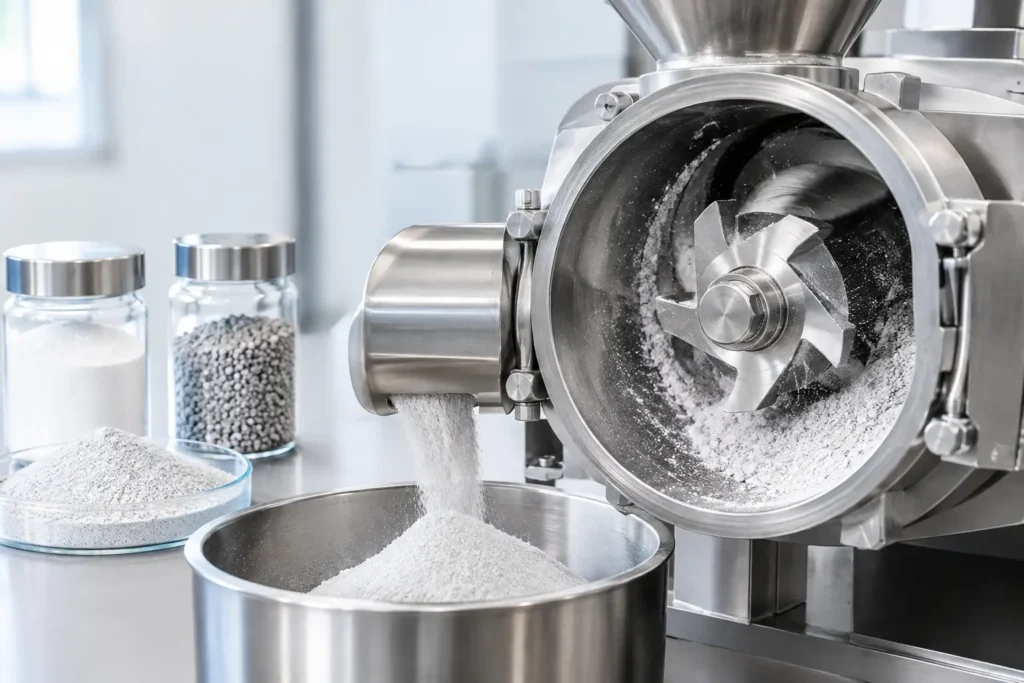
A pharmaceutical manufacturer had a familiar but costly problem: an active pharmaceutical ingredient (API) met chemical specifications after synthesis, yet downstream performance varied from lot to lot. Particle size distribution (PSD) drifted, fine-particle content was inconsistent, and the material’s behavior during blending and final dosage-form processing was less predictable than the production team could accept. This API milling case study examines the process decisions behind stabilizing particle size without creating new challenges in heat exposure, containment, yield, or scale-up.
The central lesson is straightforward. API milling is not a matter of selecting a mill based on a target micron size alone. Material properties, feed consistency, air classification, system containment, cleaning requirements, and the relationship between milling conditions and product attributes all influence the final result.
The Processing Challenge
The manufacturer needed to reduce a crystalline API to a narrower, application-specific particle size range before formulation. Its existing impact milling process could achieve the nominal median particle size, but the PSD was broad. Some batches contained excessive coarse particles, while others generated more fines than desired.
That variation created practical issues downstream. Coarse particles could affect blend uniformity and dissolution behavior. Excess fines increased dust loading, complicated material transfer, and raised the risk of poor flow through subsequent equipment. The process also showed sensitivity to feed rate and ambient conditions, making it difficult for operators to hold performance stable across longer campaigns.
The material presented additional constraints. It was moderately heat-sensitive, required controlled handling, and could not tolerate meaningful contamination from product-contact surfaces or accumulated residue. The production team needed a solution that would support development work first, then translate to commercial-scale manufacturing without changing the fundamental particle-engineering approach.
Why the Existing Mill Was Not Enough
The original mill relied primarily on impact and screen selection to control the product. That approach can be effective for many materials, particularly where a broader distribution is acceptable. In this application, however, screen-based control did not provide enough separation between particles that had reached the desired size and particles that remained too coarse.
As a result, properly sized particles could remain in the milling zone longer than necessary. That increases the opportunity for overgrinding and raises the fraction of fines. Simply reducing the screen opening was not a reliable answer. A smaller screen could restrict throughput, increase residence time, and add heat to a material already sensitive to process conditions.
This is where a case study must remain application-specific. A jet mill, air classifier mill, pin mill, or other technology may be appropriate depending on the API’s hardness, cohesiveness, moisture behavior, thermal sensitivity, target size, and required production rate. There is no universal pharmaceutical milling configuration.
Process Development Focused on Classification
The development team evaluated an air classifier milling approach because it offered two process functions in one controlled system: size reduction and dynamic classification. Rather than depending only on a screen to determine product size, the system could use controlled airflow and classifier speed to reject oversized particles while allowing material within the target range to exit the milling chamber.
This distinction mattered. The objective was not to make the finest possible powder. It was to produce a repeatable PSD with controlled coarse-particle content and a limited fine fraction. The process window therefore needed to account for more than the median size, commonly measured as D50. The team also monitored D10, D90, span, and the percentage of material above and below critical particle-size thresholds.
Establishing the Material Baseline
Before selecting operating conditions, the process team characterized the API in its incoming state. This included initial PSD, bulk density, moisture level, flow behavior, particle morphology, and tendency to agglomerate. The team also reviewed whether milling could alter crystallinity, create electrostatic handling issues, or cause a meaningful temperature rise.
That baseline work prevented a common error: treating feed material as a constant when it is not. Changes in upstream drying, crystallization, sieving, or storage can change how an API responds in a mill. A stable milling process begins with defined feed conditions and an understanding of which incoming variables require control.
Identifying the Operating Window
Pilot trials varied feed rate, rotor or grinding-element speed, classifier speed, airflow, and system pressure. Each setting affected the PSD differently. Higher classifier speed generally shifted the product finer, but excessive speed could raise the fine fraction and reduce throughput. Increasing feed rate could improve production efficiency up to a point, then overload the classification zone and allow more coarse material into the product.
The preferred operating range was selected based on repeatability, not a single best data point. A setting that achieves the target PSD during a short trial may not remain stable through a full production campaign. The team therefore tested for steady-state performance, monitored product temperature, and evaluated collection efficiency over extended runs.
Containment Was Designed Into the System
For pharmaceutical APIs, particle control and containment cannot be treated as separate projects. Fine powders are more likely to become airborne during charging, milling, collection, discharge, and cleaning. If the process produces a higher fine fraction than expected, dust-control demands may increase even when the PSD appears acceptable on paper.
The selected process concept included contained material transfer between the feed system, mill, classifier, and collection equipment. Connections, seals, filter arrangement, and discharge methods were considered alongside the milling parameters. The goal was to reduce manual handling points and maintain negative-pressure control where appropriate for the facility’s containment strategy.
Cleaning and changeover requirements were also part of the equipment evaluation. Product-contact surfaces needed to be accessible and designed to minimize powder hold-up. For multiproduct facilities, cleanability can directly affect available production time and validation effort. A mill that performs well but requires an impractical cleaning sequence may not deliver the expected operating value.
Results: Better Control Without Overprocessing
Following process development, the manufacturer established a milling configuration that produced a narrower PSD across repeated lots. The critical improvement was consistency at the tails of the distribution. Coarse particles were reduced through effective classification, while the process avoided prolonged exposure that would create unnecessary fines.
The production impact extended beyond particle-size data. More predictable powder behavior improved downstream handling and reduced the need for corrective adjustments during formulation operations. Operators had defined setpoints, acceptable ranges, and clearer indicators for when feed conditions or process performance required investigation.
Throughput remained an active trade-off. The highest possible feed rate was not the best operating point because it reduced classification efficiency. Instead, the selected range balanced output with PSD control and campaign stability. This is often the more useful measure of capacity: not the maximum instantaneous rate, but the rate that consistently produces acceptable material with minimal rework, waste, and downtime.
What This API Milling Case Study Means for Scale-Up
The most valuable outcome was a scale-up strategy built around process relationships rather than a single machine setting. As production volume increased, the team preserved the same control logic: define feed quality, maintain an appropriate air-to-solids relationship, control classifier performance, and verify the PSD with an established sampling plan.
Scale-up still required confirmation. Larger equipment can change airflow patterns, residence-time distribution, feed behavior, and heat transfer. A successful pilot result is strong evidence, but it is not a substitute for production-scale qualification. Equipment selection should account for expected commercial demand, cleaning frequency, containment requirements, and the ability to support future formulation or capacity changes.
For manufacturers evaluating API milling systems, the right question is not simply, “What mill reaches our target size?” The better question is, “What process will repeatedly produce the particle characteristics our formulation requires while supporting safe handling, practical cleaning, and reliable production?”
DP Mills approaches this type of project as a process-engineering problem. Material trials, technology selection, classifier control, and system integration should work together from early development through commercial operation. The most dependable milling result is achieved when the equipment is designed around the API and the production reality, not when the API is forced to fit a generic mill.