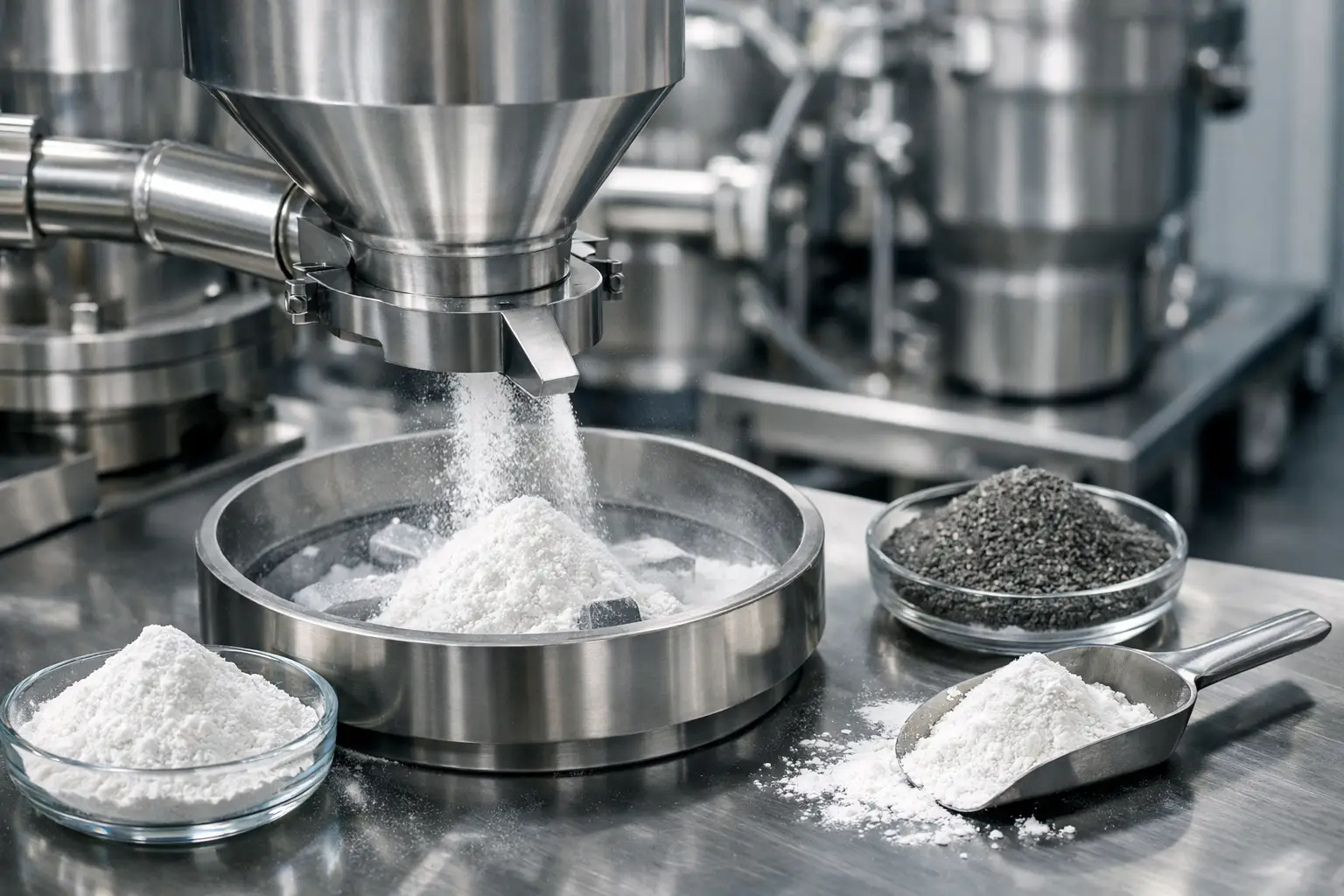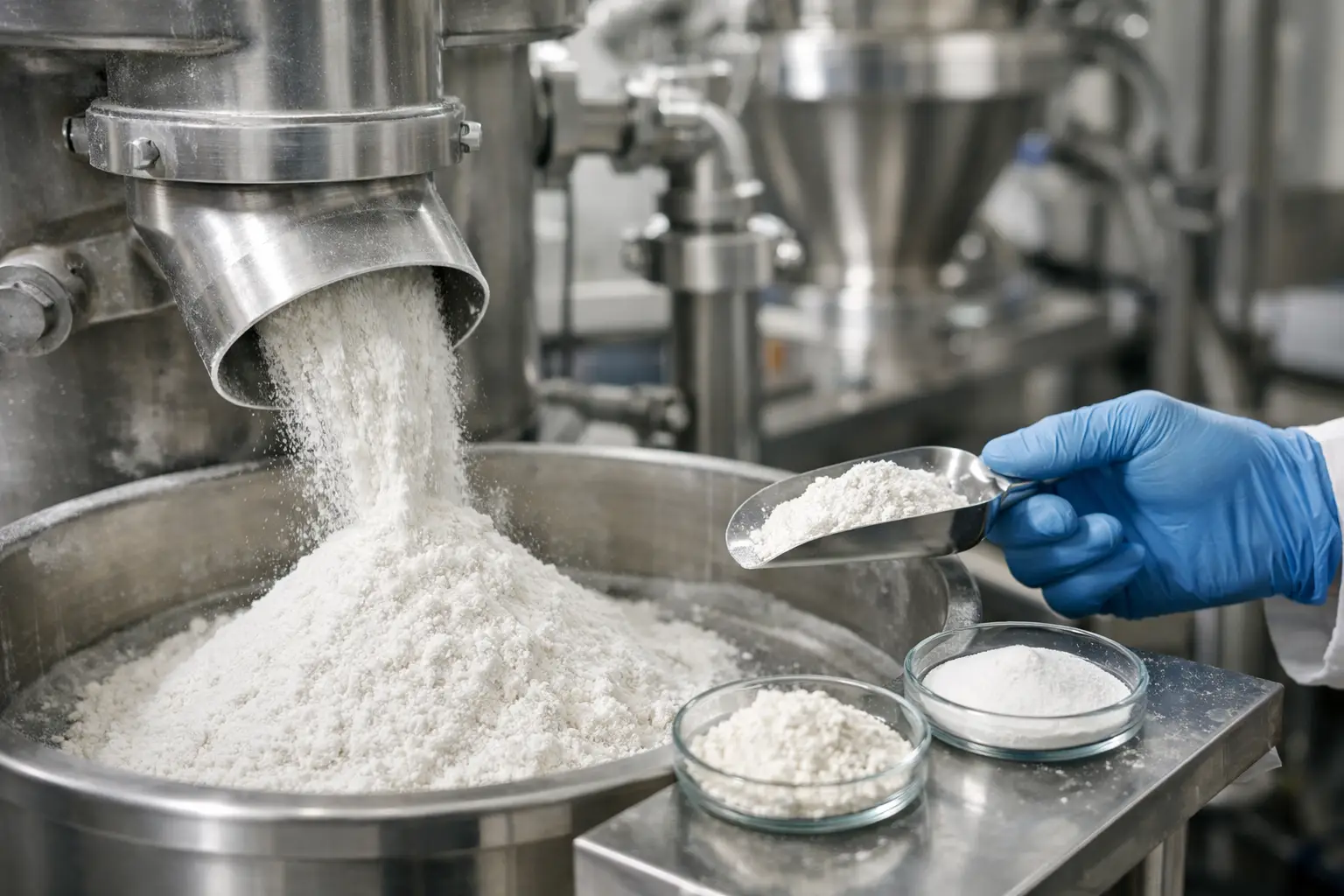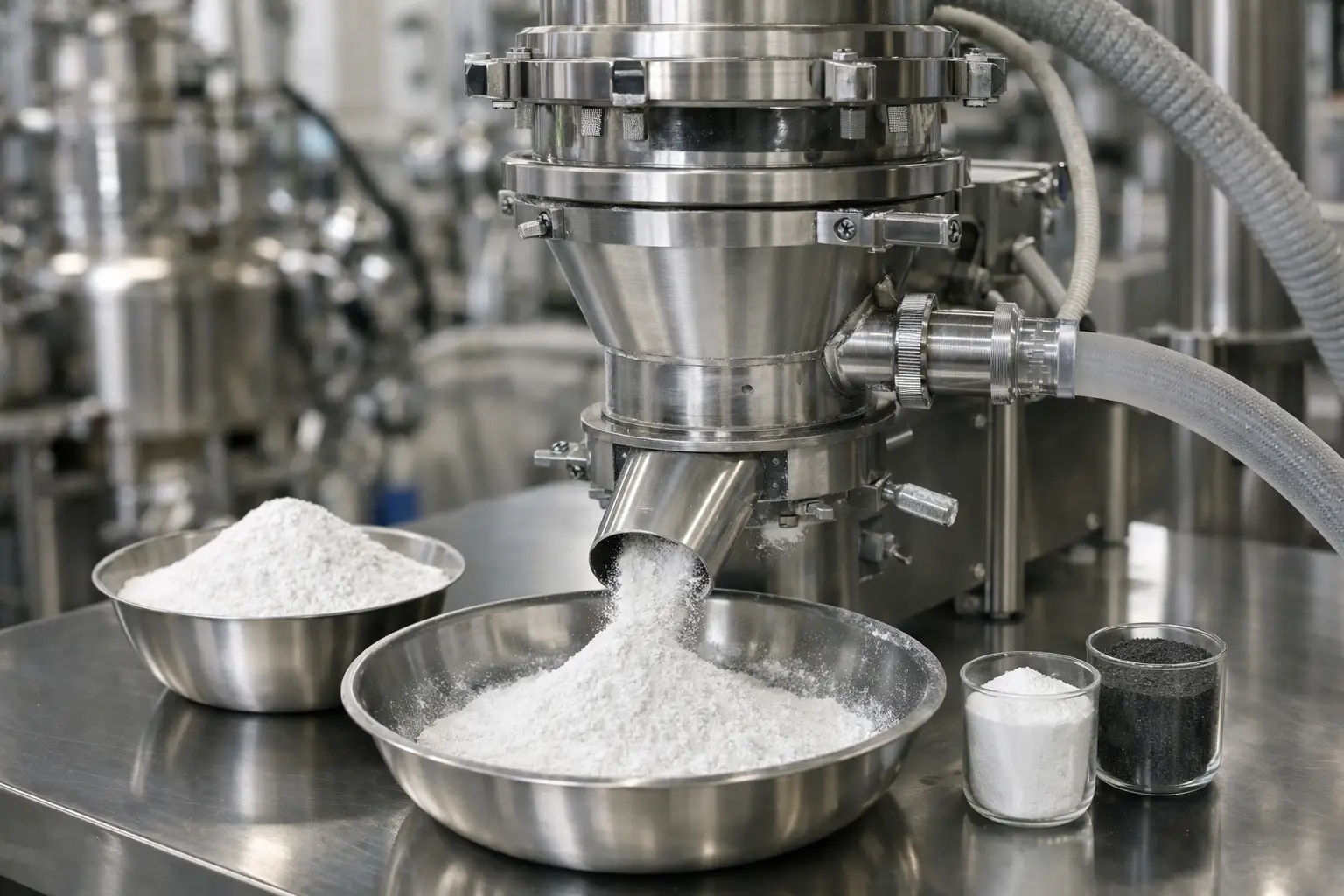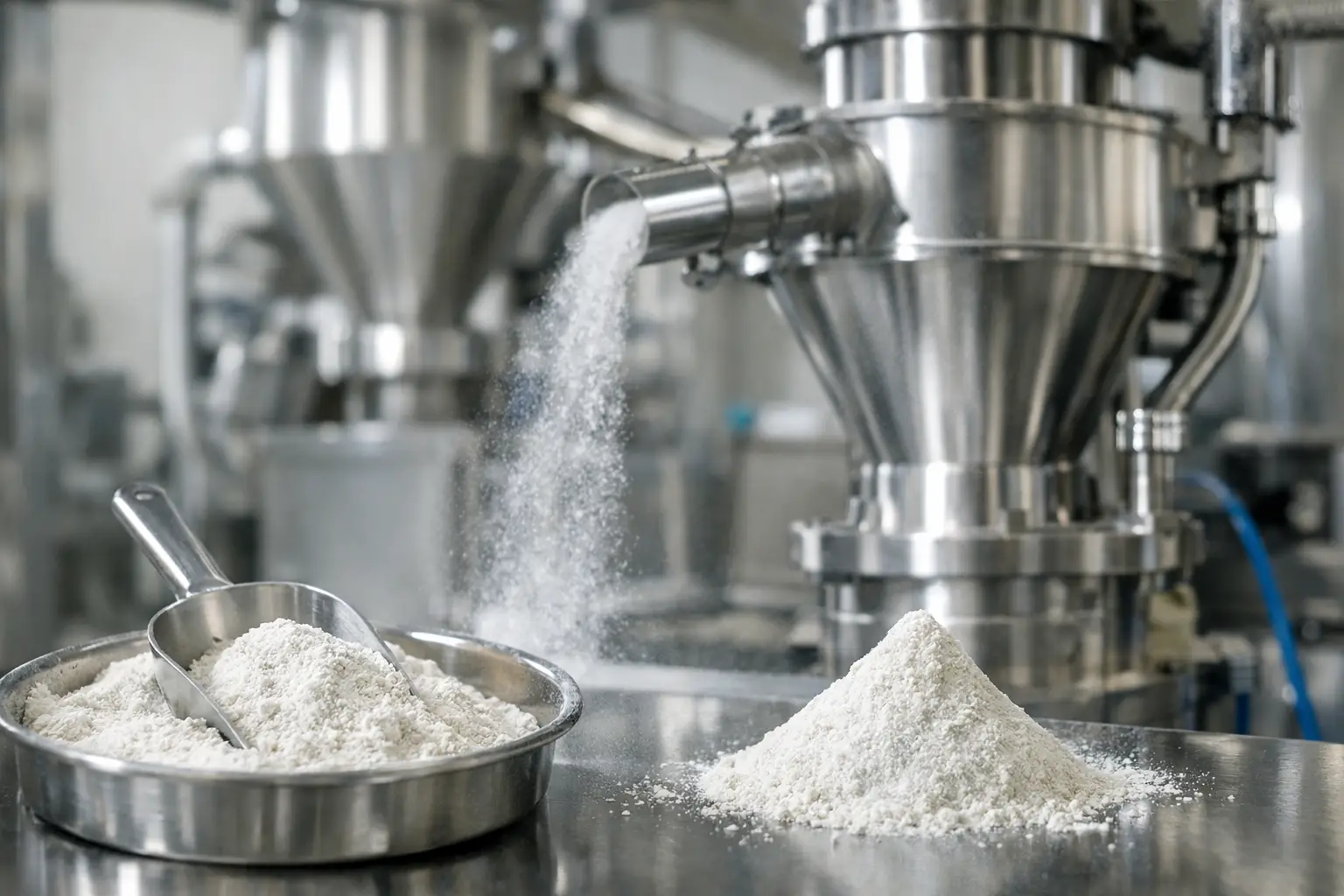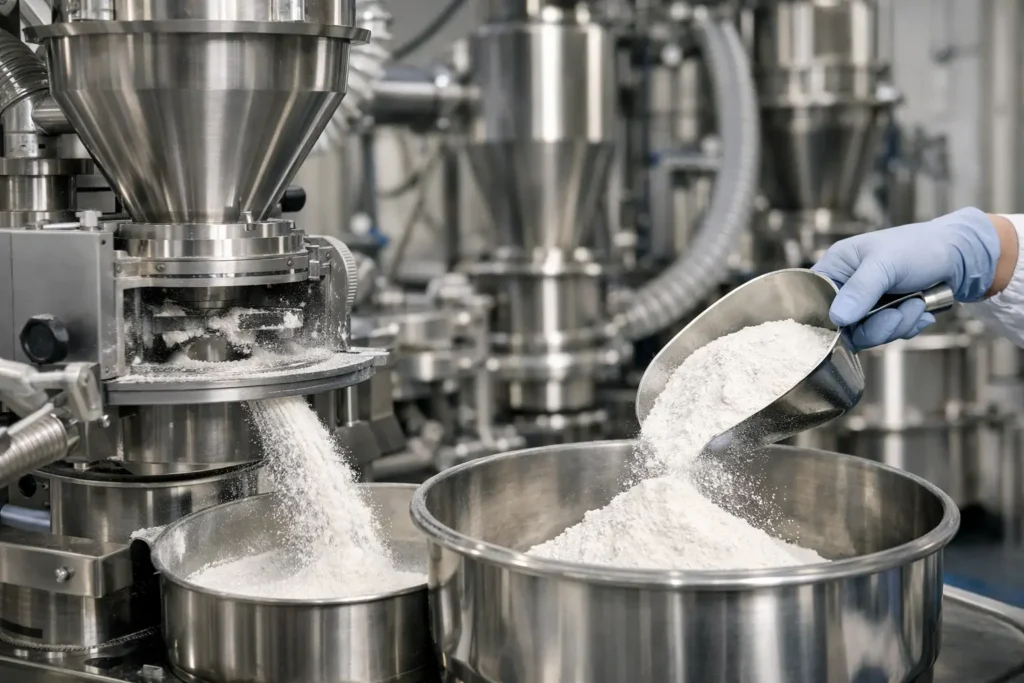
A mill can achieve the target particle size in a trial and still fail the production line. Material may bridge at the feeder, collect in transfer piping, segregate after classification, or create dust-control issues at discharge. Turnkey powder systems address these connected process risks by engineering the full material path rather than treating the mill as an isolated purchase.
For manufacturers processing pharmaceuticals, food ingredients, chemicals, battery materials, minerals, or advanced powders, this distinction has direct operational consequences. Particle size, yield, containment, cleaning time, energy use, and operator involvement are all affected by how equipment works together. A properly designed system turns a defined production objective into an integrated, controllable process.
What Turnkey Powder Systems Include
A turnkey powder system is a coordinated processing line supplied as a complete solution for a defined application. The exact configuration varies, but it commonly combines material receiving or charging, feeding, size reduction, air classification or screening, pneumatic or mechanical conveying, dust collection, product collection, controls, and safety features.
The word turnkey should not mean a fixed package with a few standard options. In demanding applications, the system must reflect the material’s flow behavior, abrasiveness, moisture sensitivity, heat sensitivity, particle-size target, contamination requirements, and production rate. It must also fit the operating environment, available utilities, cleaning expectations, and downstream packaging or blending equipment.
This is why an engineered system begins with process definition, not a catalog selection. A pin mill, jet mill, air classifier mill, hammer mill, cone mill, or cryogenic grinding system may all be appropriate under different conditions. The right choice depends on the material and the performance required from the entire line.
Start With the Material and the Production Objective
The most useful system specifications describe more than an average particle size. They identify the target distribution, allowable oversize and fines, feed characteristics, desired throughput, acceptable product temperature, and expected operating schedule. These details determine whether a process will remain stable over a full shift rather than only during a short test run.
Feed behavior deserves particular attention. Powders with poor flowability, low bulk density, high fat content, static charge, or variable moisture can produce inconsistent milling results even when the mill itself is correctly sized. A controlled feeder, agitation, loss-in-weight dosing, or conditioning step may be needed to maintain a steady feed rate. Without that control, operators often compensate by changing mill settings, which creates unnecessary variation in the final product.
Material sensitivity also influences the system architecture. Heat-sensitive products may require cooling air, controlled residence time, or cryogenic grinding. Abrasive minerals and hard advanced materials may require wear-resistant contact surfaces and a maintenance plan that protects particle-size consistency over time. Fine powders with strict purity requirements may call for stainless steel construction, carefully selected seals, minimal product hold-up, and an enclosed transfer path.
Throughput Is a System Value
A mill’s rated capacity is not the same as sustained system output. If collection capacity, conveying air, feeder accuracy, bagging speed, or filter cleaning cannot support the mill, the line will operate below its potential. In some cases, a smaller mill with correctly matched auxiliaries produces more saleable product per hour than a larger machine constrained by the rest of the process.
Engineering should therefore consider usable throughput: the output achieved while meeting particle-size, yield, temperature, and quality requirements. This measure gives plant teams a more reliable basis for capacity planning and return-on-investment decisions.
Selecting the Right Milling and Classification Method
Size reduction technology should match the material’s fracture behavior and the required finished specification. There is no universal best mill.
Hammer mills and universal mills are often effective for coarse-to-medium grinding where high throughput and practical versatility are priorities. Pin mills can support finer grinding for many dry materials and may be configured for different operating needs. Air classifier mills combine impact milling with internal classification, allowing tighter control of the upper particle-size limit in a compact process arrangement.
Jet milling is frequently selected when very fine particle sizes, narrow distributions, low contamination, or reduced mechanical contact are required. It can be highly effective for pharmaceutical ingredients, specialty chemicals, and advanced materials, though compressed gas consumption and overall operating cost must be evaluated against the quality benefit.
Cryogenic grinding is appropriate when ambient milling creates excessive heat, smearing, softening, odor release, or poor fracture. Cooling brittle materials with liquid nitrogen or another suitable cryogen can improve grindability and preserve product characteristics. The trade-off is additional utility infrastructure and process controls, which must be justified by material performance and product value.
Classification is equally important when controlling fines or oversize particles. An external air classifier may allow greater flexibility in cut-point adjustment and can support recirculation of coarse material. For applications where a simple particle-size reduction is sufficient, that added complexity may not be necessary. The correct choice depends on how tightly the final distribution affects product performance.
Containment, Dust Collection, and Product Recovery
Fine-powder processing is not complete when material exits the mill. It is complete when the required product is recovered safely, consistently, and with acceptable loss. Cyclones, bag filters, cartridge collectors, bins, drums, and continuous liners must be selected around particle characteristics and the recovery objective.
A collection system that is undersized or incorrectly balanced can reduce throughput, shift the classification point, increase product losses, and burden operators with frequent intervention. Airflow design must account for pressure drop across filters, conveying distances, bends, pickup velocity, and the behavior of the powder itself. Lightweight or highly cohesive powders may require a different transport strategy than dense, free-flowing granules.
Containment requirements also vary by industry and product hazard. Pharmaceutical and nutraceutical producers may prioritize operator exposure control and cleanability. Food processors may focus on hygienic design and allergen changeover. Chemical, battery, and advanced material manufacturers may need protection from cross-contamination, moisture intrusion, or combustible dust hazards.
These requirements affect equipment interfaces from the start. Enclosures, dust-tight connections, isolation devices, grounding, inerting, and dust-collection design cannot be treated as late-stage accessories. They are part of the processing system and should be addressed during engineering and risk review.
Controls Make the System Repeatable
A well-designed mechanical system still depends on controls to deliver repeatable production. The control platform should coordinate feeder rate, mill operating parameters, classifier speed where applicable, air volume, collection equipment, alarms, and interlocks. It should also give operators useful visibility into conditions that affect quality and uptime.
For a basic production line, reliable start-up and shutdown sequencing, fault indication, and recipe-based settings may be sufficient. More complex applications may benefit from data logging, batch traceability, remote diagnostics, or integration with plant-level automation. The appropriate level of automation depends on the process risk, regulatory expectations, product mix, and staffing model.
Controls should simplify decisions rather than hide the process. Operators need clear indications when feed is unstable, filter differential pressure is rising, process temperatures are moving outside the acceptable range, or a downstream restriction is limiting output. Early visibility helps prevent off-spec material and avoids turning a minor issue into extended downtime.
Commissioning Should Prove Performance, Not Just Operation
Mechanical installation is only one milestone. A turnkey project should include a structured approach to commissioning that verifies the equipment operates as designed with the actual material or a representative production material. This process confirms particle-size performance, throughput, product temperature, recovery, dust control, and control logic under realistic conditions.
Acceptance criteria should be defined before fabrication whenever possible. Clear targets prevent uncertainty later and give both the manufacturer and the plant team a common basis for evaluating results. Criteria may include production rate, particle-size distribution, maximum product temperature, yield, cleaning requirements, or allowable foreign-material risk.
Training is also part of long-term performance. Maintenance teams need access to wear components and inspection points. Operators need to understand the relationship between feed rate, airflow, rotor speed, classifier settings, and product quality. When these relationships are clear, the plant can maintain stable performance without relying on trial-and-error adjustments.
Design for Change, Not Only Day One
Manufacturing requirements rarely remain fixed. Product portfolios expand, demand rises, and quality specifications become tighter. A system designed only for the first production campaign can become a constraint sooner than expected.
Scalability does not always mean installing the largest possible equipment. It may mean selecting a layout that allows a second collector, additional milling capacity, a larger receiver, or a different packaging interface later. Pilot-scale development can also reduce scale-up risk by establishing how material behavior changes with feed rate, airflow, and equipment geometry.
The strongest turnkey powder systems give manufacturers control over the variables that matter most while leaving room to adapt. When process engineering begins with the material, the finished specification, and the real operating environment, the result is not simply a connected set of machines. It is a production asset built to deliver consistent powder performance shift after shift.