A mill can reduce particle size, but it cannot always deliver the narrow, repeatable particle-size distribution a production process requires. That is why use air classification is a practical question for manufacturers processing powders where oversize particles, excess fines, and inconsistent flow behavior can affect finished-product performance. Classification separates particles according to aerodynamic behavior, allowing the process to make a controlled cut rather than relying on grinding alone.
For pharmaceuticals, food ingredients, chemicals, minerals, battery materials, and advanced powders, that distinction has direct operational value. A controlled particle-size distribution can improve downstream blending, coating, dissolution, compaction, packing density, screening performance, and final-product consistency. It can also reduce the unnecessary energy and material degradation associated with continuing to mill particles that are already at the required size.
Why Use Air Classification for Tighter Size Control?
Air classification separates particles in an air stream based on the balance between drag force and centrifugal force. Fine particles are more readily carried with the air flow toward the fines outlet. Larger or denser particles have greater inertia and are rejected to the coarse stream. The exact separation point, commonly called the cut point, is controlled through equipment geometry and operating conditions such as classifier wheel speed, air volume, feed rate, and material properties.
This is fundamentally different from a fixed screen. A screen relies on physical openings and can become a limitation when materials are sticky, fibrous, abrasive, very fine, or prone to agglomeration. An air classifier uses dynamic forces to separate material, making it particularly valuable when the target cut is below the practical range of conventional screening or when a precise, adjustable separation is needed.
No classifier creates a perfectly sharp dividing line. Some particles near the target size will report to either stream, and the slope of that transition is part of classifier performance. Still, a properly selected and tuned system can narrow the particle-size distribution significantly compared with an uncontrolled milling circuit. The result is greater control over both the maximum particle size and the amount of undesirable ultrafine material.
Remove Oversize Without Overprocessing the Fines
In many conventional milling operations, every particle remains in the grinding zone until it can leave the mill. Fine material may therefore receive more impacts, attrition, and residence time than necessary. This can create excess fines, increase heat exposure, reduce yield, or alter the characteristics of heat-sensitive and friable materials.
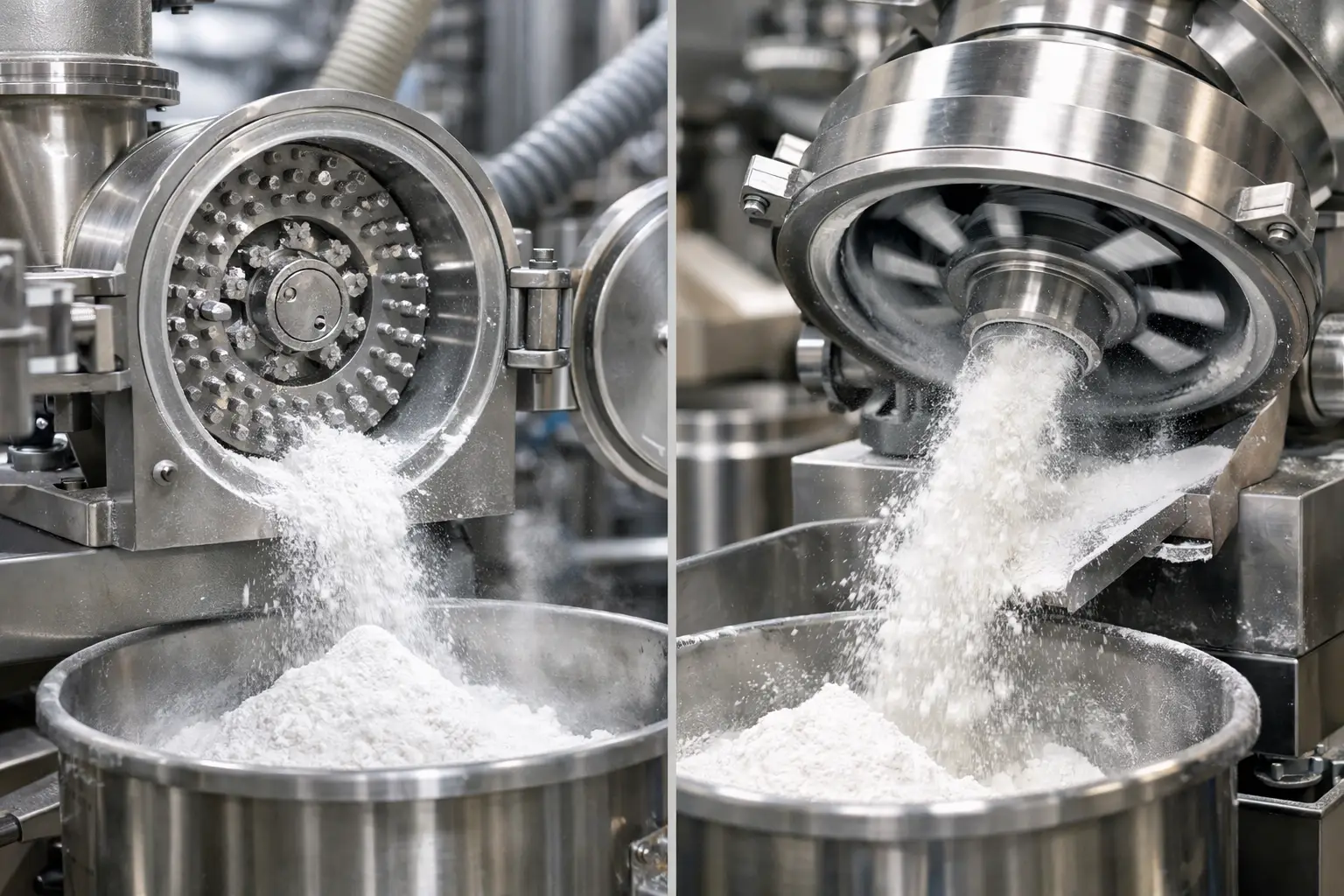
Integrated air classification changes the circuit logic. Product that has reached the required fineness is removed promptly, while material that remains too coarse is returned for further size reduction. In an air classifier mill or jet-milling system, this closed-loop action supports efficient grinding because the mill focuses its energy on the particles that still require it.
The benefit is not simply a smaller median particle size. Manufacturers often need a distribution that meets upper and lower specification limits while preserving particle morphology, bulk density, flowability, color, or functional performance. Air classification provides another process control variable for achieving that balance.
Improve Consistency Across Production Runs
A process that produces an acceptable average particle size can still create quality problems if its distribution varies from batch to batch. Oversize particles may cause rough texture, poor dispersion, plugging, incomplete reactions, or defects in a finished coating. Excess fines may increase dusting, lower flowability, change compaction behavior, or create handling losses.
Air classification helps stabilize these outcomes by separating the process into a coarse fraction and a fine fraction at a defined operating point. Once the appropriate wheel speed, airflow, and feed conditions are established, operators have a structured way to maintain the target cut. This is especially useful when raw-material characteristics change within an approved range or when production moves from pilot quantities to sustained commercial throughput.
Consistency still depends on upstream control. Feed moisture, particle shape, density, temperature, and the degree of agglomeration all influence aerodynamic separation. A classifier cannot correct every source of variation, but it can make the process more responsive and less dependent on repeated trial-and-error adjustments at the mill.
Where Air Classification Delivers Process Value
The strongest case for classification is usually not a single specification on a data sheet. It is the combined effect on product quality, throughput, and operating cost.
In a mineral or chemical application, removing coarse grit can protect downstream pumps, nozzles, and coating equipment. For food and nutraceutical powders, a controlled distribution can support mouthfeel, blend uniformity, and predictable ingredient handling. Pharmaceutical applications may require closely managed particle-size distributions to support dissolution, content uniformity, or inhalation performance. Battery and advanced-material manufacturers often need precise control because particle size can influence packing, surface area, electrode processing, and final material behavior.
Classification can also support recovery of a usable fine fraction from a mixed feed. Rather than discarding all off-spec material or applying additional milling to the entire batch, a classifier can separate a stream for recycle, rework, or alternate use. The economic value depends on material cost, yield requirements, and the quality requirements of each fraction, but this approach can reduce waste in suitable applications.
For abrasive materials, classification may reduce wear compared with forcing a broad feed distribution through restrictive screens. For heat-sensitive materials, rapid removal of on-size product can reduce exposure to energy input. These advantages are application-dependent, however. Air movement, classifier wheel rotation, and auxiliary equipment all consume energy, and the best system is not always the one with the finest available cut point.
Selecting the Right Classification Approach
Air classification may be installed as a standalone system after a mill, incorporated directly into an air classifier mill, or used as part of a larger pneumatic conveying and collection system. The correct approach depends on the required particle-size cut, feed characteristics, capacity, containment needs, and whether coarse material will be recycled.
A standalone classifier can be appropriate when an existing milling system produces a broad distribution and the operation needs a secondary separation step. It can also be useful for fractionating materials into multiple value streams. An integrated air classifier mill is often preferred when a material must be milled and classified continuously, with oversize retained in the grinding chamber and finished fines conveyed out of the process.
When evaluating equipment, engineering teams should establish four operating requirements early: the target particle-size distribution, required throughput, material behavior, and the complete process environment. The process environment includes dust collection, explosion protection where applicable, product-contact material requirements, cleaning access, controls, and the method for handling coarse rejects.
Material behavior deserves particular attention. Free-flowing, dry powders usually classify more predictably than cohesive materials with high moisture content. Soft materials can create fines quickly, while hard materials may require more energy before reaching the target cut. Particle density and shape also matter. A classifier separates based on aerodynamic response, not size alone, so a low-density irregular particle may behave differently than a dense spherical particle with the same measured diameter.
Air Classification Requires Whole-System Engineering
Classifier performance is influenced by more than the classifier itself. Feed consistency, milling conditions, conveying air, cyclone or filter efficiency, pressure balance, and control strategy all affect final results. A poorly designed collection system, for example, can increase pressure drop or compromise recovery of the desired fine fraction. Inadequate feed control can overload the classifier and broaden the cut.
For this reason, equipment selection should begin with representative material testing whenever possible. Testing establishes whether the target distribution is achievable at the required production rate and identifies practical operating limits. It also provides data for selecting the mill, classifier, feeder, dust collector, and controls as one coordinated system rather than as isolated components.
Scale-up requires the same discipline. A pilot result is valuable, but production equipment must account for continuous feed behavior, heat generation, cleaning intervals, wear rates, operator access, and the effect of extended runs on product consistency. DP Mills approaches these projects as process-engineering decisions, matching classification and milling technology to the material and production objective rather than applying a standard configuration.
The most productive next step is to define the specification that actually matters – not only a median particle size, but the acceptable coarse tail, fine fraction, throughput, recovery target, and material constraints. With that information, air classification can be evaluated as a measurable route to better powder control rather than an added piece of equipment.