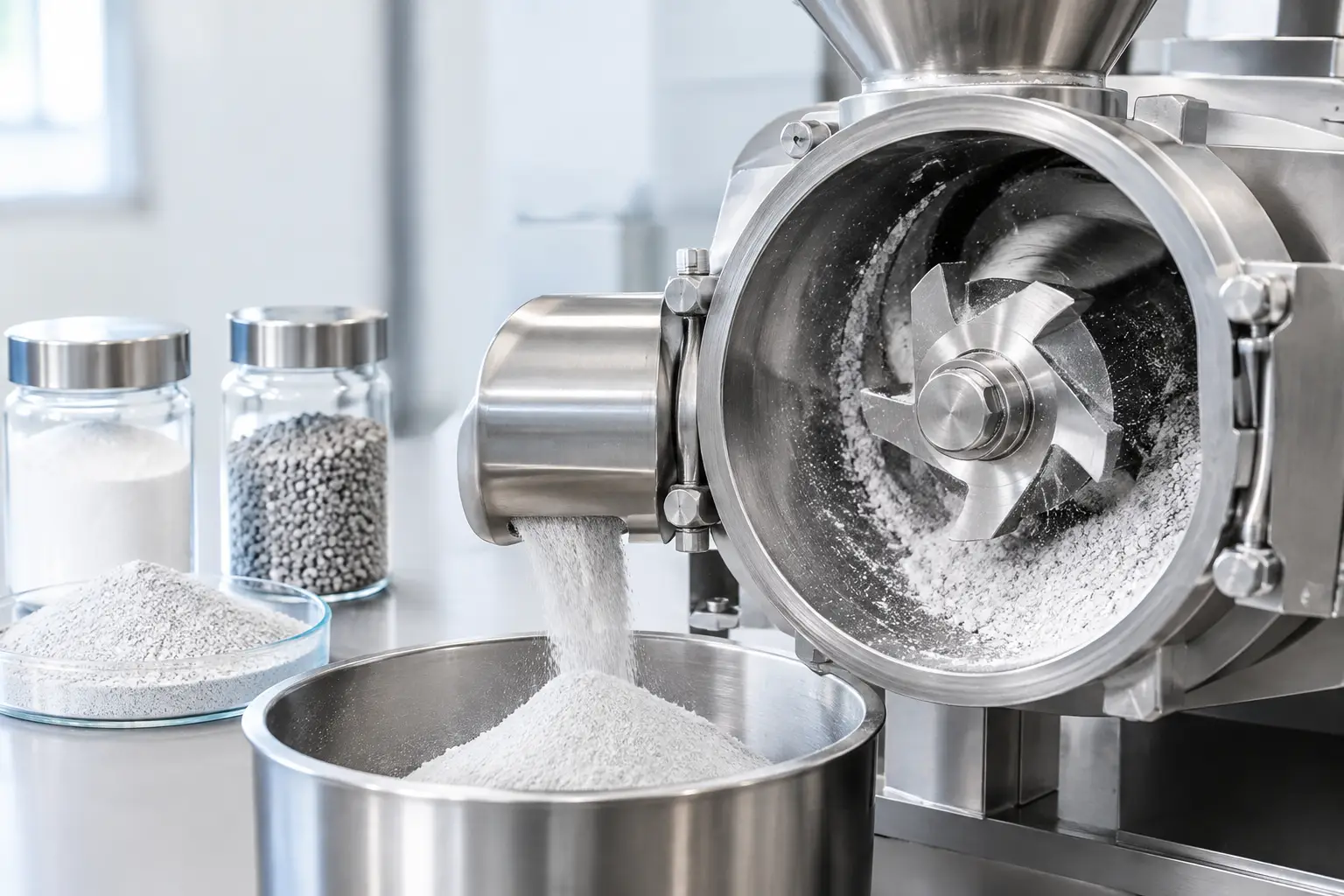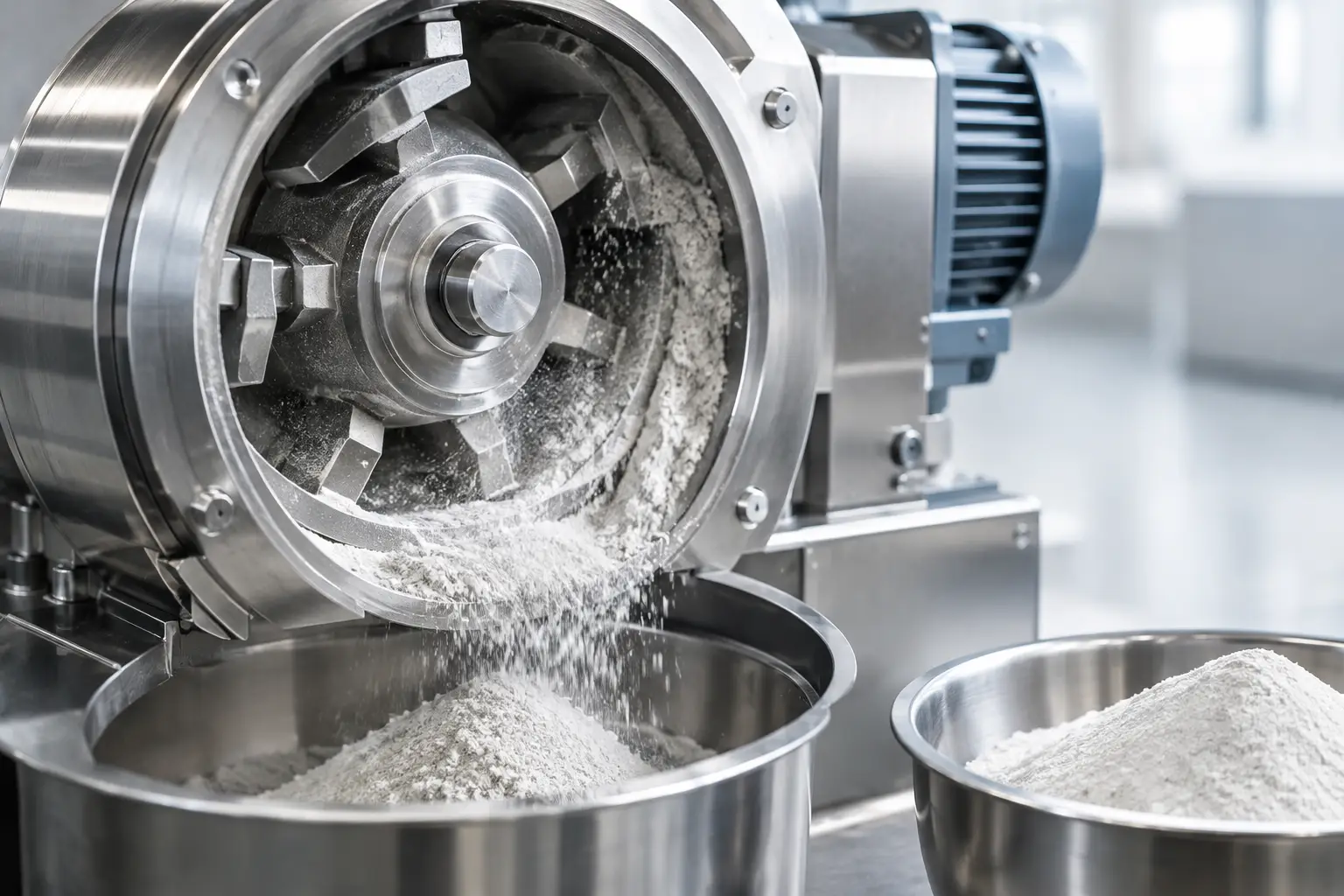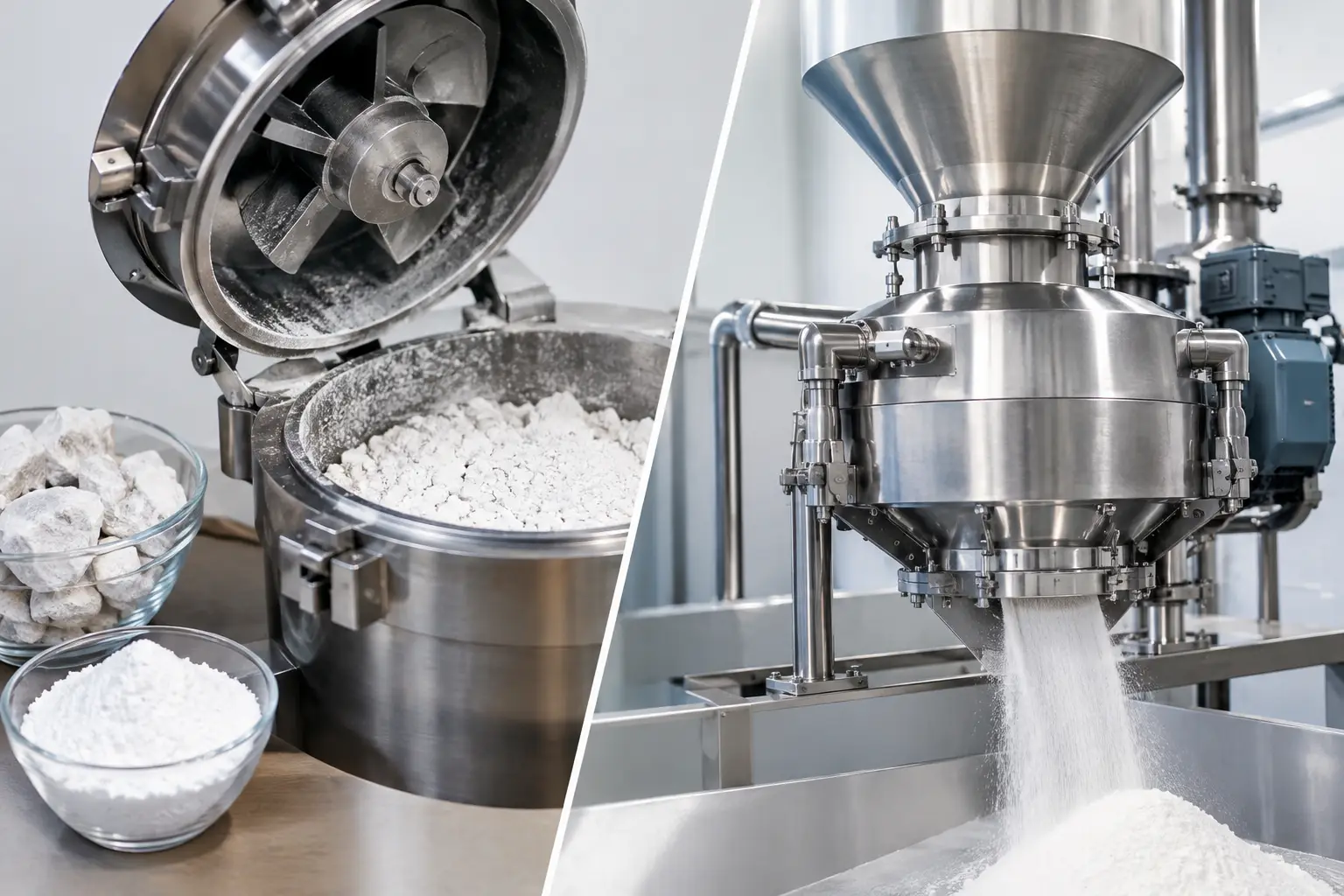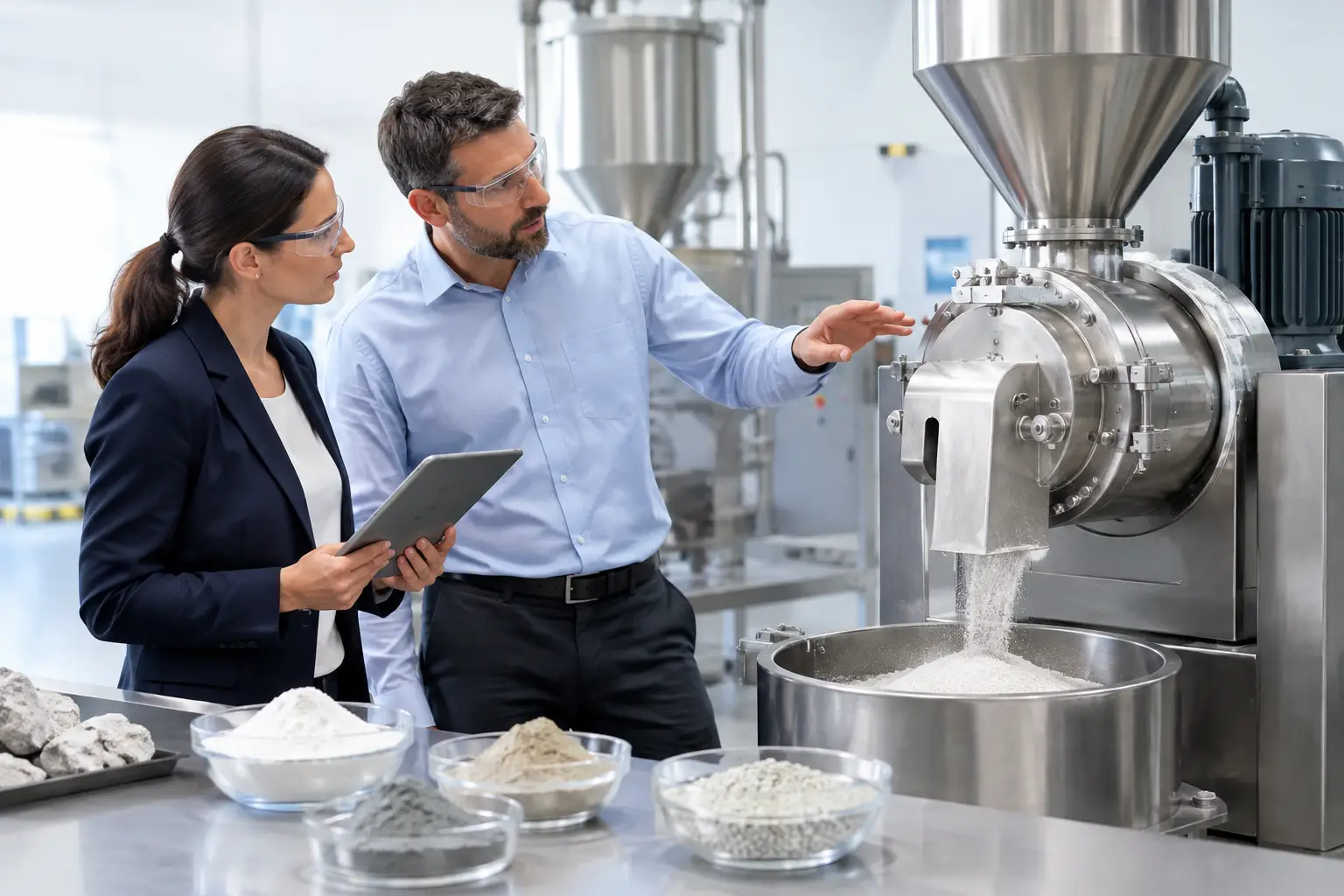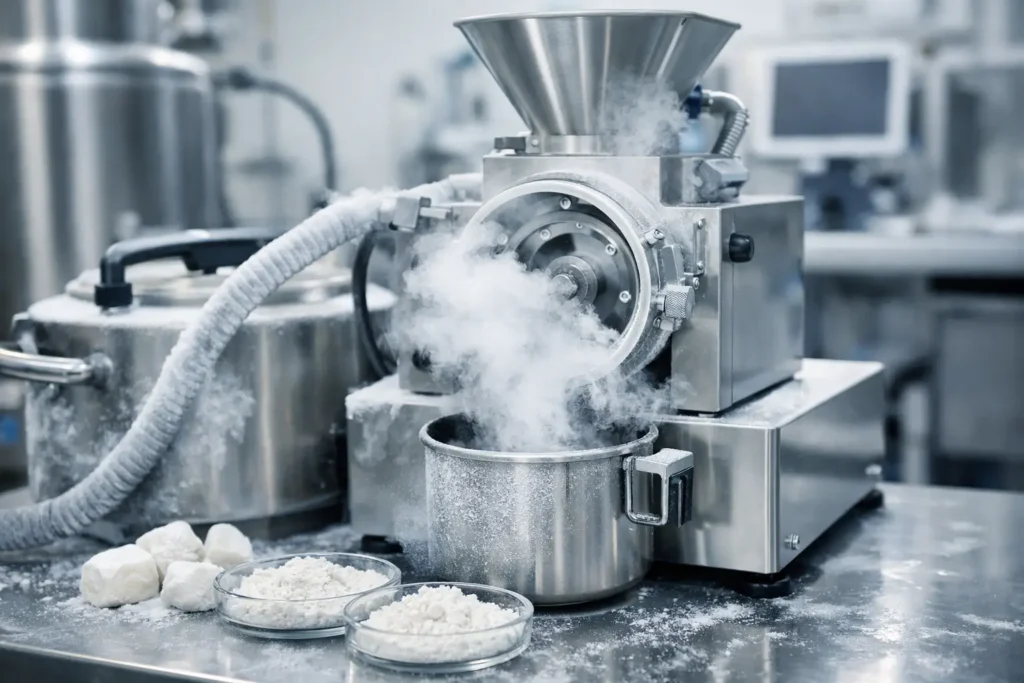
When a material softens, smears, oxidizes, or loses potency under mechanical heat, standard milling stops being a size reduction problem and becomes a process control problem. That is where cryogenic mills earn their place. By reducing product temperature during grinding, these systems help manufacturers process difficult materials that would otherwise clog equipment, drift out of specification, or degrade before they ever reach target particle size.
For operations working with elastomers, waxes, spices, APIs, nutraceutical ingredients, specialty chemicals, battery materials, and other temperature-sensitive products, cryogenic milling is not simply a colder version of conventional grinding. It is a different operating strategy built around preserving material integrity while achieving reliable size reduction.
What cryogenic mills actually do
Cryogenic mills use a refrigerant, most commonly liquid nitrogen, to lower product temperature before or during size reduction. Cooling the feed changes how the material behaves under stress. Products that are normally elastic, tacky, oily, fibrous, or heat-sensitive can become brittle enough to fracture cleanly instead of deforming.
That distinction matters in production. In a conventional mill, heat generated by impact, friction, and high rotor speed can cause materials to smear across internals, blind screens, agglomerate, or lose volatile compounds. In a cryogenic system, lower temperatures reduce those effects and create a more stable milling environment. The result is often a narrower particle size distribution, better throughput consistency, and less fouling inside the mill.
This is especially useful when product quality depends on retaining active compounds, aroma, color, crystallinity, or other physical and chemical attributes that are affected by temperature rise.
Why manufacturers choose cryogenic mills
The most common reason to move toward cryogenic grinding is simple: the material will not behave well at ambient conditions. That can show up as low throughput, screen blockage, excessive fines, poor flowability, product discoloration, or batch-to-batch variation.
Cryogenic mills address these issues by changing fracture behavior at the point of impact. Instead of stretching or compressing, the cooled material breaks. That improves process predictability, particularly in applications where the target particle size is fine and the margin for thermal damage is small.
There is also a contamination control benefit in many applications. If product buildup inside the mill is reduced, cleaning becomes more manageable and the risk of retained material drops. For processors handling high-value or regulated products, that can affect uptime as much as product quality.
The trade-off is that cryogenic systems introduce another layer of process complexity. Temperature control, refrigerant consumption, feed conditioning, and insulation all have to be engineered properly. A cryogenic mill is rarely the right answer for every material, but for the right application it can solve problems that conventional systems cannot.
Materials that respond well to cryogenic milling
The strongest candidates are materials that become brittle at lower temperatures and are otherwise difficult to grind cleanly. Polymers and elastomers are a classic example. Many rubber-like materials resist fracture at room temperature, then mill far more efficiently once cooled below their glass transition range.
Food and spice manufacturers also use cryogenic mills when heat can strip volatile oils, flatten aroma, or alter flavor. In these cases, lower milling temperatures help preserve product character while improving grinding efficiency.
Pharmaceutical and nutraceutical applications often involve heat-sensitive active ingredients, waxy excipients, or compounds that are prone to degradation. Cryogenic milling can support tighter process control where thermal exposure must be minimized.
Specialty chemicals, pigments, battery materials, and advanced composites may also benefit, though the reasons vary. In some cases the goal is finer particle size. In others it is maintaining chemistry, reducing agglomeration, or preventing phase change. The material behavior always drives the equipment choice.
How cryogenic mills are configured
Cryogenic milling systems are not limited to one machine type. The cooling method can be integrated with several size reduction technologies depending on the feed characteristics and final product requirements. Pin mills, hammer mills, impact mills, and attrition-based systems can all be adapted for cryogenic operation when the application supports it.
The core system usually includes feed handling, controlled cooling or pre-chilling, the mill itself, product collection, and nitrogen management. In some designs, the material is cooled before entering the mill. In others, refrigerant is introduced directly into the grinding zone. The right configuration depends on residence time, feed rate, moisture behavior, target particle size, and how quickly the product warms during processing.
System integration matters here. If feeding is inconsistent or the discharge path allows product temperature to rebound too quickly, milling performance will become unstable. That is why cryogenic mills are best evaluated as a complete process system rather than as a standalone machine.
Process advantages beyond temperature reduction
Lower temperature is the mechanism, but the value usually shows up in broader production metrics. One advantage is improved particle size control. Because the material fractures more consistently, operators often see less smearing and a cleaner cut at the desired size range.
Another is throughput stability. Difficult materials processed at ambient conditions can create unpredictable surges in motor load, screen blockage, or buildup. Cryogenic operation often smooths that out, which supports more dependable production planning.
Product quality can also improve in less obvious ways. Reduced thermal exposure may help preserve volatile constituents, limit oxidation, and maintain physical structure. For manufacturers working under tight quality specifications, these are not secondary benefits. They are often the reason the system pays for itself.
There can even be maintenance advantages. When material buildup decreases, wear patterns become more predictable and cleaning intervals may be easier to manage. That said, cryogenic service also places demands on seals, insulation, instrumentation, and safe handling practices, so system durability has to be engineered for the operating environment.
Where cryogenic mills may not be the best fit
Cryogenic milling is highly effective, but it is not automatically the most economical option. If a material can be processed at ambient temperature without degradation, caking, or throughput loss, the added cost of refrigerant may not be justified.
Some products also show limited improvement when cooled. If brittleness does not change meaningfully with temperature, the return on cryogenic operation can be modest. The same applies when the target size is relatively coarse and heat generation is already low.
Operating cost needs careful evaluation. Liquid nitrogen consumption is a real factor, and so are control requirements, operator training, and plant utility considerations. For many manufacturers, the decision comes down to whether cryogenic milling improves yield, quality, or uptime enough to offset those costs. In high-value materials or hard-to-process products, the answer is often yes. In commodity applications, it depends.
Selecting cryogenic mills for industrial production
The right cryogenic mill starts with the material, not the machine category. Engineers need to understand brittleness at low temperature, moisture behavior, thermal sensitivity, bulk density, feed form, and the required particle size distribution. Those factors determine whether a pin mill, hammer-style system, or another configuration will perform best.
Scale matters as well. A system that works in pilot testing may need different feeding, insulation, and gas control strategies at production volume. Throughput targets, batch versus continuous processing, cleaning requirements, and downstream conveying all affect final system design.
It is also worth evaluating how tightly product temperature must be controlled. Some applications only need to stay below a threshold that prevents softening or loss of volatiles. Others require a much narrower operating window. That difference influences refrigerant use, instrumentation, and automation.
Manufacturers are usually best served by working with an equipment partner that can evaluate both milling mechanics and full process integration. At DP Mills, that engineering-first approach is central to how demanding particle processing systems are developed – especially when performance depends on more than rotor speed and screen size.
The practical case for cryogenic mills
Cryogenic mills are most valuable when they solve a material behavior problem that conventional grinding cannot solve reliably. They help turn elastic materials brittle, limit heat-driven degradation, improve particle size control, and support cleaner, more stable production. For processors under pressure to improve consistency without sacrificing product quality, those are meaningful gains.
The strongest projects usually begin with clear questions: What is heat doing to the product now? Where is throughput being lost? Is contamination risk tied to buildup? How much value comes from preserving actives, aroma, structure, or chemistry? Once those answers are on the table, cryogenic milling becomes easier to evaluate as a process decision rather than a specialty add-on.
If your material changes character the moment temperature rises, the best path forward may not be more grinding force. It may be a colder, better-controlled process built around how the product actually behaves.