A powder that flows consistently in a lab may bridge above a production hopper, flood a feeder, segregate during conveying, or compact in storage. These failures are rarely solved by changing one component in isolation. Learning how to improve powder flowability requires a process-level view of particle properties, environmental conditions, equipment geometry, and the handling forces applied throughout the line.
For manufacturers, flowability is not simply a material characteristic. It is a production requirement that affects dosing accuracy, throughput, batch consistency, dust control, downtime, and final product quality. The right solution depends on why the powder is not flowing and where the problem begins.
Start by Identifying the Flow Failure
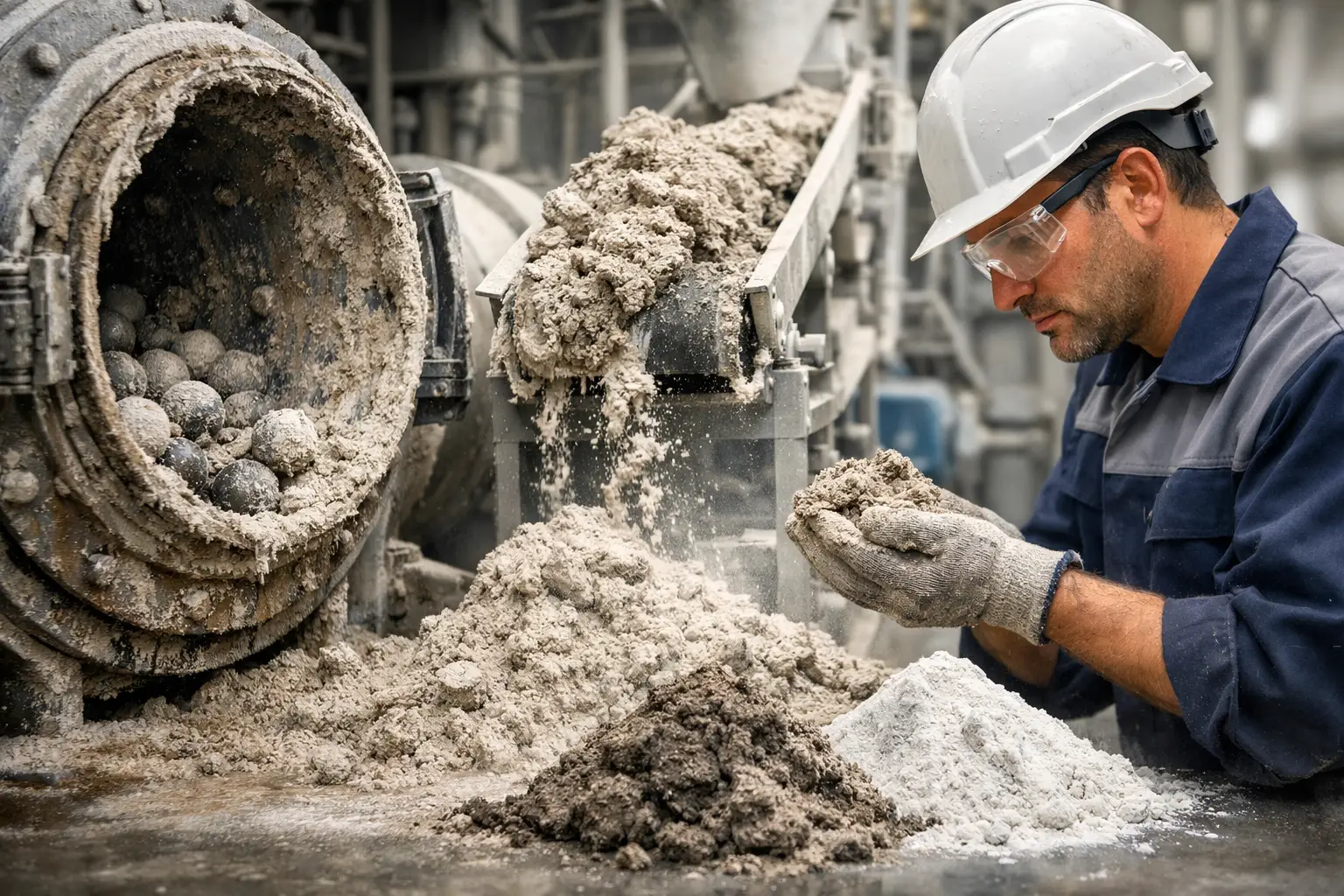
“Poor flow” can describe several different behaviors, and each points to a different corrective action. A cohesive powder may form stable arches or bridges at a hopper outlet. A material that compacts under its own weight may develop a rathole, where only a narrow channel flows while material along the walls remains stationary. Fine, aerated powders can flush or flood uncontrollably, particularly during pneumatic transfer or screw feeding.
Segregation is another common issue. It may not stop flow, but it can create unacceptable variation in a blend when particles differ substantially in size, density, or shape. Electrostatic charging can cause fines to adhere to vessel walls and transfer lines. Moisture uptake can produce agglomerates, increasing both wall friction and cohesive strength.
The most effective investigation observes the powder under actual operating conditions. Record where the issue occurs, whether it changes by lot or season, how long material sits before discharge, and whether vibration, conveying, or milling occurs upstream. A hopper problem may be caused by the hopper, but it may also originate in an overly broad particle size distribution, a hot milling step, or uncontrolled humidity during packaging.
Measure Flowability Before Selecting a Fix
Visual observation is useful, but it is not sufficient for specifying equipment or validating an improvement. Process teams should evaluate the properties most relevant to the failure mechanism. Bulk density and tapped density can indicate compressibility. Angle of repose can provide a quick comparative screen, although it does not reliably predict behavior in every hopper or feeder.
For more demanding applications, shear-cell testing provides actionable data on unconfined yield strength, wall friction, compressibility, and flow function. These values help engineers determine whether a powder is likely to bridge, rathole, or discharge reliably from a specific vessel geometry. Wall friction testing is particularly valuable when selecting hopper liner materials and establishing wall angles.
Particle size distribution, particle shape, moisture content, and surface area should be measured alongside flow tests. A single flowability number cannot explain every handling issue. The objective is to connect measurable powder behavior with a known process condition, then verify that the proposed change improves performance without creating a new issue downstream.
Control Particle Size Distribution and Particle Shape
Particle engineering is often the highest-leverage path to better flow. Very fine particles have a high surface-area-to-mass ratio, so van der Waals forces, electrostatic attraction, and liquid bridges can dominate their behavior. A large fraction of fines can turn an otherwise free-flowing material into a cohesive powder.
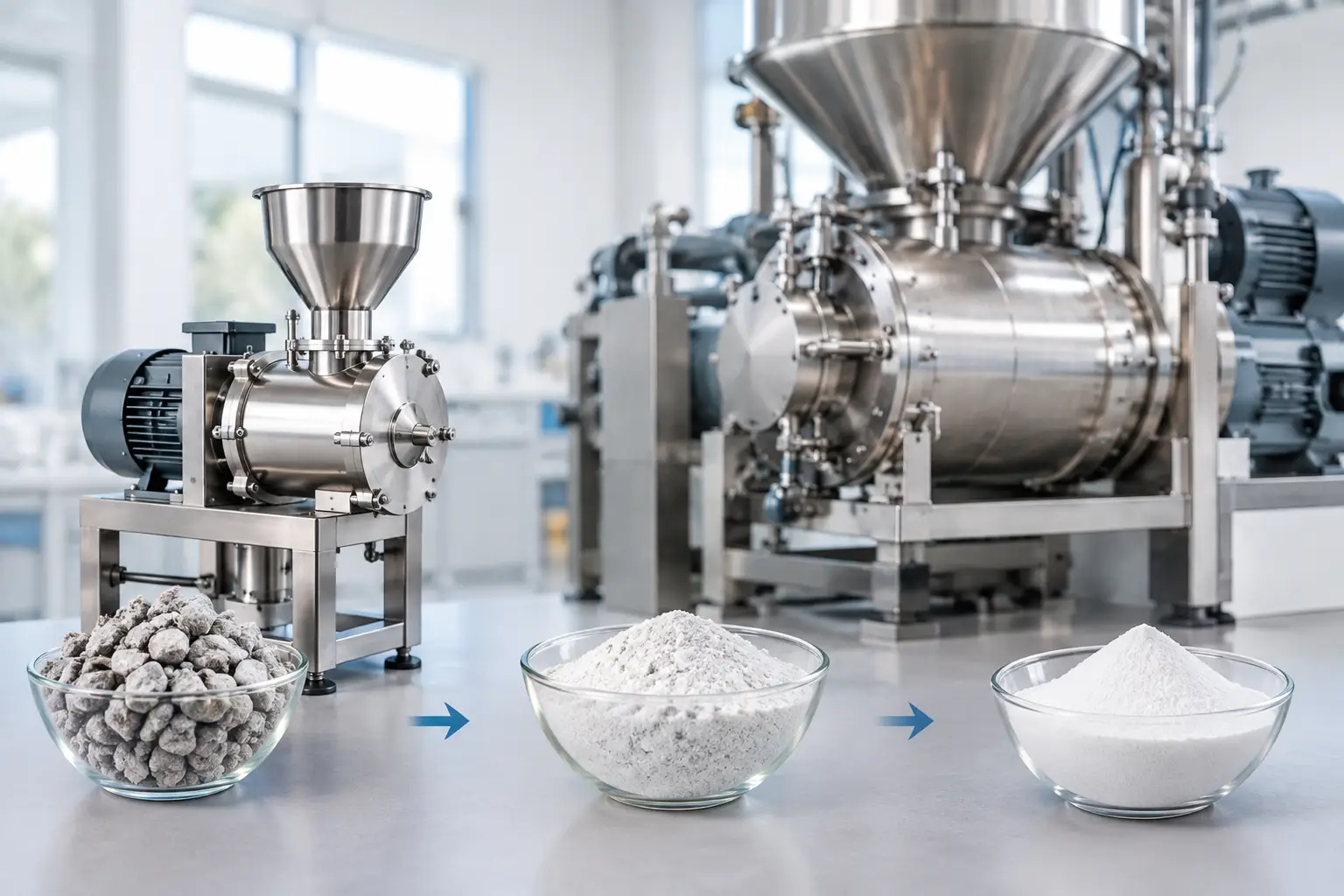
Milling should therefore be treated as a controlled process, not just a size-reduction step. The target is not always the smallest possible particle. It is the particle size distribution that supports the required dissolution, reactivity, blend uniformity, compaction, coating, or end-use performance while remaining practical to convey and feed.
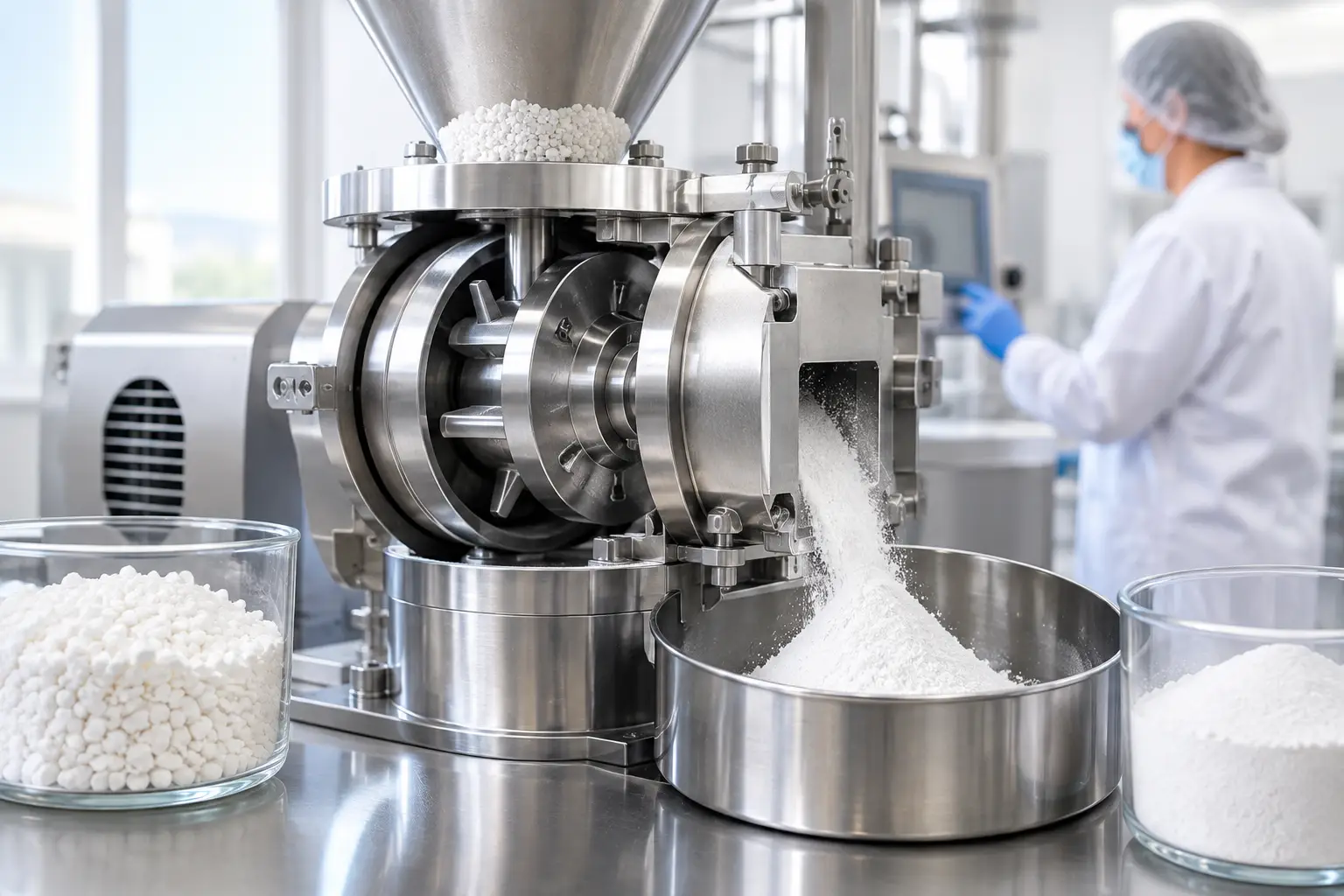
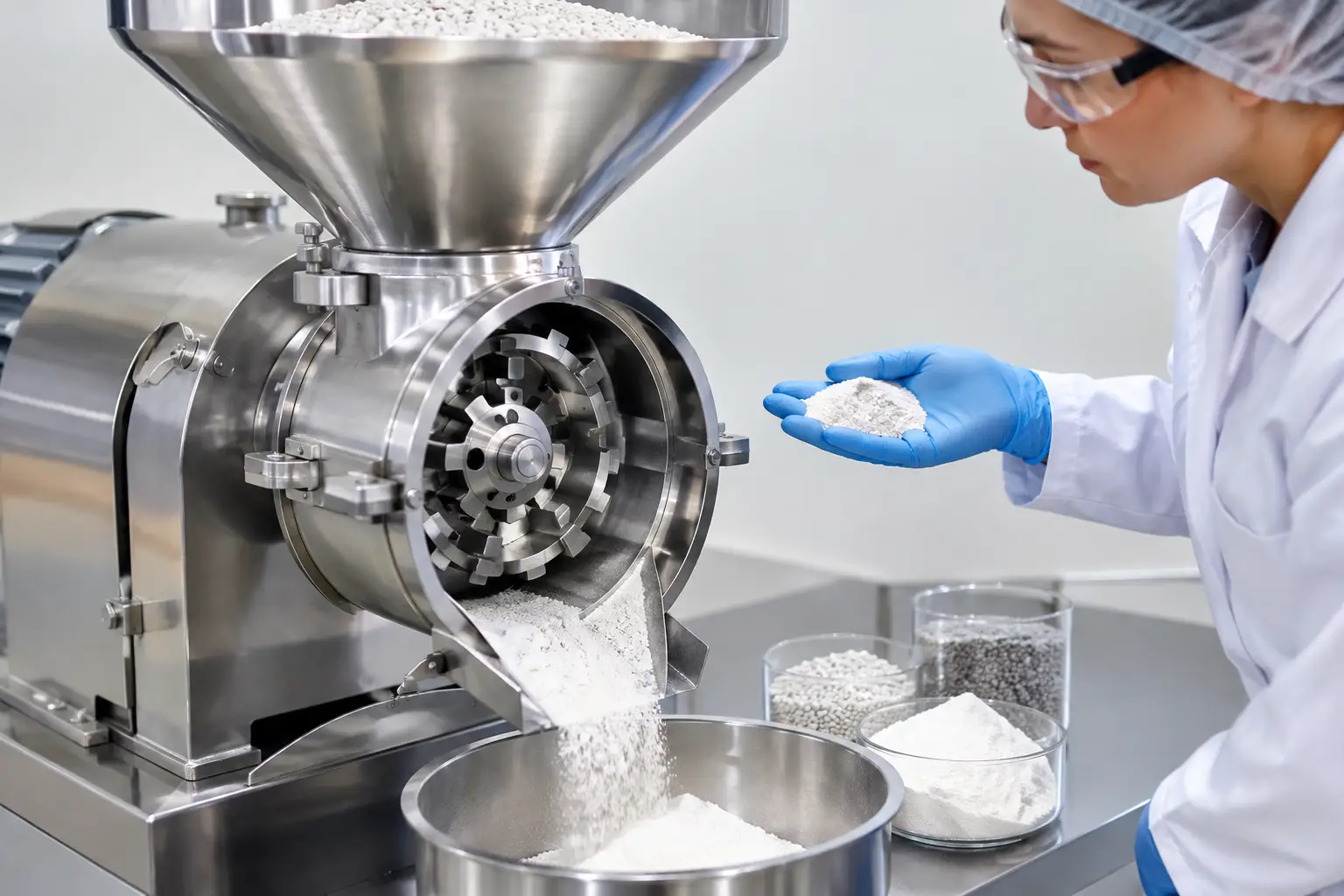
A narrow, repeatable distribution can reduce variability in bulk density and flow behavior. Air classification can remove excessive fines or limit oversized particles that interfere with downstream processing. Where particle morphology permits, selecting a milling method that produces less irregular or fibrous material may also improve flow. Pin mills, hammer mills, air classifier mills, jet mills, and cone mills all impose different breakage mechanisms, and their suitability depends on hardness, friability, heat sensitivity, and the required final specification.
There is a trade-off. Removing fines can improve handling but reduce yield if the fine fraction is within the saleable product range. Producing a coarser powder may improve feeder stability while compromising dissolution or product texture. Pilot-scale trials are the practical way to establish the operating window before committing to full-scale equipment changes.
Manage Moisture, Heat, and Static Charge
Many powders are highly sensitive to their environment. Hygroscopic materials may absorb water during storage, transfer, or open handling, creating liquid bridges between particles. Even small moisture changes can sharply increase cohesion in sugar-based blends, mineral powders, food ingredients, and certain chemical products.
Control begins with knowing the material’s critical moisture range and conditioning the process environment accordingly. Closed transfer systems, dehumidified rooms, properly sealed containers, and defined storage limits can prevent a flow issue before it reaches the hopper. If drying is required, it must be controlled carefully to avoid overdrying materials that become more electrostatically active or otherwise difficult to process.
Heat deserves the same attention. A temperature rise during milling can soften waxy materials, activate binders, increase stickiness, or change moisture behavior. For heat-sensitive products, cryogenic grinding or cooled milling may preserve material integrity while limiting agglomeration. The added utility demand and handling complexity must be justified by the product’s thermal sensitivity and required performance.
Static charge is especially relevant for low-humidity, fine-powder operations. Grounding, conductive components where appropriate, controlled humidity, and properly designed transfer velocities can reduce charge buildup. These measures should be considered alongside dust collection and explosion protection requirements, not as separate design decisions.
Design Hoppers and Feeders for the Actual Powder
A well-flowing powder can fail in a poorly designed vessel. Hopper outlet size, wall angle, transition geometry, surface finish, and feeder interface all influence discharge. Equipment should be designed using measured flow properties rather than generic angles or rules of thumb.
Mass-flow hoppers are designed so material moves across the entire cross-section during discharge. They can improve inventory turnover and reduce segregation, but they often require steeper walls, larger outlets, and more careful engineering than funnel-flow vessels. Funnel flow may be acceptable for non-segregating, free-flowing materials, but it can leave stagnant zones and create inconsistent residence times for cohesive powders.
At the outlet, feeder selection matters. A screw feeder that is undersized, operated at an unsuitable speed, or poorly matched to the hopper can produce pulsation, flooding, or compaction. Agitators, live-bottom systems, flexible-wall hoppers, or flow aids may help, but they are not universal remedies. Excessive vibration can segregate blends, while aggressive agitation can damage fragile particles or introduce heat.
The best approach is to use flow aids only after establishing whether particle properties and vessel geometry are fundamentally compatible. A flow aid can support reliable discharge; it should not be expected to compensate indefinitely for an undersized outlet or an uncontrolled powder specification.
Improve Powder Flowability Without Sacrificing Product Quality
Flow additives such as colloidal silica, tricalcium phosphate, magnesium stearate, or other anti-caking agents can reduce interparticle friction and moisture-related cohesion in suitable formulations. They are common in food, pharmaceutical, nutraceutical, and chemical applications, but regulatory requirements and product performance must guide their use.
An additive can affect dissolution, compressibility, appearance, taste, conductivity, or chemical stability. In battery and advanced materials processing, even a small additive may be unacceptable because of purity or electrochemical performance requirements. For these products, particle classification, dry-room control, and equipment design are often more appropriate than formulation changes.
Granulation, agglomeration, or controlled densification can also improve flow by increasing particle size and reducing dustiness. This may be beneficial for direct compression, packaging, and bulk handling. However, it changes the material architecture and may not be appropriate where a fine, high-surface-area powder is essential to the final application.
Validate Improvements Across the Full Process Line
A successful flowability project does not end when powder leaves a test hopper. Verify performance from raw material receiving through milling, classification, storage, conveying, feeding, blending, packaging, and cleaning. Confirm that the change improves production consistency at expected throughput and does not increase wear, contamination risk, energy consumption, or maintenance burden.
For new products or difficult materials, pilot trials can reveal interactions that bench testing misses. DP Mills applies this process perspective when evaluating milling and classification solutions because particle size control must support the complete manufacturing operation, not only the mill discharge.
The most reliable path forward is to define the failure mechanism, measure the powder under relevant conditions, and make controlled changes that can be validated at scale. When flowability is treated as an engineered process outcome, manufacturers can reduce interruptions while protecting the quality specifications that matter most.