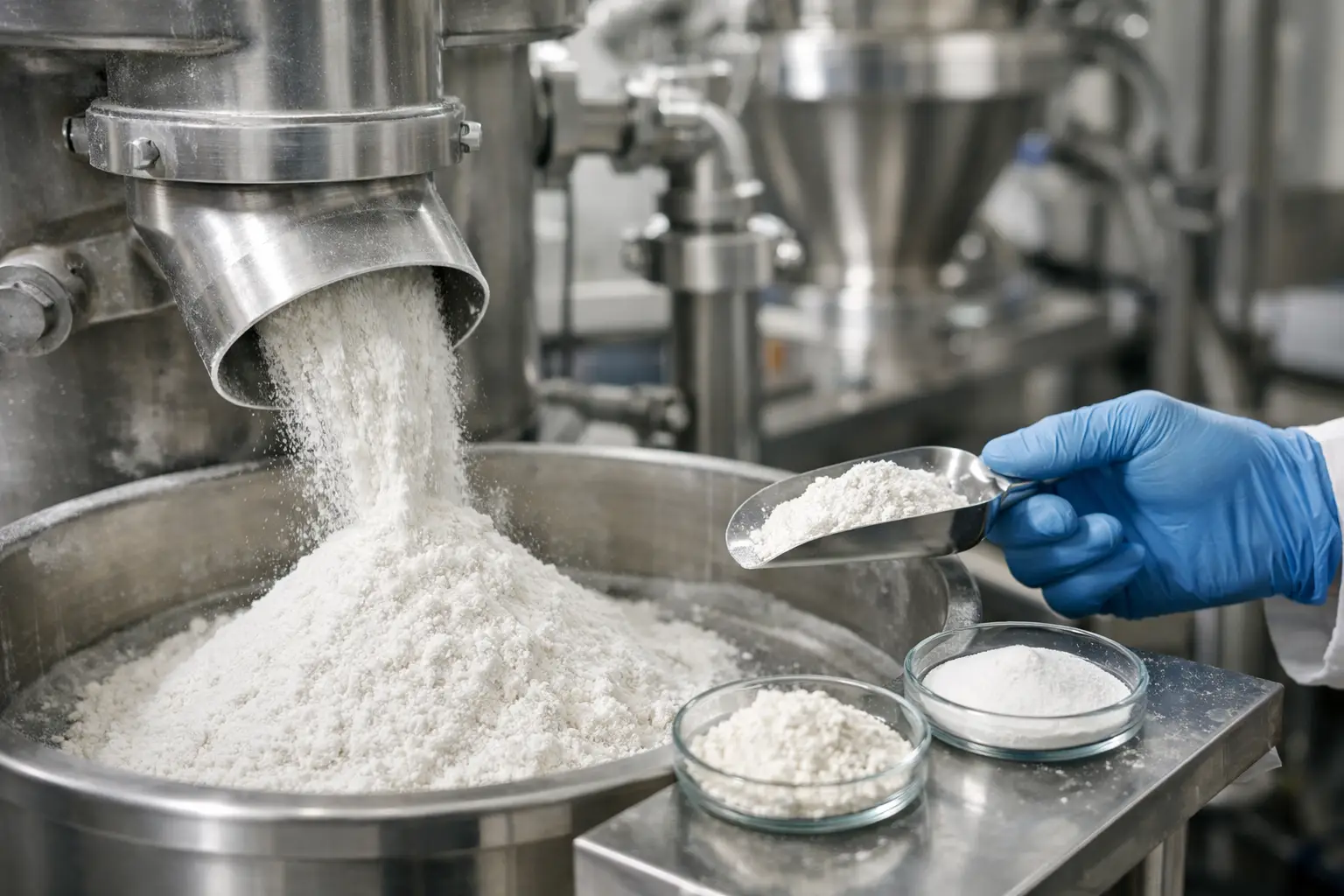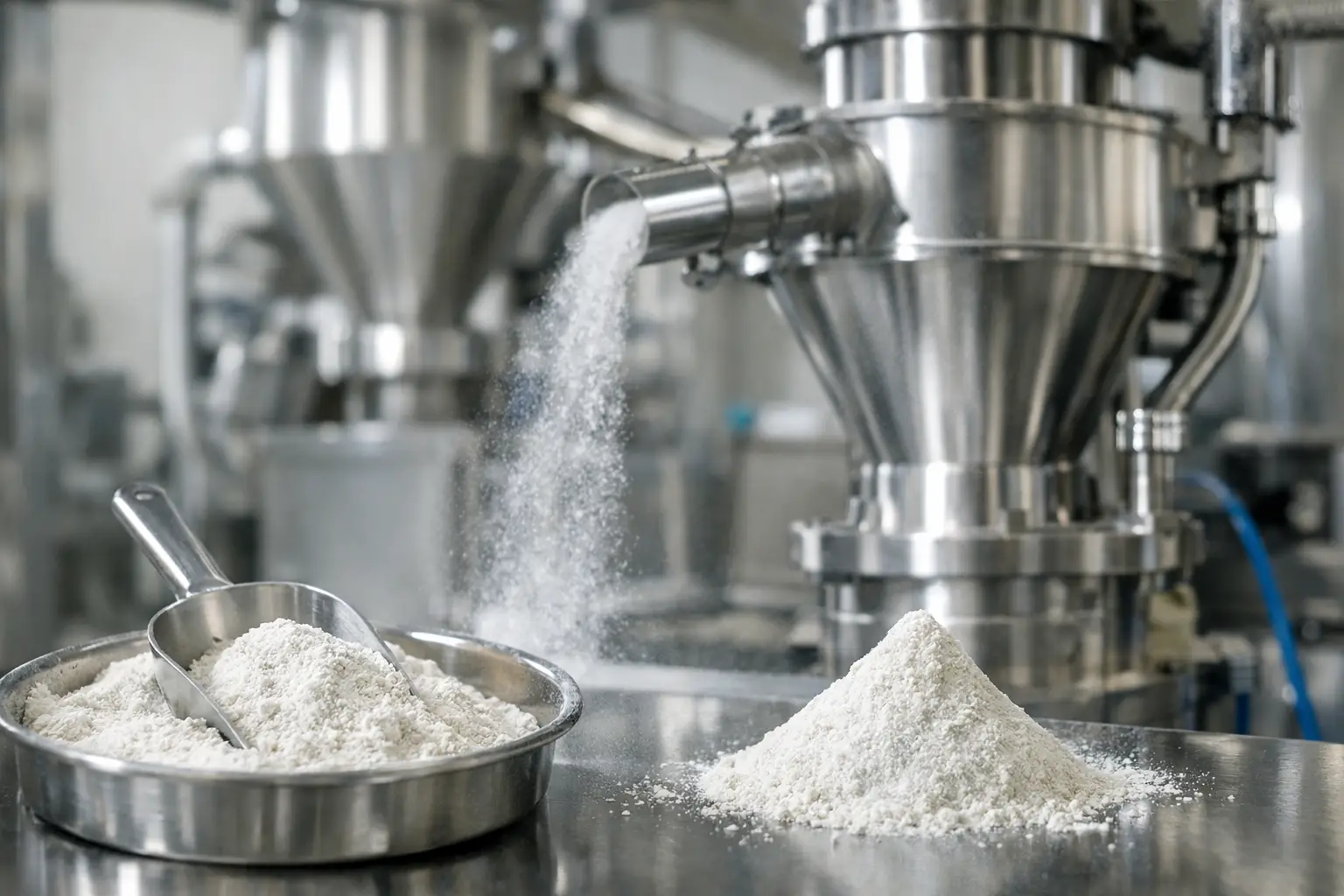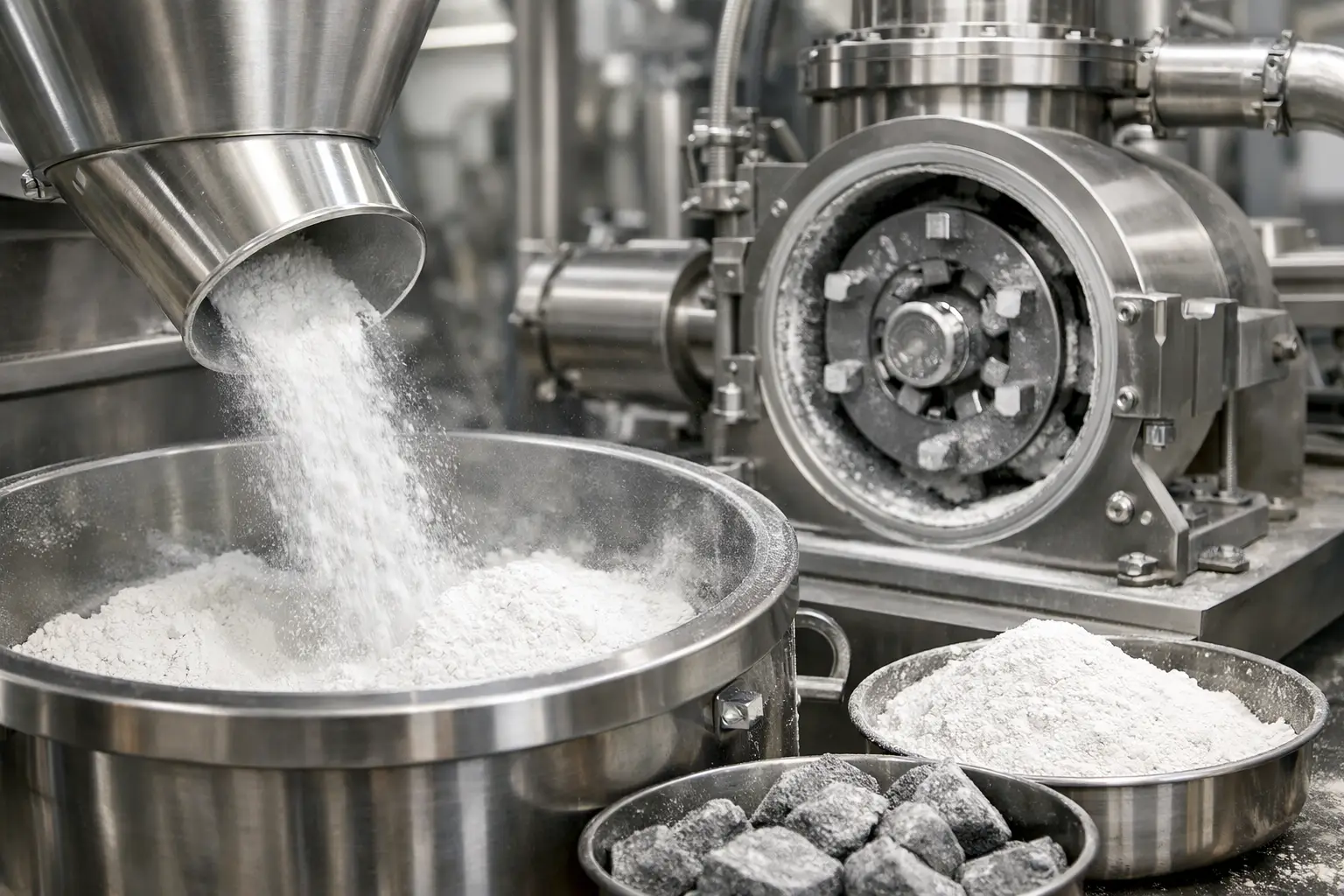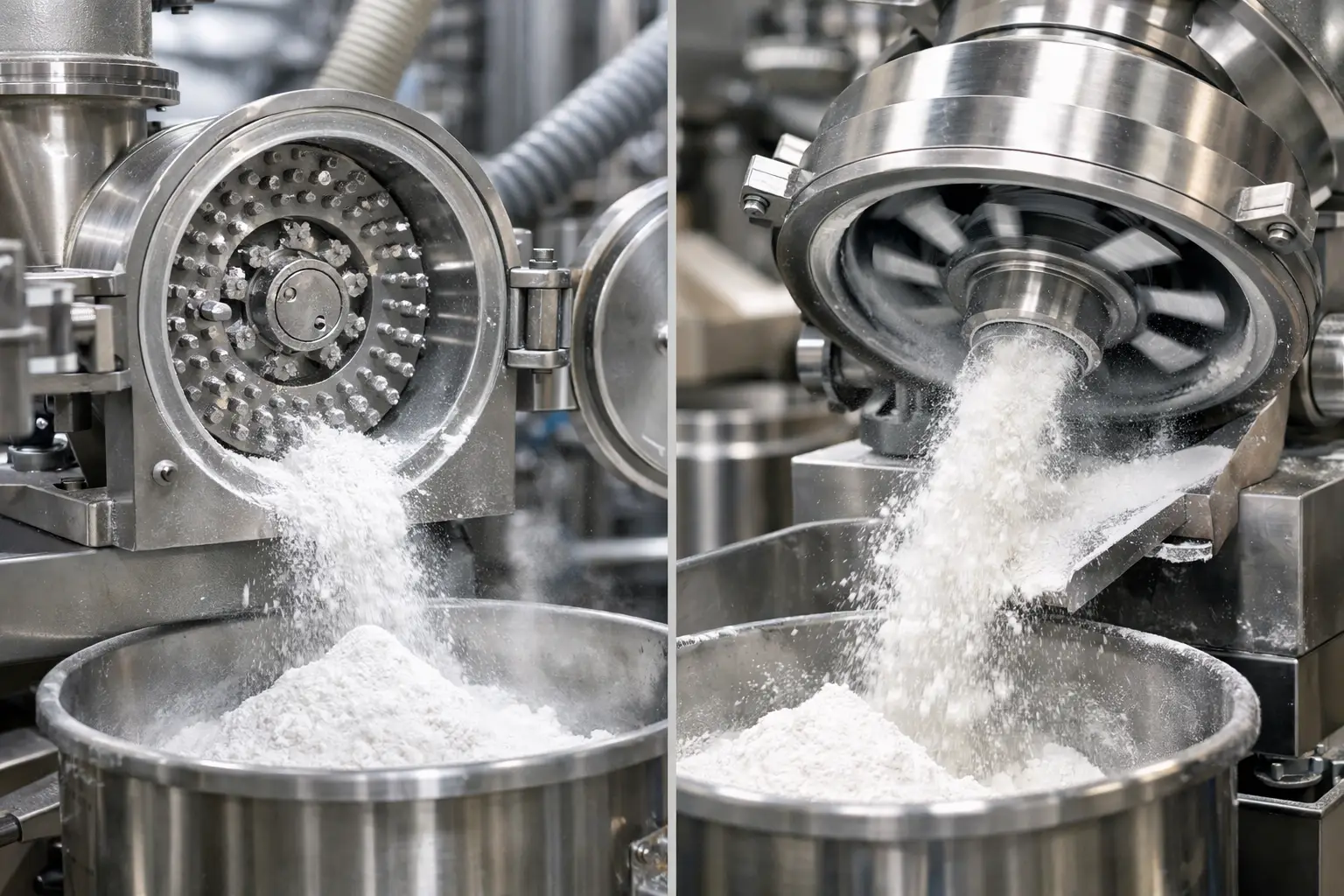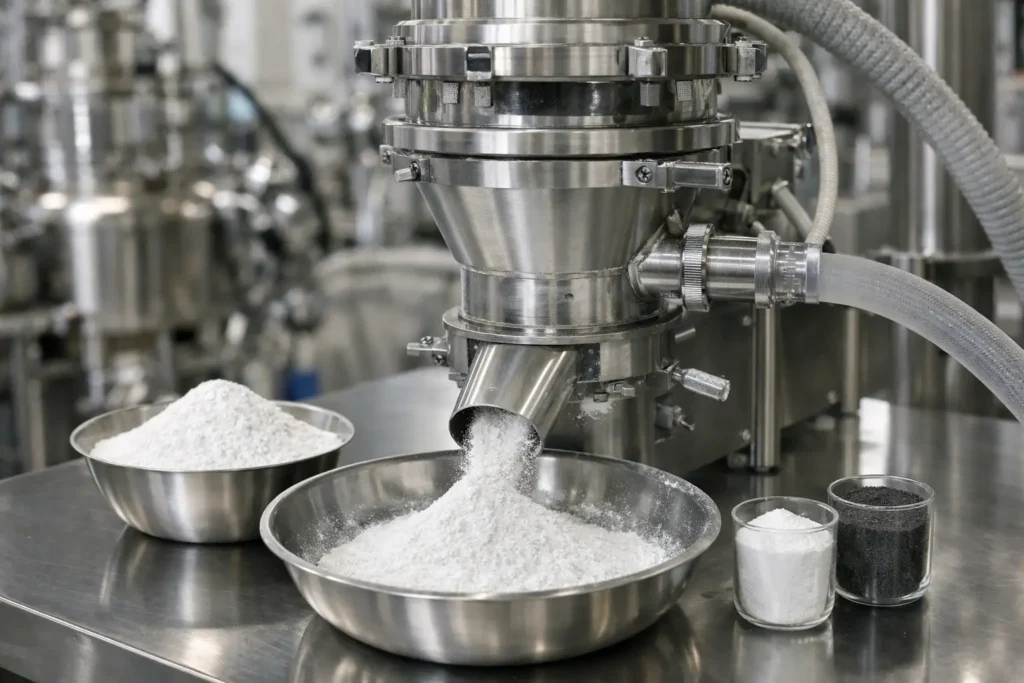
Battery powder milling is rarely a simple size-reduction decision. A mill that produces the target micron size can still be the wrong choice if it introduces metal contamination, broadens the particle size distribution, damages particle morphology, creates excessive fines, or becomes a throughput bottleneck. For manufacturers asking what mill is best for battery powders, the practical answer is usually a jet mill for high-purity, ultra-fine final milling – but the right system depends on the material, the target specification, and where milling occurs in the process.
Cathode active materials, graphite anodes, conductive additives, precursors, and recycled black mass behave differently under mechanical stress. A production-worthy selection must account for particle size distribution, particle shape, hardness, moisture sensitivity, heat sensitivity, wear, dust containment, and the required production rate. The mill is one part of a controlled powder-processing system, not an isolated machine.
What Mill Is Best for Battery Powders?
For many high-value battery materials, an air jet mill is the preferred option when the application requires a fine, tightly controlled particle size distribution and low contamination risk. Jet milling uses high-velocity gas rather than conventional mechanical grinding tools as the primary size-reduction force. Particle-on-particle collisions reduce material while an integrated classifier controls the maximum particle size leaving the mill.
This operating principle matters for battery materials. Eliminating high-speed internal grinding elements can reduce the risk of metallic wear contamination compared with conventional impact milling. Jet mills also generate relatively low mechanical heat at the point of grinding, which can help preserve sensitive chemistries and minimize unwanted material changes.
That does not mean a jet mill is automatically the best answer for every battery powder. If the required final size is moderate, throughput requirements are high, or the material is an intermediate rather than a final active powder, an air classifier mill, pin mill, hammer mill, or other impact system may deliver better operating economics. The best mill is the one that achieves the complete specification at an acceptable cost per pound while supporting consistent, safe production.
Why Jet Mills Are Often Used for Final Battery Powder Milling
Jet mills are particularly well suited to fine powders that demand close top-size control. The dynamic classifier returns oversized particles to the grinding zone while allowing in-specification fines to exit with the process gas. This can produce a narrower and more repeatable particle size distribution than an uncontrolled impact process.
For cathode active material processing, this level of control can support downstream slurry preparation, coating uniformity, packing behavior, and electrochemical consistency. Fine-particle control is also valuable for conductive additives and specialty materials where agglomerates or oversized particles can compromise dispersion. However, reducing a powder to the smallest possible size is not always desirable. Too many ultrafines can increase surface area, alter flow behavior, complicate handling, and affect slurry rheology.
Jet milling also supports contamination-conscious designs. Depending on the chemistry and quality requirements, contact components may be specified in stainless steel, hardened materials, ceramics, or engineered wear-resistant linings. The proper material of construction should be selected based on both product purity requirements and expected abrasion, not simply on initial equipment cost.
Gas selection is equally important. Some applications can operate with compressed air, while moisture-sensitive, oxidation-sensitive, or combustible materials may require a closed-loop nitrogen system. A closed-loop arrangement can provide oxygen control, product containment, gas recovery, and safer handling of fine dust. These are process-engineering decisions that should be established during application testing.
Where Jet Milling Has Limits
Jet mills require substantial gas flow and compressed-gas energy. At coarse size targets, they can be less energy-efficient than mechanical mills. Very hard, abrasive powders may also accelerate wear in nozzles, classifiers, and downstream collection components. Their capacity is strongly tied to feed characteristics, gas pressure, classifier speed, and the target cut point.
For these reasons, jet milling is often most effective as the final precision-sizing step, especially after upstream crushing, deagglomeration, or pre-milling has reduced the feed to a suitable size. Designing a staged process can lower energy use and improve overall throughput.
When an Air Classifier Mill Is the Better Choice
An air classifier mill combines mechanical impact grinding with an internal dynamic classifier. It can offer a useful balance of fine grinding capability, throughput, and size control for battery powder intermediates and applications that do not require the finest jet-milled distribution.
The classifier allows operators to tune the upper particle size limit by adjusting rotational speed and airflow. This makes the technology more controllable than a conventional screen mill, while the mechanical grinding zone can provide higher capacity and lower operating cost at certain particle-size targets.
An air classifier mill is often worth evaluating when a manufacturer needs a consistent fine powder but can tolerate some mechanical contact within the milling chamber. It may be appropriate for precursor processing, certain mineral-based battery components, or recycled material conditioning before later separation and purification steps. As with any mechanical system, wear monitoring and appropriate internal surface materials are essential where trace contamination affects final product quality.
Pin, Hammer, and Turbo Mills Have Useful Roles
Pin mills, hammer mills, and turbo mills are not typically first choices for ultra-fine, high-purity active-material finishing. They are, however, valuable tools for upstream conditioning, deagglomeration, coarse reduction, and processing materials with less demanding final-size requirements.
A pin mill uses concentric rows of rotating and stationary pins to create high-impact particle reduction. It can be effective for brittle materials and soft agglomerates, and it may provide economical throughput at medium-fine sizes. For powders that tend to form weak agglomerates during storage or transport, a pin mill can prepare a more uniform feed for a downstream classifier or jet mill.
Hammer and turbo mills offer durable, high-throughput reduction for larger feed material and coarser products. Their limitations for battery applications are familiar: heat generation, internal wear, broader size distributions, and potential contamination from contact surfaces. They should be selected only where those trade-offs align with the material specification and the stage of production.
Match the Mill to the Powder, Not Just the Micron Target
Two battery powders with the same nominal target size may require completely different milling strategies. A graphite anode powder may need particle-size adjustment without excessive shape degradation. Recycled black mass may arrive with variable composition, residual moisture, entrained metal fragments, and a wide feed-size distribution. A cathode material may need careful control of agglomerates while limiting contamination and preserving its engineered morphology.
A productive evaluation begins with the full material profile: feed size distribution, bulk density, hardness, abrasiveness, moisture, flowability, thermal behavior, and chemical sensitivity. The final specification should define more than D50. It should include D10, D90 or top-size limits, acceptable fines, morphology requirements, moisture target, contamination limits, bulk density, and batch-to-batch consistency.
The process also needs a realistic capacity basis. A system that produces an excellent laboratory sample at a few pounds per hour may behave differently at production scale. Feed stability, classifier loading, collection efficiency, filter performance, gas balance, and heat management all affect sustained output. Pilot trials should evaluate steady-state operation, not only a short initial run.
Process Features That Matter as Much as the Mill
For battery powder manufacturing, the surrounding system can determine whether a mill performs as intended. Accurate gravimetric feeding prevents surges that broaden the product distribution. Properly designed conveying protects the powder from segregation and contamination. Cyclones, filters, and collection vessels must recover fine product efficiently while maintaining pressure balance.
Dust containment deserves the same level of attention as particle size. Fine powders can create housekeeping, exposure, yield, and combustible-dust concerns. Depending on the material, a system may require inert gas operation, pressure relief or suppression measures, sealed transfer points, conductive grounding, and controlled packaging. The appropriate safeguards must be based on a formal material hazard assessment and the site’s operating requirements.
Cleaning and changeover also affect the real cost of ownership. If a facility processes multiple chemistries, accessible contact surfaces, validated cleaning procedures, and clear segregation practices help reduce cross-contamination risk. For single-product lines, a dedicated integrated milling system may provide the most consistent quality and uptime.
Select With a Representative Material Trial
Equipment selection should end with a trial using representative material and production-relevant conditions. Test results should compare particle size distribution, morphology, contamination, yield, energy demand, wear, and achievable throughput. They should also establish operating windows rather than one nominal setpoint, because normal feed variation is unavoidable in commercial production.
DP Mills approaches battery powder milling as a process-development question: define the required powder performance first, then engineer the mill, classifier, feeding, containment, and collection system around it. A well-run trial can show whether a jet mill delivers the precision the material needs or whether a classifier or staged mechanical process provides stronger long-term production value.