A pin mill that reaches the target average particle size but overheats the product, creates excessive fines, or becomes a maintenance bottleneck is not the right mill. When evaluating how to select pin mill equipment, manufacturers should begin with the material and the complete process requirement, not a catalog capacity rating. The best selection balances particle size distribution, throughput, product integrity, containment, cleanability, and operating cost under real production conditions.
How to Select Pin Mill Equipment for the Material
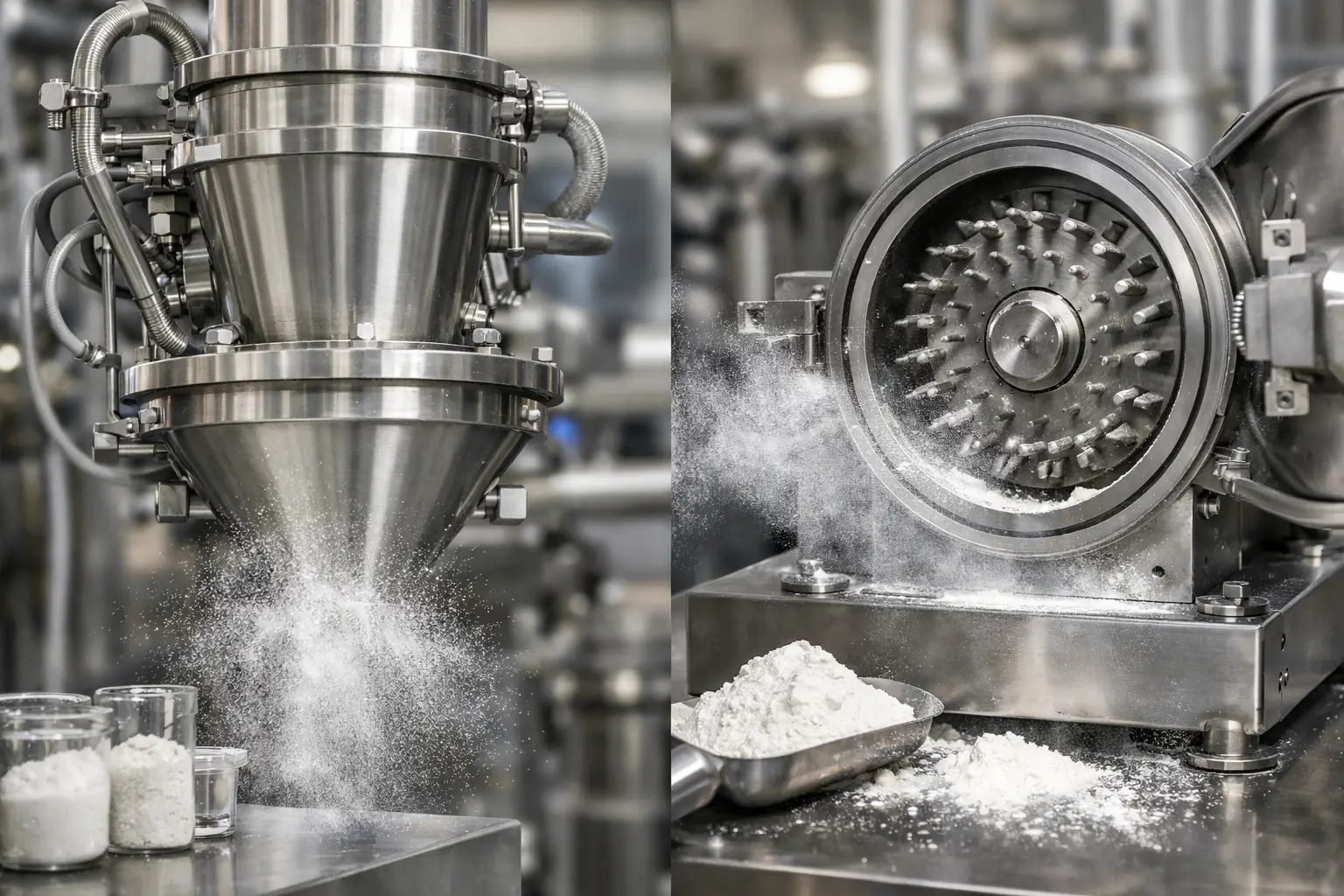
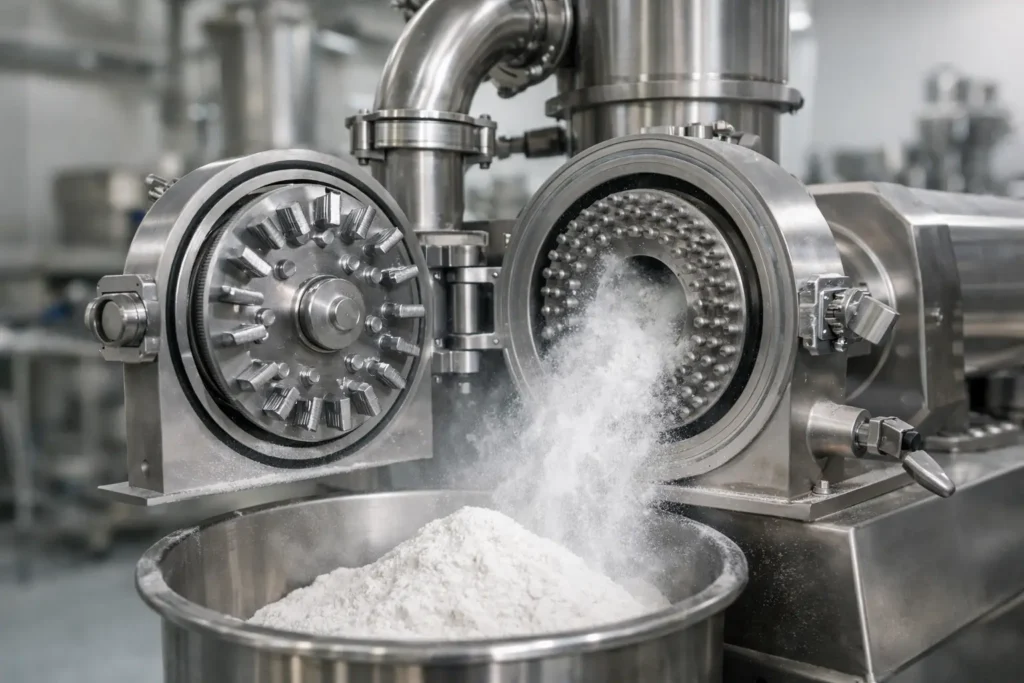
Pin mills use high-speed impact between rows of pins to reduce relatively dry, brittle, crystalline, friable, or moderately hard materials. Depending on the design, one disc may rotate against a stationary disc, or two discs may rotate in opposite directions. The resulting tip speed creates intensive impact and shear, making the technology well suited to applications that need fine grinding with a comparatively narrow particle size distribution.
Material behavior should determine whether a pin mill is appropriate before the equipment is sized. A free-flowing crystalline ingredient, for example, may mill efficiently at ambient temperature. A fatty, waxy, hygroscopic, elastic, or low-melting material may soften, smear, agglomerate, or coat the pins as temperature rises. In those cases, a pin mill may still be viable with conditioned inlet air, chilled operation, lower energy input, or a cryogenic system. In other cases, an alternative technology may produce a more stable process.
Start the selection process by documenting the feed material in terms that affect milling behavior: feed particle size and its variability, moisture level, bulk density, hardness, friability, abrasiveness, melting point, oil or fat content, and electrostatic behavior. Also identify whether the material is hazardous, combustible, toxic, allergenic, sensitive to metals, or subject to sanitary or regulatory requirements. These factors influence not only mill configuration, but also the feeder, dust collector, seals, construction materials, and explosion protection strategy.
Laboratory testing is especially valuable when a material has variable moisture, a broad feed-size range, or limited production history. A representative trial can reveal temperature rise, achievable distribution, yield, screen performance, pin wear, and whether recirculation or classification is needed. It is a faster and lower-risk path than selecting a larger machine based on nominal specifications alone.
Define the Particle Size Requirement Precisely
“Fine powder” is not a usable milling specification. Define the target with a particle size distribution, such as D10, D50, D90, top size, or percentage passing a specified sieve. Also establish the acceptable tolerance from lot to lot. A pharmaceutical blend, battery precursor, food ingredient, and mineral filler can all have similar median particle sizes while requiring very different control of oversize particles, fines, heat exposure, and contamination.
A pin mill can generate fine particles effectively, but finer is not always better. Higher rotor speed and more intensive impact may reduce the median size while increasing fines, energy use, heat generation, and wear. Excess fines can reduce powder flow, increase dust loading, affect blending, or create downstream feeding and packaging problems. The objective is a repeatable distribution that supports the product’s next process step.
Feed size matters as much as the final specification. If incoming material includes large lumps, foreign material, or significant size variation, consider upstream screening, de-lumping, or pre-crushing. Stable feed conditioning allows the pin mill to operate at settings that produce consistent results instead of compensating for every change in incoming material.
Understand the Role of Screens and Classification
Many pin mills use screens to retain oversize particles until they are reduced sufficiently. Screen opening, open area, thickness, and wear condition all influence throughput and particle size. A smaller screen may tighten top size, but it can also increase residence time, heat, and the risk of blinding with cohesive material.
For applications requiring tighter control than a screen can provide, an integrated air classifier or downstream classification stage may be the better engineering solution. Classification separates the size-control function from the grinding intensity, which can reduce overgrinding and improve yield. The right arrangement depends on whether the process is limited by top size, median size, fines content, or throughput.
Size the Mill for Sustained Capacity, Not Peak Output
Pin mill capacities are material-specific. A stated capacity achieved on a dry, free-flowing sugar or salt does not predict output on a heat-sensitive nutraceutical, an abrasive mineral, or a cohesive chemical intermediate. Request performance expectations based on the actual material, feed size, target distribution, and operating mode.
Production capacity should include the full operating picture: planned throughput, surge requirements, batch size, runtime per shift, changeover time, cleaning time, and allowance for maintenance. A mill that barely meets the hourly target may force operators to run at maximum speed continuously, leaving little room for normal variation in feed condition. A properly sized system has operating headroom without being so oversized that it loses control at lower feed rates.
The feeding system is part of mill sizing. Starve feeding is often required to maintain stable grinding and avoid flooding the grinding chamber. Loss-in-weight feeders, screw feeders, rotary valves, vibratory feeders, and pneumatic conveying systems each have different strengths depending on powder flow and containment requirements. An inconsistent feed rate can cause a wider particle distribution even when the mill itself is correctly configured.
Also evaluate discharge and collection capacity. The mill, conveying line, cyclone, filter receiver, and dust collector must be matched to the air volume and powder loading. A restricted discharge can increase residence time and temperature. Poor air balance can reduce throughput, carry over usable product, or create housekeeping and containment issues.
Control Heat, Contamination, and Product Loss
Heat management is often the deciding factor in fine milling. Mechanical energy becomes heat, and product temperature can rise quickly with high rotor speed, restricted screens, long residence time, or recirculation. Establish a maximum allowable outlet temperature based on the material’s stability, flavor, potency, moisture behavior, and downstream performance.
Where ambient operation is insufficient, evaluate process air conditioning, jacketed components, chilled air, or cryogenic grinding. Cryogenic operation can make brittle materials easier to fracture while protecting volatile compounds and reducing smearing. It adds utility and controls requirements, however, so it should be justified by measurable improvements in product quality, yield, or uptime.
Contamination control requires equal attention. Product-contact surfaces may need stainless steel, polished finishes, sanitary welds, food-grade materials, or specialized alloys. Abrasive feeds can wear pins and liners, introducing metal into the product while changing milling performance over time. For sensitive applications, specify wear-resistant materials, inspection access, magnetic separation where appropriate, and a documented preventive maintenance plan.
Cross-contamination risk affects the required level of cleanability. A mill serving a single dedicated material has different design priorities than one changing frequently between allergens, active ingredients, colors, or high-value formulations. Quick-access doors, removable screens, clean-in-place provisions, minimized product hold-up, and validated cleaning access may be worth more than a lower initial equipment price.
Build Safety and Compliance Into the System
Fine powders can create combustible dust hazards, particularly in food, chemical, nutraceutical, polymer, and advanced-material operations. A complete assessment should address the material’s dust explosibility data, minimum ignition energy, ignition sensitivity, and the applicable facility classification requirements. Do not treat explosion protection as an accessory added after the mill has been chosen.
Depending on the risk assessment, the system may require grounding and bonding, explosion venting, suppression, isolation devices, inert gas operation, pressure-rated construction, or dust collection designed for the hazard. Solvent residues, toxic materials, and potent compounds may also require closed transfer, negative-pressure containment, specialized seals, and operator protection measures.
For regulated applications, document requirements early. This may include sanitary design, material certifications, surface finish expectations, traceability, validation support, and controls integration. Retrofitting these features after fabrication is usually more expensive and can compromise access or maintainability.
Evaluate Reliability Beyond the Mill Chamber
A pin mill is a system, not only a rotor and grinding chamber. Motor sizing, variable-frequency drive range, bearings, shaft seals, screen-change access, instrumentation, controls, and spare-parts availability all affect uptime. Ask how the mill performs during normal inspection and cleaning, not only during a short trial run.
Variable speed is particularly useful because it gives operators a practical adjustment for changes in material behavior and particle-size requirements. But it is not a cure for poor process design. If stable results demand constant intervention, the root cause may be feed variability, improper screen selection, insufficient air handling, or unsuitable milling technology.
Specify the data needed for production control. At minimum, many operations benefit from monitoring motor load, rotor speed, feed rate, inlet and outlet temperature, differential pressure, and product collection performance. These signals help operators detect screen blinding, bearing issues, feed disruptions, and process drift before a full batch is affected.
The strongest equipment decision comes from application testing and system-level engineering. DP Pulverizer Americas works with manufacturers to evaluate material behavior, define performance targets, and configure milling systems around the realities of their production environment. Select the pin mill that gives your operation a controllable process window, not simply the smallest particle size on a specification sheet.