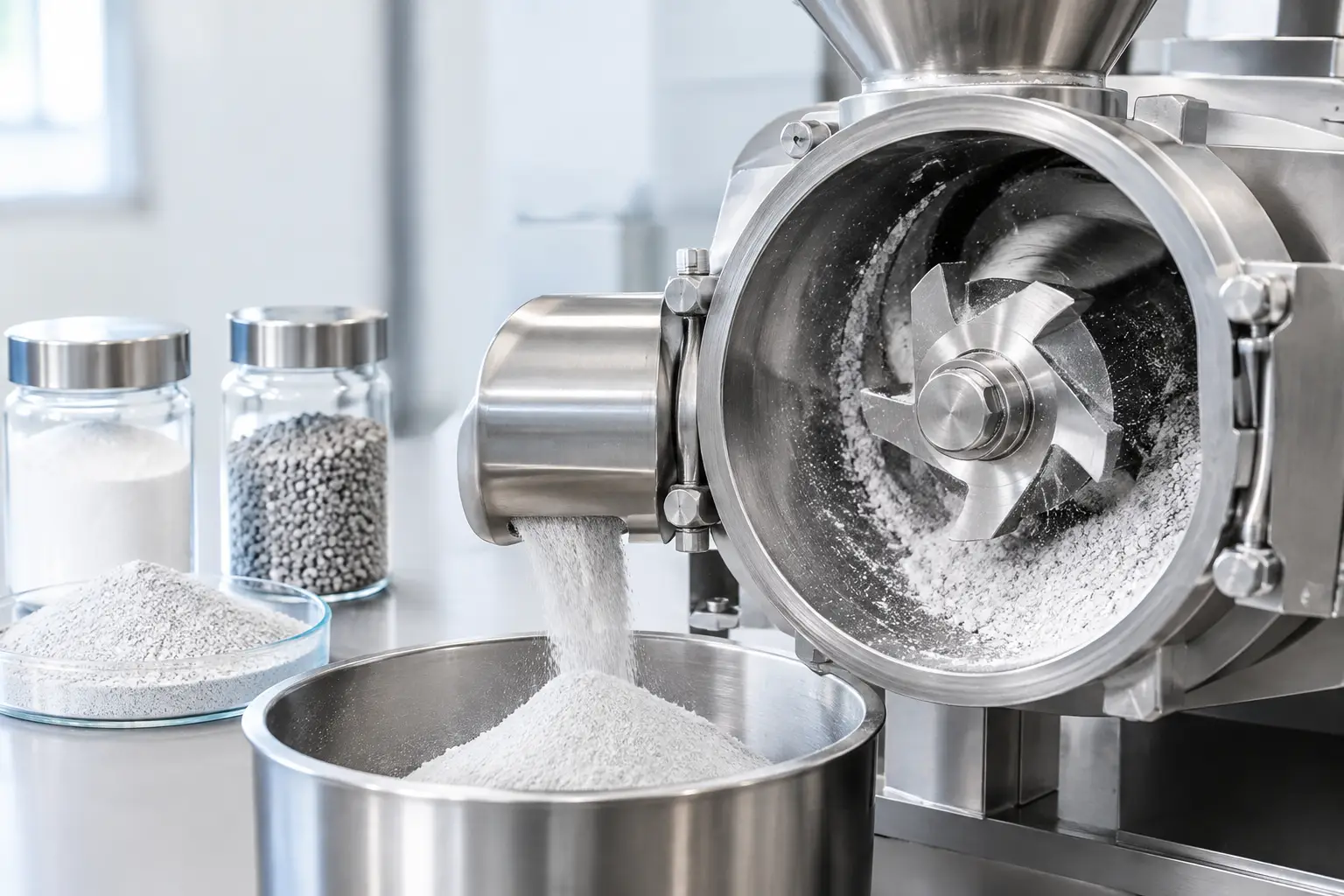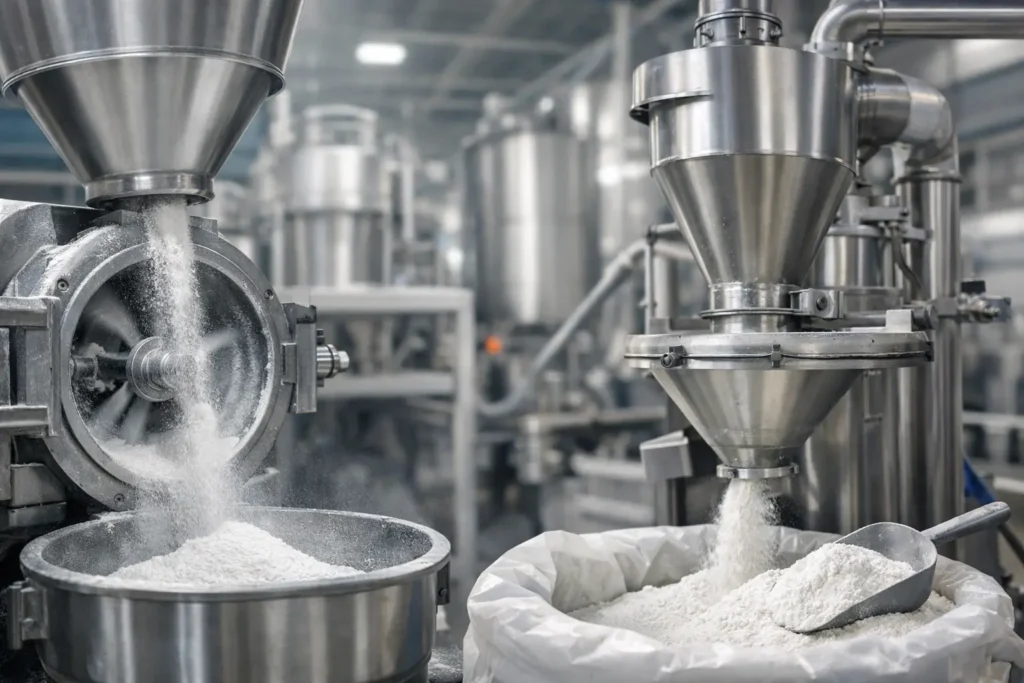
A mill can produce the target particle size in a short trial and still create a production problem. If the material bridges in the feeder, heats during size reduction, separates in transfer, or overwhelms the dust collector, the finished system will not deliver consistent output. This powder processing system guide addresses the system-level decisions that determine whether a milling line performs reliably at production scale.
For process engineers and operations teams, equipment selection starts with material behavior and production requirements, not a catalog of mill types. The objective is to build a controlled process that produces the required particle size distribution, protects product integrity, contains dust, supports cleaning requirements, and maintains practical throughput over time.
Start With the Required Process Outcome
Particle size is usually the first specification discussed, but it is not enough on its own. A nominal target such as D50 or a screen size does not define the acceptable distribution. The allowable oversize fraction, fines content, bulk density, flow behavior, moisture range, and sensitivity to heat all affect the equipment configuration.
A useful process definition identifies the incoming material condition, desired particle size distribution, hourly production rate, acceptable product temperature, and quality requirements. It should also establish how the material will be tested. Laser diffraction, sieve analysis, bulk density measurements, moisture analysis, and microscopy can each reveal different aspects of performance. A system cannot be optimized against an undefined or inconsistent measurement method.
Production rate deserves particular attention. A mill that produces an excellent distribution at a low feed rate may not sustain that result when throughput increases. As feed rate rises, residence time, airflow, motor load, internal temperature, and classifier performance can all change. The right design window is the one that meets quality targets at the required operating rate, not just under favorable trial conditions.
Evaluate Material Behavior Before Selecting the Mill
The material determines how much energy is needed to reduce particle size and how the powder will move through the process. Hardness and abrasiveness influence wear and mill construction. Fat content, waxy components, hygroscopicity, and low melting temperatures influence heat management. Fibrous or elastic materials may resist impact grinding and require a different approach than brittle crystals or minerals.
Particle shape also matters. Some applications require a narrow distribution with controlled fines. Others need deagglomeration without excessive size reduction. Certain battery, pharmaceutical, and advanced-material applications must limit metallic contamination, which can affect the choice of contact materials, liners, grinding media, and downstream magnetic separation.
Before committing to a production design, characterize the material across the realistic range of incoming conditions. A powder that flows well at 1% moisture may bridge at 3%. A material that mills cleanly at room temperature may soften during continuous operation. These are not minor variables. They often determine whether a standard configuration is adequate or whether the process requires conditioning, cooling, specialized feeding, or cryogenic grinding.
Match Milling Technology to the Application
There is no universally best mill. Each technology applies energy differently, and each involves trade-offs in particle size capability, heat generation, capacity, maintenance, and operating cost.
Impact and Mechanical Mills
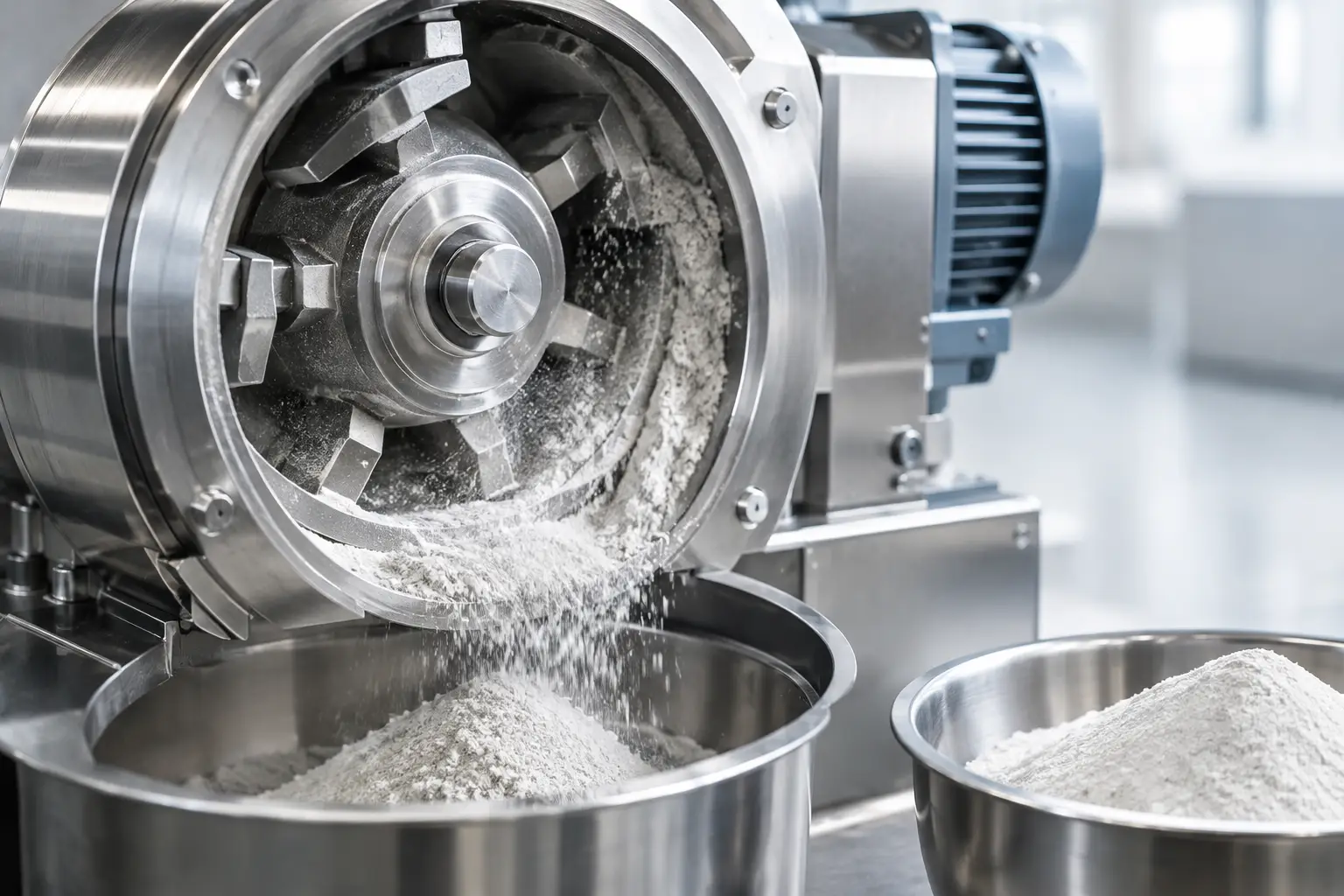
Hammer mills, pin mills, turbo mills, universal mills, and cone mills are widely used for size reduction, deagglomeration, and controlled milling across food, nutraceutical, chemical, and industrial applications. They can provide practical throughput and straightforward operation when the material is suited to mechanical impact, shear, or centrifugal force.
These mills are often appropriate when the target size is moderate and high capacity is important. However, speed, screen selection, rotor configuration, and feed consistency must be matched carefully to prevent excessive fines, temperature rise, or screen blockage. For friable materials, a lower-energy approach may preserve yield and reduce unnecessary dust generation.
Air Classifier Mills and Jet Mills
When tight particle size control and finer powders are required, air classifier mills and jet mills are often stronger candidates. An air classifier mill combines mechanical grinding with internal classification, allowing oversized particles to remain in the grinding zone while qualified particles exit with the air stream. This can improve control over the final distribution compared with an open-loop impact mill.
Jet mills use high-velocity gas to create particle-to-particle collisions. With no mechanical grinding media in the milling chamber, they can be valuable for fine powders, heat-sensitive materials, and applications where contamination control is critical. Their trade-off is typically higher compressed gas demand and a need for careful control of feed rate, gas flow, and classifier settings.
Cryogenic Grinding Systems
Cryogenic grinding is appropriate when conventional milling causes softening, smearing, loss of volatile components, or unacceptable temperature rise. Cooling with cryogenic media can embrittle difficult materials and improve fracture behavior, particularly for polymers, spices, rubbery products, and materials with heat-sensitive constituents.
The added complexity is justified only when temperature control changes the processing result. Cryogenic operation requires consideration of coolant consumption, insulation, safety procedures, venting, and the operating cost of the cooling medium. It should be evaluated against the cost of poor yield, blocked equipment, degraded product quality, or repeated downtime in an ambient process.
Design the Powder Processing System Around Material Flow
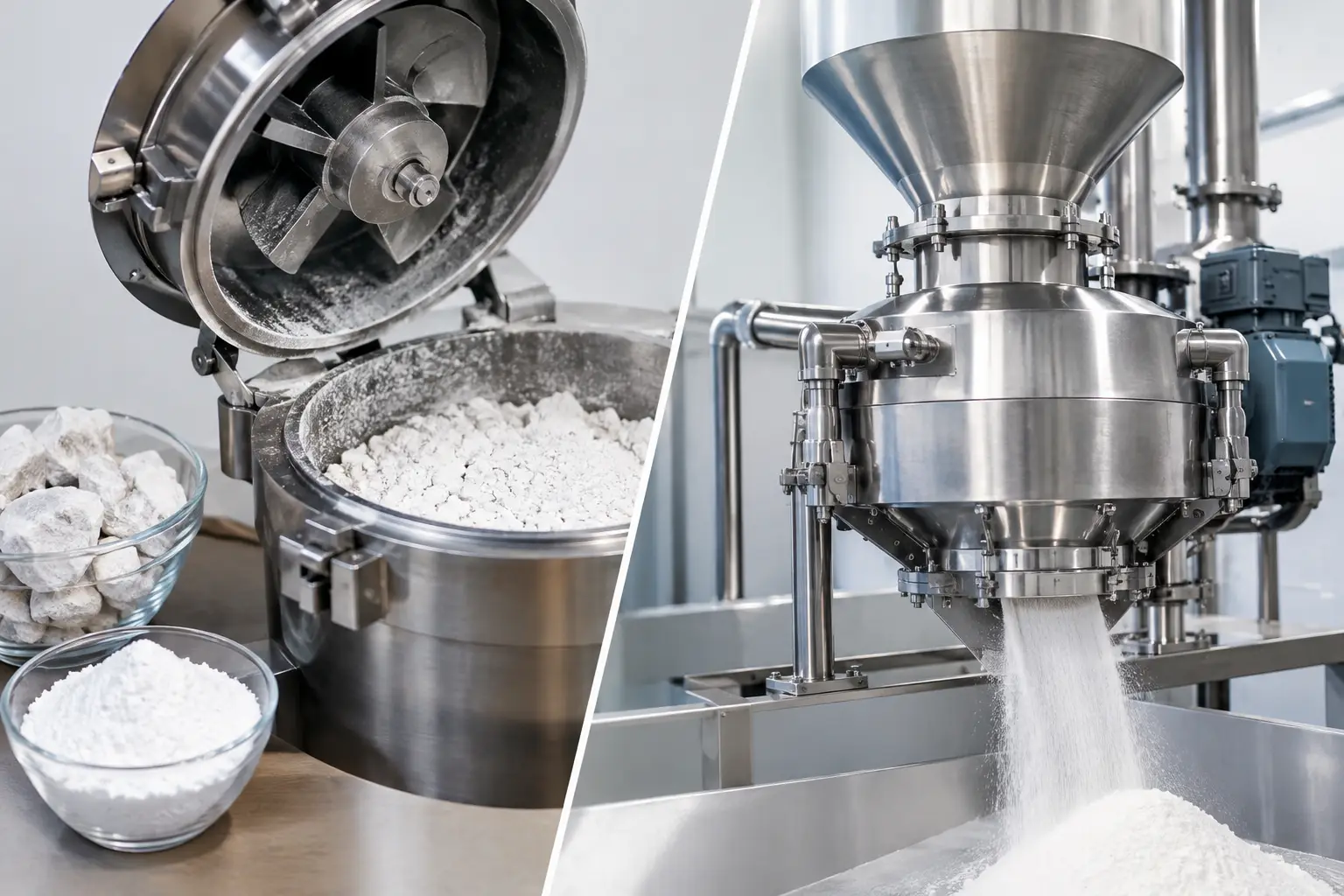
A milling system is more than the mill. Reliable performance depends on how powder enters, travels through, separates from process air, and reaches final packaging or downstream processing.
Feeding is a common source of instability. Free-flowing granules may work with a simple loss-in-weight feeder, while cohesive powders may need agitation, live-bottom hoppers, twin-screw feeders, or hopper geometry designed to prevent bridging and rat-holing. Inconsistent feed causes fluctuating mill load and particle size variation, even when the mill itself is correctly configured.
Air handling also deserves engineering attention. In pneumatic or air-classified systems, airflow affects conveying, classification efficiency, product recovery, and dust containment. Cyclones, filters, rotary valves, and collection bins must be sized for the powder’s actual bulk density, loading behavior, and fines fraction. Poorly designed collection equipment can create pressure instability, product loss, cleanup burdens, and avoidable operator exposure.
For dust-sensitive processes, containment is a primary design requirement rather than an accessory. The required level depends on the material hazard, exposure limits, facility standards, and cleaning practices. System design may include sealed transfers, local exhaust, negative pressure operation, contained discharge, and appropriate dust collection. When combustible dust is possible, the engineering review should also address material testing, hazard classification, explosion protection, isolation, and applicable facility requirements.
Build Quality and Contamination Control Into the Design
In pharmaceutical, food, nutraceutical, battery, and specialty chemical operations, equipment must support more than particle size performance. Contact surfaces, gasket materials, finish requirements, cleanability, and batch traceability can be as important as throughput.
Stainless steel construction may be suitable for many applications, but highly abrasive materials can require wear-resistant liners or ceramics. Conversely, a wear-resistant component is not automatically acceptable where metallic or ceramic contamination limits are stringent. The selection must reflect the material, the allowable contamination level, and the inspection plan.
Cleaning requirements should be discussed early. A system designed for long campaigns of a single product can prioritize capacity and wear life. A multi-product line may need accessible components, minimized hold-up areas, quick-change tooling, or validated clean-in-place strategies. Retrofitting cleanability after installation is usually more expensive than incorporating it into the original layout.
Use Pilot Trials to Reduce Scale-Up Risk
Pilot testing should confirm more than the target particle size. It should document throughput, energy use, product temperature, yield, classifier performance, wear observations, dust collection behavior, and cleaning effort. Where feasible, test material should represent normal production variability rather than a single ideal sample.
Scale-up is not always linear. Larger equipment can change airflow patterns, residence time, tip speed, heat transfer, and feed behavior. A well-planned trial program establishes the operating parameters that matter most and identifies the controls needed to keep the process inside its acceptable range.
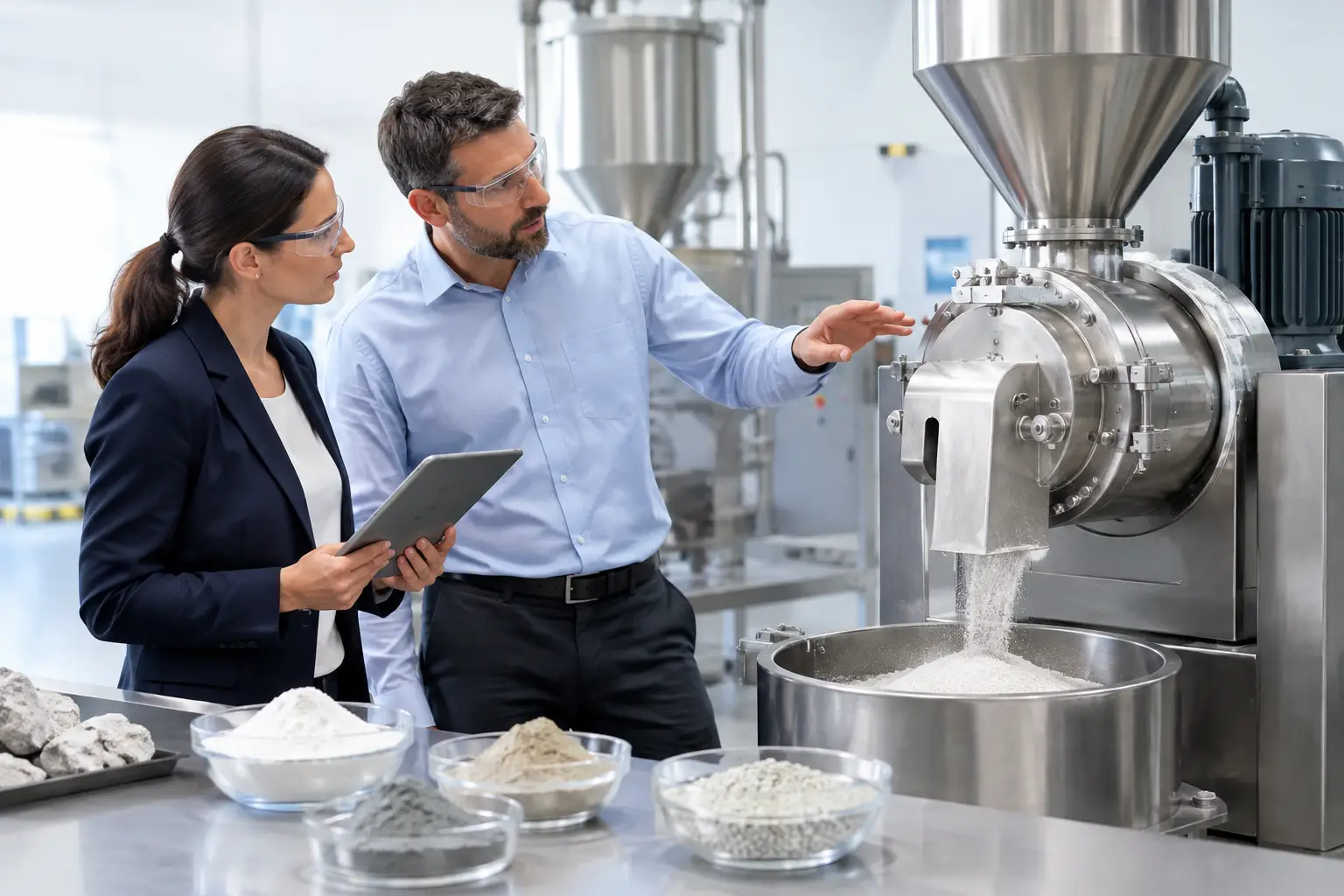
DP Mills approaches system development as an engineering exercise: define the material and outcome, test the process where necessary, then configure the milling, classification, feeding, collection, and controls as an integrated line. That approach helps avoid the costly gap between a successful sample run and dependable production performance.
Plan for Operation, Maintenance, and Future Capacity
The lowest initial equipment price does not necessarily produce the lowest operating cost. Energy use, compressed air demand, wear-part replacement, cleaning labor, downtime, and yield losses all affect long-term value. A system with better access for inspection and maintenance can be the better choice when uptime is a critical production metric.
Controls should provide operators with useful process visibility, including feed rate, mill load, airflow, temperature, pressure differential, classifier speed where applicable, and collection status. The goal is not unnecessary automation. It is the ability to recognize drift before it becomes off-spec product or unplanned downtime.
Capacity planning should account for realistic utilization, not nameplate output alone. Consider campaign length, changeovers, maintenance windows, product recovery, and expected growth. A modular layout or allowance for an additional feeder, classifier, collector, or packaging connection can preserve expansion options without oversizing the initial investment.
The most effective powder processing system is the one that makes the desired result repeatable under normal plant conditions. When material characterization, equipment selection, containment, and operating controls are engineered together, the system becomes a dependable production asset rather than a recurring source of variation.