A powder can meet its average micron target and still fail on the production floor. It may bridge in a hopper, segregate after blending, generate excessive dust, dissolve too slowly, or produce an unstable finished product. In most cases, the missing variable is particle size distribution: the complete spread of particle sizes in the material, not simply its average size.
For manufacturers handling pharmaceuticals, food ingredients, chemicals, minerals, batteries, and advanced materials, distribution control is a process requirement. It affects downstream equipment behavior, finished-product consistency, yield, cleaning demands, and the ability to scale a process from development to full production.
What Particle Size Distribution Actually Shows
Particle size distribution, often abbreviated as PSD, describes the proportion of particles present at different sizes within a powder. A single average value can conceal meaningful variation. Two materials may both report a median size of 50 microns, yet one may contain a tightly controlled population around that target while the other contains substantial fines and oversized particles. Their behavior in a real process can be very different.
Distribution is commonly communicated through percentile values. D10 is the particle size below which 10% of the sample falls. D50, also called the median, is the size below which 50% of particles fall. D90 is the size below which 90% of particles fall. Together, these values provide a practical view of the fine end, central tendency, and coarse tail of the distribution.
The span between these values matters. A narrow distribution generally indicates that particles are concentrated within a tighter size range. A broad distribution indicates greater variation. Neither is automatically better. The correct profile depends on how the powder must perform in the next step and in the final application.
Why Distribution Matters More Than an Average
Average particle size is useful for a quick reference, but production performance is usually governed by the tails of the distribution. Excess fines can alter surface area, dustiness, flow, reactivity, and moisture pickup. Oversized particles can create texture defects, incomplete dissolution, poor coating coverage, screen blockages, or nonuniform reaction behavior.
Consider a dry blending operation. A wide distribution may increase the chance of segregation because fine and coarse particles move differently during transport, vibration, and discharge. In a tablet formulation, too many fines may affect flow into dies, while too many coarse particles can influence content uniformity or dissolution behavior. In battery material processing, a shift in the coarse fraction can affect packing density and electrode performance. In mineral applications, the same shift can reduce liberation efficiency or disrupt classification performance.
Distribution also affects bulk density. Finer particles may fill the spaces between larger particles, changing how the powder packs and how much material fits in a container, feeder, or process vessel. That can be beneficial when higher packing density is needed, but it can also make a powder more cohesive and harder to discharge.
The objective is not simply to make material finer. It is to produce a repeatable particle population that supports the required product and process outcomes.
Measuring PSD With the Right Method
No single measurement technique is ideal for every material. The instrument must be matched to the particle size range, particle shape, material properties, and process objective. A measurement method that works well for free-flowing mineral powder may be unsuitable for a cohesive pharmaceutical active or a fibrous food ingredient.
Laser diffraction is widely used because it can measure a broad size range quickly and provide D10, D50, and D90 values. Its results depend on proper sample dispersion, optical properties, and operating method. If agglomerates are not adequately dispersed, the reported distribution may reflect temporary clusters rather than primary particle size.
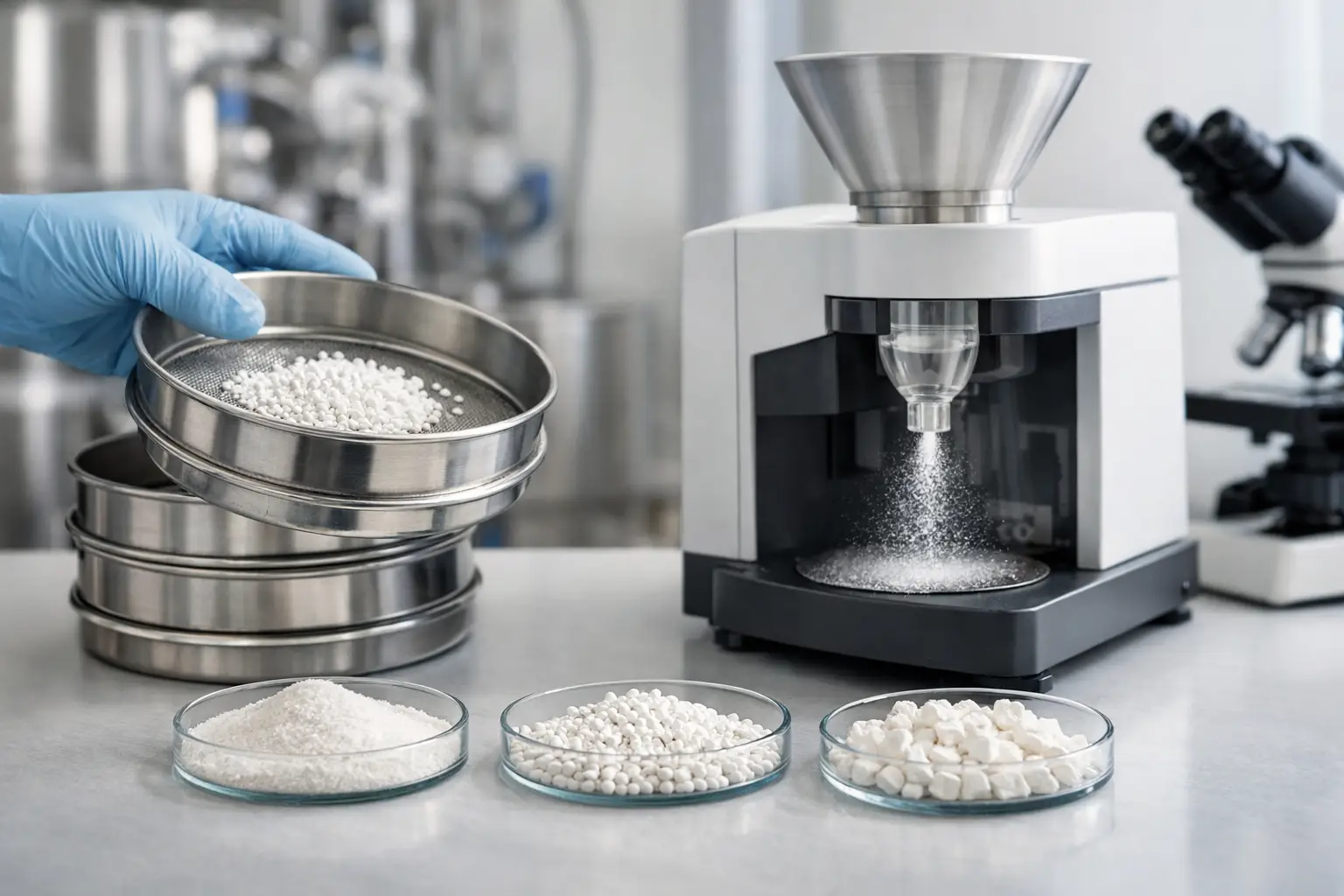
Sieve analysis remains practical for larger particles and applications where a screen-based specification is directly relevant. It is simple and familiar, but it is less effective at fine sizes and can be influenced by particle shape, blinding, and screen condition. Air jet sieving may improve separation for finer, dry powders that would otherwise cling to screens.
Dynamic image analysis provides useful information when shape is as important as size. Needles, flakes, fibers, and irregular particles can behave differently from spherical particles with the same equivalent diameter. Microscopy can also be valuable during development or troubleshooting, particularly when contamination, agglomeration, or unexpected morphology is suspected.
For meaningful trend data, measurement discipline matters as much as the analyzer. Sampling location, sample preparation, dispersion energy, test frequency, and data interpretation must be standardized. A precise instrument cannot correct a nonrepresentative sample pulled from an inconsistent process stream.
How Milling Changes the Distribution
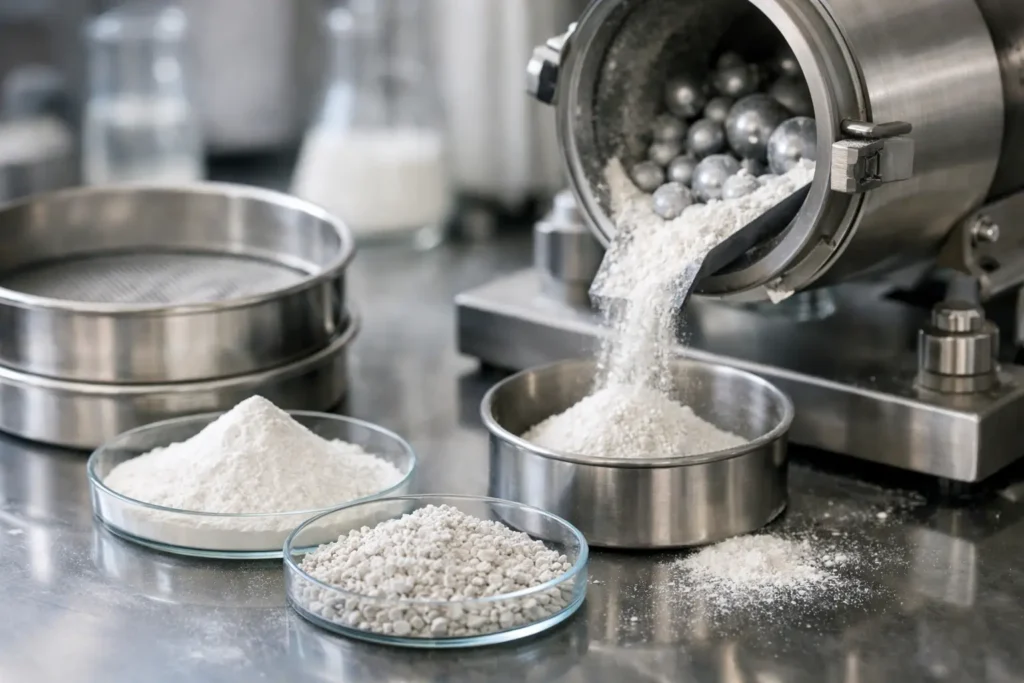
Every size reduction technology produces a characteristic distribution based on how it applies energy to the material. The choice of mill should begin with material behavior and the desired PSD, not with a preferred machine category.
Hammer mills and universal mills are often effective for coarse-to-medium grinding where high throughput and practical versatility are priorities. Screen selection, rotor speed, feed rate, and material moisture influence the resulting top size and the amount of fines generated. A tighter screen does not always create a tighter distribution. It may increase residence time and overgrinding, especially with brittle materials.
Pin mills can provide efficient impact grinding for many dry, friable materials. Their performance depends on pin configuration, tip speed, air flow, and feed consistency. They are often selected when a finer result is needed than conventional hammer milling can efficiently provide, though heat-sensitive materials may require careful operating control.
Jet mills use high-velocity gas streams to accelerate particles into one another. With integrated air classification, they can produce fine powders with controlled upper particle limits and minimal mechanical contact in the grinding zone. This makes them well suited to high-purity, abrasive, heat-sensitive, or contamination-sensitive applications. However, compressed gas demand, feed characteristics, and target fineness must be evaluated against operating cost and throughput requirements.
Air classifier mills combine impact grinding with internal classification. The classifier rejects particles that remain too coarse and returns them to the grinding zone, enabling tighter control than an open-loop mill alone. Classifier speed, air volume, rotor speed, and material feed rate must work together. Pushing one setting aggressively to achieve a finer cut can reduce throughput or increase fines if the rest of the system is not balanced.
For materials that soften, smear, oxidize, or lose functional properties at ambient temperatures, cryogenic grinding can change the process window. Cooling the material before and during milling can improve fracture behavior and reduce heat-related degradation. It adds system complexity and utility requirements, but it may be the most practical route for polymers, spices, elastomers, waxy materials, and other temperature-sensitive products.
Controlling the Process, Not Just the Mill
A stable PSD is the result of an integrated process. Milling equipment is central, but upstream feed conditioning and downstream collection have equal influence. Variability in moisture, feed particle size, bulk density, or material temperature can cause a mill to produce a different distribution even when machine settings have not changed.
Feed rate deserves particular attention. Overfeeding can reduce grinding efficiency, increase coarse carryover, and shift the distribution upward. Underfeeding can increase particle residence time and create unnecessary fines. A controlled feeder that maintains a consistent mass flow is often one of the most effective process improvements available.
Air management is equally important in pneumatic and classified systems. Changes in air volume, pressure, filter loading, or exhaust balance can affect classification cut point, retention time, product temperature, and collection efficiency. Dust collectors and conveying lines should be treated as part of the milling system, not as separate utilities.
Wear is another common source of PSD drift. Rotor components, pins, hammers, liners, classifier wheels, and screens gradually change geometry during service. In abrasive applications, wear can alter performance quickly and introduce contamination risk if material selection is not appropriate. Preventive inspection should be based on process indicators as well as calendar intervals. A rising D90, declining throughput, or increasing energy draw can reveal an issue before a finished-product specification is missed.
Building a Useful Particle Size Specification
A useful specification connects the PSD to product performance. It should define the measurements that matter, acceptable ranges, test method, sample handling approach, and response when a result trends toward a limit. Specifying only a D50 often leaves too much room for process variation.
For many applications, a D10, D50, and D90 range provides a practical starting point. Where oversized particles are especially harmful, a top-size limit or retained-screen requirement may be necessary. Where dust control, flow, or reactivity is sensitive to fines, a lower-end limit may be equally important. The right acceptance criteria should be confirmed through application testing rather than copied from a similar material.
Scale-up requires the same discipline. A pilot mill can establish whether the material can achieve the required distribution, but production design must account for feed system behavior, heat load, air flow, classification efficiency, collection capacity, cleaning requirements, and run duration. Results achieved during a short development run are valuable, but they do not automatically predict long-term production stability.
DP Mills approaches size reduction as a system-level engineering problem. The most effective solution may involve a specific milling technology, but it also requires the right feeding, classification, air handling, containment, and controls to hold the target distribution through normal production variation.
When particle size distribution becomes a controlled process variable rather than a final inspection result, manufacturers gain more than a better lab report. They gain a clearer path to consistent throughput, predictable downstream performance, and a process that can continue to meet specification as production demands change.