Mill Selection Guide: Choosing the Right Technology for Precision Particle Size Reduction
In particle size reduction, the difference between success and failure often comes down to one critical decision:
Selecting the right mill.
It sounds simple—but in reality, it’s one of the most misunderstood and costly mistakes in processing.
Because the truth is:
There is no “best mill.”
There is only the right mill for your specific application.
Why Mill Selection Matters More Than You Think
Choosing the wrong milling technology doesn’t just reduce efficiency—it directly impacts your entire operation:
- Product quality and consistency
- Throughput and production rates
- Energy consumption
- Maintenance costs
- Process stability
In many cases, companies unknowingly design their process around the wrong equipment—and spend years fighting avoidable issues.
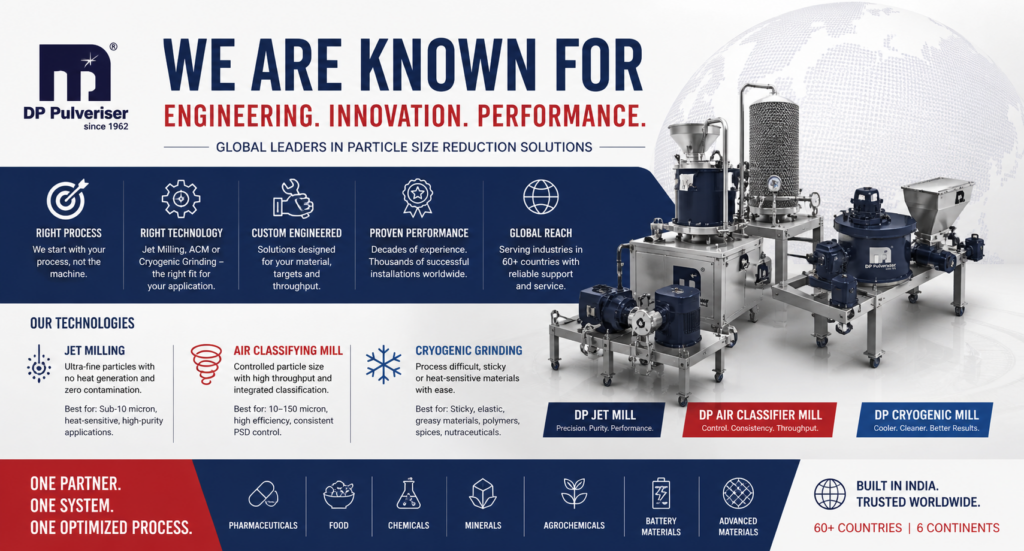
As highlighted in our DP Pulverizers Mill Selection Guide, each milling technology is designed for a very specific purpose, and understanding these differences is critical to achieving optimal results
The Three Core Milling Technologies
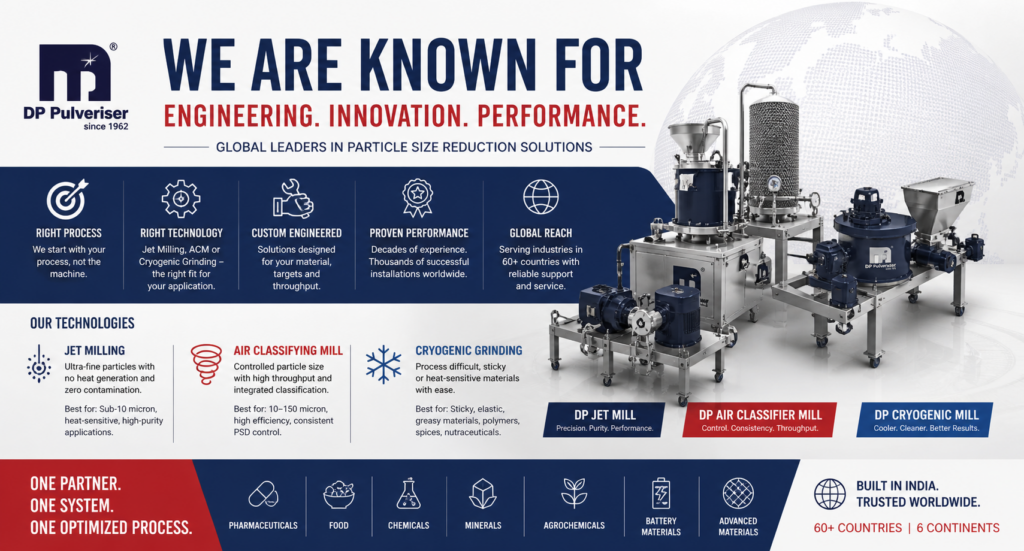
At DP Pulverizers, most applications fall into three primary milling categories:
Jet Milling (Fluid Energy Grinding)
Best for:
- Ultra-fine particle sizes (<10 microns)
- Heat-sensitive materials
- Contamination-sensitive applications
How it works:
High-velocity air or steam accelerates particles, causing particle-on-particle collision and size reduction—without mechanical grinding surfaces.
Key advantages:
- No heat generation
- Zero contamination risk
- Extremely tight particle size distribution (PSD)
- Capable of sub-10 micron performance
Typical industries:
Pharmaceuticals, battery materials, advanced chemicals
Air Classifying Mills (ACM)
Best for:
- Controlled particle size (10–150 microns)
- High-throughput continuous processing
- Applications requiring tight PSD without ultra-fine grinding
How it works:
Impact grinding combined with dynamic air classification. Fine particles exit the system while coarse particles are recirculated for further reduction.
Key advantages:
- Adjustable PSD in real time
- High efficiency and throughput
- Reduced over-grinding
- Integrated grinding + classification system
Typical industries:
Chemicals, food processing, minerals, agrochemicals
Cryogenic Grinding
Best for:
- Sticky, greasy, elastic, or heat-sensitive materials
- Products that smear, melt, or degrade under ambient conditions
How it works:
Material is cooled with liquid nitrogen, making it brittle so it fractures cleanly during grinding.
Key advantages:
- Prevents smearing and clogging
- Preserves aroma, flavor, and volatile compounds
- Enables processing of otherwise impossible materials
- Improves flowability
Typical industries:
Spices, polymers, rubber, nutraceuticals
Side-by-Side Comparison
| Parameter | Jet Mill | ACM | Cryogenic Grinding |
|---|---|---|---|
| Particle Size | 1–15 microns | 10–150 microns | 10–500 microns |
| Heat Generation | None | Moderate (controlled) | None |
| Contamination Risk | None | Low | Low |
| Sticky Materials | Poor | Moderate | Excellent |
| Throughput | Moderate | High | Moderate |
| PSD Control | Ultra-tight | Adjustable | Moderate |
When to Use Each Technology
Use a Jet Mill when:
- You need ultra-fine powders
- Product purity is critical
- Heat cannot be introduced
Use an ACM when:
- You need controlled particle size
- Throughput is a priority
- You want a single-step grinding + classification system
Use Cryogenic Grinding when:
- Your material is sticky or heat-sensitive
- Ambient grinding causes smearing or degradation
- You need to preserve product integrity
Common Mistakes in Mill Selection
Even experienced processors make these costly errors:
- Using ACM for ultra-fine applications → broad PSD, inefficient results
- Using Jet Mills for sticky materials → flow issues and instability
- Using ambient grinding for polymers → melting and product failure
- Ignoring temperature effects → degraded quality and inconsistent output
The DP Engineering Approach
At DP Pulverizers, we don’t start with equipment.
We start with your process:
- Material characteristics
- Target particle size
- Throughput requirements
- Temperature sensitivity
- Process conditions
Then we engineer:
- The right mill
- The right system
- The right integration
Because most real-world applications require more than just a single machine.
Beyond Individual Machines: Complete System Integration
Successful milling operations often involve:
- Grinding
- Classification
- Conveying
- Mixing
- Dust collection
That’s why DP Pulverizers delivers fully integrated process systems, not just standalone equipment.
One partner. One system. One optimized process.
Download the Full Mill Selection Guide
If you’re evaluating milling equipment or struggling with performance issues, this guide will give you clarity and direction.
👉 Contact our team to receive the full DP Pulverizers Mill Selection Guide and discuss your application.
Let’s Solve Your Process
Whether you’re working with pharmaceuticals, food ingredients, chemicals, or advanced materials—choosing the right milling technology is the difference between:
- Smooth production
- Or constant problems
Let’s get it right the first time.