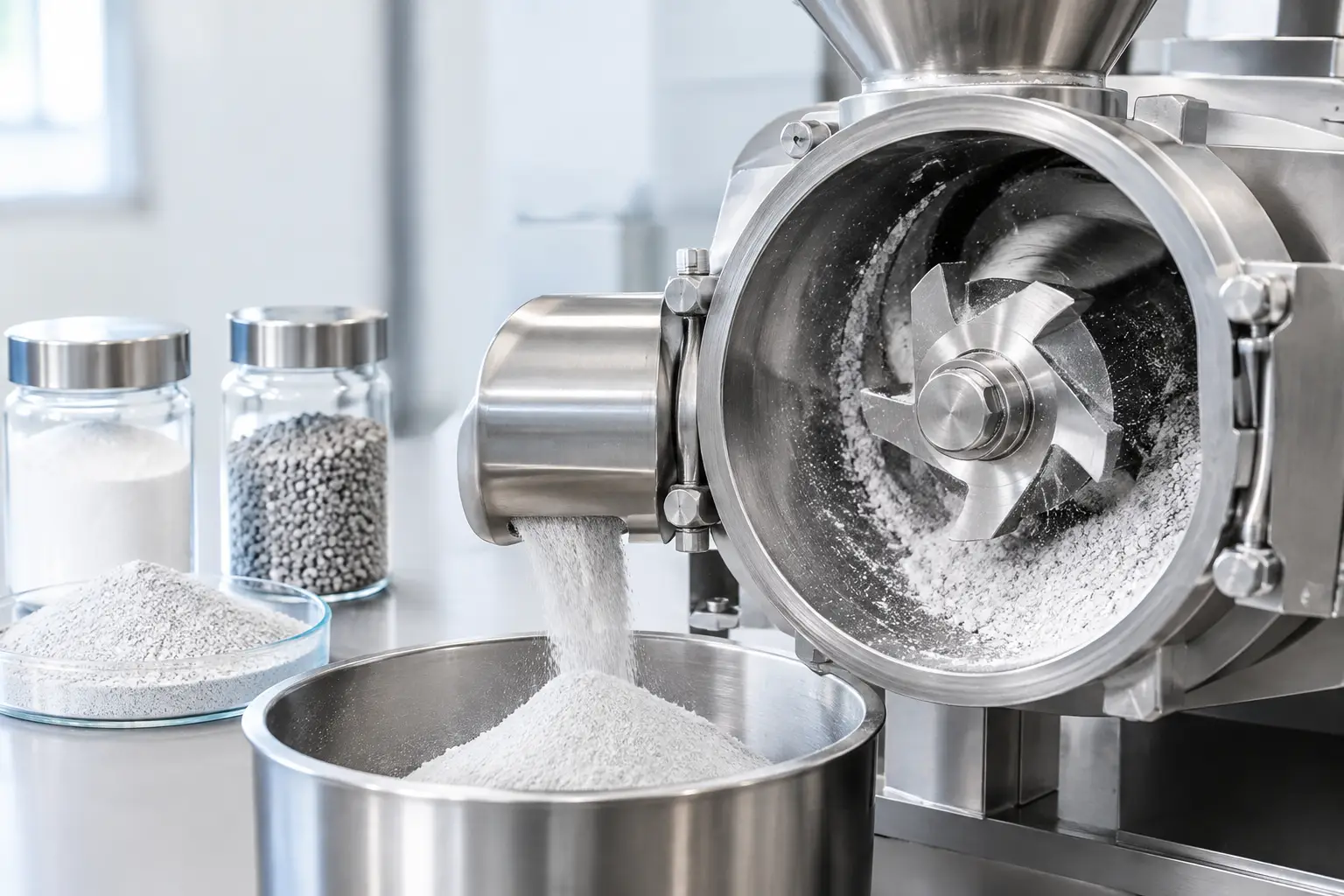
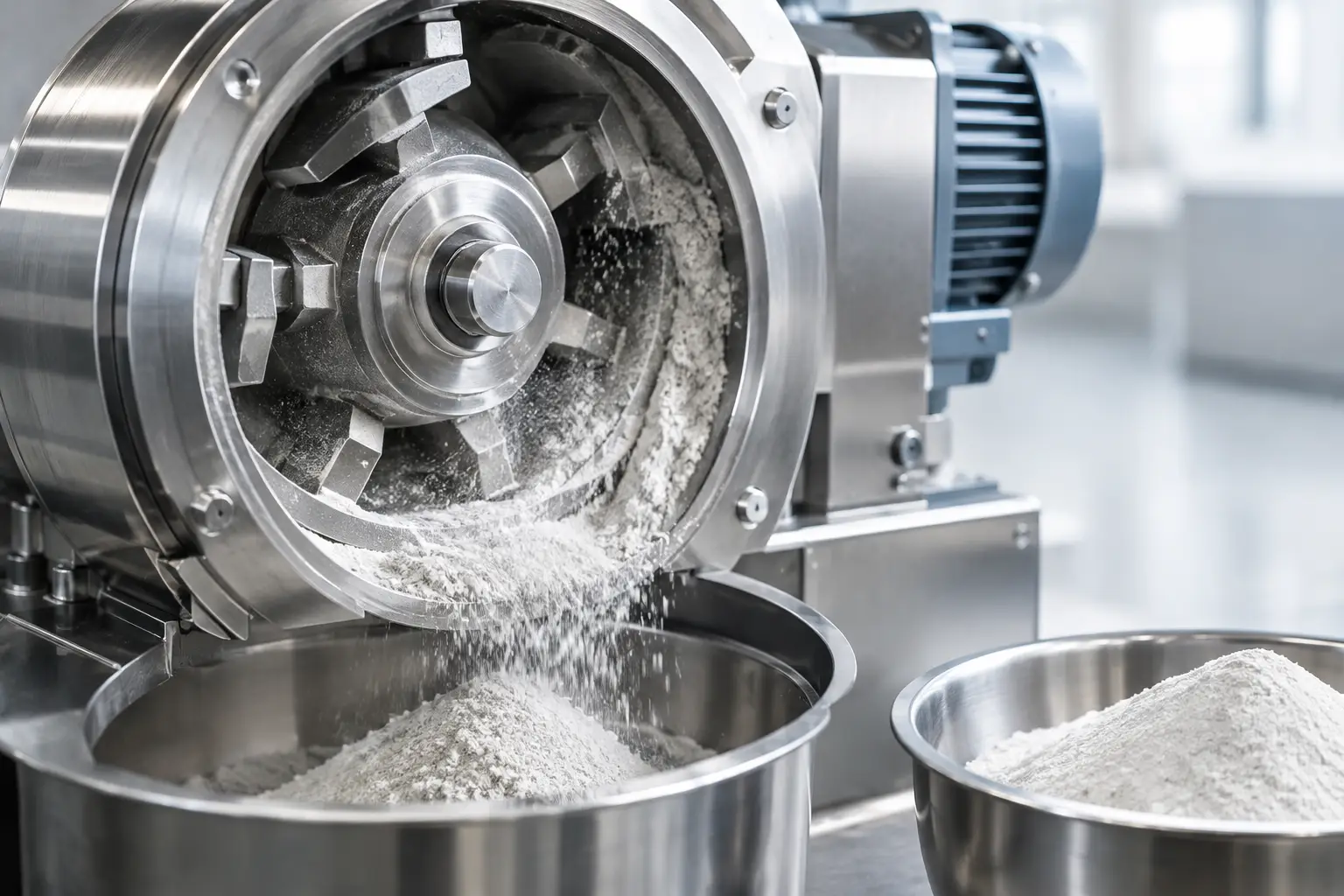
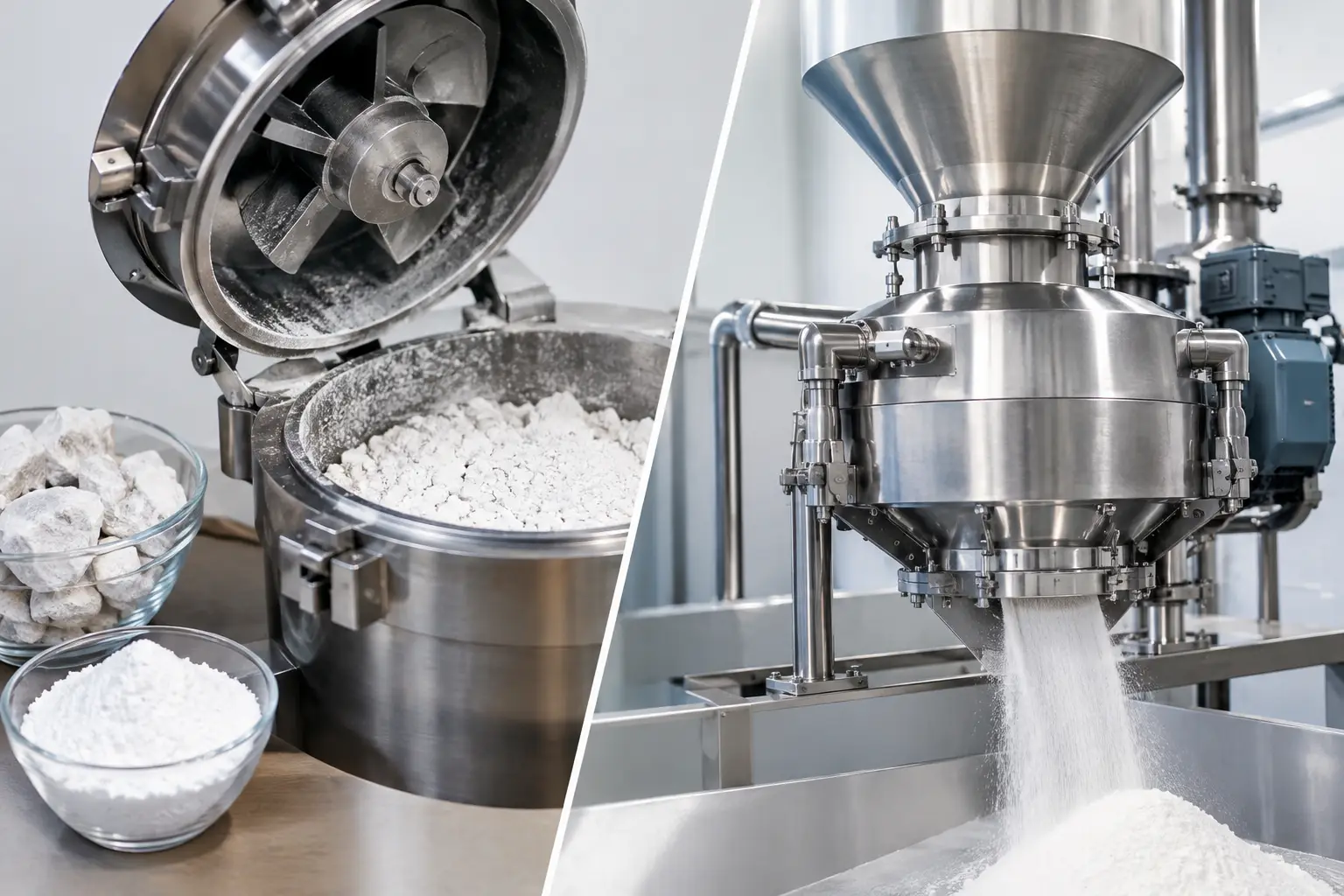
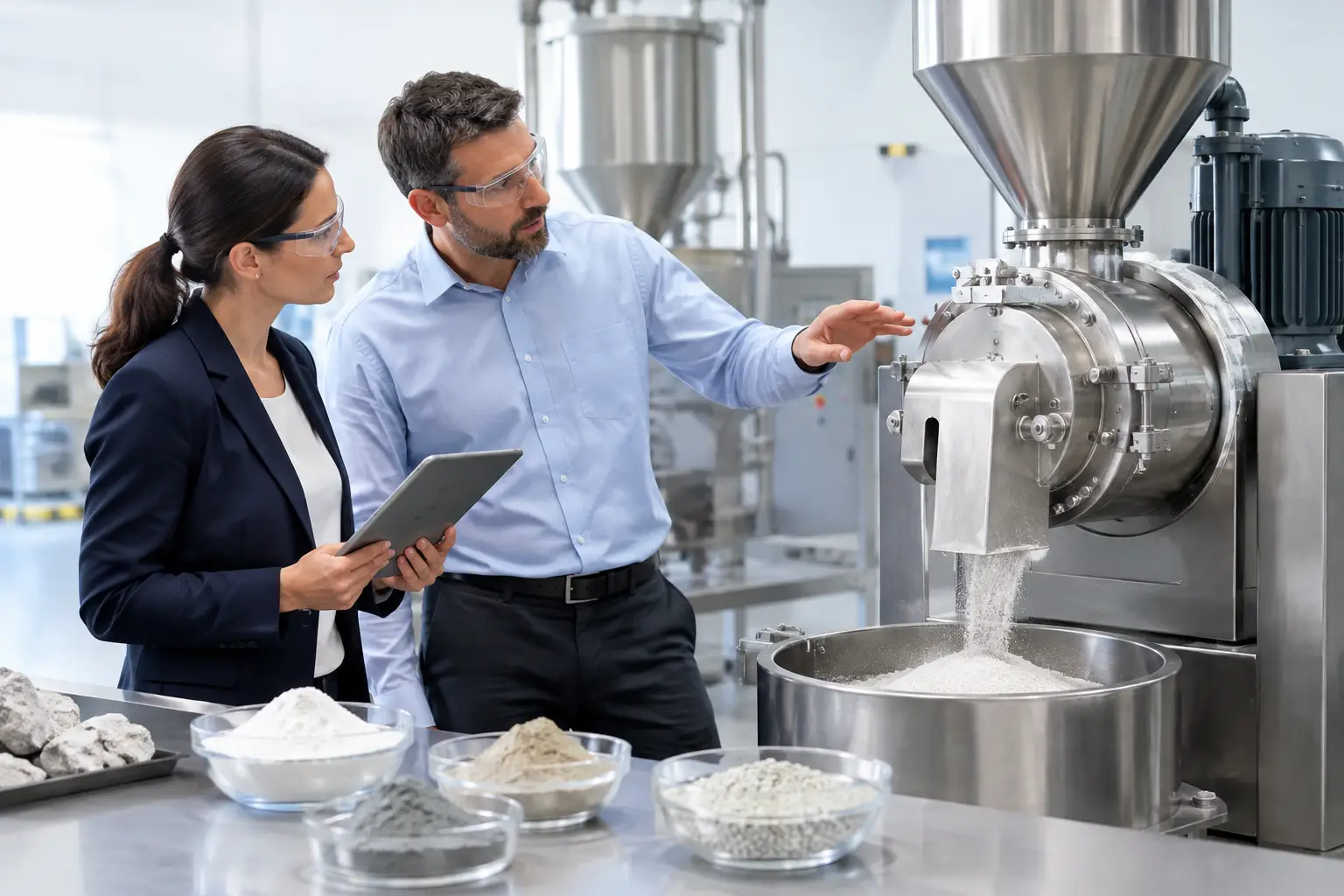
A cone mill is often selected after a powder has already met its core particle-size target but no longer behaves consistently in the process. If you are asking when should you use cone milling, the practical answer is when you need controlled deagglomeration, improved flow, or a more uniform material condition without the aggressive size reduction associated with high-impact milling.
For many production lines, the issue is not that material is too coarse. It is that storage, blending, drying, conveying, or compression has created soft lumps, compacted agglomerates, and an inconsistent feed. A properly specified conical mill restores a controlled, free-flowing product stream while protecting material properties, limiting fines, and supporting reliable downstream performance.
Use Cone Milling When Powder Condition Is the Problem
Cone milling, also called conical screening or conical milling, uses a rotating impeller to guide material through a calibrated screen. The process applies relatively low-impact mechanical action compared with hammer, pin, or jet milling. Particle reduction occurs as agglomerates contact the impeller and screen, rather than through repeated high-energy impacts.
That operating principle makes cone mills especially effective when a material needs conditioning rather than aggressive grinding. Common triggers include lumps after drying, inconsistent granule size after wet granulation, poor flow into a tablet press or capsule filler, and material bridging at hopper outlets.
In these applications, the objective is not simply to produce a smaller number on a particle-size report. The objective is to create a consistent feed that fills, conveys, blends, doses, and compacts predictably. That distinction is critical when selecting equipment.
When Should You Use Cone Milling for Deagglomeration?
Use cone milling when agglomerates are soft to moderately compacted and must be broken down without excessive damage to the underlying particles. This is common in pharmaceutical, nutraceutical, food, and specialty chemical production, where powders may form lumps from moisture exposure, compaction during handling, electrostatic attraction, or storage time.
A cone mill can break these lumps efficiently while generating fewer fines than a more aggressive impact mill. This helps retain the intended granule structure and can reduce downstream variability. In pharmaceutical tablet manufacturing, for example, preserving a controlled granule distribution may support more consistent blend uniformity, die filling, compression behavior, and finished-tablet quality.
The same principle applies to food powders and nutraceutical blends. Ingredients that have caked in bags or bulk containers may need a sanitary, contained method of restoring flow before blending or packaging. Cone milling provides a controlled step for conditioning those materials without turning a flow problem into an excessive-dust problem.
Material behavior still determines suitability. Hard, brittle particles may fracture readily, while elastic, fibrous, or sticky products can smear, block the screen, or require a different milling approach. Product trials should evaluate not only final size distribution but also screen condition, mill temperature, yield, and cleaning requirements.
Choose Cone Milling for Controlled Particle Sizing
Cone mills are appropriate when a process needs a narrower upper particle-size limit, often called top-size control, rather than ultrafine grinding. They can remove oversized granules and create a more consistent distribution for downstream operations, particularly where large particles cause feeding, blending, coating, dissolution, or packaging issues.
Screen selection and impeller configuration determine the result. A smaller screen opening generally produces a finer output, but it can also reduce throughput, increase residence time, and raise the risk of heat buildup or screen blinding. Impeller speed and design influence the intensity of particle-screen interaction. Higher speed can improve throughput or breakage for certain products, but it may also increase fines generation.
This is why screen size alone is not an equipment specification. A process engineer should evaluate the complete operating window: material moisture, bulk density, particle strength, required throughput, acceptable fines level, and the particle-size distribution needed by the next process step.
Cone milling is frequently installed both before and after key unit operations. Before a blender, it can condition incoming ingredients for more uniform mixing. After drying, it can break dried granules to a usable size. Before tableting, encapsulation, filling, or packaging, it can provide a consistent, free-flowing feed.
Improve Flow and Feeding Reliability
Poor flow creates production losses that may not appear on a particle-size specification. A powder can meet its size target yet still bridge in a hopper, rat-hole in a bin, pulse through a feeder, or fill containers inconsistently. These issues can lead to variable batch times, weight variation, equipment stoppages, and operator intervention.
Cone milling helps when poor flow is tied to oversized particles, soft agglomerates, or an uneven particle distribution. By conditioning the powder before it reaches a feeder or forming machine, the mill can improve bulk uniformity and reduce the likelihood of intermittent flow restrictions.
However, a cone mill is not a universal solution for flow problems. If the primary cause is very fine, cohesive powder, high moisture content, unsuitable hopper geometry, static charge, or poor feeder design, milling may offer limited improvement. In some cases, finer milling makes flow worse by increasing surface area and cohesion. The correct response may involve moisture control, a change in conveying method, hopper modifications, flow aids, or a different size-reduction technology.
When Cone Milling Is a Better Fit Than Other Mills
A cone mill is usually the right choice when low-to-moderate energy, predictable sizing, and product integrity matter more than maximum reduction ratio. It occupies a different position from hammer mills, pin mills, air classifier mills, and jet mills.
Hammer and pin mills are often better suited for larger reduction ratios and tougher or more brittle materials. They can process material more aggressively, but they may generate more fines, noise, heat, and wear. Air classifier and jet mills are designed for finer applications where tight particle-size distributions and micron-scale performance are required. Those technologies address a different process objective than routine deagglomeration or granule conditioning.
Cone milling is also often preferred where product contact surfaces, cleanability, and containment are central requirements. Pharmaceutical and food operations may require sanitary construction, repeatable cleaning procedures, and designs that support controlled handling of high-value or sensitive powders. Chemical, battery, and advanced-material applications may place additional emphasis on wear resistance, contained transfer, and contamination control.
Confirm the Material Can Run Reliably
The best time to select a cone mill is before a recurring process problem becomes a permanent production workaround. A sample evaluation can establish whether the material passes through the screen efficiently, how much fine material is generated, and whether the target throughput is realistic.
Several factors deserve close attention during testing. Material moisture can change milling behavior dramatically, particularly for hygroscopic products. Feed consistency matters because a mill cannot deliver steady output if it is fed in large, irregular surges. Product temperature should be monitored for heat-sensitive ingredients. For abrasive products, screen and impeller wear should be considered as part of the long-term operating cost.
It is also useful to define the true performance target before comparing equipment. Is the priority breaking bags of compacted material? Removing oversize granules? Increasing feeder consistency? Meeting a specific particle-size distribution? Processing under sanitary or contained conditions? Each objective can lead to a different screen, impeller, feed arrangement, and system configuration.
Integrate the Mill Around the Process, Not in Isolation
A cone mill performs best as part of a complete material-handling system. Upstream discharge equipment, feed control, dust collection, transfer method, and downstream receiving equipment all affect real production performance. An undersized feeder can starve the mill; uncontrolled feed can overload it; poor transfer design can reintroduce segregation after milling.
For pilot-scale development, the goal is to identify a repeatable operating range that can be translated to production. For full-scale systems, the design should account for cleanout time, access for inspection, screen changes, containment, automation, and maintenance intervals. These details directly affect uptime and labor requirements.
DP Mills approaches cone mill selection as an application and integration decision, not a catalog exercise. The most useful configuration is the one that delivers the required particle condition at the required rate while fitting the plant’s quality, cleaning, and material-handling requirements.
If a powder is already close to its desired size but is creating flow, agglomeration, or feed-consistency problems, cone milling deserves serious consideration. Start with the behavior you need downstream, then validate the mill configuration against the actual material and operating conditions. That process will produce a more reliable result than selecting equipment solely by screen opening or nominal capacity.